May 15, 2026
The global energy landscape stands at an inflection point where conventional storage paradigms face unprecedented scalability constraints. As industrial operations demand increasingly sophisticated energy management solutions, hydrogen enables energy storage way beyond batteries through capacity capabilities and duration characteristics that surpass traditional electrochemical systems. The limitations of conventional battery technologies become apparent through capacity bottlenecks and duration restrictions that constrain large-scale deployment strategies.
How Molecular Storage Transforms Industrial Energy Economics
Industrial energy storage requirements extend far beyond the operational parameters of conventional battery systems, creating market opportunities for alternative storage technologies that can accommodate extended discharge durations and massive capacity requirements. The economic framework supporting hydrogen storage systems demonstrates fundamental advantages in scenarios where energy must be preserved across seasonal cycles or maintained for extended periods without degradation.
Furthermore, recent developments in battery recycling breakthrough technology highlight the increasing complexity of managing traditional energy storage solutions, whilst hydrogen storage offers a cleaner alternative for long-term applications.
Scale Economics of Long-Duration Storage
Storage capacity benchmarking reveals significant performance gaps between different technological approaches. According to Nel ASA leadership, a single 200 MW hydrogen facility in the United States possesses greater total storage capacity than the cumulative battery storage connected to the entire U.S. electricity grid, including systems supplied by major manufacturers like Tesla. This capacity differential illustrates the scalability advantages inherent in molecular storage approaches.
Key Performance Indicators:
• Deployment timeline: Containerised systems deliverable within 12-month periods
• Historical deployment: Over 7,000 electrolysers installed globally across multiple decades
• Project scale evolution: Market shift from 100+ MW installations to 10-50 MW initial deployments
• Regional expansion: Active projects spanning Europe, North America, Middle East, and Asia
Cost Trajectory Analysis
Capital expenditure reduction trajectories demonstrate improving economics for hydrogen storage systems. Nel ASA reports achieving significant cost reductions at both stack and system design levels over recent years, with next-generation PEM technology targeting 70% stack cost reductions. This cost reduction pathway enables simultaneous achievement of low capital expenditure and low operational expenditure profiles.
The economic value proposition extends beyond initial capital costs to encompass operational characteristics that differentiate hydrogen from battery alternatives. Infrastructure leverage opportunities exist in regions with established pipeline networks and salt cavern storage capacity, though new storage infrastructure must be developed in areas lacking existing systems.
Moreover, investors exploring the broader battery metals investment landscape are increasingly considering hydrogen storage as a complementary technology that reduces dependency on critical mineral supplies.
When big ASX news breaks, our subscribers know first
Technical Performance Gaps Between Storage Technologies
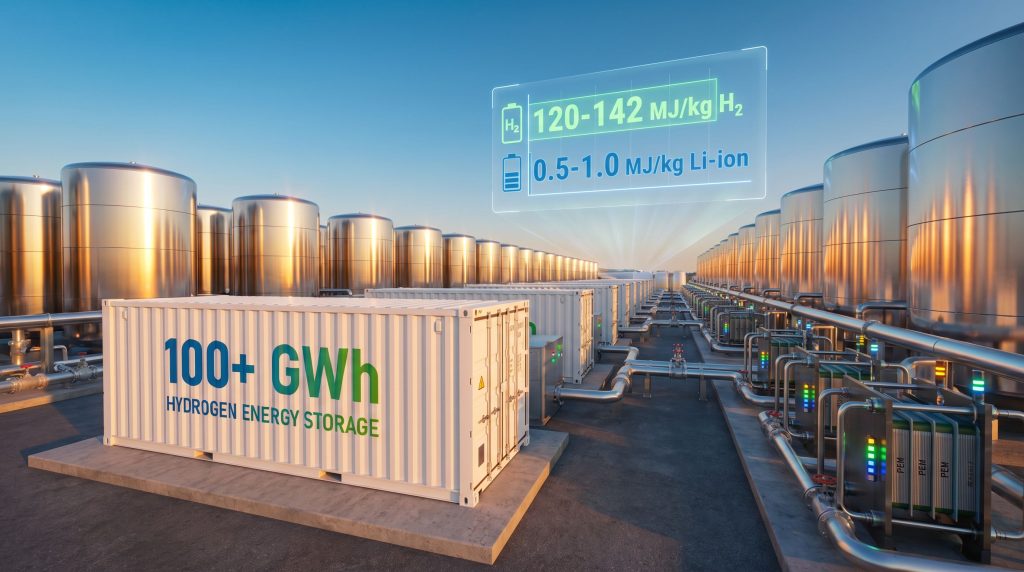
Energy density comparisons reveal substantial differences between storage approaches, with compressed hydrogen systems achieving 120-142 MJ/kg compared to lithium-ion batteries at 0.5-1.0 MJ/kg. This density advantage translates into smaller physical footprints for equivalent energy storage capacity, particularly relevant for industrial applications with space constraints.
| Storage Technology | Energy Density (MJ/kg) | Typical Duration | Industrial Scalability |
|---|---|---|---|
| Lithium-ion Batteries | 0.5-1.0 | 2-8 hours | Material supply constraints |
| Compressed Hydrogen | 120-142 | Weeks to years | Infrastructure dependent |
| Pumped Hydro | 1.5-2.0 | 6-20 hours | Geographic limitations |
According to research from the International Renewable Energy Agency, hydrogen storage systems offer unique advantages for long-duration applications that battery technologies cannot match effectively.
Round-Trip Efficiency Evolution
Current hydrogen systems operate at 35-45% round-trip efficiency, while battery systems achieve 85-95% efficiency for short-duration applications. However, hydrogen efficiency improvements through advanced electrolysis technology are expected to reach 60-90% ranges, particularly with next-generation PEM systems that demonstrate enhanced energy efficiency compared to pressurised alkaline configurations.
The efficiency comparison becomes more complex when accounting for storage duration requirements. Battery systems maintain high efficiency over hours to days, whilst hydrogen enables energy storage way beyond batteries by preserving energy content over years with minimal loss through evaporation, which remains negligible relative to total stored energy capacity.
Technology Platform Characteristics
PEM Electrolyser Systems:
• Utilise platinum and iridium catalytic materials with reduced loading requirements in future generations
• Provide rapid response capabilities and compact footprint optimisation
• Enable dynamic response characteristics superior to pressurised alkaline systems
• Target 70% cost reduction in stack components for next-generation platforms
Alkaline Electrolyser Systems:
• Cost-optimised for large-scale industrial deployment
• Demonstrate excellent dynamic capabilities at larger project scales
• New product launches scheduled for mid-2026 with enhanced performance characteristics
• Established manufacturing base supporting immediate deployment requirements
Industrial Demand Drivers and Market Segmentation
Defence sector applications represent a significant demand driver for hydrogen storage systems, with multi-year grant funding from the U.S. Department of Defence supporting energy resilience infrastructure development. This sector values extended backup power capabilities that exceed traditional battery discharge windows and diesel generator dependency.
Grid balancing applications demonstrate immediate market viability through energy arbitrage opportunities. A 20 MW facility in Denmark operates during periods of excess electrical generation, absorbing surplus energy and reducing demand spikes during high-consumption periods. This operational model helps flatten electricity price volatility across peak and off-peak demand cycles.
In addition, the development of comprehensive critical minerals strategy initiatives further supports the hydrogen storage sector by reducing reliance on scarce battery materials.
Energy Security and Resilience Applications
Renewable hydrogen production enables localised energy generation proximate to end-use locations, addressing geopolitical energy dependency concerns and price volatility exposure mitigation. This capability becomes particularly valuable for:
• Critical infrastructure protection: Extended backup power for essential services
• Industrial process continuity: 24/7 manufacturing requirements beyond battery capabilities
• Remote site operations: Grid independence for mining and processing facilities
• Emergency response: Disaster recovery and humanitarian applications
Infrastructure Requirements and Storage Options
Hydrogen storage infrastructure encompasses multiple technological approaches tailored to specific duration and capacity requirements. Storage methodologies include compressed gas systems for medium-term applications, underground salt caverns for multi-year seasonal storage, pipeline networks leveraging existing natural gas infrastructure, and liquefaction systems for high-density applications.
Storage Technology Implementation
Underground Salt Caverns:
Sweden demonstrates salt cavern utilisation for large-scale hydrogen storage, providing multi-year capacity for seasonal energy arbitrage applications.
Pipeline Networks:
Existing pipeline infrastructure enables distribution and storage through compressed hydrogen systems, though new capacity development remains necessary in many regions.
Liquefaction Systems:
High-density storage through liquefied hydrogen enables transportation applications and backup power systems with associated tank storage requirements.
Buffer Tank Systems:
Large-scale compressed gas storage provides medium-term energy management for weekly and monthly demand cycles.
Containerised Solutions and Market Entry Strategy
Market dynamics have shifted deployment strategies from large-scale custom installations toward standardised containerised systems. This evolution reflects customer preferences for gradual capacity expansion aligned with actual offtake materialisation rather than upfront full-scale construction commitments.
However, the broader industry is also witnessing increased activity at events such as the resources innovation expo where containerised hydrogen solutions are gaining attention from mining and industrial operators.
Modular Deployment Advantages
Containerised PEM systems offer proven, efficient, and standardised alternatives to customised solutions. Multiple containerised units provide scalability pathways that match demand growth patterns whilst reducing project execution risks through established reference installations.
Implementation Benefits:
• Reduced engineering costs through standardised designs
• Faster deployment timelines under 12-month delivery schedules
• Scalability pathways enabling incremental capacity additions
• Risk mitigation through validated reference portfolio
Regional Market Development
Europe currently leads deployment activity with active project development and delivery execution. North America demonstrates emerging opportunities with defence sector support and grid resilience applications. Middle East and Asian markets show increasing interest in industrial diversification and energy security initiatives.
Economic Comparison with Battery Alternatives
Capital expenditure analysis reveals improving competitiveness for hydrogen storage systems, particularly for long-duration applications. Whilst battery systems maintain cost advantages for short-duration energy management, hydrogen enables energy storage way beyond batteries for applications requiring storage durations exceeding 8-12 hours.
Investment Cost Structure
System-Level Costs:
Integration expenses encompass electrolyser equipment, storage infrastructure, and fuel cell components. Stack-level cost reductions target 70% reduction in the most expensive system components, enabling low capital expenditure and low operational expenditure profiles.
Operational Expenditure:
Maintenance requirements differ significantly between technologies. Hydrogen systems require electrolysis system servicing, whilst battery systems face degradation management and periodic replacement cycles affecting total cost of ownership calculations.
Research published in Energy Storage News demonstrates the growing interest in hydrogen-based storage solutions for industrial applications.
Energy Arbitrage Economics
Peak and off-peak pricing optimisation strategies enable revenue generation through demand response participation and frequency regulation services. Capacity factor optimisation depends on utilisation rates for different storage duration applications, with longer-duration systems demonstrating improved economics through extended operational cycles.
Furthermore, integration with renewable energy solutions creates synergistic opportunities for hydrogen storage deployment in mining and industrial operations.
The next major ASX story will hit our subscribers first
Technology Evolution and Future Platforms
Next-generation electrolyser development focuses on simultaneous cost reduction and performance enhancement. PEM technology advancement targets full prototype stack completion within the current development cycle, followed by industrialisation partnerships and commercial deployment targeting mid-2028 through 2029 timeframes.
Advanced System Characteristics
Future PEM platforms aim to achieve comparable or superior performance to pressurised alkaline systems whilst maintaining smaller physical footprints at reduced costs. Dynamic response capabilities remain superior for PEM configurations, though larger pressurised alkaline systems demonstrate excellent dynamic characteristics at scale.
Development Timeline:
- 2026: New alkaline product launch scheduled for May
- 2026-2027: Full prototype PEM stack development and testing
- 2027-2028: Industrial partner engagement and manufacturing preparation
- 2028-2029: Commercial availability of next-generation PEM technology
Market Outlook and Investment Implications
Larger projects in the 50-150 MW range are emerging and approaching Final Investment Decision status within upcoming quarters. This scale expansion demonstrates market maturation beyond initial containerised deployments toward utility-scale infrastructure development.
Growth Projections and Market Development
Order intake expectations for 2026 suggest meaningful activity levels supporting 2027 production and delivery schedules. Growing reference portfolios strengthen market confidence and reduce technology adoption barriers for new industrial customers.
Market Dynamics:
• Project scale evolution: From 100+ MW custom installations to standardised 10-50 MW deployments
• Geographic expansion: Europe leadership with North American, Middle Eastern, and Asian development
• Technology maturation: Established manufacturing and deployment capabilities
• Investment readiness: FID-stage projects approaching commercial implementation
Strategic Investment Considerations
Technology risk assessment favours established platforms with demonstrated commercial viability. Market demand visibility improves through defence sector commitments and industrial energy security requirements. Competitive landscape evolution supports multiple technology providers and system integrators serving different market segments.
"Industrial hydrogen storage represents a strategic infrastructure investment aligned with energy security priorities and renewable energy integration requirements. The technology enables energy independence through local production and extended storage capabilities that complement existing battery infrastructure for comprehensive grid resilience."
Future Market Integration and Infrastructure Development
Long-term hydrogen storage deployment requires coordinated infrastructure development encompassing production, storage, and distribution networks. Integration with existing energy systems enables grid balancing services, demand response capabilities, and frequency regulation participation that generate revenue streams supporting investment economics.
The technology pathway toward mainstream adoption depends on continued cost reductions, performance improvements, and successful reference project execution across multiple geographic markets and industrial applications. Consequently, as deployment scales increase and manufacturing volumes expand, hydrogen enables energy storage way beyond batteries by addressing industrial energy requirements that exceed the capabilities of alternative storage technologies.
Note: This analysis is based on industry presentations and public disclosures. Investment decisions should consider multiple sources of information and professional financial advice. Market projections and technology development timelines remain subject to technical, commercial, and regulatory uncertainties.
Want to Invest in the Next Energy Storage Breakthrough?
Discovery Alert's proprietary Discovery IQ model delivers instant notifications on significant ASX mineral discoveries, including critical materials powering hydrogen storage and renewable energy technologies. Explore how major mineral discoveries have generated substantial returns throughout history, then begin your 14-day free trial today to position yourself ahead of the market.