
June 21, 2026
The Processing Problem That Defines Nevada Gold Economics
Refractory gold has shaped the economics of Nevada mining for decades. Unlike free-milling ore, where cyanide leaching extracts gold efficiently from crushed rock, refractory sulphide ore locks gold within iron sulphide mineral matrices, primarily pyrite and arsenopyrite, rendering conventional processing largely ineffective. The gold is physically encapsulated, and standard leach circuits cannot access it without a pre-treatment step that breaks open the sulphide structure first.
Pressure oxidation, more commonly called autoclave processing, is the dominant solution. High-temperature, high-pressure vessels use oxygen to oxidise the sulphide minerals, liberating the gold and making it available for downstream cyanide leaching at recovery rates that can exceed 90%. The capital intensity of autoclave infrastructure is significant, which is precisely why access to it has historically acted as a bottleneck for mid-tier Nevada gold producers without the balance sheet to build their own.
This is the structural context within which the confirmation that i-80 Gold Lone Tree is funded and under construction carries its analytical weight. Furthermore, with record gold prices providing a supportive macro backdrop, the timing of this development milestone is particularly significant.
When big ASX news breaks, our subscribers know first
Why Brownfield Autoclave Refurbishment Changes the Capital Equation
The Greenfield vs. Brownfield Distinction in Autoclave Development
Building an autoclave facility from scratch is among the most capital-intensive undertakings in gold mining. Site preparation, civil works, vessel procurement, materials handling infrastructure, tailings management, and utilities integration can collectively push a greenfield autoclave project well beyond the costs associated with refurbishing an existing facility that retains its core infrastructure.
Lone Tree is not a greenfield project. The facility already exists as a brownfield site with substantial plant infrastructure in place, and the development programme focuses on refurbishment and reconfiguration rather than ground-up construction. The engineering assessment estimates approximately 600,000 direct construction hours for the refurbishment scope, a figure that would be materially higher for an equivalent greenfield autoclave development.
That distinction has a direct bearing on the $430 million capital estimate and the credibility of the Q4 2027 commissioning target. A definitive feasibility study reflects a degree of engineering completion that substantially reduces contingency ranges relative to scoping or preliminary assessment work. The Lone Tree capital estimate was developed at this standard by Hatch, which originally completed the feasibility study and subsequently updated it, with results released in November 2025.
Lone Tree as a Central Processing Hub for Multiple Feed Sources
The strategic logic of Lone Tree extends beyond a single mine. The plant is designed to function as a centralised processing hub, drawing refractory sulphide feed from three sources:
- Granite Creek (underground sulphide ore currently being stockpiled due to third-party processing constraints)
- Archimedes (underground development advancing ahead of schedule, feeding into the same sulphide inventory base)
- Cove (a high-grade refractory gold deposit subject to ongoing NEPA permitting through the Bureau of Land Management)
The multi-feed design provides throughput optionality and reduces the facility's dependence on any single ore source. It also means the resource base supporting Phase 1 production is not confined to one deposit, which lowers operational concentration risk over the production ramp period beginning in 2028.
Currently, refractory sulphide ore from Granite Creek is sent to a third-party autoclave operator under a toll processing agreement. The arrangement validated the ore's metallurgical behaviour at an operational scale and confirmed that autoclave technology performs as expected on the material. However, the toll arrangement carries a volume ceiling that owner-operated processing is designed to remove. A sulphide stockpile holding over 4,000 recoverable ounces had accumulated by the end of March 2026, representing gold already mined and staged but withheld from revenue by third-party processing availability.
How the $787.5 Million Recapitalisation Was Structured
Three Instruments, One Structural Outcome
The financing package that placed i-80 Gold Lone Tree as funded and under construction comprised three distinct instruments, each serving a different purpose within the overall capital architecture:
| Financing Instrument | Counterparty | Value |
|---|---|---|
| Net Smelter Return Royalty | Franco-Nevada | $250 million ($225M at close + $25M contingent) |
| Gold Prepayment Facility (+ $100M accordion) | National Bank of Canada and Macquarie Bank Limited | $250 million |
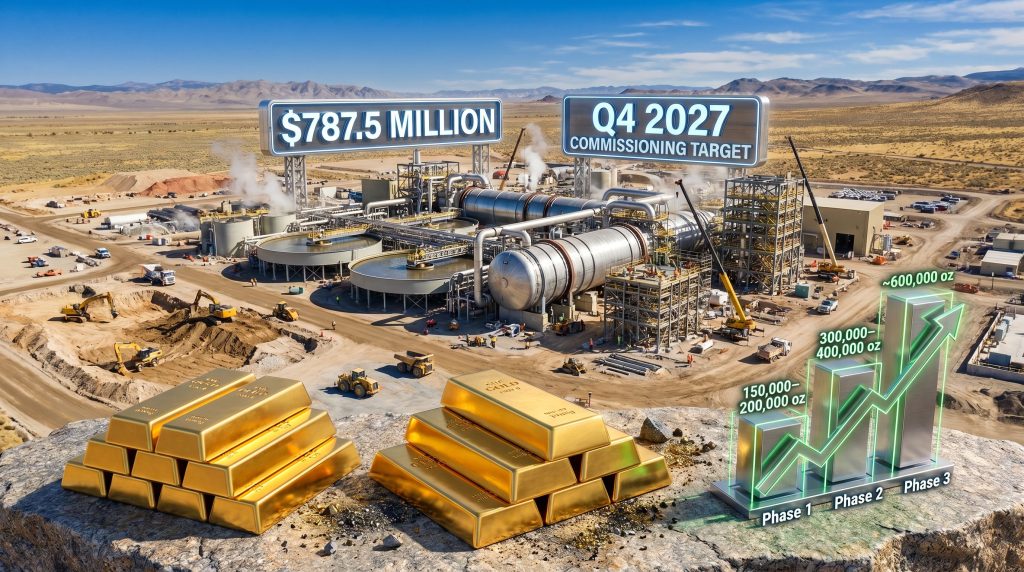
| 3.75% Unsecured Convertible Senior Notes (due 2031) | Public Markets | $287.5 million |
| Total Financing Package | $787.5 million |
The Franco-Nevada royalty delivered $225 million at closing, with a further $25 million contingent on Mineral Point conditions. The gold prepayment facility with National Bank of Canada and Macquarie Bank Limited includes a $100 million accordion option, providing additional drawdown capacity if required. The convertible senior notes, priced at 3.75% and maturing in 2031, completed the structure through public capital markets.
Legacy Debt Retirement and the Going-Concern Elimination
A portion of the royalty proceeds, specifically $165 million, was applied directly to retiring legacy debt obligations: the Orion Gold Prepay, the Orion convertible loan, and the 2023 convertible debentures. These instruments had generated recurring financial obligations that conditioned every prior forward-looking projection the company made.
Key Risk Shift: The retirement of legacy debt obligations removed the capital dependency that had previously defined the company's risk classification. The analytical question has changed from whether funding can be secured to whether the construction programme can be executed on schedule and within the approved capital estimate.
The outcome at 31 March 2026 was a cash and cash equivalents balance of $513.5 million, an increase of $450.3 million from December 2025. Going-concern doubt, which had been formally noted in prior financial statements, was eliminated. The development plan covering both Phase 1 and Phase 2 is fully funded.
Construction Sequence and Production Targets
Phase-by-Phase Development Progression
The Lone Tree construction programme follows a defined sequence with discrete milestones that investors can track as execution confirmation signals:
- Limited Notice to Proceed issued to Hatch in August 2025, initiating critical-path engineering and procurement work before full Board approval
- Demolition phase targeted to commence in Q2 2026
- Construction phase commencing in H2 2026, representing the point of major capital deployment
- Plant commissioning targeted for Q4 2027
- Phase 1 production of 150,000 to 200,000 ounces annually commencing from 2028
Capital commitments stood at $31.2 million at the end of March 2026, with approximately 50% of total project capital expected to be committed by mid-2026. That 50% commitment milestone represents a meaningful execution signal, as it marks the point at which procurement and contracting activity has converted planned expenditure into binding obligations.
Production Phase Targets at Scale
The phased development plan extends well beyond the initial production ramp:
| Development Phase | Annual Production Target | Timing |
|---|---|---|
| Phase 1 | 150,000 to 200,000 oz | From 2028 |
| Phase 2 | 300,000 to 400,000 oz | Post-Phase 1 ramp |
| Phase 3 (anticipated average) | ~600,000 oz | Long-term |
The progression from Phase 1 to Phase 3 reflects both throughput expansion at the Lone Tree facility and the incorporation of additional feed sources as permitting and feasibility work at Cove and Mineral Point advances. Phase 3 production is the outermost target in the sequence and is subject to a longer permitting horizon. Understanding permitting in mining is consequently essential context for evaluating how this timeline may evolve, particularly given the NEPA Environmental Impact Statement process at Cove and the acceleration of the Environmental Impact Statement timeline at Mineral Point.
Q1 2026 Financial Performance: The Operating Base Before Lone Tree
Record Gross Profit From Existing Assets
The first quarter of 2026 financial results demonstrate that the operating base is generating positive gross contributions before Lone Tree processes a single ounce. The year-on-year comparison is instructive:
| Metric | Q1 2026 | Q1 2025 | Change |
|---|---|---|---|
| Revenue | $52.4 million | $14.0 million | +274% (3.7x) |
| Gross Profit | $16.1 million | $2.9 million | +455% |
| Gold Sales Volume | 10,590 oz | n/a | n/a |
| Average Realised Gold Price | $4,941/oz | n/a | n/a |
| Adjusted Loss Per Share | $0.03 | $0.05 | Improved |
The revenue expansion to $52.4 million was driven by the finalisation of the third-party toll processing agreement at Granite Creek, which enabled higher gold sales volumes, combined with an average realised gold price of $4,941 per ounce. Cost of sales reached $35.8 million, producing a gross profit of $16.1 million, which represents the highest quarterly gross profit in the company's history and was achieved entirely by the existing operating base.
Understanding the $78.6 Million Net Loss
The reported net loss requires contextual disaggregation to be analytically useful. The $78.6 million figure is dominated by non-cash and non-recurring items tied directly to the recapitalisation structure:
- $48.4 million: Non-cash fair value revaluations on derivative financial instruments
- $7.1 million: Non-cash losses on legacy debt extinguishment
- $25.7 million: One-time interest payments on retired debt (cash, but non-recurring)
- Adjusted net loss: $28.6 million (compared to $23.6 million in the prior year period)
Analytical Note: The reported net loss is an accounting consequence of the recapitalisation mechanics, not a reflection of the company's capacity to generate gross profit from gold production. Adjusted loss per share of $0.03, down from $0.05, represents the operational trajectory once these non-recurring charges are excluded. This metric is the relevant indicator of progress for assessing operational performance.
Granite Creek Operating Performance
Q1 2026 Production Metrics
Granite Creek delivered the majority of production in the quarter, operating across both oxide and sulphide ore types:
| Metric | Q1 2026 Result |
|---|---|
| Gold Produced | 8,857 oz |
| Gold Sold | 8,767 oz |
| Oxide Mined Grade | 8.86 g/t |
| Sulphide Mined Grade | 6.16 g/t |
| Total Material Mined | 31,427 tonnes |
| Total Material Processed | 32,232 tonnes |
| Sulphide Stockpile (recoverable) | 4,000+ oz |
The oxide mined grade of 8.86 grams per tonne exceeded expectations set out in the March 2025 Preliminary Economic Assessment, a meaningful signal given that PEA-level estimates typically incorporate conservative grade assumptions to account for geological uncertainty. Outperformance at this stage of development indicates that the oxide ore body is delivering at or above modelled parameters.
The Sulphide Stockpile as Staged Inventory
The accumulation of over 4,000 recoverable ounces in the sulphide stockpile by quarter-end is a feature of the current processing arrangement rather than an operational problem. This material has been mined, moved to surface, and is awaiting processing capacity. Once Lone Tree commences operations, this staged inventory feeds directly into the production pipeline without requiring additional mining activity to initiate throughput.
Archimedes underground development advanced approximately 660 metres during the quarter, ahead of the planned schedule, expanding the accessible inventory base that will support Lone Tree feed grades and continuity from the initial production phase.
Operational continuity at Granite Creek required active management during the quarter. A transformer fire at the main surface electrical substation in January 2026 required temporary generator installation before permanent replacement infrastructure was completed in mid-March. A second, larger water treatment plant was on track for commissioning in June 2026 to manage underground water inflows that had been approaching pumping capacity.
The next major ASX story will hit our subscribers first
Outstanding Permits and Remaining Dependencies
What Still Needs to Be Approved for the New Plant Design
Existing operational components at Lone Tree are covered by current permits. The outstanding applications relate specifically to the new plant design configuration and include:
- Air quality permits
- Mercury control approvals
- Water pollution control authorisations
- Reclamation management plans
- Secondary programme approvals
At Cove, NEPA permitting activities are underway with the Bureau of Land Management, with an Environmental Impact Statement anticipated as the next formal milestone. The capital secured through the recapitalisation enables acceleration of the Mineral Point permitting process, potentially advancing that EIS timeline by one to two years relative to the trajectory that existed prior to funding being secured.
Schedule Dependency: Q4 2027 commissioning is contingent on these permits being received within a window compatible with the construction programme. Permit receipt timing represents the primary external schedule risk, alongside monitoring the 50% capital commitment milestone expected by mid-2026.
Feasibility studies incorporating reserve statements for both Granite Creek and Cove are targeted for Q2 2026. The Granite Creek study has been delayed by ongoing ore discovery during the exploration campaign, a complication that reflects expanding geological understanding rather than deteriorating conditions. The largest drilling programmes in the company's history, with approximately $80 million allocated to drilling in 2026, are actively expanding the resource base that Lone Tree is designed to process.
Milestone Tracker for Investors
Key Execution Signals Through 2028
| Milestone | Target Timing | Significance |
|---|---|---|
| ~50% of Lone Tree capital committed | Mid-2026 | Confirms construction momentum through procurement |
| Demolition commencement | Q2 2026 | First physical construction signal |
| Granite Creek feasibility study (with reserves) | Q2 2026 | Technical foundation for Phase 1 modelling |
| Cove feasibility study (with reserves) | Q2 2026 | Confirms feed material availability for Lone Tree |
| Second water treatment plant commissioning | June 2026 | Operational continuity at Granite Creek underground |
| Construction phase commencement | H2 2026 | Major capital deployment begins |
| Lone Tree plant commissioning | Q4 2027 | Revenue-generating transition to owner-operated processing |
| Phase 1 production commencement | 2028 | 150,000 to 200,000 oz annually |
The transition from capital risk to execution risk is not a minor adjustment in investment framing. Capital-stage companies carry binary outcomes: funding either arrives or the development stalls. Execution-stage companies carry a more granular risk set — construction cost control, permitting timelines, equipment delivery schedules, and commissioning performance — that can be monitored progressively against defined milestones. That shift in risk character, now that i-80 Gold Lone Tree is funded and under construction, is material for how the investment case is assessed.
Frequently Asked Questions: i-80 Gold Lone Tree Funded and Under Construction
Is the Lone Tree Plant fully funded?
Yes. Financing transactions totalling $787.5 million were closed, delivering $513.5 million in cash at the end of March 2026. The Board-approved development plan covers both Phase 1 and Phase 2, and going-concern risk has been formally eliminated. i-80 Gold's Q1 2026 results confirm the fully funded status and provide further detail on the capital structure underpinning the development plan.
When will Lone Tree be commissioned?
The current target is Q4 2027, following demolition in Q2 2026 and construction commencing in H2 2026. Phase 1 production of 150,000 to 200,000 ounces annually is targeted from 2028.
What is the total capital cost for the Lone Tree refurbishment?
The project carries a $430 million capital estimate, supported by a Level 3 engineering study completed by Hatch. Approximately 50% of total project capital was expected to be committed by mid-2026, with capital commitments standing at $31.2 million at the end of March 2026.
Why is Lone Tree described as a brownfield refurbishment rather than a new build?
Lone Tree is an existing autoclave facility with substantial infrastructure already in place. The refurbishment requires approximately 600,000 direct construction hours, materially less than a comparable greenfield autoclave development. Existing operational components are already permitted; outstanding applications relate specifically to the new design configuration.
What ore will Lone Tree process?
Lone Tree is designed to process refractory sulphide ore from Granite Creek, Archimedes, and Cove, replacing the current arrangement under which ore is sent to a third-party autoclave operator. Owner-operated processing is expected to improve recoveries and materially expand operating margins compared to the toll processing structure.
What permits are still outstanding for Lone Tree?
Applications for air quality, mercury control, water pollution control, reclamation management, and secondary programmes remain pending for the new plant design. The commissioning timeline is contingent on these permits being received within a window compatible with the construction programme. In addition, interpreting drill results from the ongoing 2026 exploration campaign will inform reserve statements that underpin the final production schedule.
This article contains forward-looking statements and financial projections derived from company disclosures. All production targets, capital estimates, and timelines are subject to change and involve assumptions that may not prove correct. This content is for informational purposes only and does not constitute financial or investment advice. Readers should conduct their own due diligence before making any investment decisions.
Want to Capitalise on Major Mineral Discoveries Before the Broader Market?
Discovery Alert's proprietary Discovery IQ model delivers real-time alerts on significant ASX mineral discoveries, turning complex geological and financial data into actionable investment insights for both short-term traders and long-term investors. Explore how historic discoveries have generated substantial returns and begin your 14-day free trial today to position yourself ahead of the market.