May 19, 2026
Brazil's mining sector stands at the forefront of digital innovation, with enhanced intelligence platforms revolutionising how stakeholders access and analyse resource data. The IBRAM updated mining map demonstrates unprecedented expansion in both scope and accessibility, representing a fundamental shift toward data‐driven mining operations. Furthermore, this technological evolution reflects broader trends in mining industry innovation across emerging economies worldwide.
What Does IBRAM's Expanded Mining Database Reveal About Brazil's Resource Sector?
Brazil's mining intelligence landscape has undergone substantial transformation, with the IBRAM updated mining map showcasing remarkable growth in operational transparency. The platform's evolution represents a fundamental shift in how resource sector data is collected, processed, and disseminated across the mining ecosystem.
Digital Transformation in Mining Intelligence
Interactive mapping platforms are revolutionising sector transparency by converting traditional static datasets into georeferenced, real-time visualisation systems. The IBRAM updated mining map exemplifies this technological evolution, providing stakeholders with immediate access to comprehensive operational intelligence across Brazil's mining landscape.
The platform's architecture enables multi-dimensional analysis through thematic filtering systems that organise operations by strategic categories. These include energy transition minerals, agricultural inputs, and construction materials. This systematic approach transforms fragmented industry data into coherent intelligence frameworks that support both regulatory oversight and investment analysis.
Real-time georeferencing capabilities enable spatial analysis of mining operations, revealing geographic clustering patterns previously invisible in traditional reporting formats. The platform recorded over 180,000 visualisations during its first operational year, indicating significant user engagement and demonstrating market demand for accessible mining intelligence.
Scale of Brazil's Mining Ecosystem Expansion
The numerical expansion of Brazil's documented mining ecosystem reveals remarkable growth in operational transparency over the past year. Comparative analysis between the initial platform launch in January 2025 and the updated version in March 2026 demonstrates substantial increases across all measured categories.
| Metric | January 2025 | March 2026 | Growth Rate |
|---|---|---|---|
| Active Mining Operations | 262 | 1,051 | 301.5% |
| Development Projects | 178 | 465 | 161.2% |
| Mining Companies | 261 | 1,068 | 309% |
The 301% increase in mapped active operations reflects both improved data collection methodologies and systematic inclusion of previously undocumented smaller-scale operations. This expansion particularly encompasses construction aggregate producers through partnership integration with the Associação Nacional das Entidades de Produtores de Agregados para Construção Civil (ANEPAC).
Geographic distribution patterns reveal significant concentration variations across Brazilian states. However, specific regional breakdowns require additional data granularity beyond current public disclosure levels. The platform's comprehensive coverage enables macro-economic analysis of mining's geographic footprint and regional economic impact distribution.
When big ASX news breaks, our subscribers know first
How Are Mining Operations Distributed Across Brazil's Resource Landscape?
Brazil's operational mining landscape demonstrates distinct methodological preferences that reflect both geological characteristics and economic optimisation principles. The distribution of extraction methods across the country's 1,051 active operations reveals clear patterns in how companies approach resource recovery.
Operational Method Analysis
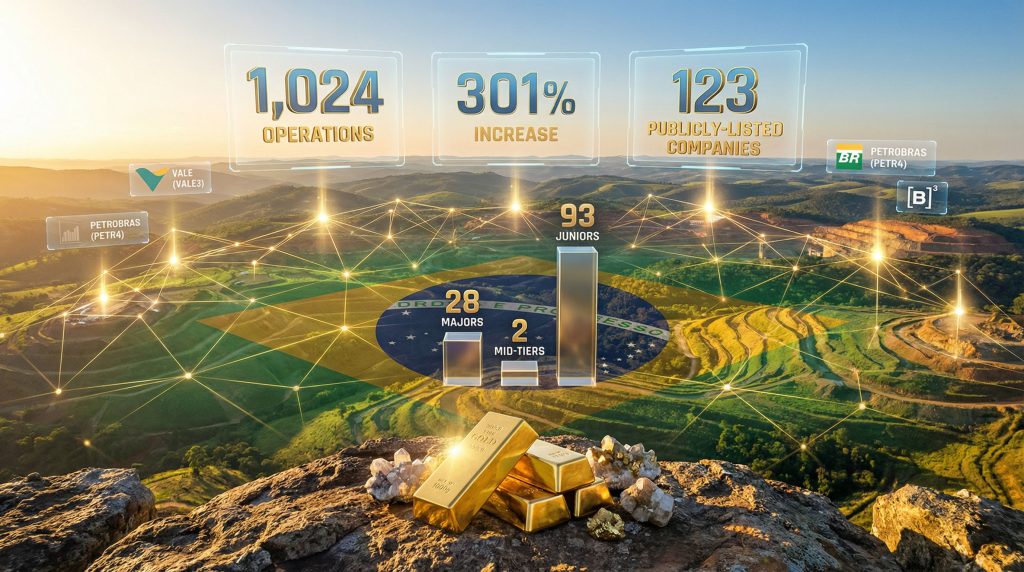
Open-pit mining maintains overwhelming dominance across Brazil's active operations, with 1,024 sites representing 97.4% of all extraction activities. This concentration reflects several underlying factors including geological accessibility, capital efficiency, and commodity pricing dynamics.
Surface mining operations enable rapid resource access and lower initial capital requirements compared to underground development. The prevalence of open-pit methods indicates that Brazil's ore bodies frequently occur at economically accessible depths where stripping ratios remain favourable.
Underground mining operations, numbering 32 specialised facilities, represent 3.0% of active sites but typically focus on higher-value commodities. These operations generally target gold deposits, specialised industrial minerals, or ore bodies where surface access is geologically or economically impractical.
Hybrid methodology adoption remains limited to 6 companies utilising dual extraction methods, representing 0.6% of operations. These facilities typically manage complex geological transitions where ore body characteristics vary spatially, requiring operational flexibility to optimise recovery.
Corporate Structure and Market Participation
Brazil's mining ecosystem encompasses 1,068 companies operating across the spectrum from major multinational corporations to specialised regional producers. This corporate diversity reflects the sector's multi-tier structure where different company types serve distinct market segments and operational niches.
Key Corporate Statistics:
• 86 IBRAM member companies participate directly in the institute's activities
• 8.05% institutional representation among total mapped entities
• Construction aggregate integration through ANEPAC partnership expansion
• State-level syndicate participation enabling comprehensive regional coverage
The integration of construction aggregate producers significantly expanded database coverage to include sand, gravel, and crushed stone operations. These materials serve as primary inputs for concrete production and infrastructure development, representing a critical but often overlooked segment of the mining economy.
IBRAM membership penetration of 8.05% among documented companies suggests that institutional representation focuses on larger-scale operations. Meanwhile, the broader mining ecosystem includes numerous smaller entities operating independently of formal industry associations.
What Role Do International Stock Exchanges Play in Brazilian Mining?
International capital markets serve as fundamental infrastructure for Brazilian mining development, with cross-border equity financing enabling project development and operational expansion. The integration of 123 publicly-listed companies into global financial markets demonstrates the sector's deep interconnection with international investment flows.
Global Capital Market Integration
Brazilian mining companies maintain listings across 26 international stock exchanges, creating geographic diversification in capital access. This distribution strategy reduces dependence on single capital markets while expanding potential investor bases across multiple time zones and regulatory jurisdictions.
The corporate classification system reveals distinct segmentation within Brazil's publicly-traded mining sector:
| Company Classification | Number of Entities | Market Characteristics |
|---|---|---|
| Major Mining Companies | 28 | Multi-billion-dollar market caps, diversified operations |
| Mid-tier Operators | 2 | Intermediate scale and capital access |
| Junior Companies | 93 | Early-stage exploration, development financing |
Junior companies represent 75.6% of publicly-listed entities, indicating that early-stage exploration relies heavily on equity financing rather than debt or internal cash generation. This concentration reflects typical mining sector development patterns where numerous exploration entities compete for advancement to production status.
The presence of 28 major mining companies signals Brazil's capacity to attract and retain globally significant mining enterprises. These entities typically possess established production profiles, diversified commodity portfolios, and sufficient scale to access multiple financing sources including international debt markets.
Investment Transparency and Market Access
Ticker symbol integration within the IBRAM platform enables seamless cross-referencing between operational data and financial market information. This technological integration creates direct linkages between:
• Physical mining operations (location, commodity, production stage)
• Corporate financial performance (stock price, market capitalisation)
• Regulatory filings (earnings, reserves reporting, ESG disclosures)
• Investor relations (shareholder communications, analyst coverage)
The transparency enhancement facilitates due diligence processes for institutional investors whilst enabling more sophisticated risk assessment. Cross-border investment decisions benefit from integrated intelligence platforms that consolidate traditionally fragmented information sources.
Corporate sizing methodologies enable strategic assessment of company development stages and financing requirements. The concentration of junior companies suggests active exploration and development pipelines that represent future production potential.
Which Strategic Commodities Drive Brazil's Mining Future?
Brazil's mineral resource portfolio positions the country strategically within global supply chains for critical materials essential to economic transformation trends. The thematic organisation of mining operations by commodity category reveals strategic focus areas that align with international demand patterns.
Energy Transition Minerals Mapping
Critical materials for renewable energy infrastructure represent a growing segment of Brazil's mining focus. These encompass minerals essential for solar panels, wind turbines, battery systems, and electric vehicle components. The identification of energy transition minerals within the IBRAM platform reflects recognition of shifting demand patterns driven by global decarbonisation initiatives.
Brazilian geological formations contain significant deposits of minerals crucial for clean energy technologies. However, specific reserve quantification and development timelines vary by commodity and deposit characteristics. The mapping of these resources enables strategic planning for supply chain participation in renewable energy markets.
Supply chain security considerations for green technologies have elevated the strategic importance of mineral resource mapping, as nations seek to reduce dependence on concentrated supply sources whilst building domestic capabilities in critical material processing.
Decarbonisation pathway commodity identification supports policy development and investment prioritisation decisions. The platform's thematic organisation enables stakeholders to assess Brazil's potential contribution to global clean energy mineral supply.
Food Security and Agricultural Input Resources
Fertiliser and remineraliser project distribution represents another strategic focus area where Brazil's mineral resources directly support agricultural productivity. The country's significant agricultural sector creates domestic demand for mineral-based fertilisers whilst export opportunities exist for surplus production.
Key Agricultural Mineral Development Regions:
• Phosphate rock deposits supporting fertiliser production capacity
• Potassium mineral resources for balanced fertiliser formulations
• Limestone and gypsum for soil pH adjustment and conditioning
• Micronutrient minerals for speciality agricultural applications
Agricultural productivity enhancement through mineral resources creates direct linkages between mining operations and food production systems. The geographic distribution of these resources influences both domestic agricultural development patterns and export market participation strategies.
Brazil's position as a major agricultural exporter creates strategic incentives for developing domestic mineral fertiliser capacity. This approach aims to reduce import dependence whilst potentially creating export opportunities in fertiliser markets.
How Does Enhanced Data Accessibility Impact Sector Stakeholders?
Comprehensive mining intelligence platforms transform stakeholder decision-making processes by providing previously unavailable data accessibility and analytical capabilities. The IBRAM platform's impact extends across multiple user categories including researchers, policymakers, investors, and industry participants.
Research and Academic Applications
Academic research facilitation through georeferenced datasets enables sophisticated spatial analysis of mining operations and their economic, environmental, and social impacts. The platform's 180,000+ visualisations during its first operational year indicate substantial research and professional usage across multiple disciplines.
University researchers and policy institutions utilise comprehensive mining data for:
• Economic impact modelling of regional mining activities
• Environmental assessment research and monitoring
• Supply chain analysis for strategic materials
• Infrastructure planning studies and optimisation
Policy development support through comprehensive mapping enables evidence-based regulatory decision-making and strategic planning initiatives. Government agencies benefit from consolidated industry intelligence that previously required extensive data collection efforts across multiple sources and jurisdictions.
The georeferenced nature of the data enables sophisticated spatial analysis capabilities that support infrastructure planning, environmental monitoring, and economic development policy formulation. Academic institutions can access comprehensive datasets that previously remained fragmented across multiple proprietary sources.
Investment Analysis and Due Diligence Enhancement
Steps for Utilising Interactive Mining Data in Investment Analysis:
-
Commodity sector screening using thematic filters to identify relevant opportunities
-
Geographic risk assessment through regional concentration analysis
-
Corporate comparison using market capitalisation and development stage classifications
-
Operational method evaluation for technical and economic feasibility assessment
-
Market intelligence gathering through integrated ticker symbol information
Risk assessment improvements through operational transparency enable more sophisticated due diligence processes for institutional investors. The integration of operational data with financial market information creates comprehensive intelligence frameworks that support investment decision-making across multiple risk dimensions.
Market intelligence gathering benefits from centralised platforms that consolidate traditionally scattered information sources. Investors can conduct preliminary screening and analysis using publicly accessible data before engaging in detailed proprietary research efforts.
The platform's accessibility democratises mining intelligence by providing smaller investors and research institutions with data previously available only through expensive commercial databases or extensive primary research efforts.
What Are the Implications for Brazil's Mining Investment Climate?
Enhanced mining intelligence infrastructure creates multiple positive feedback effects that strengthen Brazil's position as an attractive mining investment destination. Furthermore, transparency improvements and data accessibility contribute to reduced information asymmetries and improved investor confidence in regulatory and operational environments.
Regulatory Transparency and Compliance Monitoring
Digital mapping capabilities enhance regulatory oversight by providing government agencies with comprehensive operational visibility across the mining sector. This technological improvement enables more effective monitoring whilst reducing regulatory compliance costs for companies through standardised reporting mechanisms.
Environmental impact assessment facilitation benefits from integrated operational data that enables more sophisticated environmental monitoring. The AI in mining sector continues to evolve, supporting compliance verification processes that integrate seamlessly with existing frameworks.
Permitting process insights reveal that process optimisation through centralised data reduces information collection costs and processing times. The consolidation of operational intelligence creates opportunities for more efficient regulatory processes whilst maintaining oversight effectiveness.
Enhanced oversight capabilities support improved regulatory decision-making through better information availability and analytical capabilities. The platform creates opportunities for more sophisticated regulatory analysis whilst reducing administrative burdens on both industry participants and government agencies.
Strategic Resource Planning and Development
Hypothetical Foreign Direct Investment Impact Scenario:
Consider an international mining company evaluating Brazilian investment opportunities. The enhanced data accessibility enables preliminary screening of potential targets, geographic risk assessment, and competitive landscape analysis without requiring extensive preliminary field research. This information accessibility could reduce due diligence costs by 20-30% whilst improving decision-making quality through better baseline intelligence.
Infrastructure development planning benefits from comprehensive operational mapping that reveals transportation needs, utility requirements, and potential shared infrastructure opportunities. Regional development planning can incorporate mining sector intelligence to optimise infrastructure investments across multiple user categories.
Supply chain optimisation opportunities emerge from comprehensive operational visibility that enables identification of potential synergies, shared services, and logistical efficiencies. Companies can identify collaboration opportunities whilst government agencies can plan infrastructure development more effectively.
The platform creates foundation conditions for more sophisticated sector planning and development coordination whilst maintaining competitive market dynamics and individual company strategic flexibility. Additionally, the sustainability transformation occurring across the industry benefits from enhanced data transparency and operational visibility.
The next major ASX story will hit our subscribers first
FAQ: Understanding Brazil's Updated Mining Intelligence Platform
Platform Access and Navigation
How can users access the IBRAM interactive mapping system?
The platform operates as a publicly accessible web-based interface available through IBRAM's official website. Users can navigate the system without registration requirements or access fees, democratising mining intelligence access across stakeholder categories.
What data filtering capabilities are available by commodity and region?
The system provides thematic filtering options organised by strategic commodity categories including energy transition minerals, fertilisers, construction aggregates, and precious metals. Geographic filtering enables state-level and regional analysis capabilities.
How frequently does the platform receive data updates and contributions?
The platform utilises continuous update mechanisms that incorporate new operational data as it becomes available through industry sources, regulatory filings, and direct company contributions. The system maintains current operational status information through multiple data verification channels.
Data Accuracy and Verification
What quality assurance protocols govern mining operation data integrity?
The platform employs multi-source verification methodologies that cross-reference company reports, regulatory filings, and industry association databases to ensure accuracy. Data verification processes include geographic validation and operational status confirmation through multiple independent sources.
How does the system verify company information and operational details?
Verification processes incorporate regulatory database cross-referencing, company filing analysis, and industry association membership verification. The system maintains data integrity through systematic validation protocols that identify and correct inconsistencies.
What maintenance procedures ensure ongoing data quality and system reliability?
Regular maintenance procedures include database updates, geographic coordinate verification, and operational status confirmation through multiple information sources. The system maintains reliability through systematic quality control processes and user feedback integration mechanisms.
Conclusion: Brazil's Mining Sector Digital Evolution
Long-term Implications for Resource Sector Development
Enhanced decision-making capabilities across all stakeholder categories create positive network effects that strengthen Brazil's mining ecosystem. The democratisation of mining intelligence through accessible platforms reduces information asymmetries whilst supporting more sophisticated analysis and planning capabilities.
Improved international competitiveness through transparency positions Brazil favourably in global mining investment comparison analysis. Countries with superior information infrastructure attract investment capital more effectively whilst supporting better regulatory and policy decision-making processes.
Foundation conditions for sustainable mining practice advancement benefit from comprehensive operational visibility that enables better environmental monitoring. In addition, social impact assessment and economic development planning are enhanced through improved data accessibility.
The IBRAM updated mining map represents significant progress in mining sector intelligence infrastructure that creates benefits for researchers, investors, policymakers, and industry participants. The platform's continued development and expansion will likely serve as a model for mining intelligence systems in other resource-producing nations seeking to enhance sector transparency and investment attractiveness. For more detailed analysis of Brazil's strategic positioning, refer to Mining Outlook's industry insights.
Disclaimer: This analysis is based on publicly available information and should not be considered as investment advice. Mining investments involve significant risks including commodity price volatility, regulatory changes, and operational uncertainties. Readers should conduct independent research and consult qualified financial advisors before making investment decisions.
Looking to Capitalise on Mining Intelligence Breakthroughs?
Discovery Alert's proprietary Discovery IQ model delivers real-time alerts on significant ASX mineral discoveries, transforming complex mining data into actionable investment insights for both short-term traders and long-term investors. Understand why major mineral discoveries can lead to substantial market returns by exploring Discovery Alert's dedicated discoveries page, showcasing historic examples of exceptional outcomes, then begin your 14-day free trial today to position yourself ahead of the market.