July 5, 2026
Australia's LNG Sector and the Recurring Fault Line of Industrial Relations
Energy markets tend to price in geopolitical risk with considerable speed, yet one category of supply disruption consistently catches Asian LNG buyers underprepared: the enterprise bargaining cycle at Australia's major liquefaction facilities. Unlike pipeline explosions or weather events, industrial action in Australia's offshore oil and gas sector follows a largely predictable rhythm. The Ichthys LNG strike is the latest episode in this recurring pattern, tied to agreement expiry dates, FIFO roster structures, and the concentrated bargaining leverage of highly specialised workforces operating on remote facilities.
When big ASX news breaks, our subscribers know first
The Ichthys Facility: More Than an LNG Export Terminal
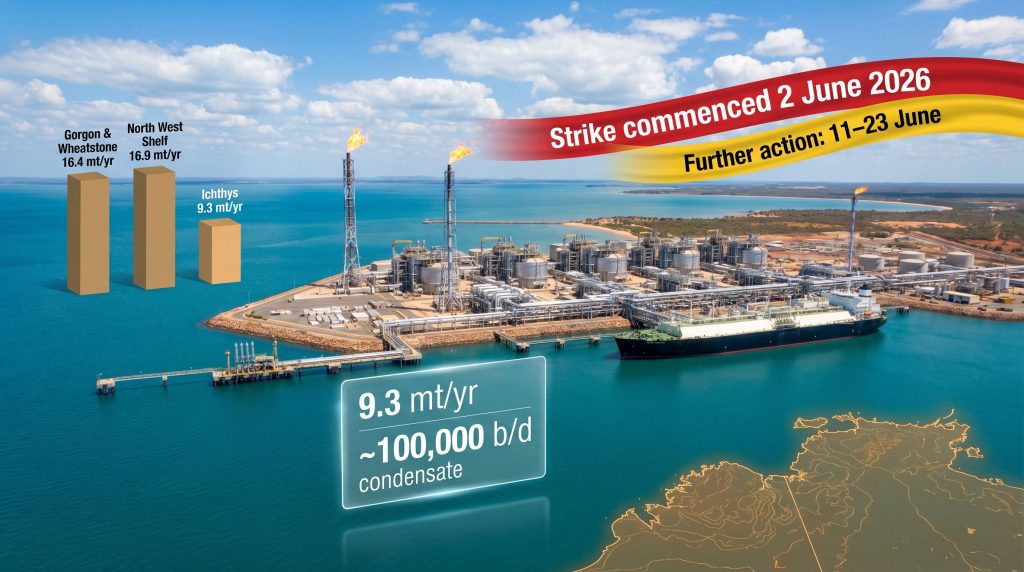
To frame the Ichthys LNG strike purely as a natural gas supply story is to misunderstand the facility's market significance. Located near Darwin in Australia's Northern Territory and operated by Japan's Inpex Corporation, Ichthys is a multi-commodity production hub operating at a nameplate LNG capacity of 9.3 million tonnes per year (mt/yr). That alone positions it among Australia's most consequential export assets, but the fuller picture includes approximately 100,000 barrels per day (b/d) of condensate output and 1.65 million tonnes per year of LPG production capacity, with roughly 1.36 million tonnes of LPG shipped during 2025.
This product diversification is precisely what makes the dispute a multi-commodity supply risk event rather than a single-market concern. The three product streams feed into distinct but interconnected Asian supply chains. Furthermore, Australia's energy exports have faced mounting scrutiny, making this episode particularly consequential:
- LNG flows primarily to Japanese utilities under long-term offtake arrangements, reflecting Inpex's Japanese corporate ownership structure
- Condensate feeds directly into Northeast Asian petrochemical feedstock chains, functioning as a naphtha substitute in crackers across Japan, South Korea, and Taiwan
- LPG supplies residential and industrial energy consumers across Japan, South Korea, and Southeast Asia, where it remains a critical cooking and heating fuel for millions of households
Australia consistently ranks among the world's top two LNG exporters, meaning any sustained disruption at a facility of Ichthys's scale creates ripple effects across Asian spot markets that extend well beyond the contracted volumes directly at risk.
How the Ichthys LNG Strike Is Structured
The Offshore Alliance and the Mechanics of Protected Industrial Action
The Offshore Alliance (OA), a combined industrial body representing members of the Australian Workers' Union (AWU) and the Maritime Union of Australia (MUA), commenced protected industrial action at the Ichthys facility at 6am Australian Western Standard Time on 2 June 2026 (10pm GMT on 1 June). This action had been formally authorised by union members as far back as April 2026, providing the legal foundation required under Australia's Fair Work framework.
A critical and often overlooked feature of Australian protected industrial action in the LNG sector is that it rarely takes the form of a complete work stoppage. Instead, unions construct layered disruption mechanisms that accumulate operational pressure across shifts, cargo scheduling, and maintenance windows. The Ichthys action follows this pattern precisely:
| Action Type | Specific Details |
|---|---|
| Daily tool-down periods | 6am to 8am and 6pm to 8pm |
| Overtime bans | No overcycle work permitted |
| Demobilisation restrictions | No work permitted past 6am on demobilisation day |
| Shift flexibility bans | Shift swaps require minimum four weeks' management notice |
All three Inpex-operated facilities are covered by the stoppages and work bans simultaneously:
- The onshore LNG processing facilities and export terminal at Darwin Harbour
- The Floating Production, Storage and Offloading (FPSO) vessel operating offshore
- The Central Processing Facility (CPF), which processes gas from the subsea field before it reaches the FPSO
The simultaneous coverage of the FPSO, CPF, and onshore terminal is significant from an operational standpoint. Each facility represents a distinct choke point in the Ichthys production chain. Disrupting all three simultaneously means that partial output losses at each stage compound rather than offset one another.
Why the Ichthys Dispute Took This Long to Escalate
The path to active industrial action was neither linear nor inevitable. A timeline of the bargaining breakdown illustrates the stop-start nature of negotiations:
- Early May 2026: Reports emerged that strikes could commence as early as 7 May if enterprise bargaining discussions failed to produce meaningful progress
- 27-28 May 2026: Initially scheduled strikes were paused as talks between the OA and Inpex showed genuine forward movement, temporarily reducing immediate supply risk assessments
- Late May 2026: Continued negotiations sustained the delay, with both parties indicating willingness to reach a concluded agreement
- 2 June 2026: Despite the progress achieved, the OA formally commenced strike action, citing the absence of a finalised agreement
- 11-23 June 2026: The OA served further notice to Inpex outlining additional planned industrial action across this extended window
The OA has publicly indicated it remains willing to suspend industrial action should Inpex return to what it characterises as genuine bargaining. This framing is important: it signals that the dispute has not hardened into an irreconcilable position, and that a negotiated resolution remains the most probable outcome based on historical precedent in this sector.
What Australian LNG Industrial History Tells Us About Likely Outcomes
The 2023 Precedent and the Psychology of Supply Risk Pricing
Australian LNG labour disputes have a well-established track record of producing market reactions disproportionate to actual output losses. The most instructive recent precedent involves threatened strikes at Woodside's Gorgon and Wheatstone facilities in mid-2023, which briefly pushed European TTF gas prices sharply higher despite Australia not directly supplying European markets. That episode illustrated a fundamental dynamic in global LNG pricing psychology: the market prices the possibility of Australian supply disruption far more aggressively than the eventual physical impact typically warrants. In addition, natural gas price trends over recent months have already reflected broader anxiety about supply reliability.
The 2023 Woodside disputes resolved through negotiation without a full work stoppage, yet the market volatility generated during the uncertainty period was substantial, particularly in European spot gas markets still recovering from the energy crisis of the previous year.
A comparison of the major Australian LNG facilities involved in recent enterprise bargaining disputes provides useful context for scaling the current Ichthys risk:
| Facility | Operator | Capacity (mt/yr) | Dispute Year | Outcome |
|---|---|---|---|---|
| Gorgon and Wheatstone | Woodside | ~16.4 combined | 2023 | Resolved via negotiation; no full stoppage |
| North West Shelf | Woodside | ~16.9 | 2023 | Agreement reached pre-strike |
| Ichthys LNG | Inpex | 9.3 | 2026 | Strike commenced; further action flagged |
Ichthys is meaningfully smaller than the combined Woodside assets involved in 2023. However, its Japanese corporate ownership introduces a distinct geopolitical dimension. Inpex is partly owned by the Japanese government through the Japan Organization for Metals and Energy Security (JOGMEC), making supply continuity a matter of national energy security rather than purely commercial calculus. This dynamic echoes broader conversations about energy superpower strategy playing out across multiple producer nations simultaneously.
Why Australia's FIFO Model Creates Structural Bargaining Leverage
A factor rarely examined in mainstream coverage of Australian LNG disputes is the role that fly-in, fly-out (FIFO) rostering plays in amplifying union bargaining power. Because offshore LNG facilities operate on concentrated roster cycles, large cohorts of workers rotate in and out simultaneously. This means that a ballot for protected action reaches the majority of the relevant workforce within a single roster cycle, and the vote outcome reflects the current mood of a highly cohesive, co-located workforce.
The practical consequences for operators are significant:
- Skill concentration: The workers involved hold highly specialised certifications that cannot be rapidly substituted with alternative labour
- Simultaneous expiry cycles: Enterprise agreements across multiple Australian LNG facilities frequently expire in similar windows, creating sector-wide bargaining pressure that operators cannot address sequentially
- Roster leverage: The demobilisation day bans and shift swap restrictions in the current Ichthys action are designed to maximise operational inconvenience while maintaining the legal protections of a structured action rather than a wildcat stoppage
Market Exposure Across Three Commodity Streams
LNG, Condensate, and LPG: Distinct but Interconnected Risks
Scenario A: Quick Resolution (1-2 weeks)
- Time-limited tool-down periods cause partial shift disruption absorbed by existing inventory buffers
- Asian spot LNG price premium remains contained given the structured rather than total nature of the action
- Condensate and LPG markets experience minor tightening with no structural repricing
Scenario B: Extended Action Through Late June
- Cumulative shift disruptions begin affecting cargo scheduling and loading programmes at Darwin Harbour
- Buyers dependent on Ichthys spot or short-term contract volumes seek alternative supply from Qatar, the United States, or other Australian facilities
- Condensate supply tightness amplifies naphtha pricing pressure in Northeast Asian petrochemical markets, where Ichthys condensate is a preferred feedstock due to its light, low-sulphur characteristics
- Force majeure assessments become a realistic operational consideration for Inpex management
Scenario C: Full Escalation Beyond June
- Sustained curtailment triggers formal adjustments in Asian LNG spot price benchmarks
- Inpex's contractual obligations to Japanese utility customers create significant financial and reputational pressure
- Australia's standing as a reliable supplier among Asian buyers, already a point of sensitivity following the 2023 disputes, faces further erosion
A less commonly discussed risk in Scenario B and C involves the condensate cargo scheduling window. Condensate from Ichthys is classified as a light, sweet grade that commands a quality premium in Asian petrochemical markets. If loading programmes are disrupted beyond a single cargo cycle, buyers who use Ichthys condensate as a direct naphtha substitute in steam crackers may face input cost increases. Furthermore, the LNG supply outlook for 2025 and beyond had already flagged structural tightness as a concern for regional buyers.
Bargaining Dynamics: What Each Side Controls
Inpex's Leverage vs. the OA's Tactical Position
The OA's decision to serve notice of further strikes for 11-23 June while simultaneously offering to pause action if genuine bargaining resumes is a textbook dual-pressure strategy. It maintains credibility with union members by demonstrating resolve, while preserving an off-ramp for management that avoids the reputational and financial cost of a prolonged stoppage.
Inpex's leverage in these negotiations rests primarily on:
- Long-term contracted supply obligations to Japanese utilities, which create financial pressure to resolve quickly
- Operational continuity requirements tied to the facility's FPSO and CPF units, both of which involve complex subsea systems where extended standby periods carry technical risks
- Reputational considerations with Japanese institutional shareholders and the broader Japanese energy security apparatus
The union's leverage derives from:
- Legally authorised industrial action with member backing secured in April, providing a democratic mandate that is difficult for Inpex or the Fair Work Commission to challenge procedurally
- Multi-facility scope covering the FPSO, CPF, and onshore terminal simultaneously
- Seasonal timing: While northern hemisphere summer represents a seasonally softer period for LNG demand, Asian utility buyers begin restocking LNG inventories ahead of winter in the third quarter, meaning any disruption extending into July carries amplified commercial consequences
However, the oil market impacts stemming from broader geopolitical pressures add another layer of complexity for producers navigating concurrent labour and pricing tensions.
The next major ASX story will hit our subscribers first
Key Takeaways for Market Participants
The Ichthys LNG strike encapsulates several structural realities about Australian LNG supply risk that deserve broader recognition among Asian energy buyers, commodity traders, and energy policy observers:
- The multi-commodity production profile of Ichthys means the dispute simultaneously affects LNG, condensate, and LPG markets, creating layered supply risk across different buyer categories
- Historical resolution patterns in Australian LNG disputes suggest negotiated outcomes are the modal result, but the market volatility generated during uncertainty periods can be substantial relative to actual physical disruption
- The FIFO workforce model embedded in Australia's offshore LNG sector is a structural source of industrial action risk that is unlikely to diminish as enterprise agreements continue to cycle through expiry and renegotiation
- Asian buyers, particularly Japanese utilities with direct Inpex offtake exposure, should monitor cargo scheduling communications and Darwin Harbour loading programme updates closely over the coming weeks
- The broader lesson for LNG portfolio strategy is the reinforcement of the diversification premium: buyers who rely on single-source Australian supply face a category of risk that more diversified procurement portfolios can partially mitigate
Disclaimer: This article contains forward-looking assessments and scenario analysis based on publicly available information. It does not constitute financial or commodity trading advice. Energy market outcomes involve significant uncertainty and actual developments may differ materially from the scenarios described.
Want to Stay Ahead of the Next Major Resource Discovery Before the Market Moves?
While industrial disputes reshape LNG supply chains across Asia, Discovery Alert's proprietary Discovery IQ model scans ASX announcements in real time, delivering instant notifications on significant mineral discoveries across more than 30 commodities — the kind of actionable intelligence that positioned early investors ahead of transformative finds like those made by De Grey Mining and WA1 Resources. Begin your 14-day free trial at Discovery Alert today, or explore the historic returns major discoveries have generated to understand the scale of opportunity that real-time alerts can unlock.