June 15, 2026
The Hidden Vulnerabilities in Critical LNG Infrastructure
When analysts assess energy supply risk, they typically focus on geopolitical flashpoints, pipeline vulnerabilities, or extreme weather events. What often escapes scrutiny is the structural fragility embedded within a single large-scale LNG terminal when its workforce decides to stop loading ships. Unlike pipeline disruptions or port closures, industrial action at an LNG facility creates a particularly dangerous operational cascade: production cannot simply be paused at the flick of a switch. Pressure builds, storage fills, and the technical thresholds for a forced shutdown creep closer with every passing day.
That is precisely the situation unfolding at Inpex's Ichthys LNG facility in northern Australia, where a prolonged Ichthys LNG strike in Australia has moved from a labour dispute into a potential supply chain crisis with consequences stretching across Northeast Asia.
When big ASX news breaks, our subscribers know first
Ichthys LNG: A Facility Whose Scale Demands Attention
Understanding why this strike carries outsized market significance requires appreciating exactly how much energy flows through a single terminal at Darwin's doorstep. Ichthys operates at a nameplate production capacity of approximately 9.3 million tonnes per year (Mtpa), making it one of the largest single LNG export facilities in the Southern Hemisphere.
That figure translates directly into a share of roughly 10% of Australia's total LNG export volume. Given that Australia ranks as the world's second-largest LNG exporter after the United States, losing even a portion of Ichthys output is not a localised inconvenience. It is a measurable reduction in global supply availability, further complicating the LNG supply outlook for buyers across Asia.
The facility's primary customers sit in Japan, Taiwan, and broader Northeast Asia. These are economies with structurally limited ability to rapidly substitute supply sources. Japanese utilities operate under long-term supply agreements that define volume commitments, and when loading bans prevent cargo departures, those commitments cannot be met by simply redirecting a tanker from another port.
A Strike That Grew Larger Than Its Origins
The roots of the current dispute stretch back well before the first work stoppage. Bargaining between Inpex and the Offshore Alliance (a coalition of the Australian Workers Union, the Maritime Union of Australia, and the Electrical Trades Union) began in 2025, with the first formal strike threats emerging in April 2026.
The demands driving the action are not unusual in the offshore energy sector, but they reflect deeper structural tensions. Workers are seeking:
- Meaningful pay increases commensurate with the cost and conditions of remote offshore work
- Clearly defined career progression pathways within a sector increasingly reliant on contract labour
- Long-term job security guarantees as operators pursue cost efficiency through contractor casualisation
What is less commonly understood is that the involvement of three separate unions under one coordinated banner signals something more significant than a site-level grievance. The Offshore Alliance's coordination across the AWU, MUA, and ETU reflects a deliberate sector-wide bargaining strategy, not an isolated dispute. This posture has historical precedent in Australia's offshore sector and represents a form of industrial leverage that is far more difficult for operators to neutralise through partial concessions.
The Escalation Timeline in Detail
| Date | Development |
|---|---|
| 2025 | Bargaining between Inpex and Offshore Alliance commences |
| April 2026 | Strike action first threatened |
| 2 June 2026 | Protected industrial action formally begins |
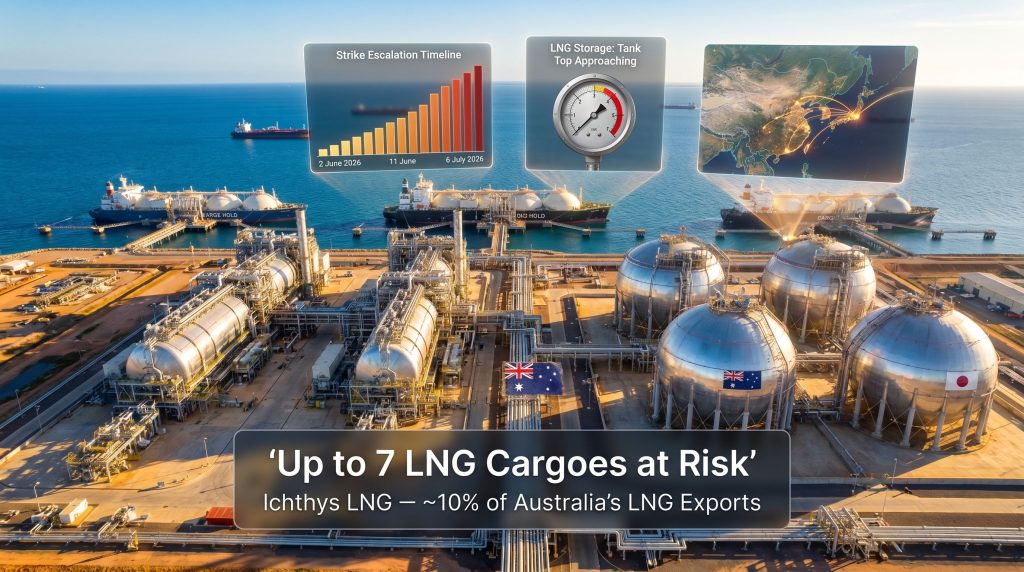
| 11 June 2026 | Stoppages escalate to 8 hours per day |
| 12-13 June 2026 | Fair Work Commission hearing convened |
| 13 June 2026 | FWC dismisses Inpex's application to halt the strike |
| 23 June 2026 | Original planned end date for strike action |
| 24 June 2026 | Strike reverts to two four-hour blocks per day |
| 6 July 2026 | Extended strike deadline |
The transition from two-hour morning and evening stoppages to two four-hour blocks from 24 June is a critical escalation detail that receives insufficient attention. The shift in timing and duration is not merely symbolic. Four-hour continuous stoppages create far greater operational disruption than two shorter interruptions, particularly for a facility managing continuous upstream gas flows from offshore wells. Reports from the Offshore Alliance confirm that workers were prepared to escalate further if negotiations stalled.
The Tank Top Problem: Why LNG Strikes Are Different
Most industrial disputes affect production rates or dispatch schedules. An LNG strike affecting a loading ban operates differently, and understanding the specific technical dynamics here is essential for appreciating the severity of the risk.
Critical Technical Risk: Inpex disclosed during the Fair Work Commission hearing that Ichthys's LNG storage tanks were projected to reach full capacity, a condition known in the industry as a tank top, by midday on the Wednesday following the 13 June hearing. Condensate storage was expected to reach maximum capacity the following day.
The term tank top describes the point at which onshore cryogenic storage tanks holding liquefied natural gas at approximately minus 162 degrees Celsius reach their volumetric limit. Once this threshold is reached, there are only two options: continue loading ships to clear inventory, or slow upstream production at the offshore platform.
Under the current loading ban, the first option is unavailable. The second option introduces its own risks that are not immediately obvious to observers outside the LNG sector:
- Offshore gas wells and processing trains are not designed for frequent start-stop cycling. Slowing production creates pressure management challenges across the entire upstream system.
- Maintenance and repair work cannot be conducted under the work bans in place during the strike period. This removes the usual safety valve that engineers use to manage equipment stress during non-standard operating conditions.
- If technical complications from reduced production rates trigger a forced facility shutdown, the restart sequence for an LNG plant of Ichthys's complexity typically takes days to weeks, not hours. The disruption extends far beyond the formal strike period.
This is the specific mechanism through which a labour dispute transitions from a cargo scheduling problem into an extended supply outage. Furthermore, escalating strike action at Australian LNG sites more broadly has drawn renewed scrutiny from energy security analysts tracking regional supply risks.
Fair Work Commission: The Legal Architecture of the Dispute
Inpex's application to the Fair Work Commission sought to have the protected industrial action suspended or terminated on national interest grounds. The FWC serves as Australia's primary industrial relations tribunal with the authority to intervene in protected action under specific provisions, but the threshold for doing so on national interest grounds is deliberately high.
The dismissal of Inpex's application was legally significant for two reasons. First, it validated the Offshore Alliance's right to continue and escalate protected action. Second, it effectively shifted negotiating leverage toward workers at precisely the moment when storage constraints were intensifying operational pressure on the operator.
The Offshore Alliance publicly attributed the strike's extension to Inpex's failure to meet deadlines agreed during earlier FWC proceedings, specifically around locking in employment commitments for its members. This framing positions the extended action not as aggression but as a response to perceived bad faith in the negotiation process, a distinction that carries weight in how Australian industrial relations law evaluates ongoing disputes.
Cargo Exposure: Quantifying What Is at Stake
Evidence presented before the Fair Work Commission provided rare public visibility into the specific commercial consequences of the loading ban.
| Period | Cargoes at Risk | Primary Risk Driver |
|---|---|---|
| Initial strike period | 4 LNG cargoes | Loading ban on all hydrocarbons |
| Through to 2 July 2026 | 3 additional cargoes | Extended industrial action |
| Total exposure | Up to 7 LNG cargoes | Compounding storage and loading constraints |
Each LNG cargo from a facility of Ichthys's scale typically represents approximately 60,000 to 70,000 tonnes of LNG, though vessel sizes vary. Seven cargoes therefore represents a meaningful volumetric shortfall for customers who cannot simply source replacement supply on short notice at competitive spot prices.
The next major ASX story will hit our subscribers first
The Global Market Context That Makes This Worse
Under ordinary market conditions, a temporary disruption affecting roughly 10% of one major exporter's output would be partially absorbed through spot market reallocation. Traders would identify alternative cargoes, prices would adjust modestly, and the system would rebalance within a few weeks.
However, the Ichthys LNG strike in Australia is not unfolding under ordinary conditions. Global LNG markets entered 2026 already operating with compressed buffer capacity following months of disruption tied to the Iran conflict and the closure of the Strait of Hormuz, a waterway critical to global energy trade. The dispute consequently compounds existing gas price pressures that were already straining buyers across multiple regions. While a preliminary ceasefire agreement briefly pushed energy prices lower on 15 June 2026, the structural supply tightness that months of disruption created cannot be resolved in days.
In this context, Asian importers face a more difficult substitution problem than the headline numbers suggest. Spot market alternatives exist, but at prices that reflect the same tightness that makes Ichthys's disruption consequential in the first place.
Three Scenarios for Resolution
Scenario A: Negotiated Settlement Before 6 July
Resolution probability is moderate. If Inpex agrees to binding job security commitments before the extended deadline, the strike ends, delayed cargoes are rescheduled, and market impact remains contained. Spot price pressure stabilises within days of resumed loading operations.
Scenario B: Strike Runs to the Full 6 July Deadline
This outcome carries moderate-to-high probability given the FWC dismissal and the Offshore Alliance's stated rationale for the extension. Up to seven cargoes would be affected. Storage constraints force production management decisions that elevate technical risk. Asian spot prices face meaningful upward pressure, potentially triggering cargo diversions from other suppliers to Japan and Taiwan.
Scenario C: Forced Production Shutdown
The probability here is lower but not negligible, particularly if tank top conditions materialise as disclosed during FWC proceedings. A forced shutdown would extend the disruption timeline from weeks to potentially longer, depending on the nature of any technical issues encountered during reduced operation. The price impact across Northeast Asian spot markets would be severe relative to current conditions.
What This Means for LNG Market Participants
For Asian LNG importers, the immediate priority is assessing contract flexibility provisions and evaluating emergency procurement options while spot markets retain some liquidity. The Ichthys dispute also reinforces a longer-term strategic argument for supply portfolio diversification across multiple exporting nations and geographies.
For LNG operators across Australia, the Ichthys LNG strike in Australia should function as a clear signal that workforce relations represent a first-order supply continuity risk, not a secondary human resources matter. The sector-wide coordination demonstrated by the Offshore Alliance, combined with the technical leverage that offshore production workers hold over facilities with limited storage flexibility, creates conditions where unresolved industrial tension can rapidly translate into material commercial damage. Consequently, Australia's energy export challenges extend well beyond infrastructure and logistics into the domain of industrial relations.
For policymakers, the FWC's decision not to invoke national interest provisions raises substantive questions about where the threshold sits between protecting workers' legal rights to industrial action and safeguarding energy export commitments that underpin Australia's relationships with key trading partners in Asia. Furthermore, these disputes feed into broader debates about energy geopolitics and the reliability of supply chains that importing nations depend upon. These are not simple questions, but they are ones that the Ichthys dispute has placed firmly back on the policy agenda.
Frequently Asked Questions: Ichthys LNG Strike in Australia
What is the Ichthys LNG facility and who operates it?
Ichthys LNG is a major liquefied natural gas production and export facility in northern Australia, operated by Japan's Inpex. It produces approximately 9.3 million tonnes per year and supplies LNG primarily to customers in Japan, Taiwan, and other Northeast Asian markets. Its global energy importance to Northeast Asian buyers cannot be understated.
Why did the Offshore Alliance extend the strike to 6 July 2026?
The Offshore Alliance extended the action after the Fair Work Commission dismissed Inpex's application to halt the strike. The alliance cited Inpex's failure to meet previously agreed FWC deadlines on employment security commitments as the direct reason for the extension.
What is a tank top and why does it matter at Ichthys?
A tank top occurs when onshore LNG storage reaches maximum capacity. Once this happens, operators must either load ships to clear inventory or slow upstream production. With a loading ban in place, the latter becomes the only option, introducing technical risks that could trigger a facility shutdown.
How many LNG cargoes are at risk from this dispute?
Evidence presented during FWC proceedings indicated four cargoes were at risk during the initial strike period, with three additional cargoes scheduled through to 2 July 2026, bringing the total potential exposure to seven LNG shipments.
What share of Australian LNG does Ichthys represent?
Ichthys accounts for approximately 10% of Australia's LNG export volume. Given Australia's position as the world's second-largest LNG exporter, this represents a structurally significant portion of supply to Asian customers.
Could the broader global energy situation worsen the impact?
Yes. Global LNG supply buffers are already compressed following disruption linked to the Iran conflict and Strait of Hormuz closure. This reduces the market's normal capacity to absorb single-facility outages through spot reallocation, amplifying the commercial impact of the Ichthys LNG strike in Australia on Asian buyers.
Key Facts at a Glance
| Dimension | Detail |
|---|---|
| Facility capacity | ~9.3 million tonnes per year |
| Ichthys share of Australian LNG exports | ~10% |
| Australia's global LNG rank | 2nd largest exporter (behind the US) |
| Strike commencement | 2 June 2026 |
| Escalation to 8-hour stoppages | 11 June 2026 |
| FWC hearing outcome | Application dismissed; action upheld |
| Extended strike deadline | 6 July 2026 |
| Total cargoes at risk | Up to 7 LNG shipments |
| Tank top risk timeline | Projected mid-week following 13 June hearing |
| Market backdrop | Compressed global LNG supply post-Strait of Hormuz disruption |
This article reflects information available as of 15 June 2026 and incorporates publicly disclosed evidence from Fair Work Commission proceedings. Scenario projections represent analytical assessments of possible outcomes and should not be interpreted as predictions of specific market movements or operational outcomes. Energy market conditions and negotiating positions may change rapidly.
Want to Stay Ahead of the Next Major Resource Discovery Amid Global Supply Disruptions?
As energy market volatility continues to reshape commodity investment landscapes, Discovery Alert's proprietary Discovery IQ model delivers real-time ASX mineral discovery alerts, transforming complex resource data into actionable investment insights for both short-term traders and long-term investors — explore historic discoveries and their remarkable returns to understand the opportunity, then begin your 14-day free trial to position yourself ahead of the broader market.