June 15, 2026
The Asymmetry at the Heart of European Sanctions Policy
When policymakers design commodity sanctions, the instinct is typically to target the most visible and tradeable end product. Aluminium ingots are tangible, trackable, and easy to identify on a trade manifest. Alumina, the white powder that sits one industrial step upstream, is less visible politically, yet every tonne of primary aluminium ever smelted began its life as alumina. This upstream blind spot has become one of the most contested fault lines in the EU's current Russia sanctions architecture, and Ireland now sits directly at its centre.
The broader strategic materials debate across Europe has shifted considerably since 2022. What began as a relatively straightforward set of import bans on Russian commodities has evolved into a far more complex exercise in supply chain accountability, where the legal permissibility of a trade and its geopolitical consequences can point in entirely different directions. Nowhere is this tension more exposed than in the debate over Ireland EU alumina sanctions on Russia and the operations of Europe's largest alumina refinery in County Limerick.
When big ASX news breaks, our subscribers know first
Understanding the Alumina-Aluminium Policy Gap
The chemical and commercial distinction between alumina and aluminium is straightforward in a laboratory but enormously consequential in a sanctions context. Alumina, or aluminium oxide, is produced by refining bauxite ore through the Bayer process, generating a fine white powder that serves as the exclusive feedstock for aluminium smelting via electrolysis. Without a continuous supply of alumina, no primary aluminium smelter can function.
Current EU sanctions prohibit the importation of Russian-origin primary aluminium into European markets. What those sanctions do not address is the reverse flow: European-produced alumina travelling eastward into Russian smelting facilities. This creates a commercially legal trade corridor that critics describe as a fundamental gap in sanctions design, one that effectively allows European refinery output to sustain the very industrial capacity that produces the metal Europe has chosen to restrict.
Furthermore, the European critical minerals supply chain context makes this gap even more consequential, as alumina sits at the intersection of both strategic materials policy and geopolitical enforcement.
The core policy concern is not simply the legality of the trade. It is whether European alumina is extending the productive lifespan of Russian industrial infrastructure with documented connections to sanctioned entities, including those linked to military procurement chains.
The table below illustrates the current sanctions asymmetry across the aluminium value chain:
| Material | Position in Value Chain | Current EU Sanctions Status |
|---|---|---|
| Bauxite | Raw ore extraction | Unrestricted |
| Alumina | Refined intermediate powder | Not currently restricted for export to Russia |
| Primary Aluminium | Smelted metal product | Russian imports banned under EU sanctions |
| Fabricated Products | Rolled, extruded, cast | Varies by product classification |
Aughinish Alumina: Europe's Largest Refinery Under Scrutiny
The Aughinish Alumina facility in Limerick holds a structurally significant position in European industrial geography. As the largest alumina refinery on the continent by processing capacity, it occupies a role that extends well beyond its immediate economic footprint in the Irish midwest. Its ownership structure, with ties to Rusal, Russia's dominant aluminium producer, has brought it under sustained scrutiny since geopolitical tensions escalated following Russia's actions in Ukraine.
Investigative reporting and parliamentary inquiries since 2023 have raised concerns about the direction of the facility's export volumes, with allegations that Irish alumina exports have been flowing toward Russian smelting operations. What makes this particularly sensitive from a policy standpoint is the alleged downstream pathway of that material.
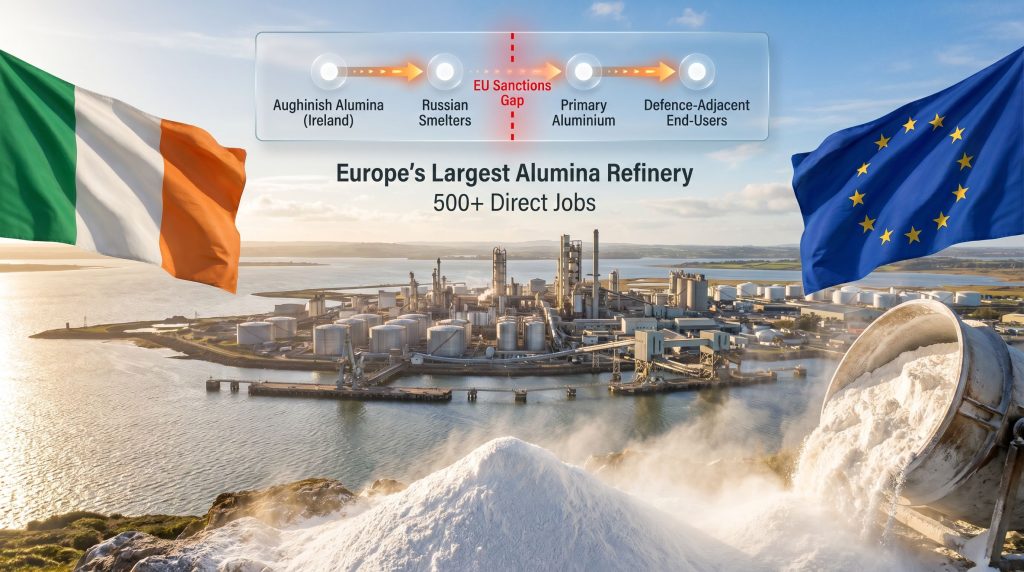
The alleged supply chain sequence under investigation runs as follows:
- Aughinish refinery produces alumina from imported bauxite in Limerick, Ireland
- Alumina is exported under commercially standard arrangements to Russian smelting facilities
- Those smelters, linked to the Rusal corporate network, convert alumina into primary aluminium
- The aluminium produced enters Russian domestic and industrial markets
- A portion of end-user demand allegedly includes entities already subject to existing EU sanctions, including those with connections to Russian defence procurement
Aughinish Alumina has maintained publicly that its entire operation functions in full compliance with applicable EU law, including sanctions regimes, export control frameworks, and trade regulations. The company's position is legally defensible under current rules precisely because alumina is not yet a sanctioned export commodity. The political debate is therefore centred on whether the existing legal framework is adequate, not on whether the company is in breach of it.
Is the Current Legal Framework Fit for Purpose?
The OCCRP has reported extensively on pressure mounting against the EU to close what investigators describe as an Irish alumina loophole, particularly given alleged links to Russian arms networks. However, the absence of an explicit prohibition on alumina exports means that enforcement agencies are constrained by the boundaries of existing legislation rather than its intended purpose.
Ireland's Political Response: Conditional but Shifting
Ireland's Minister of State Seán Canney has provided the clearest indication yet of where the Irish government stands. His position represents a measurable shift from earlier, more guarded official statements. Canney has indicated that Ireland would support EU-level sanctions on alumina exports to Russia, but conditioned that support on the outcome of an active Department of Enterprise investigation. He specified a two-week review timeline and emphasised that credible, substantiated evidence of military-industrial end-use would be required before Ireland formally backs the measure.
His framing of the issue was notable for its directness: he made clear that no one in the Irish government was avoiding responsibility, and that if sanctions become necessary, they will be pursued. That conditional clarity distinguishes his statements from the more cautious diplomatic language that characterised earlier official communications on the subject.
The economic complexity of the situation cannot be overstated. More than 500 direct jobs at the Limerick refinery are directly tied to its operational continuity, and policymakers have flagged the potential for downstream disruption to European industrial supply chains if sanctions alter the refinery's trade patterns without managed transition arrangements.
Tánaiste and Finance Minister Simon Harris has reinforced the seriousness of the situation, stating that the most recent investigative findings are not something that can be set aside or treated as inconclusive without further examination. Harris has indicated that any formal sanctions action would most likely be coordinated at the EU level, following the conclusion of the domestic investigation process.
The timing is politically acute. Ireland's upcoming presidency of the EU Council means that how Dublin handles this controversy will be scrutinised not just domestically, but across European capitals watching for signs of whether smaller member states can reconcile concentrated economic interests with collective foreign policy commitments.
Parliamentary Voices: Urgency, Employment, and Alternative Markets
The Irish parliamentary debate has produced a range of positions that collectively reflect the genuine complexity of the issue. Across party lines, there is broad agreement that Ireland cannot be seen as an indirect enabler of Russian military capability. The disagreement lies in the pace, mechanism, and accompanying safeguards of any policy response.
Social Democrats TD Sinéad Gibney has argued that the review process must be completed without delay, warning that extended timelines erode Ireland's credibility as a constructive EU member during an active geopolitical conflict. Her core concern is reputational: that prolonged deliberation signals ambivalence rather than principled engagement.
Sinn Féin TD Matt Carthy has taken a dual-track approach that combines a firm position against indirect military support with a pragmatic focus on employment protection. Carthy has questioned whether the Irish government has actively engaged with Aughinish Alumina's management to identify alternative export markets. His framing of alumina as a premium product in global demand reflects a genuine commercial reality: alumina of refinery-grade quality commands buyers across multiple geographies, and the question of whether those buyers have been approached is a legitimate policy question.
| Politician | Party | Core Policy Position |
|---|---|---|
| Seán Canney | Independent (Minister of State) | Backs sanctions if hard evidence confirmed by Department of Enterprise |
| Simon Harris | Fine Gael (Tánaiste/Finance) | Findings are serious; EU-level action the preferred mechanism |
| Sinéad Gibney | Social Democrats | Faster review timeline essential for credibility |
| Matt Carthy | Sinn Féin | Oppose indirect military support; pursue alternative market diversification |
The EU Unanimity Problem: Why Ireland's Position Is Structurally Decisive
One of the least discussed but most consequential aspects of this debate is the procedural architecture of EU sanctions decision-making. EU sanctions require unanimous agreement across all 27 member states. This is not a technicality. It means that a single member state holding an objection can prevent a sanctions measure from proceeding regardless of how many other countries support it.
Ireland's position is therefore not merely politically significant. It is structurally determinative. As the host country of Europe's largest alumina refinery, with a domestic political environment shaped by the employment stakes involved, Ireland holds what amounts to a functional veto over any EU decision to sanction alumina exports to Russia. Estonia and Belgium have both pushed actively for the measure, but neither country's advocacy can substitute for Irish consent.
This dynamic illustrates a broader tension in EU sanctions architecture. The unanimity requirement distributes leverage unevenly, concentrating effective veto power in member states with the greatest economic exposure to the targeted trade. Countries with diffuse or minimal economic interests in a sanctioned commodity face a very different political calculus than those with major industrial facilities at stake. Politico has reported on how EU foreign policy chief Kaja Kallas has been pressing on metals and oil sanctions, with Ireland's position emerging as a focal point in those broader discussions.
The next major ASX story will hit our subscribers first
What Would Sanctions Actually Mean for European Supply Chains?
The commercial consequences of EU alumina sanctions would extend beyond Aughinish Alumina itself. Europe's alumina refining capacity is not abundant, and the continent relies on a combination of domestic production and imports from major bauxite-producing regions including Australia, Guinea, and Brazil to meet its smelting needs. Any mandatory redirection of Aughinish's Russian-bound export volumes would require the facility to either:
- Secure new long-term offtake agreements with European or third-country aluminium smelters
- Accept a managed reduction in production volumes during a transition period
- Explore tolling or processing arrangements with buyers in markets outside Russia
The broader EU aluminium sector already operates under structural pressure from elevated energy costs, particularly following the 2022 European energy crisis, which forced the curtailment of significant smelting capacity across the continent. Adding supply-side complexity at the alumina level during this period would introduce additional strain into an already constrained value chain.
Aluminium is classified under the critical raw materials supply framework under EU strategic autonomy provisions, and the upstream alumina supply chain therefore carries implications that reach into industrial policy, defence supply chains, and green transition manufacturing, where aluminium demand is expected to grow substantially through the end of the decade.
The ripple effects on global commodity markets should not be underestimated either, as any significant disruption to European alumina flows would likely prompt immediate price adjustments across trading hubs in London, Chicago, and Singapore.
Disclaimer: Scenario projections and supply chain impact assessments presented here are analytical in nature and do not constitute investment advice or policy recommendations. Actual outcomes will depend on regulatory, commercial, and geopolitical developments that remain uncertain.
Three Scenarios for the Road Ahead
Scenario 1: Evidence Confirmed, Sanctions Proceed
The Department of Enterprise investigation concludes with substantive findings linking Irish alumina exports to Russian military-adjacent supply chains. Ireland formally endorses the EU measure. The Council achieves unanimity, and alumina is added to the sanctions package. Aughinish Alumina undergoes a managed commercial transition toward alternative markets, with government engagement to protect employment during the adjustment period.
Scenario 2: Inconclusive Evidence, Status Quo Maintained
The investigation does not produce evidence meeting Ireland's stated threshold. Dublin declines to support sanctions. EU unanimity is not achieved. Political pressure from Estonia, Belgium, and the European Parliament continues, and the issue of Ireland EU alumina sanctions on Russia becomes a recurring point of friction in EU foreign policy discussions without reaching resolution.
Scenario 3: Voluntary Market Diversification as a Diplomatic Off-Ramp
The Irish government brokers a voluntary commercial arrangement with Aughinish Alumina's management, facilitating a gradual redirection of Russian-bound volumes toward European or third-country buyers. The trade corridor closes through commercial means without requiring a formal sanctions vote. Ireland consequently avoids a politically divisive EU Council decision while achieving the substantive objective of ending the Russia alumina trade.
What This Debate Reveals About Sanctions Design
The Ireland-Russia alumina case is instructive well beyond its immediate subject matter. It exposes a recurring structural challenge in commodity sanctions: regimes that target finished products without addressing their upstream precursors create arbitrage opportunities that are commercially exploitable while remaining fully legally compliant. The gap between intent and effect in sanctions policy is often most visible at the boundary between processed intermediate materials and the finished goods they enable.
Several systemic lessons emerge from this debate:
- Sanctions targeting finished metal products should be accompanied by upstream precursor assessments to identify foreseeable circumvention pathways
- The unanimity requirement in EU sanctions creates structural leverage asymmetries that concentrate effective veto power in economically exposed member states
- Critical materials classifications, while valuable for strategic planning, do not automatically translate into streamlined policy responses when economic and geopolitical interests conflict at the national level
- Employment-anchored industrial facilities present unique political obstacles to sanctions enforcement, particularly when alternative market arrangements have not been pre-positioned
The question of Ireland EU alumina sanctions on Russia is unlikely to be resolved quickly. The interplay between domestic Irish politics, EU Council dynamics, investigative timelines, and the commercial realities facing a major industrial employer creates conditions where any outcome will involve significant trade-offs. What is clear is that the current legal gap, whatever its origins, now sits uncomfortably at the intersection of European foreign policy commitments and the continent's own critical materials security. Resolving that contradiction will require more than a two-week review, regardless of what the evidence shows.
Want to Stay Ahead of the Commodity Market Shifts Driving Investment Opportunities?
The geopolitical tensions reshaping critical materials supply chains — from alumina to aluminium and beyond — create exactly the kind of market-moving conditions where Discovery Alert's proprietary Discovery IQ model delivers real-time alerts on significant ASX mineral discoveries, turning complex commodity developments into actionable investment insights. Explore historic examples of major discoveries and their market returns, then begin your 14-day free trial at Discovery Alert to position yourself ahead of the next significant market opportunity.