
June 10, 2026
The Hidden Architecture of Mining Safety: Why Most Fatalities Happen Despite Working Controls
Across the global mining industry, a troubling pattern has persisted for decades. Companies invest heavily in safety technology, training programs, and compliance infrastructure, yet catastrophic incidents continue to occur with disturbing regularity. The paradox is not one of ignorance or negligence — it is one of structural mismatch between the controls that exist on paper and the controls that actually prevent people from dying. Understanding the ICMM critical control management guide is central to resolving this disconnect.
This gap is precisely what the ICMM Critical Control Management Good Practice Guide was designed to close. And with the release of its comprehensively revised 2026 edition, the International Council on Mining and Metals (ICMM) has made its most significant attempt yet to transform how mining organisations worldwide identify, implement, and verify the specific controls that stand between hazardous conditions and fatal outcomes.
When big ASX news breaks, our subscribers know first
What Makes a Control "Critical" and Why the Distinction Saves Lives
Most mining operations maintain extensive inventories of safety controls. The critical insight embedded in the CCM framework is that not all of these controls carry equal weight. The vast majority reduce risk in a general sense, lowering the probability or severity of an unwanted outcome. However, a much smaller subset are categorically different: their failure or absence does not merely elevate risk — it creates a direct and near-inevitable pathway to a catastrophic event.
This distinction between a standard safety measure and a critical control is the intellectual foundation of the entire CCM system. For those new to this space, a mining basics guide can help contextualise where CCM fits within the broader operational landscape.
The Five Attributes That Define a True Critical Control
For a control to qualify as critical under the ICMM framework, it must satisfy a specific set of foundational criteria:
- It directly prevents or mitigates a Material Unwanted Event (MUE), not merely a contributing hazard
- Its absence or failure would on its own materially increase the likelihood of an MUE occurring
- It is verifiable — its performance can be measured, tested, and reported against defined standards
- It requires named ownership at both operational and management levels
- It is distinct and specific enough to be managed as an individual system element, not bundled within a broader program
A control that merely reduces risk when working is not the same as a control whose failure directly produces catastrophe. Only the latter qualifies as critical — and only critical controls deserve the intensive verification resources the CCM framework demands.
Material Unwanted Events: The Anchor Points of the Whole System
Material Unwanted Events function as the organising reference points around which the entire CCM process is structured. An MUE is not just any negative outcome — it represents a defined, high-consequence event category that a mining operation has identified as carrying the potential for fatality, severe injury, or irreversible environmental damage.
Common MUE categories applied across global mining operations include:
- Underground fire and explosion events
- Uncontrolled ground fall and slope instability
- Water or material inrush and flooding
- Collisions involving mobile equipment and personnel
- Loss of containment in explosives handling and storage
- Structural failure or overtopping at tailings storage facilities
The criticality of any individual control is therefore relative to a specific MUE. A roof bolting program that is critical for preventing ground fall in an underground operation may have no relevance to the tailings facility integrity MUE at the same site. This context-dependency is one of the most frequently misunderstood aspects of the CCM approach.
How Bowtie Analysis Maps the Path From Hazard to Catastrophe
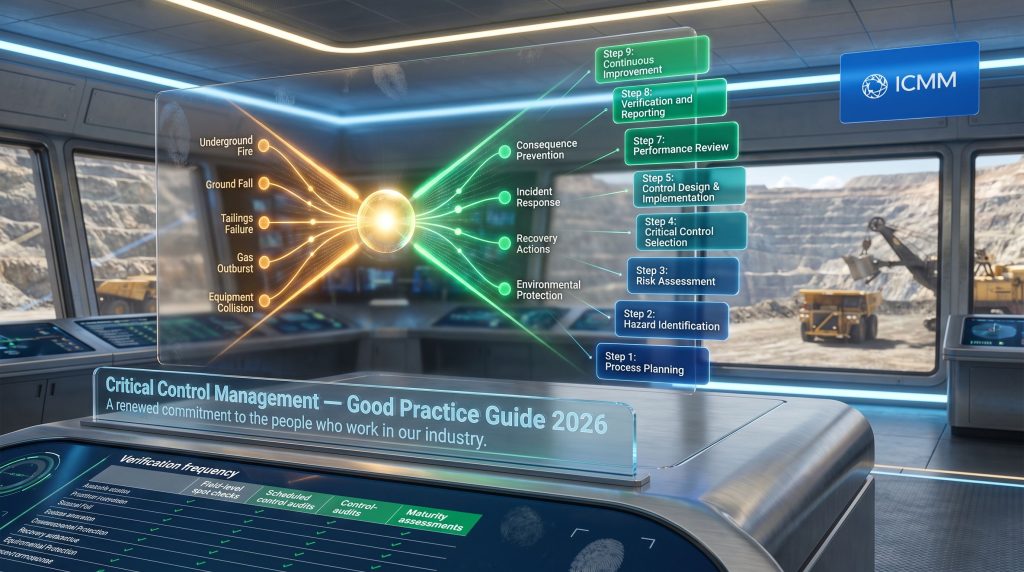
The ICMM CCM framework uses bowtie diagram methodology as its primary visual tool for mapping relationships between hazard sources, critical controls, and downstream consequences. The bowtie model places the MUE at the centre, with threatening conditions and escalation pathways mapped on the left side, and potential consequences cascading outward on the right.
Critical controls appear as barriers at specific points along these pathways. A barrier on the left side of the bowtie prevents a threat from escalating into the MUE. A barrier on the right side limits the severity of consequences once an MUE has occurred.
This structure makes something important visible: a site can have many controls across its full bowtie but only a small number of them are critical. Furthermore, the bowtie approach forces organisations to identify which specific barriers are carrying the most protective load and therefore require the most rigorous verification. The ICMM's critical control management resources offer additional technical guidance on applying bowtie methodology in practice.
Inside the Nine-Step CCM Process
The 2026 ICMM critical control management guide structures its implementation approach around a nine-step process organised across three phases: planning, implementation, and continuous feedback. Each step has a defined primary objective and produces a specific deliverable.
| CCM Step | Phase | Primary Objective | Core Deliverable |
|---|---|---|---|
| Step 1: Process Planning | Planning | Define scope, roles, and timelines | Documented project charter |
| Step 2: MUE Identification | Planning | Prioritise highest-consequence hazards | Ranked MUE register |
| Step 3: Control Inventory | Planning | Map all existing and potential controls | Comprehensive control library |
| Step 4: Critical Control Selection | Planning | Isolate the critical few from the many | Verified critical control list |
| Step 5: Performance Definition | Implementation | Set measurable effectiveness standards | Control performance criteria |
| Step 6: Accountability Assignment | Implementation | Assign ownership at all levels | Named accountability matrix |
| Step 7: Site-Specific Integration | Implementation | Adapt controls to local conditions | Site implementation plan |
| Step 8: Verification and Reporting | Feedback | Monitor and communicate control health | Performance reporting dashboard |
| Step 9: Response to Underperformance | Feedback | Investigate failures and drive improvement | Corrective action register |
Building the Planning Foundation: Steps 1 Through 4
The first four steps are entirely concerned with getting the intellectual architecture right before any implementation activity begins. Step 2, MUE identification, is arguably the most consequential of the nine: if a site fails to correctly identify or rank its highest-consequence hazard categories, every subsequent step is built on a flawed foundation.
Step 4, critical control selection, is where the framework's core discipline is exercised. Out of a potentially large library of controls documented in Step 3, the organisation must apply rigorous criteria to identify the small number that are genuinely critical. This filtering process is where most implementation failures begin — either by including too many controls (diluting verification resources) or too few (leaving material gaps).
Translating Principles Into Operations: Steps 5 Through 7
Steps 5 through 7 move from design to deployment. Step 5 requires organisations to define, in measurable terms, what a functioning critical control actually looks like. A control that cannot be assessed against defined performance criteria cannot be verified, and a control that cannot be verified cannot be managed.
Step 7's emphasis on site-specific integration reflects a core principle of the framework: prescriptive control lists don't work across diverse operating environments. What constitutes an effective ground-fall prevention system in a deep underground gold mine is structurally different from what works in a shallow open-pit copper operation. The framework provides methodology, not mandates.
Closing the Loop: Steps 8 and 9
Verification and corrective response are where many CCM programs historically break down. Step 8 requires not just data collection but meaningful communication of control health to the right people at the right levels of the organisation. Step 9 converts underperformance signals into structured action — ensuring that a verification failure triggers investigation rather than simply being logged and forgotten.
What's New in the 2026 Edition
The 2026 edition of the ICMM Critical Control Management Good Practice Guide represents a consolidation and substantial enhancement of two previously separate resources. The original Control Management Good Practice Guide and its accompanying Implementation Guidance documents, which had each operated as standalone references for over a decade, have been merged into a single unified publication.
Beyond consolidation, the revision incorporates more than ten years of member company feedback and real-world implementation experience from mining operations across diverse commodities and geographies. The practical implication is that many of the enhancements reflect actual failure modes encountered in the field, not theoretical improvements identified in review workshops.
Four Key Areas of Enhancement
| New or Enhanced Feature | Purpose | Who Benefits Most |
|---|---|---|
| Maturity evaluation tools | Benchmark CCM program development stage | HSE managers, site leadership |
| Operational readiness checks | Confirm pre-deployment control effectiveness | Site supervisors, operations teams |
| Enhanced accountability frameworks | Clarify ownership at every organisational tier | Board, executive, and operational levels |
| Expanded performance monitoring guidance | Improve real-time control health visibility | Safety professionals, auditors |
The addition of maturity evaluation tools is particularly significant. Prior to this edition, organisations had limited structured means to assess where their CCM program sat on a development continuum. Maturity assessments provide a standardised benchmark that allows leadership to make evidence-based decisions about resource allocation and improvement priorities.
Operational readiness checks, furthermore, address a specific failure mode: the deployment of a control that has been designed correctly but has not been adequately prepared or tested before it is relied upon in a live operating environment.
Governance, Leadership Accountability, and Organisational Structure
One of the most consequential themes running through the 2026 guide is its explicit treatment of leadership accountability as a non-negotiable prerequisite for CCM effectiveness, not a desirable cultural attribute. Earlier safety management frameworks often positioned leadership engagement as a supporting factor. The updated guide, however, elevates it to a structural requirement.
The framework distributes accountability across three distinct organisational levels:
- Board and executive level: Responsibility for setting CCM policy, resourcing implementation, and receiving performance reporting
- Management level: Accountability for MUE registers, critical control lists, verification programs, and corrective action follow-through
- Operational level: Responsibility for day-to-day control execution, field verification activities, and immediate escalation when controls show signs of failure
ICMM President and CEO Rohitesh Dhawan framed the 2026 edition as a renewed institutional commitment to the workers, families, and communities who depend on the mining industry, affirming that the knowledge and tools needed to eliminate mining fatalities are already within reach. (Canadian Mining Journal, April 28, 2026)
This framing carries weight beyond motivational language. It signals that ICMM regards the persistence of mining fatalities not as an unsolvable technical problem, but as an organisational execution challenge that improved governance and accountability structures can address. In addition, the broader mining industry evolution context helps explain why such governance reforms have become increasingly urgent at an industry-wide level.
The next major ASX story will hit our subscribers first
Documenting a Critical Control Record: A Step-by-Step Approach
For site-level practitioners, the practical challenge is translating framework principles into documented, auditable control records. The following sequence reflects the CCM guide's approach to creating a robust critical control record for a single MUE:
- Name the critical control precisely — generic labels like "safe work procedure" are insufficient; the control must be specific enough to be verified as a discrete entity
- Define the control objective in terms of the failure it prevents — what specific pathway from threat to MUE does this control interrupt?
- Establish measurable performance requirements — what does "this control is working" look like in operational terms that can be tested?
- List the supporting activities that sustain the control's function — maintenance schedules, inspection protocols, calibration requirements
- Design a verification protocol specifying who checks the control, by what method, and on what frequency
- Assign named ownership at both the operational level (who maintains it daily) and the management level (who is accountable for its sustained effectiveness)
- Set escalation triggers — define the specific threshold at which underperformance must be escalated to leadership rather than managed locally
Operational Warning: Resource allocation gaps and insufficient personnel training remain the two most consistently cited barriers to sustained critical control effectiveness across global mining operations. The 2026 guide directly targets both through its enhanced accountability structures and verification design requirements.
Verification: The Difference Between a Control That Exists and One That Works
Control existence and control effectiveness are fundamentally different states, and the gap between them has contributed to a significant proportion of catastrophic mining incidents. A roof bolting system can exist — be documented, resourced, and visible on site — while simultaneously failing to meet the performance standards required to prevent a ground collapse event.
The CCM framework addresses this through a structured, multi-tiered verification program:
| Verification Type | Frequency | Conducted By | Output |
|---|---|---|---|
| Field-level spot checks | Daily or shift-based | Frontline supervisors | Real-time status log |
| Scheduled control audits | Monthly or quarterly | HSE team or internal auditor | Formal audit report |
| Maturity assessments | Annual | Senior management or third party | Maturity score and gap analysis |
| Operational readiness reviews | Pre-commissioning or post-incident | Cross-functional team | Readiness certification |
The escalation protocols built into Step 9 are what convert verification data into safety improvement. Without predefined thresholds that trigger management response, verification programs tend to become documentation exercises rather than early warning systems. Consequently, responsible mining training programs that embed CCM verification principles into their curricula are increasingly valuable for developing workforce capability in this area.
How CCM Compares to Other Mining Safety Frameworks
A common question among safety professionals is how the CCM framework relates to existing management systems such as ISO 45001 or site-specific occupational health and safety programs.
The key distinctions are as follows:
- ISO 45001 provides a comprehensive system architecture for occupational health and safety management. It is broad by design, covering everything from hazard identification to emergency preparedness. CCM is narrowly focused on the subset of controls that prevent catastrophic events and is designed to function within a broader management system, not replace it.
- Site-specific OHS systems typically address the full spectrum of workplace hazards, including low-consequence risks. CCM introduces a deliberate triage function, ensuring that the most life-critical controls receive disproportionately more verification attention than lower-consequence controls.
- Bow-tie methodologies are complementary analytical tools that the CCM framework explicitly incorporates. They provide the visual and logical structure through which MUEs and control pathways are mapped.
Framework Distinction: Unlike compliance-based standards that mandate specific controls, the ICMM CCM guide operates on a principles-based model. It defines how to identify and manage critical controls without prescribing which controls every site must adopt — a deliberate design choice that preserves operational flexibility across highly diverse mining environments.
This principles-based approach reflects a key insight from implementation experience: the most effective critical controls at any given site are invariably those that have been designed with a deep understanding of local geology, equipment, workforce capability, and operational conditions. For a broader perspective on how these principles interact with environmental responsibility, the mine reclamation importance discussion offers useful complementary context.
The Strategic Case for Sustained CCM Adoption
The case for prioritising critical control management extends well beyond regulatory compliance or institutional membership requirements. Three converging drivers are making CCM capability an increasingly material factor in how mining operations are assessed.
The ethical and workforce dimension is perhaps the most straightforward. Persistent mining fatalities carry profound human costs that extend to families and communities far beyond the immediate incident. A framework that demonstrably reduces catastrophic incidents has a direct bearing on workforce trust, which in turn affects recruitment, retention, and operational productivity in an industry facing structural labour shortages.
The social licence dimension is becoming increasingly consequential. Communities that host mining operations are more organised, better informed, and more capable of imposing material consequences on operations they regard as unsafe or insufficiently governed. A credible, independently verifiable CCM program provides a structured basis for demonstrating safety performance to external stakeholders. The mining sustainability transformation underway across major producers further reinforces why governance frameworks like CCM are gaining strategic priority.
The regulatory trajectory across major mining jurisdictions continues to move in the direction of greater accountability at the leadership level for safety outcomes. Regulatory frameworks in Australia, Canada, and several other jurisdictions increasingly scrutinise whether organisations have identified their highest-consequence hazards, documented the controls that address them, and verified that those controls are functioning as intended. The CCM good practice guidance from industry safety experts aligns closely with what regulators in these jurisdictions are looking for.
Frequently Asked Questions: ICMM Critical Control Management Guide
What is the purpose of the ICMM Critical Control Management Good Practice Guide?
The guide provides a structured methodology for mining organisations to identify the specific controls that prevent their most catastrophic potential incidents, implement those controls with clear accountability, and verify their ongoing effectiveness through systematic monitoring.
What is a Material Unwanted Event in the context of mining safety?
An MUE is a defined, high-consequence event category — such as a ground collapse, tailings dam failure, or underground explosion — that a site has identified as carrying the potential for fatality or severe irreversible harm. MUEs serve as the reference anchor around which all critical controls are designed.
How many steps are in the ICMM CCM process?
The framework uses a nine-step process organised across three phases: planning (Steps 1 to 4), implementation (Steps 5 to 7), and continuous feedback and improvement (Steps 8 and 9).
What separates a critical control from a standard safety control?
A standard safety control reduces risk in a general sense. A critical control is one whose specific failure or absence creates a direct pathway to a Material Unwanted Event. The distinction determines where organisations concentrate their most intensive verification resources.
How does the 2026 edition differ from previous versions?
The 2026 edition consolidates two previously separate ICMM resources, incorporates over a decade of member implementation experience, introduces new maturity evaluation and operational readiness tools, and provides significantly enhanced guidance on governance, leadership accountability, and performance monitoring.
Is the CCM guide applicable across all mining commodities and geographies?
Yes. The principles-based design of the framework is deliberately non-prescriptive with respect to specific control requirements, making it applicable across underground and open-cut operations, all major commodities, and diverse regulatory and geographic environments.
Where can mining professionals access the 2026 CCM guide?
The updated guide is available directly through the ICMM website at icmm.com/en-gb/guidance/health-safety/2026/ccm-good-practice-guide.
This article is intended for informational purposes only. Details regarding the 2026 ICMM Critical Control Management Good Practice Guide are drawn from publicly available sources including Canadian Mining Journal (April 28, 2026) and ICMM's published guidance. Readers should consult the full guide and qualified safety professionals before implementing any changes to their occupational health and safety management systems.
Want to Stay Ahead of the Next Major ASX Mineral Discovery?
While robust safety frameworks like CCM protect the people behind mineral extraction, the investment opportunity begins the moment a significant discovery is announced — and timing is everything. Discovery Alert's proprietary Discovery IQ model delivers real-time alerts on significant ASX mineral discoveries, turning complex data across more than 30 commodities into clear, actionable insights for both traders and long-term investors. Explore historic discoveries and their exceptional returns to understand what's possible, then begin your 14-day free trial at Discovery Alert and position yourself ahead of the broader market.