June 17, 2026
The Architecture of a Supply Shock: Understanding the Hormuz Disruption
Global oil markets are engineered around assumptions of continuous flow. Decades of infrastructure investment, trade routes, and pricing mechanisms all operate on the premise that key transit arteries remain open. When one of those arteries closes abruptly, the entire system recalibrates in ways that extend far beyond the immediate shortage.
The Strait of Hormuz sits at the intersection of the Persian Gulf and the Gulf of Oman, a corridor barely 33 kilometres wide at its narrowest navigable point. Despite its modest geography, it carries the weight of the world's most concentrated energy dependency. Roughly 20% of global petroleum supply transits this passage daily, making it structurally irreplaceable in the short term.
No pipeline network, alternative tanker route, or emergency reserve system was designed to absorb its sudden disappearance. Furthermore, the crude oil price trends that had shaped market expectations for years were rendered immediately obsolete by the scale of what followed.
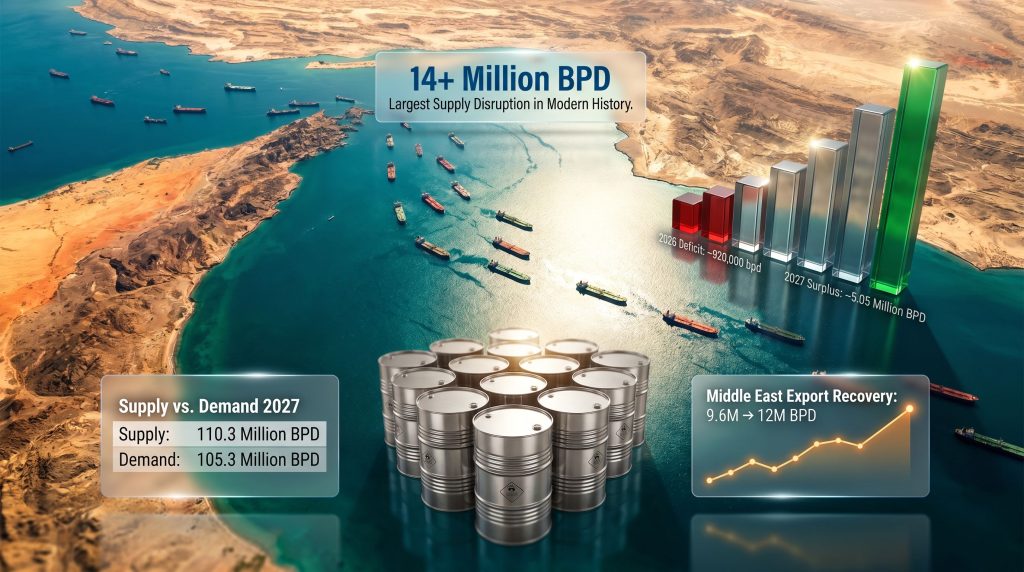
That disappearance, triggered by the conflict that began on 28 February 2026, removed more than 14 million barrels per day (bpd) of Middle Eastern oil output from global markets. To contextualise that figure properly, it represents approximately 14% of total global daily consumption. No prior event in the history of the modern oil era comes close to matching this scale.
When big ASX news breaks, our subscribers know first
Putting the Disruption in Historical Perspective
A comparison against prior supply crises reveals just how anomalous the 2026 Hormuz closure truly is:
| Disruption Event | Estimated Supply Loss | Duration | Market Recovery Time |
|---|---|---|---|
| 1973 Arab Oil Embargo | ~4 million bpd | ~5 months | 12–18 months |
| 1990 Gulf War | ~4.3 million bpd | ~7 months | 6–12 months |
| 2011 Libya Civil War | ~1.6 million bpd | ~8 months | 18+ months |
| 2026 Hormuz Closure | 14+ million bpd | Ongoing (as of mid-2026) | Gradual recovery projected |
The 1973 Arab oil embargo, long regarded as the defining supply shock of the twentieth century, removed roughly 4 million bpd from markets. The 2026 closure dwarfs that figure by a factor of more than three. Previous disruptions were typically the product of a single country's political decision or internal instability.
The Hormuz closure, however, simultaneously impacted multiple Gulf producers through a combination of active conflict, naval blockade, and infrastructure damage. Broader geopolitical trade tensions have further complicated any straightforward recovery pathway.
Crucially, unlike embargo-style disruptions where production capacity remains technically intact, the 2026 event involved physical destruction and prolonged access denial. That distinction matters enormously for recovery timelines and has shaped the IEA's cautious framing of the post-conflict rebalancing process.
The IEA 2027 Oil Surplus After Hormuz Recovery: What the Numbers Actually Say
Breaking Down the 2027 Supply-Demand Balance
The International Energy Agency's first formal projection for 2027 market conditions represents the agency's inaugural attempt to model what a post-conflict normalisation looks like in quantitative terms. The IEA Oil Market Report provides the headline figures, and they are striking:
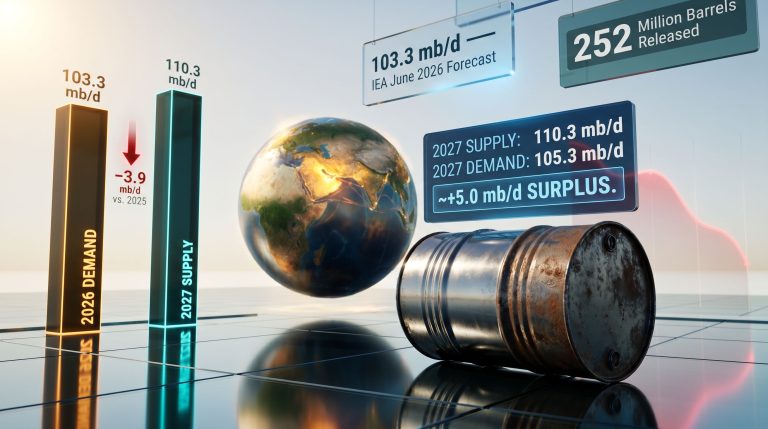
- Projected 2027 global oil supply: approximately 110.3 million bpd
- Projected 2027 global oil demand: approximately 105.3 million bpd
- Implied net surplus: approximately 5.05 million bpd
The IEA projects global oil supply to expand by approximately 8 million bpd in 2027, while demand growth is expected to contribute only 2 million bpd. That structural asymmetry is the defining feature of the IEA 2027 oil surplus after Hormuz recovery scenario, and it has significant implications for price formation, OPEC strategy, and energy security planning across importing nations.
A 5 million bpd surplus would rank among the largest supply overhangs in IEA analytical history. For reference, the 2014 to 2016 price collapse that drove Brent crude from above $110 per barrel to below $30 per barrel was underpinned by a surplus of only 1.5 to 2 million bpd. The arithmetic alone suggests the potential for substantial downward price pressure, though real-world outcomes will depend heavily on OPEC market influence and the pace of inventory rebuilding.
The 2026 Transition: From Deep Deficit to Near-Balance
Before any surplus materialises, markets must first navigate 2026's supply shortfall. The IEA projects a supply deficit of approximately 920,000 bpd across 2026 as a whole, a figure that represents meaningful improvement from the prior month's estimate of a 1.78 million bpd deficit. That narrowing trajectory reflects the early signs of Hormuz recovery already emerging in flow data.
Total oil supply is forecast to decline by 3.9 million bpd across 2026, as Middle Eastern production losses continue to outpace growth from non-OPEC producers in the Americas. The market is effectively moving through two distinct phases:
- A deep deficit phase in early 2026, driven by the acute shock of the Hormuz closure
- A narrowing deficit phase in the second half of 2026, as Gulf flows partially recover
- A surplus phase in 2027, as the full weight of returning Middle Eastern barrels overwhelms demand growth
How OPEC's Outlook Compares
The IEA and OPEC have arrived at meaningfully different conclusions about demand, with direct implications for how each organisation frames the surplus risk:
| Metric | IEA Projection | OPEC Projection |
|---|---|---|
| 2026 Demand Growth | -1.1 million bpd (contraction) | +970,000 bpd (modest growth) |
| 2027 Supply Surplus | ~5.05 million bpd | Not formally published |
| Key Divergence Driver | Demand destruction from conflict spillover | Assumes faster demand normalisation |
OPEC's more optimistic demand baseline implies a smaller eventual surplus, which matters for how the cartel calibrates any production response to returning Gulf barrels. If OPEC's demand assumptions prove closer to reality, the 2027 surplus could be meaningfully smaller than the IEA projects. If the IEA's demand destruction narrative is correct, the surplus overhang could be sustained for an extended period.
Recovery in Motion: How the Strait of Hormuz Is Reopening
Early Flow Data Signals a Partial Restoration
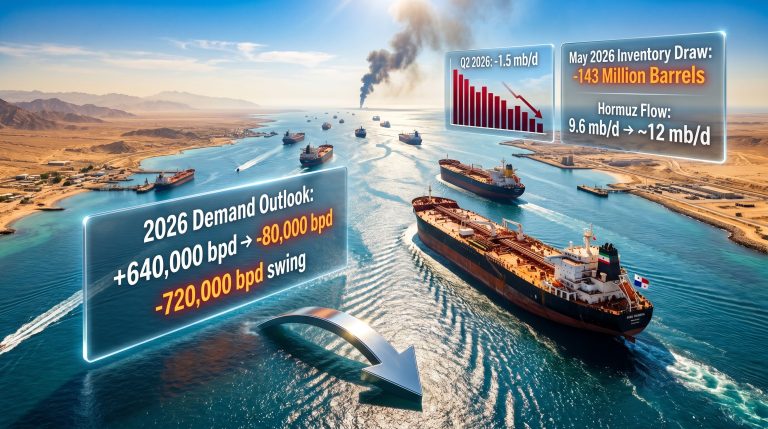
Concrete evidence of recovery was already accumulating by early June 2026. Ship-to-ship transfer activity in the Gulf of Oman accelerated, and total Middle East oil export flows climbed to approximately 12 million bpd in early June, recovering from a trough of 9.6 million bpd in May 2026. That 2.4 million bpd restoration represents real progress, but it still leaves the region far below pre-conflict throughput levels.
The mechanism driving this early recovery deserves attention. Ship-to-ship transfers in the Gulf of Oman represent a workaround that allows tankers to load cargo from vessels that have navigated partial route sections. This technique is operationally inefficient and more costly than direct port loading, but it provides a measurable bridge between closure and full transit restoration.
Operational Barriers That Could Delay Full Recovery
The IEA explicitly flags several constraints that introduce downside risk to the recovery timeline:
- Demining operations: Naval mining conducted during the conflict period requires systematic clearance before commercial tanker traffic can resume at full scale. Demining is a methodical, time-intensive process that cannot be accelerated beyond the technical limits of the equipment and personnel involved.
- Transit arrangements: Unresolved diplomatic and logistical frameworks governing vessel passage through the strait create ongoing uncertainty for shipping operators planning voyages.
- Infrastructure rehabilitation: Iranian export terminals, loading facilities, and pipeline networks may require significant repair work before pre-war export volumes are achievable.
- Sanctions sequencing: The interim US-Iran agreement includes provisions for lifting the naval blockade, but the conditionality and sequencing of sanctions relief will determine how quickly Iranian crude can re-enter global trade flows.
The IEA has been explicit that political and operational constraints, taken together, represent a credible downside risk to the Middle East recovery timeline that cannot be dismissed purely on the basis of the positive early flow data.
Iranian Crude: The Single Largest Incremental Supply Variable
Iranian crude exports were effectively zeroed out during the conflict period. Their full resumption represents the single largest discrete supply event embedded in the IEA's 2027 outlook. Once the US naval blockade is formally lifted, Iranian export volumes could recover relatively quickly given that the upstream production infrastructure was largely preserved during the conflict.
However, the IEA frames this recovery as gradual rather than instantaneous, reflecting the operational realities of restarting export logistics at scale. According to the IEA's analysis, normalisation of pre-conflict Gulf production and trade flows may not be fully achieved until late 2026 or early 2027, consistent with the agency's phased recovery framing.
Demand Destruction: Deeper and More Widespread Than Initially Modelled
The Scale of Demand Collapse in 2026
The demand side of the 2026 oil equation has deteriorated faster and more broadly than early estimates suggested. The IEA projects global oil demand will contract by 1.1 million bpd across 2026, with the sharpest single-quarter decline occurring in the April to June 2026 period, when consumption fell by an estimated 5 million bpd. That quarterly collapse is comparable in magnitude to the demand destruction experienced during COVID-19 in early 2020.
Critically, demand weakness has spread well beyond the regions most directly exposed to the conflict. In addition, the oil price trade war impact from concurrent geopolitical pressures has amplified the demand-side deterioration across virtually every global region, with gasoil identified by the IEA as experiencing the most pronounced deterioration.
Fuel Categories Under Greatest Pressure
- Gasoil and diesel: Industrial, logistics, and agricultural sectors are most acutely sensitive to fuel cost inflation. Gasoil demand weakness is visible across developed and emerging markets alike, reflecting the broad economic transmission of the energy price shock.
- Jet fuel: Aviation demand recovery has stalled as elevated fuel costs and economic uncertainty suppress both business and leisure travel. Airline margins, already compressed, are limiting route expansion.
- Gasoline: Consumer demand erosion is accelerating in price-sensitive emerging markets where fuel subsidies are proving fiscally unsustainable.
The Demand Recovery Feedback Loop
The IEA's 2027 demand recovery scenario rests on a self-reinforcing mechanism. As the supply surplus materialises and oil prices fall, lower energy input costs reduce inflationary pressure across manufacturing, logistics, and agriculture. This acts as a de facto economic stimulus, gradually restoring consumption growth that the 2026 price shock suppressed. The feedback loop between surplus-driven price declines and demand recovery is central to the constructive 2027 outlook.
The Inventory Crisis: How Deep Is the Drawdown?
Global oil inventories have been drawing down at an average rate of 3.8 million bpd since the conflict began on 28 February 2026. In May 2026 alone, preliminary IEA data indicates stock draws accelerated to approximately 4.6 million bpd.
A 4.6 million bpd monthly draw rate translates to roughly 138 million barrels of commercial stock depletion per month. At that pace, commercially available buffer stocks face exhaustion within a compressed timeframe, shrinking the window available for policy intervention.
The IEA warns that global oil inventories could fall to historic lows before the market balance tips into surplus, potentially in late 2026. This creates a sequencing risk: the period of maximum inventory vulnerability arrives before the surplus that would allow replenishment. The agency frames the anticipated IEA 2027 oil surplus after Hormuz recovery not merely as a market correction but as a strategic opportunity. A sustained supply overhang would enable governments to:
- Replenish strategic petroleum reserves drawn down during the 2026 crisis at cyclically depressed prices
- Build additional reserve capacity to improve resilience against future chokepoint disruptions
- Reassess national energy security frameworks in light of the demonstrated concentration risk of Hormuz-dependent supply chains
The next major ASX story will hit our subscribers first
Scenario Modelling: Three Possible 2027 Market Outcomes
Scenario 1: Orderly Surplus (Base Case)
Gulf exports recover gradually in line with IEA projections. OPEC+ maintains reasonable production discipline as surplus volumes accumulate. Prices stabilise in the $55 to $70 per barrel range. Inventory rebuild proceeds steadily, providing a meaningful buffer against future disruptions.
Scenario 2: Surplus Overshoot (Bear Case)
Iranian and Gulf exports recover faster than anticipated, and OPEC+ cohesion fractures under the pressure of returning barrels competing for market share. Prices fall below $50 per barrel, triggering significant capital destruction in high-cost production basins including deepwater, oil sands, and tight oil.
Scenario 3: Delayed Recovery (Upside Case)
Demining operations and infrastructure rehabilitation constraints extend the Hormuz recovery timeline into mid-2027. The surplus materialises later and is smaller than forecast. Prices hold above $75 per barrel, supporting continued investment in non-OPEC supply growth.
Russian Export Strategy in a Surplus Environment
Russian crude and refined product exports held relatively stable at approximately 7.4 million bpd in May 2026, despite ongoing Ukrainian drone attacks on refinery infrastructure. Those attacks forced a structural reallocation of Russian oil flows, prioritising domestic fuel supply whilst maximising crude export volumes to maintain hard currency revenues.
A 2027 surplus scenario creates a challenging pricing environment for Russian crude, which already trades at a discount to Brent due to sanctions-related marketing constraints. Consequently, a broader price decline driven by Gulf supply restoration would compress Russian export revenues at a time when fiscal pressure from the ongoing conflict remains acute.
The Longer Strategic Implication: Rethinking Chokepoint Dependency
The Hormuz disruption has stress-tested a structural vulnerability that energy security analysts had long identified but policymakers had largely treated as a theoretical concern. The concentration of roughly one-fifth of global oil supply through a single 33-kilometre corridor was always a systemic risk. The events of 2026 have converted that theoretical risk into a documented, quantified reality.
The energy security policy response is likely to encompass several dimensions:
- Strategic reserve expansion: Legislative and budgetary commitments to significantly larger strategic petroleum reserve holdings in major importing nations are probable outcomes of the 2026 experience.
- Supply diversification requirements: Formal diversification mandates may be imposed on national oil companies and major importers to reduce structural dependency on Hormuz-transiting supply.
- Accelerated deployment: Energy transition investment is gaining both economic and political momentum, as the price shock and supply insecurity of 2026 provide a compelling argument for accelerating renewable energy deployment and electrification to reduce structural oil import dependency over the medium term.
If the IEA 2027 oil surplus after Hormuz recovery materialises as projected, it will create a rare convergence of lower prices, rebuilding inventories, and policy bandwidth. Historically, those conditions have coincided with major reorientations in energy strategy. The window between the onset of surplus conditions and the next demand upcycle may well define the trajectory of global energy security policy for the decade that follows.
Disclaimer: This article contains forward-looking projections sourced from IEA and OPEC monthly market reports. These projections are subject to material revision based on geopolitical developments, infrastructure conditions, and macroeconomic outcomes. Nothing in this article constitutes financial or investment advice. Readers should conduct independent research before making any investment decisions.
Want to Stay Ahead of ASX Commodity Opportunities Shaped by Global Energy Shifts?
Major supply disruptions like the 2026 Hormuz closure ripple far beyond oil markets, creating downstream opportunities across ASX-listed mineral and energy explorers that reward investors who act quickly on quality information. Discovery Alert's proprietary Discovery IQ model delivers real-time alerts on significant ASX mineral discoveries the moment they are announced, transforming complex market data into actionable insights — explore historic discovery returns on Discovery Alert's dedicated discoveries page and begin your 14-day free trial to position yourself ahead of the broader market.