June 17, 2026
The IEA Oil Market Report: Understanding the Framework Behind the Forecast
The International Energy Agency's monthly Oil Market Report functions as one of the most closely watched demand and supply benchmarks in commodity markets worldwide. Published monthly, the OMR draws on preliminary consumption data, trade flow analysis, refinery throughput metrics, and macroeconomic modelling to generate near-term forecasts that directly influence OPEC+ production strategy, sovereign energy budgets, and institutional capital allocation.
Every major oil market disruption in modern history has eventually resolved into one of two outcomes: a controlled rebalancing managed through coordinated production discipline, or a disorderly price collapse driven by a flood of supply into a weakened demand environment. The global oil market in mid-2026 is navigating a path that could lead to either outcome, and the stakes for producers, consumers, and investors — particularly regarding the IEA oil demand forecast and 2027 surplus — could not be higher.
It is worth distinguishing the OMR from the IEA's longer-term publications. The Oil 2025 medium-term outlook models structural demand trajectories through the end of the decade. The OMR, by contrast, reflects rolling revisions based on current data, making it a more responsive but also more volatile signal of where the market is heading in the months immediately ahead.
The IEA's June 2026 OMR represents one of the most consequential single monthly reports in years, combining a deep downward revision to 2026 demand with the agency's inaugural projection for 2027, a year that could see one of the largest peacetime supply overhangs in modern oil market history.
When big ASX news breaks, our subscribers know first
What the IEA's June 2026 Demand Forecast Actually Shows
A Downward Revision With No Modern Peacetime Precedent
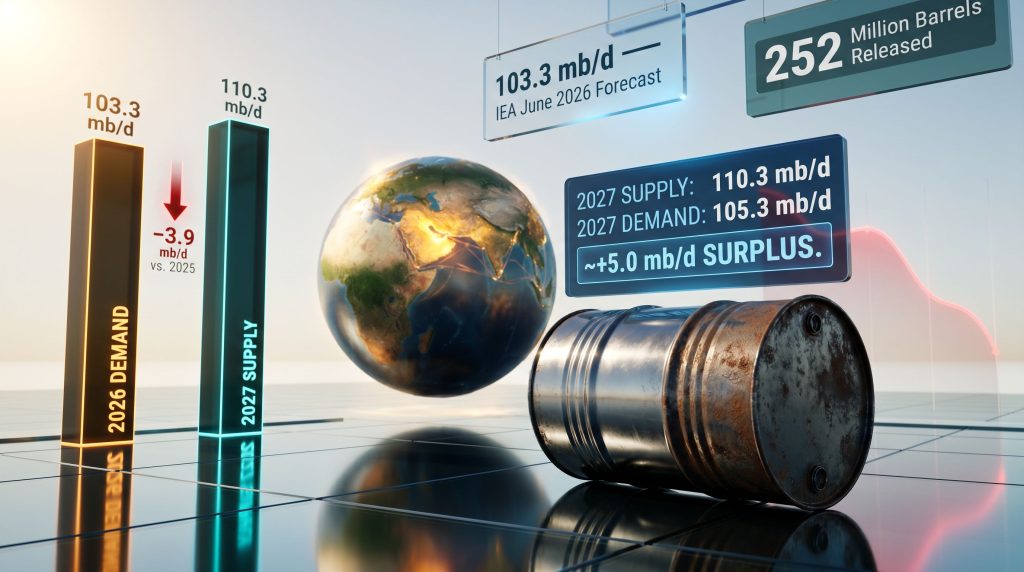
The IEA's June 2026 OMR revised full-year global oil demand down to 103.3 million barrels per day (mb/d), compared with the 104.0 mb/d projected in the prior month's report. That single-month revision of 700,000 b/d reflects not a gradual softening but a sharp reassessment driven by deteriorating data across virtually every major consumption category.
Compared with 2025 consumption levels, the 2026 forecast implies a year-on-year contraction of approximately 3.9 mb/d, a scale of demand destruction that has no peacetime precedent in the modern era of global oil markets. Furthermore, understanding the broader crude oil price trends helps contextualise just how unusual this revision cycle has become.
| Metric | Value |
|---|---|
| IEA 2026 Demand Forecast (June OMR) | 103.3 mb/d |
| IEA 2026 Demand Forecast (May OMR) | 104.0 mb/d |
| Month-on-Month Revision | -700,000 b/d |
| Year-on-Year Change vs. 2025 | -3.9 mb/d |
| Q2 2026 YoY Demand Change (Preliminary) | -5.0 mb/d |
| Last Comparable Quarterly Decline | Q2 2020 (COVID-19) |
The Broadening of Demand Weakness: From Sectoral to Systemic
What makes the IEA's June assessment particularly significant is the characterisation of where the demand weakness is occurring. Early in the disruption period, consumption declines were concentrated in specific sectors and geographies most directly exposed to the US-Iran conflict and the closure of the Strait of Hormuz. By June 2026, that pattern had shifted fundamentally.
The IEA found that fuel deliveries, particularly gasoil, were showing evidence of strain across almost every consuming region. The combination of elevated prices and a deteriorating macroeconomic backdrop had pushed all major product categories into simultaneous contraction, a development that goes well beyond a simple supply-shock response.
When demand erosion spreads from the directly affected sectors to the broader economy, it signals a feedback loop between energy costs, industrial activity, and consumer spending that is considerably harder to reverse quickly. In addition, according to the IEA's Oil Market Report for May 2026, slowing demand growth and surging supply are placing global oil markets on course for a major surplus this decade.
Preliminary data for the second quarter of 2026 pointed to a year-on-year demand decline of approximately 5 mb/d, which would mark the first quarterly contraction in global oil consumption since the COVID-19 pandemic year of 2020. The IEA had previously anticipated a consumption recovery beginning in June 2026; that assumption has been abandoned, with weakness now expected to persist through the third quarter.
The 2027 Surplus Projection: How a 5 mb/d Overhang Forms
A Modest Demand Recovery Collides With an 8 mb/d Supply Surge
The IEA's inaugural 2027 demand projection stands at 105.3 mb/d, implying a partial recovery of roughly 2 mb/d from the suppressed 2026 base. The agency described this rebound as relatively modest and attached a substantial level of uncertainty to it, citing the unresolved trajectory of the US-Iran peace process and the timeline for full normalisation of Strait of Hormuz navigation.
On the supply side, the picture is dramatically different. Global supply in 2026 is estimated at 102.4 mb/d, representing a minor upward revision of 200,000 b/d from the prior OMR. However, for 2027, the IEA projects supply climbing to 110.3 mb/d, an increase of approximately 8 mb/d in a single year. That surge reflects:
- The anticipated restoration of Middle East Gulf production capacity following the end of hostilities
- OPEC+ unwinding output restraint as the group moves to restore curtailed volumes
- The return of Iranian barrels to international markets under the peace agreement framework
| Year | IEA Supply Forecast | IEA Demand Forecast | Implied Balance |
|---|---|---|---|
| 2025 (Baseline) | ~107.2 mb/d (est.) | ~107.2 mb/d | Roughly balanced |
| 2026 | 102.4 mb/d | 103.3 mb/d | ~-0.9 mb/d (deficit) |
| 2027 (Projected) | 110.3 mb/d | 105.3 mb/d | ~+5.0 mb/d (surplus) |
Note: 2025 baseline is estimated for comparative context. 2027 figures are IEA projections subject to revision.
Based on the IEA's June 2026 OMR projections, the implied global oil surplus for 2027 is approximately 5 mb/d. This would represent one of the largest peacetime supply overhangs ever recorded in modern oil market history.
Why the Hormuz Disruption Made This Surplus Mathematically Inevitable
To understand why supply could surge so dramatically in 2027, it is necessary to understand what was removed from the market in 2026. The Strait of Hormuz, through which approximately one-fifth of global oil supply transited before the US-Iran conflict, was effectively closed to normal commercial navigation for an extended period.
This had a compounding effect on both the supply and demand sides simultaneously. Supply chains were disrupted; refinery throughput fell; product availability collapsed in import-dependent markets. Southeast Asia, which sources approximately 60 percent of its crude oil from the Middle East, faced acute shortages of petrochemical feedstocks including naphtha, chemical products, and LPG.
The region's energy import bill is projected to reach a record $160 billion in 2026, with long-term modelling suggesting costs could reach $400 billion annually by 2050 under current policy settings. The mathematical consequence is straightforward. When peace terms restore access to that volume of suppressed production capacity, supply does not return gradually — it surges as producers and OPEC+ members rush to restore revenue flows, whilst demand remains constrained by the lagged effects of the price shock.
The Strait of Hormuz: A Geopolitical Variable Still In Play
The Peace Deal Timeline and Its Uncertainties
As of mid-June 2026, US President Donald Trump announced that a peace agreement with Iran was complete, authorising what he described as the toll-free reopening of the Strait of Hormuz. However, vessel tracking data indicated no immediate change in tanker traffic patterns, with shipowners adopting a wait-and-see posture ahead of the formal signing scheduled for 19 June in Switzerland.
Complicating the picture further, Iran's position characterised the 19 June signing as the start of a 60-day period of further negotiations, covering sanctions relief, nuclear programme arrangements, economic reconstruction, and the mechanisms governing navigation through the strait. Iranian officials suggested that after the 60-day period, fees linked to safety, navigation, environmental and insurance services could potentially be introduced, a position that diverges significantly from the toll-free framework described by the US.
More than 500 ships remained stranded in the Mideast Gulf as of mid-June 2026, with industry estimates suggesting it could take several weeks for all to exit. Floating mines in transit lanes represent a significant ongoing hazard, with major shipping industry bodies explicitly describing the risk as remaining very high even after a political agreement is reached.
These operational realities are directly relevant to the IEA oil demand forecast and 2027 surplus projection. If Hormuz normalisation is delayed, or if navigation restrictions or transit fees are imposed, the supply restoration underpinning the 8 mb/d surge could be considerably slower than the base case assumes.
The Emergency Stock Release Programme
To partially offset supply disruptions during the conflict period, the IEA coordinated a major emergency strategic petroleum reserve release. The scale of the programme is notable:
| Emergency Stock Release Programme | Volume |
|---|---|
| Released as of 12 June 2026 | 252 million barrels |
| Scheduled for release by end of July 2026 | 79 million barrels |
| Remaining available (conditional) | 107 million barrels |
| Total Programme Capacity | ~438 million barrels |
Global observed oil inventories drew down by 3.8 mb/d since the onset of the conflict, with preliminary May 2026 data showing an accelerated draw of 4.6 mb/d. The IEA explicitly identified the 2027 surplus as an opportunity to replenish commercial stockpiles and potentially build new strategic reserves, particularly for nations that experienced acute shortages.
IEA vs. OPEC: Two Forecasting Bodies, Two Very Different 2027 Narratives
Why the Divergence Matters More Than Either Forecast Alone
The IEA and OPEC approach demand forecasting from structurally different analytical frameworks. The IEA's methodology incorporates assumptions about electric vehicle penetration, energy efficiency gains, and structural fuel switching that lead it toward a view of demand plateauing around the middle of the decade. Consequently, OPEC demand forecasts place greater emphasis on population growth and industrialisation in developing economies, producing a more constructive long-run demand outlook.
| Dimension | IEA Outlook | OPEC Outlook |
|---|---|---|
| 2027 Demand Growth Estimate | Modest recovery; plateau thesis mid-decade | ~1.34-1.5 mb/d annual growth in 2027 |
| Long-Run Demand Trajectory | Peak/plateau expected around mid-2020s | Continued growth through 2030s |
| Key Demand Driver Assumptions | EV adoption, efficiency, structural transition | Population growth, developing economy industrialisation |
| 2027 Market Balance Framing | Large surplus risk | More balanced market outlook |
| Policy Implications for Producers | Supply discipline required | Supports gradual output restoration |
For market participants, the gap between these two institutional frameworks creates genuine uncertainty about capital allocation, project financing, and price risk management. If the IEA's surplus scenario materialises as projected, downward pressure on crude benchmarks could be substantial, particularly if OPEC market influence fails to restrain the pace at which output restraint is unwound.
Analytical Caution: The 2027 surplus projection carries significant uncertainty. If the US-Iran peace process stalls, Hormuz reopening is delayed, or OPEC+ maintains output restraint, the actual surplus could be materially smaller than the IEA's base case suggests. Investors and market participants should treat all forward projections as scenario-dependent rather than deterministic.
Price Implications and the OPEC+ Strategic Calculus
Historical Precedent for What a 5 mb/d Surplus Means for Crude Prices
The historical record offers a sobering reference point. The oil price collapse of 2014 to 2016 was triggered by a sustained surplus estimated at approximately 1.5 to 2.0 mb/d, driving Brent crude from above $100 per barrel to below $30 per barrel at the cycle trough. The projected 2027 surplus is more than twice that magnitude, at least on the IEA's base case numbers.
The actual price trajectory will depend on several interacting variables:
- Whether OPEC+ producers exercise collective output discipline as supply comes back online
- The pace at which depleted commercial inventories absorb surplus barrels
- How quickly demand recovers in Southeast Asia and other disruption-affected regions
- Whether the Hormuz reopening proceeds smoothly or faces renewed delays
Saudi Arabia's fiscal breakeven oil price, broadly estimated at $80 to $90 per barrel, provides a practical floor that the kingdom's leadership would seek to defend through production management. This creates a built-in incentive for OPEC+ to moderate the pace of output restoration, even if the formal production targets imply a rapid ramp-up. However, the scale of the oil market disruption facing producers in 2027 may test even the most disciplined cartel coordination.
The next major ASX story will hit our subscribers first
The Energy Transition Dimension: How the 2026 Shock Reshapes Long-Run Policy
Southeast Asia as a Case Study in Forced Diversification
Beyond the near-term market mechanics, the Hormuz crisis has accelerated structural energy policy reform across Southeast Asia in ways that carry genuine long-run significance for oil demand. Governments across the region moved quickly to curtail fuel demand through public transport incentives, remote working policies, and fuel price interventions. Simultaneously, longer-term diversification strategies gained urgency, reflecting energy transition pressures that were already building before the crisis began.
The renewable energy trajectory is particularly notable. Installed renewable capacity in Southeast Asia stood at 120 GW in 2024 and is projected to nearly triple by 2035 under existing policy settings, or potentially grow fivefold if announced targets are fully achieved. Grid and storage investment requirements are expected to scale from $13 billion today to $50 billion annually by 2050.
An estimated $27 billion is needed through 2040 to realise planned cross-border interconnections under the ASEAN Power Grid framework. Electricity demand in Southeast Asia is projected to rise from approximately 1,300 TWh per year today to 2,000 TWh per year by 2050, requiring transmission and distribution networks to more than double in length over the same period.
These figures point toward a structural shift in the region's energy dependency that the Hormuz crisis has accelerated by years. For long-term oil demand models, the implication is that the IEA's mid-decade plateau thesis may prove more accurate for Southeast Asia specifically than OPEC's continued growth scenario.
The Macro Backdrop as an Independent Demand Suppressor
Separate from the geopolitical shock, the IEA's revised outlook reflects a deteriorating global macroeconomic environment that was already constraining energy consumption before the conflict escalated. Higher interest rates, slowing industrial output, and currency pressures in emerging markets have compressed discretionary energy demand in ways that will not automatically reverse when Hormuz reopens.
This distinction matters for how investors interpret any eventual demand recovery. A rebound driven purely by the removal of the supply constraint is structurally fragile if the underlying macroeconomic headwinds remain in place. The IEA's characterisation of a worsening macro climate as a co-driver of demand weakness signals that the path back to pre-conflict consumption levels is neither quick nor guaranteed. Furthermore, the EIA's global oil outlook similarly points to persistent macroeconomic headwinds weighing on consumption recovery timelines.
Frequently Asked Questions: IEA Oil Demand Forecast and 2027 Surplus
What is the IEA's oil demand forecast for 2026?
The IEA's June 2026 Oil Market Report projects global oil demand at 103.3 mb/d for the full year, a reduction of 700,000 b/d from the May OMR and approximately 3.9 mb/d below 2025 consumption levels.
What is the projected 2027 oil surplus according to the IEA?
Based on the June 2026 OMR, global supply in 2027 is forecast at 110.3 mb/d against demand of 105.3 mb/d, implying a surplus of approximately 5 mb/d.
Why is such a large surplus projected for 2027?
The surplus reflects a convergence of modest demand recovery from suppressed 2026 levels and an approximately 8 mb/d surge in supply driven by the anticipated restoration of Middle East Gulf production capacity, OPEC+ output increases, and the return of Iranian barrels following the peace agreement.
How does the IEA's outlook differ from OPEC's?
The IEA projects a large 2027 surplus and sees demand trending toward a mid-decade plateau driven by EV adoption and structural efficiency gains. OPEC forecasts demand growth of approximately 1.34 to 1.5 mb/d in 2027 and continued consumption expansion through the 2030s, producing a far more balanced market outlook.
What happened to global oil inventories during the conflict?
Global observed oil stocks drew down by approximately 3.8 mb/d since the start of the US-Iran conflict, with preliminary May 2026 data showing an accelerated draw of 4.6 mb/d. The IEA coordinated the release of over 250 million barrels of emergency strategic petroleum reserves to partially offset the supply disruption.
What does the surplus mean for crude oil prices?
A surplus of the projected scale would historically exert significant downward pressure on crude benchmarks. However, the actual price impact will depend on OPEC+ production discipline, demand recovery velocity, and whether surplus barrels are absorbed through strategic inventory rebuilding rather than price-driven demand stimulation. All price forecasts in this context carry high uncertainty and should not be treated as investment advice.
Want to Stay Ahead of the Next Major Commodity Discovery Before the Market Moves?
While macro forces like the IEA's projected 2027 oil surplus reshape global commodity markets, Discovery Alert's proprietary Discovery IQ model scans ASX announcements in real time — instantly identifying significant mineral discoveries and turning complex data across 30+ commodities into clear, actionable opportunities. Explore how major discoveries have historically delivered exceptional returns on Discovery Alert's dedicated discoveries page, and begin your 14-day free trial today to position yourself ahead of the broader market.