July 15, 2026
The Architecture of Vulnerability: How a Single Waterway Holds Global Energy Markets Hostage
Every decade or so, global energy markets encounter a stress test severe enough to expose the structural fragility underlying decades of infrastructure investment and supply chain optimisation. Most of the time, the system absorbs the shock, prices normalise, and institutional memory fades within a few quarters. Occasionally, the disruption lands differently, catalysing a genuine reordering of how energy is produced, transported, and consumed. The Iran war energy shock turning point is now forcing analysts, governments, and investors to determine which category this crisis belongs to.
The answer is far from straightforward, and the evidence points in two directions simultaneously.
When big ASX news breaks, our subscribers know first
The Strait of Hormuz: A Chokepoint That Concentrates Global Risk
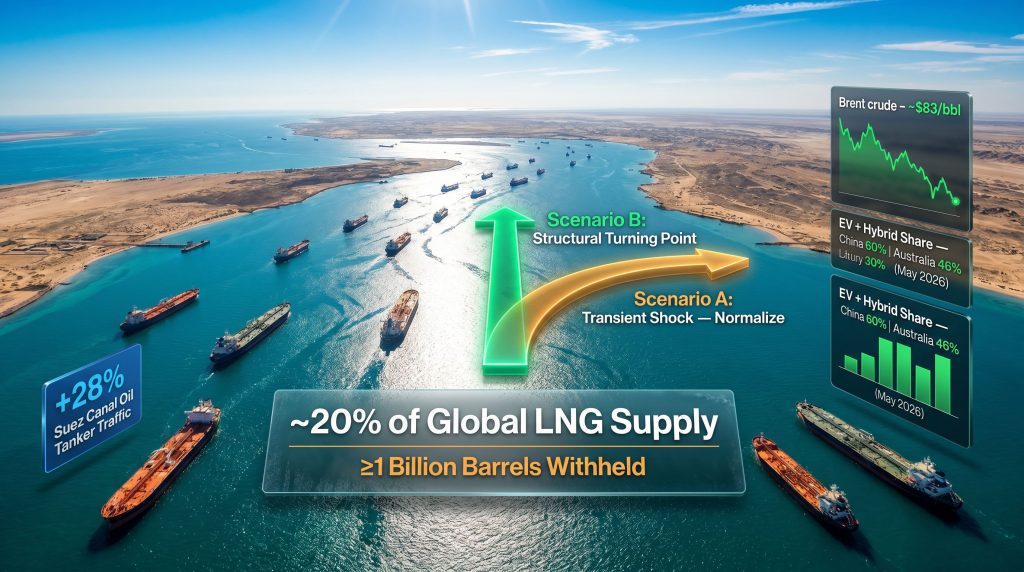
The Strait of Hormuz is approximately 33 kilometres wide at its narrowest navigable point, yet it functions as the circulatory valve for a substantial portion of the world's hydrocarbon supply. Roughly 20% of global LNG supply transits this passage, along with a significant share of crude oil exports from Iraq, Kuwait, the United Arab Emirates, and Iran itself. No other single geographic feature concentrates equivalent energy risk in such a confined space.
What makes a Hormuz closure categorically different from other supply disruptions — such as pipeline sabotage or refinery outages — is its simultaneous effect across multiple commodity classes, multiple exporting nations, and multiple importing regions. A pipeline disruption affects one fuel type moving between two fixed points. A Hormuz closure, however, freezes the entire Gulf's energy export capacity in a single event, representing a profound oil market disruption with cascading global consequences.
The data emerging from the current disruption reflects that scale:
| Metric | Estimated Impact |
|---|---|
| Crude oil and refined products withheld | At least 1 billion barrels |
| Global LNG supply effectively disrupted | Approximately 20% of total supply |
| Brent crude ceiling during peak crisis period | Below $100 per barrel |
| Brent price reaction to deal announcement | Approximately 4% decline to ~$83/bbl |
| Suez Canal oil tanker traffic increase (April) | Up 28% amid Hormuz closure |
The Suez Canal traffic surge is particularly revealing. When the Hormuz route became impassable, tanker operators rerouted through the Suez Canal and around the Cape of Good Hope, adding significant voyage time and cost. A 28% increase in Suez oil tanker traffic in April demonstrates the scale of the rerouting pressure and the cascading logistics costs that accumulate even when crude eventually reaches its destination.
Why Prices Did Not Spike Above $100: The Three Stabilising Forces
Perhaps the most counterintuitive feature of this crisis has been the relative containment of Brent crude below the $100 per barrel threshold, despite a supply loss of at least one billion barrels. Three mechanisms explain this:
- Strategic and commercial inventory releases absorbed the immediate supply gap, with governments and trading houses drawing down stockpiled volumes to bridge delivery shortfalls.
- Reduced Chinese import demand provided a significant demand-side offset. As the world's largest crude importer, China's reduced intake during the crisis materially dampened global demand pressure at precisely the moment supply was constrained.
- Diplomatic optimism discounting played a subtler but measurable role. Traders consistently priced in an earlier-than-materialised resolution, compressing the geopolitical risk premium that would otherwise have driven prices into triple digits.
This combination of factors prevented an acute crisis from becoming a catastrophic one. Whether it also prevented the kind of prolonged price pain that drives durable behavioural change is the central question now confronting energy markets. According to analysis from Reuters, the price containment may ultimately undermine the structural momentum needed for lasting change.
Two Scenarios, Two Very Different Futures
Scenario A: The Market Absorbs the Shock and Fossil Fuels Endure
The post-deal restoration sequence follows a predictable three-phase structure. First, trapped tankers exit the Gulf and deliver delayed cargoes, generating a short-term price relief rally. Second, Middle East producers ramp output and exports back toward pre-conflict levels over a multi-month timeline. Third, depleted strategic and commercial inventories are gradually rebuilt, keeping prices somewhat elevated even as acute supply fears subside.
Historical precedent strongly supports this normalisation pathway. Both the 1990 Gulf War and the September 2019 Abqaiq facility attacks in Saudi Arabia produced dramatic short-term price dislocations followed by relatively rapid market rebalancing once physical supply was restored. In the Abqaiq case, Saudi Arabia recovered roughly half of the approximately 5.7 million barrel-per-day production loss within days, and full recovery within weeks, according to contemporaneous reporting.
The Forgive and Forget Dynamic: Energy security concerns carry notoriously short institutional memory. When prices fall rapidly and remain suppressed, both consumer willingness to pay premiums for energy security and government appetite for expensive structural reform tend to evaporate together.
The Russia-Ukraine energy crisis of 2022 provides the most direct recent parallel. Despite causing dramatic European gas price spikes and forcing a wholesale rerouting of supply chains, the structural shift away from fossil fuels proved more modest than the initial alarm suggested. Furthermore, alternative sourcing emerged, demand compression occurred, and within 18 months, the acute crisis had largely resolved. If OPEC+ can restore meaningful production volumes and inventories rebuild within 6 to 12 months, Scenario A becomes the dominant trajectory, and any oil price shock will be absorbed without lasting structural consequence.
Scenario B: The Crisis Becomes a Structural Turning Point
Three threshold conditions determine whether the Iran war energy shock turning point evolves into a genuine inflection point rather than a recoverable disruption:
- Prolonged infrastructure damage that prevents rapid output recovery, keeping the supply gap open long enough to force durable behavioural and investment decisions.
- Policy lock-in by importing governments, particularly across Asia, where legislative changes enacted during the crisis create structural incentives for domestic energy development that persist even after prices normalise.
- Permanent consumer behaviour shifts, particularly fleet and household transitions to electric or hybrid vehicles, where the reduced fuel demand becomes structurally embedded in transport patterns regardless of subsequent fuel price movements.
The historical analogy that best illuminates Scenario B's potential is the 2015 Volkswagen emissions scandal. Dieselgate appeared initially to be a corporate governance failure with limited systemic implications. Instead, it triggered a collapse in European consumer and regulatory confidence in diesel technology that proved entirely irreversible. Diesel's share of European passenger car sales fell from approximately 52% in 2015 to below 10% by 2025, a structural demand destruction driven not by price economics alone but by a combination of policy response, consumer sentiment reorientation, and manufacturer repositioning toward electrification.
Consequently, the Iran war energy shock turning point carries comparable structural potential: not merely a price event, but a supply security credibility event capable of reshaping long-term investment and consumption patterns.
Asia as the Decisive Variable
EV Adoption Signals: Reading the Early Behavioural Data
Asia represents the fastest-growing energy demand region on Earth, and its trajectory will ultimately determine whether this crisis registers as a cyclical disruption or a watershed moment. Early behavioural signals are more significant than most commentators have acknowledged.
Australia presents perhaps the most instructive case study. As the world's largest diesel importer and a nation dependent on overseas refineries for over 80% of its fuel requirements, Australia carries exceptional vulnerability to Hormuz disruptions. The behavioural response has been measurable: EV sales in Australia reached a record 20% market share in May 2026, and when hybrid vehicles are included, the combined share climbed to 46%.
| Market | EV Market Share | EV + Hybrid Combined | Key Context |
|---|---|---|---|
| China | ~50%+ (full year 2025) | ~60% (May 2026) | World's leading EV manufacturer |
| Australia | ~20% (May 2026) | ~46% (May 2026) | World's largest diesel importer |
| Vietnam | Policy framework developing | Under assessment | Targeting EVs and electric scooters |
China's trajectory is equally significant. EVs and hybrids accounted for more than 50% of new vehicle sales in China during 2025, rising further to approximately 60% in May 2026. For a nation that serves as both the world's largest crude importer and its dominant EV manufacturer, this crossover carries compounding implications for global oil demand forecasts. In addition, the rapid battery storage expansion underpinning this shift is accelerating cost reductions that make electrification increasingly compelling even without a geopolitical crisis as catalyst.
The Leapfrog Opportunity: Southeast Asian economies, including Vietnam and the Philippines, are developing policy frameworks that could allow them to bypass conventional fossil fuel infrastructure investment entirely, moving directly to electrified transport and renewable power systems underpinned by cost-competitive Chinese supply chains.
LNG's Strategic Vulnerability in Asian Markets
LNG faces a structurally more challenging competitive environment post-crisis than crude oil. The Hormuz closure demonstrated that approximately 20% of global LNG supply can be simultaneously disrupted by a single geopolitical event — a concentration of chokepoint risk that has not been adequately priced into long-term LNG supply contracts or infrastructure investment decisions.
Asian governments that have historically relied on LNG imports are now conducting explicit cost-benefit analyses comparing continued LNG dependence, with its embedded Hormuz chokepoint exposure, against accelerated domestic renewable buildout using solar, wind, and battery storage increasingly available at competitive cost. According to research from Columbia University's Energy Policy Centre, this security calculus is shifting in ways that may prove more durable than transient price movements.
The Coal Paradox: An Unexpected Structural Winner
One of the least anticipated potential outcomes of this crisis is the structural reinforcement of coal's position in energy-rich economies. Nations holding substantial domestic coal reserves — including China, India, and Indonesia — face a straightforward strategic logic: domestic coal offers supply security that no imported LNG or crude oil can match, entirely independent of Hormuz conditions. Indeed, China's coal strategy of maintaining coal capacity as a renewable energy backup now appears strategically prescient in light of the current disruption.
For coal-importing nations, the geography of major export supply chains also works in coal's favour. The three dominant coal exporters — Australia, Indonesia, and South Africa — supply through maritime routes that entirely bypass the Strait of Hormuz. This structural chokepoint immunity gives coal a supply security argument that may prove persuasive to governments prioritising energy security over decarbonisation commitments.
The Coal Paradox in Full: The same crisis that may accelerate EV adoption and renewable investment across energy-importing economies could simultaneously entrench coal consumption in energy-producing economies, producing a bifurcated energy transition that advances at radically different speeds across different markets.
Policy Architecture: Why Crisis-Era Legislation Rarely Gets Reversed
Historical analysis of energy policy responses consistently demonstrates that emergency measures introduced during supply crises tend to become permanent structural features of regulatory frameworks. The 1973 oil embargo created strategic petroleum reserve programmes that remain active across multiple jurisdictions today. The 2022 European energy crisis accelerated renewable energy permitting reforms that outlasted the immediate supply disruption by years.
The Iran war energy shock turning point is likely to produce analogous policy responses. The critical variable is not whether governments enact policy changes during the crisis, but whether those changes are sufficiently legislatively embedded to survive the return of lower energy prices. Furthermore, this dynamic aligns with broader energy transition shifts already underway across multiple jurisdictions.
| Government Type | Most Probable Policy Response | Structural Implication |
|---|---|---|
| Energy-importing democracies (EU, Australia) | Accelerated EV mandates, renewable targets | Reduced long-term fossil fuel demand trajectory |
| Developing energy importers (Vietnam, Philippines) | EV incentives, clean energy partnerships | Potential leapfrog of fossil fuel infrastructure |
| Domestic fossil fuel producers (China, India, Indonesia) | Coal expansion, self-sufficiency mandates | Entrenchment of domestic fossil fuel consumption |
| Gulf OPEC+ producers | Output ramp-up, infrastructure repair | Competitive pricing strategy to retain market share |
The next major ASX story will hit our subscribers first
The Price Signal That Determines Everything
Brent crude futures fell approximately 4% to around $83 per barrel immediately following the announcement of a framework agreement between the United States and Iran that would allow tanker transit through the Strait of Hormuz to resume. The speed and scale of that single-day reaction carries important diagnostic information: markets had already partially priced in a resolution, suggesting the relief rally may prove more muted than the preceding supply loss would imply.
This creates a strategic tension that fossil fuel producers understand well. The fastest path to suppressing energy transition momentum is ensuring that prices decline rapidly and remain low for an extended period following crisis resolution. If transport fuel costs return to pre-war levels within six to nine months, the economic urgency driving EV adoption weakens for cost-sensitive consumers, and governments in energy-importing nations face reduced political pressure to maintain expensive structural reform commitments.
The competitive response from OPEC+ and LNG exporters in the months following the Strait's reopening will therefore function as a deliberate counter-move against the energy transition narrative, using price normalisation as the primary instrument.
The Three Indicators That Will Reveal the Outcome
The ultimate legacy of this crisis will be determined not by the disruption itself but by what happens in the 12 to 24 months following the Strait's reopening. Three metrics will reveal whether this was a shock or a turning point:
- EV and hybrid adoption trajectory in Asia: If market share continues climbing in Australia, Southeast Asia, and China even after fuel prices normalise, behavioural change is becoming structurally embedded rather than crisis-driven.
- Legislative durability of Asian government policy commitments: If energy security legislation enacted during the crisis survives the return of lower prices, the structural shift is real.
- OPEC+ production credibility and price trajectory: If Middle East producers successfully restore output and prices return to pre-crisis levels within six to nine months, the forgive-and-forget dynamic reasserts itself.
Markets are already placing their bet. The 4% single-session Brent decline on deal news signals that traders are pricing normalisation as the base case. Whether Asian governments and consumers reach the same conclusion is the question that will define the next decade of global energy investment.
This article contains forward-looking analysis, scenario projections, and market observations intended for informational purposes only. Nothing in this article constitutes investment advice. Energy market outcomes are subject to significant uncertainty, and actual results may differ materially from any scenarios described. Readers should conduct independent research before making any investment or policy decisions.
Want to Stay Ahead of the Next Major Market-Moving Discovery?
While geopolitical shocks reshape global energy dynamics, Discovery Alert's proprietary Discovery IQ model continuously scans ASX announcements in real time, delivering instant alerts on significant mineral discoveries — from critical minerals powering the energy transition to commodities insulated from Hormuz-linked supply risks — so subscribers can act on actionable opportunities before the broader market catches on. Explore how historic ASX mineral discoveries have generated extraordinary returns, and begin your 14-day free trial today to position yourself ahead of the next major find.