July 15, 2026
When One Port Carries the World's Energy Risk
Global oil markets have spent decades pricing risk across multiple chokepoints simultaneously. The conventional wisdom among energy strategists was that diversification across the Strait of Hormuz, the Suez Canal, and the Bab el-Mandeb provided enough systemic redundancy to prevent any single geographic node from becoming an existential vulnerability. That assumption has been systematically dismantled throughout the first half of 2026.
What has emerged in its place is a concentration of crude export dependency at a single Red Sea terminal that was never designed to carry this weight. Understanding how Saudi Arabia Yanbu oil exports amid Houthi tensions became the defining energy security story of 2026 requires examining not just the events that triggered the shift, but the structural limitations that make the current situation so precarious.
When big ASX news breaks, our subscribers know first
Saudi Arabia's Two-Corridor Export Architecture and How One Collapsed
For decades, Saudi Arabia operated a dual-corridor crude export system. The primary route ran eastward through the Persian Gulf, loading at Ras Tanura before transiting the Strait of Hormuz. This corridor handled the overwhelming majority of Saudi export volumes under normal conditions, serving Asia-Pacific buyers across relatively short shipping lanes. The secondary western route moved crude via the East-West Petroline pipeline across approximately 1,200 kilometres of Saudi territory to reach the Red Sea port of Yanbu.
The Hormuz Closure and Its Cascading Effect
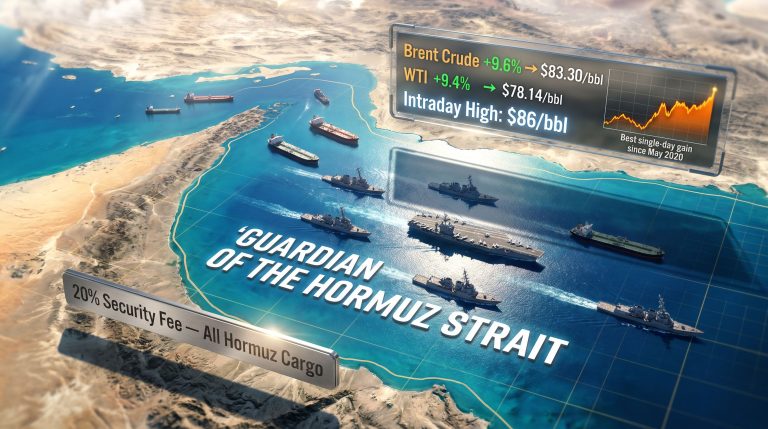
The Strait of Hormuz has long been recognised as the world's most significant oil transit chokepoint, with approximately 20 to 21 million barrels per day moving through its narrow passage under normal operating conditions. When military escalation involving the United States, Israel, and Iran intensified from late February 2026, Gulf-side export operations became severely disrupted. Furthermore, Ras Tanura, which had functioned as Saudi Arabia's workhorse export terminal, found itself operationally constrained as Gulf shipping dynamics deteriorated rapidly.
The result was an almost immediate westward redirection of Saudi crude export capacity. Volumes that would have loaded at Ras Tanura began flowing instead through the Petroline toward Yanbu. Hundreds of millions of barrels that would ordinarily have transited Hormuz became effectively locked within the Gulf system, affecting not only Saudi production but the export capacity of other regional producers. The oil trade geopolitics driving these shifts had been building for years, yet the speed of the transition caught many market participants off guard.
The East-West Petroline: Strategic Asset and Bottleneck Creator
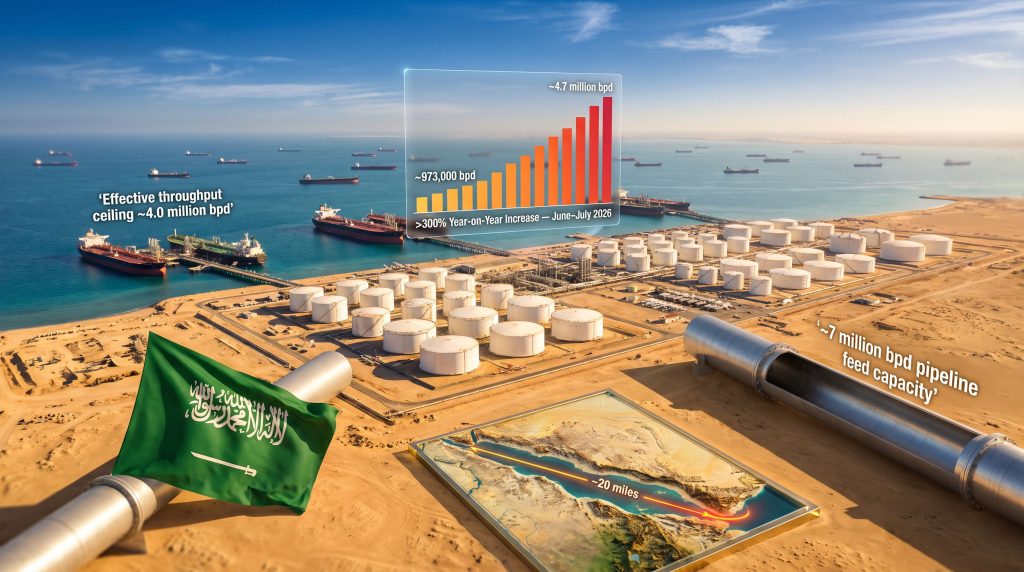
The Petroline is one of the most consequential pieces of energy infrastructure on earth, yet it receives remarkably little attention in mainstream market commentary. Its nominal capacity sits at approximately 7 million barrels per day, a figure that substantially exceeds the export ceiling Yanbu's port infrastructure can physically process. This mismatch between pipeline supply potential and terminal throughput capacity is the fundamental engineering constraint defining the current crisis.
"Critical Infrastructure Insight: The Petroline can theoretically deliver far more crude to Yanbu than the port can load onto vessels. The binding constraint is not the pipeline but the terminal itself, specifically berth availability, tanker scheduling windows, and VLCC turnaround cycles."
An attack on a Petroline pumping station in March 2026 temporarily reduced throughput by an estimated 700,000 barrels per day before full capacity was restored. The incident demonstrated the physical vulnerability of fixed pipeline infrastructure in an era of precision-guided asymmetric weapons, whilst simultaneously confirming that Saudi Arabia's redundancy planning had correctly anticipated the need to protect western corridor assets.
Reports indicate Saudi Arabia is also evaluating a capacity expansion of the East-West Petroline beyond its current ceiling, with the potential to offer westward routing to neighbouring Gulf producers seeking to bypass Hormuz exposure entirely. Any such expansion, however, represents a multi-year engineering commitment with no bearing on immediate export pressures. For a deeper look at geopolitical oil pricing dynamics shaping these decisions, the structural interplay between infrastructure and diplomacy is increasingly difficult to separate.
Yanbu Export Volumes: A Data-Driven Capacity Analysis
The scale of the volume shift at Yanbu since February 2026 is without precedent in the terminal's operational history. Tanker tracking data from Signal Ocean and vessel monitoring figures from Kpler tell a consistent story of a port pushed to and beyond its comfortable operating threshold.
Tracking the Volume Surge: February Through July 2026
| Period | Approximate Daily Loadings | Change vs. Pre-Escalation Baseline |
|---|---|---|
| February 2026 (pre-escalation) | ~1.47 million bpd | Baseline |
| March 2026 (early) | ~2.9 million bpd | +97% |
| Week of March 16, 2026 | ~4.0 million bpd | +172% |
| Late March 2026 | ~4.19 million bpd | +185% |
| Peak days (March) | >5.0 million bpd | +240%+ |
| April 2026 | ~3.5 million bpd | Pullback from congestion |
| June 2026 average | >4.0 million bpd | Sustained above threshold |
| Around July 10, 2026 | ~3.36 million bpd | Intra-week trough |
| Around July 13, 2026 | ~4.7 million bpd | Near-maximum loading |
Sources: Signal Ocean tanker tracking data; Kpler vessel monitoring data (as reported by Reuters, July 2026)
According to Baird Maritime reporting, crude exports from Yanbu surged to near 4.0 million bpd during a single week, underscoring just how rapidly the terminal has been pressed into maximum service.
What Operating at Near-Maximum Capacity Actually Means
Yanbu's nominal port capacity is estimated at between 4.5 and 5.0 million barrels per day, but effective operational throughput sits closer to 4 million bpd once real-world constraints are applied. These constraints include:
- Berth availability and the physical number of loading positions
- VLCC scheduling windows and the time required to coordinate tanker arrival sequences
- Loading arm capacity and the rate at which crude can be transferred from storage to vessel
- Maintenance cycles that reduce available berths during servicing periods
During the March 2026 congestion episode, more than 30 tankers were observed idling offshore waiting for berth assignments, with loading delays stretching to five days in the worst cases. From a commercial standpoint, each additional day a VLCC spends waiting offshore rather than loading and transiting represents a direct cost to buyers in the form of demurrage charges, effectively adding an invisible surcharge to every barrel that eventually loads.
The year-on-year comparison is striking. Loadings averaging above 4 million bpd during June and July 2026 compare with approximately 973,000 bpd during the equivalent period in 2025, according to Signal Ocean data cited by Reuters. This represents a greater than 300% increase in Red Sea crude shipments from a single terminal within twelve months, a volume shift that has reconfigured tanker routing patterns, freight rate structures, and VLCC utilisation across the Indian Ocean basin.
The Houthi Threat: Trading One Chokepoint for Another
Why Yanbu's Success Has Introduced a New Vulnerability
Saudi Arabia's successful rerouting of crude exports through Yanbu has achieved its primary objective of maintaining oil revenue streams under Vision 2030 fiscal requirements. However, it has done so by concentrating the kingdom's entire bulk export capacity at a fixed terminal whose primary outbound shipping lane passes through the Bab el-Mandeb Strait. This waterway is approximately 20 miles wide at its narrowest point and falls within the operational range of Houthi military assets in Yemen.
Approximately 70 to 75% of crude departing Yanbu must transit Bab el-Mandeb before reaching either Asian or European markets. Saudi Arabia has consequently substituted Hormuz exposure for Bab el-Mandeb exposure, and the critical difference between these two risk scenarios is the absence of any bypass infrastructure for the latter. The oil market disruption risks that analysts had modelled in theoretical frameworks are now materialising as operational realities.
"Strategic Warning: When Hormuz became untenable, Saudi Arabia had the Petroline as a pre-positioned contingency. There is no equivalent bypass route for Bab el-Mandeb. If this corridor is interdicted at scale, no pre-engineered alternative routing solution exists for Yanbu's export volumes."
Current Houthi Threat Posture
The mid-July 2026 missile exchange, in which Houthi forces launched strikes at Saudi territory following accusations that the kingdom had bombed Houthi-controlled airport infrastructure, broke a four-year ceasefire between Riyadh and Yemen's armed group. The incident marked a meaningful escalation in the threat environment surrounding Yanbu, with industry sources expressing concern that the terminal could become a direct target. As the geopolitical trade tensions in the region continue to intensify, the ripple effects on energy markets are becoming increasingly difficult to contain.
It is important to distinguish between the threat vectors currently in play. The March 2026 attack on a refinery near Yanbu was assessed as Iranian in origin rather than Houthi-initiated, demonstrating that the terminal already operates within a multi-directional threat environment. The Houthi risk layer adds a separate and distinct operational threat informed by the group's demonstrated capability to target Red Sea shipping with drone and missile systems.
A shipping industry source told Reuters in July 2026 that Yanbu had been operating at maximum capacity in recent weeks and that concerns existed around a potential Houthi escalation targeting the corridor, whilst noting there was limited physical headroom for additional volume even without a security disruption. This assessment captures the essential paradox of the current situation: the terminal is already at its operational limit, meaning any security-driven reduction in throughput would have immediate supply consequences for global markets. Lloyd's List coverage of rising Red Sea tanker loadings similarly confirms that Aramco has been actively ramping up pipeline contingency operations to their limits.
Three Scenarios for the Bab el-Mandeb Corridor
Scenario A: Partial Interdiction Through Harassment
Houthi forces conduct drone and missile attacks against tankers transiting the strait without achieving a sustained blockade. Insurance premiums spike sharply, with war risk clauses activating for Red Sea routing. A proportion of tanker operators reroute via the Cape of Good Hope, extending voyage times by approximately 10 to 14 days and effectively reducing available vessel supply on key trade lanes. Effective export volumes from Yanbu decline by an estimated 15 to 25%, with Brent crude attracting a $10 to $20 per barrel geopolitical premium.
Scenario B: Full Bab el-Mandeb Closure
Yanbu exports are effectively halted alongside residual Hormuz restrictions. Saudi Arabia loses its sole functioning bulk crude export corridor, removing an estimated 4 million or more barrels per day from global supply with no immediate alternative routing mechanism available. Energy analysts characterise this scenario as capable of generating a supply shock without historical peacetime precedent, with price impacts extending well beyond simple barrel-for-barrel substitution arithmetic.
Scenario C: Diplomatic Stabilisation
Back-channel negotiations or third-party mediation contain Saudi-Houthi tensions before they escalate into sustained maritime operations. Yanbu continues operating at near-maximum capacity with elevated but manageable security risk through the remainder of 2026, supporting Saudi revenue targets and providing a degree of global supply stability whilst Hormuz-side disruptions persist.
Infrastructure Stress Testing: Is Yanbu Built for This Role?
Terminal Design Parameters vs. Current Reality
| Infrastructure Parameter | Design Specification | Current Operational Reality |
|---|---|---|
| Port nominal capacity | 4.5 to 5.0 million bpd | Effective ceiling ~4.0 million bpd |
| Pipeline feed capacity | ~7.0 million bpd | Constrained by terminal throughput |
| Berth availability | Sequential scheduled loading | Congestion with 30+ vessels idling |
| Standard loading delay | 1 to 2 days | Up to 5 days during March 2026 peak |
| Year-on-year volume increase | — | >300% vs. June to July 2025 |
The table above illustrates a terminal operating well outside its design parameters across multiple dimensions simultaneously. Meaningful capacity expansion at the port level, including berth additions, storage tank upgrades, and loading arm infrastructure, represents a capital-intensive and time-consuming undertaking. The timeline for such investment is measured in years, not months, creating a sustained period during which Yanbu must absorb volumes it was not engineered to handle.
Security Infrastructure in the Precision Weapons Era
Fixed export terminals represent a category of critical infrastructure that presents inherent defensive challenges in an environment where adversaries possess precision-guided drone and missile capabilities. Yanbu's geographic exposure differs materially from offshore loading platforms, which offer less predictable targeting parameters. The concentration of Saudi Arabia's entire remaining export capacity at a single fixed coastal terminal creates a high-value, identifiable target profile that security planners must contend with alongside purely operational bottleneck pressures. In addition, the OPEC market influence on production decisions intersects directly with these physical constraints, further complicating any coordinated response among member states.
Global Market Consequences and Investor Risk Pricing
Asia-Pacific Import Dependency
Saudi Arabia's largest crude export customers, including China, India, Japan, and South Korea, are predominantly served via Red Sea and Indian Ocean routing. Asian refiners have built procurement models around reliable Saudi supply, and the substitution options available at equivalent price points are more limited than surface-level market liquidity figures suggest. India's strategic petroleum reserve capacity provides a limited buffer against short-term disruption but is wholly inadequate as a response to a sustained Yanbu outage scenario.
The Price Discovery Problem
Oil futures markets are currently embedding geopolitical risk premiums into Brent and WTI contracts, but the pricing of tail-risk scenarios remains asymmetric relative to the physical probability assessments circulating among energy security analysts. Historical analogies, including the 1973 Arab oil embargo and the sustained tanker warfare of the 1980s, provide only partial guidance for a situation in which:
- Both primary Gulf exit corridors face simultaneous disruption risk
- The sole functioning alternative corridor has no bypass infrastructure of its own
- The terminal managing that corridor is already operating at or near its physical throughput ceiling
- The threat actor with the capability to interdict the secondary corridor has recently broken a multi-year ceasefire
The 2026 configuration is structurally more complex than any prior disruption episode, and the market's current pricing of that complexity may not fully reflect the magnitude of downside scenarios embedded in the tail of the distribution.
"Investor Consideration: Market participants assessing energy commodity exposure should treat Yanbu throughput data as a leading indicator of both Saudi fiscal positioning and global supply adequacy. Sustained loading rates above 4 million bpd signal export maximisation under constraint; any decline from that level without a corresponding Hormuz normalisation represents a net supply reduction to global markets. This analysis reflects publicly available data and independent assessment and does not constitute financial advice."
The next major ASX story will hit our subscribers first
Frequently Asked Questions
What is Yanbu port and why has it become strategically critical?
Yanbu is Saudi Arabia's principal crude export terminal on the Red Sea coast, supplied via the East-West Petroline from Eastern Province oil fields. Under normal conditions it serves as a secondary export route. Since early 2026, with Gulf-side exports severely constrained by the Hormuz situation, it has become Saudi Arabia's primary and effectively sole bulk crude export corridor.
How much oil is currently flowing through Yanbu?
According to Signal Ocean data reported by Reuters, shipments reached approximately 4.7 million barrels per day around July 13, 2026, up from around 3.36 million bpd just days earlier on July 10. Loadings have averaged above 4 million bpd since June 2026, compared with approximately 973,000 bpd during the same period in 2025.
Why are the Houthis a threat to this corridor?
Around 70 to 75% of crude departing Yanbu must transit the Bab el-Mandeb Strait, which sits within range of Houthi military capabilities. A successful interdiction of this waterway would sever Saudi Arabia's last functioning crude export route, with no pre-positioned bypass alternative available.
What is the operational capacity ceiling at Yanbu?
The port's nominal capacity is estimated at 4.5 to 5.0 million bpd, with effective throughput constrained to approximately 4 million bpd by berth, scheduling, and logistics limitations. The East-West pipeline feeding the port can theoretically deliver up to 7 million bpd, meaning the terminal itself is the binding constraint on Saudi export capacity.
What would a Bab el-Mandeb closure mean for oil prices?
A partial harassment scenario could add an estimated $10 to $20 per barrel to global oil prices. A full corridor closure, combined with continued Hormuz restrictions, would remove more than 4 million barrels per day from global supply with no alternative routing mechanism available, a scenario that energy analysts assess as capable of triggering a supply shock without historical peacetime precedent.
The Irreversible Concentration of Global Supply Risk
What began as a contingency measure has evolved into the central load-bearing pillar of global oil supply adequacy. Saudi Arabia Yanbu oil exports amid Houthi tensions represent the convergence of three independent risk vectors into a single geographic node, creating a concentration of supply vulnerability that markets, importers, and energy security planners have not previously been required to manage at this scale.
Saudi Arabia has demonstrated operational resilience in rerouting its export volumes westward, maintaining revenue flows and signalling continued production capacity to global buyers. However, the structural reality is that this success has been achieved by trading diversified chokepoint exposure for concentrated single-corridor dependency. The Petroline expansion discussions, if they materialise, will not resolve this vulnerability within any timeframe relevant to current market dynamics.
For energy importers across Asia and Europe, for tanker operators reconfiguring fleet deployment across the Indian Ocean, and for commodity market participants pricing the probability distribution of supply outcomes, the single most important variable in global oil markets through the remainder of 2026 is the security status of a 20-mile-wide waterway at the southern end of the Red Sea.
The market has not yet fully priced what happens if that waterway closes.
Readers seeking ongoing coverage of GCC energy markets, commodity flows, and regional geopolitical developments can access reporting through Zawya (zawya.com), which provides continuous coverage of Middle East business and energy market dynamics.
Want to Track the Investment Ripple Effects of Global Energy Disruptions?
When geopolitical shocks reshape commodity flows at this scale, significant mineral discovery opportunities often emerge across adjacent resource sectors — and Discovery Alert's proprietary Discovery IQ model is built to identify them the moment they hit the ASX. Explore historic examples of how major discoveries have delivered exceptional returns and begin a 14-day free trial to ensure you're positioned ahead of the market when the next significant announcement breaks.