July 15, 2026
The Strait of Hormuz as a Price Mechanism: Understanding the 2026 Naval Blockade and Its Oil Market Consequences
Few geographic features on Earth carry as much economic weight as a waterway stretching barely 33 kilometres at its narrowest point. The Strait of Hormuz, threading between the Iranian coastline and the Omani peninsula, functions less like a shipping lane and more like a global energy valve. When that valve is threatened, commodity markets do not wait for confirmation — they reprice within hours. Understanding why oil rises as U.S. reinstates blockade of Iranian ports requires examining not just the military action itself, but the deeper structural mechanics of how geopolitical shocks transmit into crude benchmarks.
When big ASX news breaks, our subscribers know first
What the Reinstated Naval Blockade Actually Covers
The operational parameters of the blockade reinstated on July 14, 2026 are considerably broader than a simple port closure. Under the directive issued by U.S. Central Command (Centcom), all vessels, regardless of nationality, flag state, or cargo classification, are prohibited from entering or exiting Iran's full maritime perimeter. This includes Iran's primary oil export terminals and coastline facilities, not merely its commercial port infrastructure.
The military action accompanying the blockade reinstatement involved a seven-hour strike campaign targeting dozens of assets concentrated near the Strait of Hormuz and along Iran's coastline. Centcom confirmed that the strikes involved a combined force of fighter aircraft, drones, and naval assets, with specific targets including:
- Missile and drone production and storage facilities
- Iranian naval vessels operating in and around the Strait corridor
- Coastal defence systems capable of threatening commercial shipping lanes
The explicit purpose, as stated by Centcom, was to further degrade Iran's capacity to threaten commercial maritime traffic through one of the world's most economically critical transit zones.
Why Did the Blockade Come About?
Centcom Commander Brad Cooper confirmed that Iran had carried out attacks on seven commercial vessels over the preceding week, resulting in approximately a dozen crew members killed, missing, or injured. This context is essential for understanding why the blockade reinstatement was framed as a defensive maritime enforcement action rather than a purely offensive military posture. Furthermore, the trade war impact on oil dynamics already in play had heightened the sensitivity of energy markets heading into this confrontation.
The Strait of Hormuz: More Than a Shipping Lane
To grasp the full weight of this situation, it helps to understand what the Strait of Hormuz actually represents in quantitative terms. Roughly 20 to 21 percent of the world's daily petroleum liquids transit this corridor, along with a material share of global liquefied natural gas exports. For Iran specifically, approximately 90 percent of the country's external economic activity passes through or adjacent to this waterway.
"The Strait of Hormuz is not a geography problem. It is a pricing problem. Any credible threat to vessel transit generates immediate upward pressure on crude futures because traders must immediately discount the probability of reduced forward supply against existing demand assumptions."
This mechanism explains the speed and magnitude of oil market reactions. Unlike demand-side shocks, which build gradually, supply-side geopolitical shocks are priced abruptly and asymmetrically. Markets learn the upside scenario within hours; the downside scenario takes weeks or months to resolve. In addition, a thorough geopolitical oil price analysis reveals that these repricing events tend to overshoot before correcting.
How Crude Benchmarks Responded to the July 14 Reinstatement
The oil market reaction to the blockade reinstatement illustrated the non-linear repricing dynamic described above. The following table captures the key benchmark movements recorded across trading sessions:
| Benchmark | Session Movement | Settled Price | Notable Detail |
|---|---|---|---|
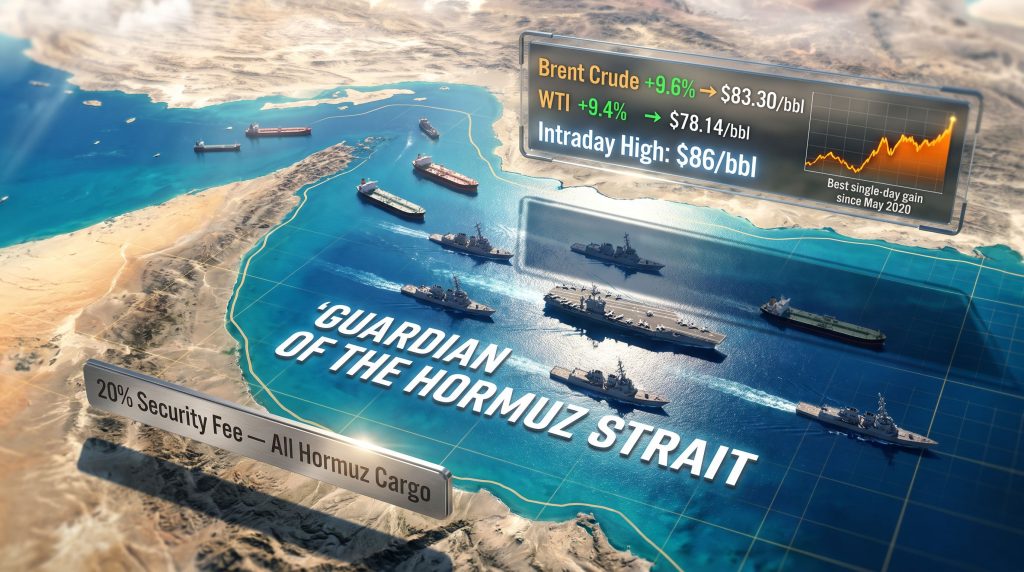
| Brent Crude (Initial Surge) | +9.6% | $83.30/barrel | Strongest single-session gain since May 2020 |
| WTI August Delivery (Initial Surge) | +9.4% | $78.14/barrel | Intraday high exceeded $86/barrel |
| WTI August Delivery (Continued Session) | +1.01% | $80.14/barrel | Choppy continuation trading |
| Brent September Futures (Continued Session) | +1.23% | $85.77/barrel | International benchmark reference |
What Do These Numbers Tell Us?
The intraday breach of $86 per barrel on WTI represents a one-month high watermark and illustrates how quickly positioning can shift when a geopolitical binary flips unexpectedly. The partial retracement to settlement levels reflects profit-taking and uncertainty about escalation trajectory, not a fundamental reassessment of the supply risk. Consequently, monitoring WTI and Brent futures remains essential for tracking how these tensions continue to influence global benchmarks.
A critical factor amplifying the move was the prior de-escalation narrative. A temporary diplomatic arrangement reached in mid-June 2026 between Washington and Tehran had resulted in the original blockade being suspended. Energy traders had begun pricing in a normalisation trajectory, reducing their geopolitical risk premiums accordingly. The abrupt reinstatement in July essentially punished that positioning, generating a sharp snapback as risk premiums were rapidly rebuilt.
Senior energy analyst Saul Kavonic of MST Marquee identified the core problem clearly: market expectations of a rapid reopening of the Strait had been premature, and the reinstatement of hostilities returned the conflict to an escalatory path. Kavonic further noted that oil price movements could push crude toward the $100 per barrel threshold if current hostility levels persist for several weeks, with the risk of moving materially higher if regional energy infrastructure becomes a strike target.
The Guardian of the Hormuz Strait Declaration and the 20% Security Fee
Beyond the immediate military dimension, the July 2026 developments introduced a structural geopolitical reframing that carries long-term market implications. President Trump formally declared the United States the "Guardian of the Hormuz Strait", a designation that signals an intent for durable U.S. control over access to this corridor rather than a temporary enforcement posture.
Accompanying this declaration is a 20% security fee applied to all cargo transiting the Strait of Hormuz. This measure introduces a new and permanent cost layer into global energy trade with several simultaneous functions:
- Revenue mechanism: Generates direct financial returns tied to Strait transit volume
- Geopolitical leverage tool: Creates economic pressure on nations dependent on Persian Gulf energy supply routes
- Market signal: Communicates that U.S. maritime governance over the Strait is intended to be structurally durable
The nations most immediately exposed to this fee are the largest importers of Middle Eastern crude and LNG, particularly China, Japan, South Korea, and India. For these economies, the 20% surcharge compounds already elevated crude prices, creating a double cost pressure: higher benchmark prices plus higher delivery costs simultaneously. As reported by investing.com, the oil market reaction to this declaration was immediate and pronounced.
Escalation Scenarios and Their Price Implications
Disciplined scenario analysis is essential for understanding the range of oil price outcomes from this situation. The following framework outlines three credible pathways:
Scenario 1: Contained Conflict
Hostilities remain at current intensity without escalating to upstream energy infrastructure. Brent crude stabilises in the $83 to $90 per barrel range. Shipping reroutes through the Cape of Good Hope, absorbing cost increases but maintaining global supply continuity.
Scenario 2: Sustained Escalation
Military operations persist at comparable or greater intensity for several weeks. Brent retests the $100 per barrel psychological threshold. War risk insurance premiums spike sharply, compounding delivered energy costs across all import-dependent economies.
Scenario 3: Infrastructure Targeting
Regional oil production infrastructure, including refineries, export terminals, or pipeline networks, becomes a strike target. Brent crude surges well above $100 per barrel. IEA member nations coordinate emergency strategic petroleum reserve releases. Global recession probability rises materially as energy costs cascade through industrial supply chains.
| Scenario | Primary Trigger | Estimated Brent Range | Risk Assessment |
|---|---|---|---|
| Contained Conflict | No infrastructure targeting; diplomacy resumes | $83 to $90/barrel | Moderate probability |
| Sustained Escalation | Weeks of continued operations at current intensity | $90 to $100/barrel | Elevated probability |
| Infrastructure Targeting | Oil terminals or pipelines struck | Above $100/barrel | Lower but non-trivial |
The next major ASX story will hit our subscribers first
Why Energy Markets Systematically Misprice Diplomatic Progress
The mid-June 2026 deal and its rapid unravelling in July offers a case study in a well-documented but repeatedly ignored behavioural dynamic in commodity markets. Traders systematically anchor on the most recent diplomatic signal, reducing risk premiums during apparent de-escalation windows even when the structural conditions for renewed conflict remain unchanged.
This creates a recurring asymmetry:
- De-escalation is priced in gradually, as traders cautiously reduce risk premiums over days or weeks
- Re-escalation is priced in abruptly, compressing weeks of positioning adjustment into hours of trading activity
The practical consequence for investors is that cease-fire or deal announcements in high-conflict energy regions create artificial price floors that are inherently fragile. Positioning for re-escalation during diplomatic lull periods has historically offered asymmetric return profiles precisely because consensus is frequently wrong about the durability of temporary agreements.
"Geopolitical risk in oil markets does not follow a linear path. The Hormuz situation demonstrates that diplomatic progress and military escalation can coexist in rapid alternation, making static risk models unreliable for pricing energy assets across medium-term horizons."
Furthermore, understanding broader crude oil price trends in this context helps investors contextualise why the mid-June de-escalation was insufficient to anchor prices at lower levels for any meaningful duration.
Downstream Economic Consequences Across Sectors
The ramifications of elevated and volatile crude pricing extend well beyond the oil futures market itself. The sector-by-sector exposure is substantial:
Global Shipping and Freight
Rerouting via the Cape of Good Hope adds 10 to 14 days to voyage times for vessels previously transiting the Strait. Combined with escalating war risk insurance premiums and the 20% U.S. security fee, freight operators face a compounding cost environment with limited short-term relief options. NBC News coverage of the blockade's impact highlights how severely this is affecting global logistics networks.
Asia-Pacific Refining
Refineries in South Korea, Japan, and China that depend heavily on Middle Eastern crude feedstocks face immediate input cost increases. Crack spreads, which measure refinery profit margins, may initially widen before demand destruction effects begin compressing them. This creates a transitional profitability window for refinery operators, followed by margin pressure if high crude prices persist.
Consumer Energy Prices
Historical patterns suggest that sustained crude prices above $90 per barrel translate into visible retail fuel price increases within approximately four to six weeks. This timing creates a lagged inflationary signal that complicates central bank monetary policy decisions, particularly in economies already managing sticky services inflation.
Emerging Market Vulnerability
Nations in South Asia, Southeast Asia, and Sub-Saharan Africa with high energy import dependency and limited foreign currency reserves face disproportionate exposure to a sustained crude price shock. For these economies, the combination of higher prices and higher delivery costs can generate balance of payments stress within a relatively short timeframe. Moreover, the fact that oil rises as U.S. reinstates blockade of Iranian ports adds an additional layer of unpredictability for economies with already fragile fiscal positions.
Key Indicators for Monitoring the Situation
For investors and energy market participants navigating this environment, the following indicators provide the most actionable real-time signals:
- Centcom operational updates: Any expansion of strike targets to include upstream oil production infrastructure represents the most significant escalation signal available
- Iranian retaliatory posture: Whether Iran responds by targeting non-U.S. commercial shipping or regional energy infrastructure such as Saudi Aramco or UAE terminal facilities
- IEA emergency reserve announcements: A coordinated strategic petroleum reserve release signals that consuming nations view the supply disruption as systemic rather than transient
- Diplomatic back-channel signals: Any confirmed contact through intermediary nations such as Oman or Qatar would represent a credible de-escalation indicator
- Lloyd's of London war risk premiums: Real-time adjustments to maritime war risk insurance rates provide a continuous market-based measure of perceived threat levels in the Persian Gulf region
The Structural Shift in Global Energy Geopolitics
What makes the current situation distinct from prior Hormuz crises is the explicit assertion of permanent U.S. maritime governance over the corridor. Previous episodes involved threats, posturing, and temporary disruptions. However, the combination of sustained military operations, a formal Guardian designation, and a monetised security fee suggests a structural rather than episodic shift in how access to the Persian Gulf's energy flows is controlled and priced.
Energy analysts increasingly frame the $80 to $100 per barrel range as the new geopolitically-adjusted baseline for crude pricing through 2026. This reflects a durable supply uncertainty premium that will persist independently of short-term diplomatic developments. Consequently, this situation has direct implications for inflation-linked assets, energy equity valuations, and the attractiveness of non-Gulf LNG supply routes as long-term infrastructure investments. The broader reality is that oil rises as U.S. reinstates blockade of Iranian ports has become a defining phrase for understanding the repricing of global energy risk in 2026.
Disclaimer: This article contains forward-looking analysis and scenario modelling that involves significant uncertainty. Oil price projections and geopolitical outcome scenarios are speculative and subject to rapid change. Nothing in this article constitutes financial advice. Readers should conduct independent research and consult qualified financial advisers before making investment decisions.
Want to Stay Ahead of the Next Major Commodity Market Shift?
Geopolitical shocks like the Hormuz blockade can reprice energy markets within hours — and Discovery Alert's proprietary Discovery IQ model ensures subscribers receive real-time alerts on significant ASX mineral discoveries the moment they are announced, transforming complex market data into actionable insights across more than 30 commodities. Explore historic examples of major discovery returns and begin a 14-day free trial to position yourself ahead of the next market-moving event.