
August 9, 2026
When Financial Markets and Physical Reality Tell Different Stories
There is a peculiar tension running through commodity markets that experienced traders learn to recognise over time. It occurs when the price of a metal falls sharply on the exchange floor while, simultaneously, the physical stock of that metal available for immediate delivery keeps shrinking. To the casual observer, this looks like a contradiction. To the informed analyst, it is one of the most important signals the market can produce.
This is precisely the situation unfolding as LME aluminium prices decline and warehouse stocks fall in tandem. Prices for both cash and forward contracts declined on June 16, 2026, while warehouse inventory levels continued their persistent downward trend. Understanding why these two things can happen at the same time, and what it means for anyone with exposure to this market, requires looking beyond the daily price feed and into the structural mechanics of how aluminium is priced, stored, and traded globally.
When big ASX news breaks, our subscribers know first
What the June 16 LME Aluminium Price Data Actually Reveals
Breaking Down the Contract-by-Contract Decline
The price movements recorded on June 16 were consistent across the curve, but the magnitude of decline varied significantly depending on contract maturity. Cash contracts absorbed the steepest losses, while longer-dated instruments held far more steady.
| Contract Type | Previous Price (USD/t) | Current Price (USD/t) | Change (%) |
|---|---|---|---|
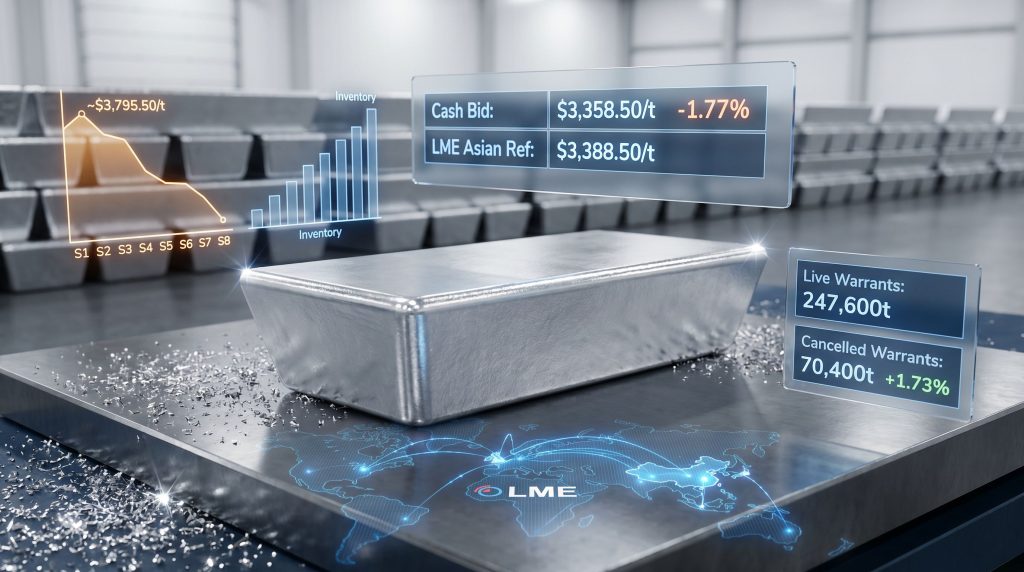
| Cash Bid | 3,418.50 | 3,358.50 | -1.76% |
| Cash Offer | 3,419.50 | 3,359.00 | -1.77% |
| 3-Month Bid | 3,430.00 | 3,388.50 | -1.21% |
| 3-Month Offer | 3,431.00 | 3,389.50 | -1.21% |
| Dec 2027 Bid | 3,208.00 | 3,203.00 | -0.16% |
| Dec 2027 Offer | 3,213.00 | 3,208.00 | -0.16% |
The steepest losses occurred at the front end of the curve, with cash contracts falling by approximately 1.76 to 1.77 percent in a single session. Three-month contracts recorded a more moderate decline of 1.21 percent, while December 2027 contracts barely moved, slipping only 0.16 percent.
This structure tells an important story. When near-term contracts fall sharply and long-dated contracts hold firm, the market is not signalling a fundamental reassessment of aluminium's long-term value. Instead, it is reflecting short-term financial selling pressure, a distinction that carries significant implications for how market participants should interpret the move. For broader context on aluminum and alumina markets, this divergence between contract maturities is a recurring feature worth monitoring closely.
The LME Asian Reference Price and Regional Demand Context
The LME Asian reference price settled at USD 3,388.50 per tonne on June 16. This benchmark serves as a critical pricing anchor for physical buyers across Asia, a region that accounts for a substantial share of global aluminium consumption. The relative stability of this reference price, compared to the broader cash contract decline, suggests that underlying physical demand from Asian buyers has not materially softened.
For industries reliant on forward purchasing contracts, particularly automotive and packaging manufacturers across Southeast Asia and Japan, this benchmark provides a more meaningful short-term signal than the daily spot volatility on the LME screen.
Contextualising the Correction: How Far Have Prices Actually Fallen?
From a Four-Year Peak to a Multi-Session Retracement
To understand the significance of the June 16 decline, it must be placed within the broader price trajectory. LME aluminium prices come off an approximate four-year peak of USD 3,795.50 per tonne before entering a corrective phase. Over approximately eight trading sessions, cash prices retreated by roughly USD 297 per tonne, representing a decline of approximately 7.8 percent from peak levels.
Corrections of this scale, following speculative-driven rallies in base metals, are not historically unusual. What matters is whether the correction is driven by a genuine deterioration in physical fundamentals or by financial market dynamics that are temporary in nature.
The evidence points strongly toward the latter.
Macro Headwinds Amplifying Financial Selling
Several macro forces converged to accelerate the price pullback beyond what physical fundamentals alone would justify:
- A strengthening US dollar applied broad downward pressure across all dollar-denominated commodities, including base metals traded on the LME
- Risk-off sentiment linked to geopolitical uncertainty, particularly around US-Iran tensions, prompted rapid unwinding of speculative long positions that had built up during the rally
- Overcrowded positioning in aluminium futures meant that when selling began, it fed on itself, compressing prices faster than the underlying supply-demand balance warranted
- The cash premium, known as backwardation in LME terminology, reportedly narrowed by more than 97 percent across just ten trading sessions, partly reflecting increased Chinese aluminium export flows that eased near-term delivery pressure in overseas markets
Furthermore, the broader policy environment has added pressure. Recent developments around aluminum and steel tariffs have introduced additional uncertainty into global trade flows, contributing to the cautious mood among financial market participants.
When speculative positioning becomes heavily concentrated on one side of a trade, the subsequent unwind can create price moves that dramatically overshoot what physical fundamentals would justify. Recognising this disconnect is what separates informed analysis from reactive trading.
It is worth noting that a narrowing backwardation does not indicate oversupply in any structural sense. It signals that the immediate delivery premium has compressed, while the longer-term supply deficit remains intact.
The Inventory Story: Why LME Warehouse Stocks Keep Falling
A Persistent and Accelerating Drawdown
While prices were falling, LME aluminium warehouse stocks continued their downward trajectory. The inventory data from June 16 reinforces a trend that has been building throughout 2026:
| Inventory Metric | Previous Level | Current Level | Change |
|---|---|---|---|
| Opening Stocks | 319,925 tonnes | 319,500 tonnes | -425 tonnes (-0.13%) |
| Live Warrants | 250,300 tonnes | 247,600 tonnes | -2,700 tonnes (-1.08%) |
| Cancelled Warrants | 69,200 tonnes | 70,400 tonnes | +1,200 tonnes (+1.73%) |
The most significant figure in this table is the 1.08 percent single-session decline in live warrants, which fell from 250,300 to 247,600 tonnes. Live warrants represent the portion of LME-registered inventory that is immediately available for physical delivery. A decline here means real metal is leaving warehouses and entering the physical supply chain.
Equally telling is the rise in cancelled warrants to 70,400 tonnes. In LME market mechanics, a cancelled warrant represents inventory that has been earmarked for physical removal from an LME-approved warehouse. It is a forward-looking indicator, meaning the drawdown pipeline is actually larger than the stock figures immediately suggest.
Since the start of 2026, total LME aluminium warehouse stocks have declined by approximately 300,000 tonnes. This is not a short-term fluctuation — it is a structural reduction that has been sustained across months and multiple market conditions.
Understanding Why Falling Stocks and Falling Prices Can Coexist
This is one of the most misunderstood dynamics in commodity markets, and it is worth unpacking carefully.
In a textbook supply-demand model, falling inventory levels should push prices higher. However, real commodity markets do not operate in isolation from financial markets. When large numbers of speculative investors simultaneously reduce their long positions, the resulting selling pressure can overwhelm the price signal that tight physical inventory would otherwise generate.
This creates a temporary decoupling between the financial price of aluminium on the LME screen and the physical reality of tightening supply. For manufacturers and industrial buyers who understand this mechanism, it can represent a purchasing opportunity. For speculators caught on the wrong side of a positioning squeeze, it is simply painful.
The inventory data, not the spot price, is the most reliable indicator of where the physical market genuinely stands during periods of speculative deleveraging.
Is the Structural Supply Shortage Still Intact?
Inventory Levels Near 20-Year Lows
The broader inventory context is striking. LME aluminium warehouse stocks are reported to be hovering near levels not seen in approximately two decades. This level of physical scarcity has historically served as a meaningful price floor, preventing sustained bear markets from taking hold even when macro headwinds are present.
The current drawdown trajectory also raises an important forward-looking question. If inventories continue declining through the second half of 2026, the market will have progressively less buffer to absorb any sudden uptick in demand. A supply response would need to emerge quickly, and there are structural reasons why that may not happen easily.
Smelter Economics and the Capacity Constraint Problem
New primary aluminium smelting capacity is extraordinarily capital-intensive and energy-intensive. The industry has faced structural underinvestment in new capacity relative to projected demand growth through 2030, driven by the twin pressures of high energy costs and the long lead times required to bring new smelters online.
In energy-sensitive regions such as Europe and parts of the Middle East, any restart of curtailed smelting capacity is closely tied to electricity pricing. Until energy economics improve sufficiently, available nameplate capacity may remain offline. This means that even if aluminium prices recover meaningfully, the supply response will lag significantly, a dynamic that reinforces the bullish case for the medium-term price outlook.
The long-term demand picture adds further weight. Aluminium's role in electric vehicle manufacturing, renewable energy infrastructure, and lightweight construction means that demand growth is structurally embedded in the global energy transition, a multi-decade tailwind with no credible near-term reversal. Consequently, the top aluminium producers are navigating a complex balance between constrained capacity and accelerating structural demand.
What Stable Alumina Prices Signal About Upstream Dynamics
LME Alumina Platts Holds at USD 305.57 Per Tonne
The LME alumina Platts reference price remained unchanged at USD 305.57 per tonne on June 16, even as downstream aluminium prices fell. This divergence between input costs and output prices is analytically significant for several reasons:
- Smelter margin compression: When aluminium prices fall while alumina costs hold steady, smelter profitability deteriorates. This reduces the incentive to expand or restart production capacity.
- Production discipline: Historically, compressed margins lead to voluntary or involuntary production curtailments, which tighten the physical supply of aluminium downstream and support price recovery over time.
- Independent market dynamics: The stability of alumina prices reflects the independent supply-demand balance in the alumina market, which is not simply a derivative of aluminium price movements.
- Barrier to new supply: New aluminium smelting capacity cannot be economically justified when input costs are high and output prices are under pressure, creating a structural barrier to supply expansion precisely when the market might need it most.
This upstream-downstream dynamic is one of the lesser-understood mechanisms in aluminium market analysis, but it has historically been one of the most reliable indicators of where production trends are heading. In addition, green metals pricing trends suggest that the energy transition is reshaping cost structures across the entire metals complex, adding another layer of complexity to smelter economics.
The next major ASX story will hit our subscribers first
Key Indicators to Watch in the Weeks and Months Ahead
Short-Term Price Catalysts
Several variables could shift the near-term price trajectory materially:
- US dollar movements: A reversal in dollar strength has historically provided meaningful relief to LME base metal prices, including aluminium
- Geopolitical risk premium: Any reduction in US-Iran tensions could release some of the risk-off pressure currently weighing on industrial commodity markets
- Speculative positioning data: CFTC and LME commitment-of-traders reports will reveal whether financial investors are beginning to rebuild long positions, which would be a meaningful bullish signal
Medium and Long-Term Structural Signals
For investors and industrial buyers with a longer time horizon, the following indicators carry more weight:
- Cancelled warrant trends: Rising cancelled warrants, as observed on June 16, are a leading indicator of continued physical withdrawals. Monitoring the rate of increase provides advance warning of inventory tightening
- Chinese export volumes: Chinese industrial demand and export activity have partially alleviated near-term delivery pressure in overseas markets. Any reduction in these flows would rapidly re-tighten the global physical market
- Smelter restart activity: Announcements of new capacity or restarts in energy-sensitive regions will shape the second half of 2026 supply outlook more than any single price session
- Energy pricing trends: Electricity cost trajectories in Europe and the Middle East will determine the economics of dormant smelter capacity, representing a key variable for the medium-term supply outlook
Frequently Asked Questions: LME Aluminium Prices and Warehouse Stocks
Why did LME aluminium prices fall on June 16?
LME aluminium cash prices declined by approximately 1.76 to 1.77 percent on June 16, driven primarily by a combination of financial selling pressure from speculative long unwinding, a stronger US dollar, and risk-off sentiment linked to geopolitical uncertainty. The move reflected financial market dynamics more than any fundamental deterioration in physical supply. Rangebound aluminium prices have been a recurring pattern as falling stocks offset seasonal slowdowns in demand.
What does a rise in cancelled warrants mean for aluminium prices?
Cancelled warrants represent LME-registered aluminium that has been formally earmarked for physical removal from approved warehouses. The increase to 70,400 tonnes signals that physical buyers are actively withdrawing metal, reinforcing the drawdown trend and supporting a medium-term constructive supply narrative.
Are LME aluminium warehouse stocks at historically low levels?
Yes. LME aluminium inventories have declined by approximately 300,000 tonnes since the beginning of 2026 and are reported to be near 20-year lows in a historical context. This level of physical scarcity provides a structural price floor even during periods of financially driven price weakness. The persistent trend of LME aluminium prices decline and warehouse stocks fall together represents one of the most consequential dynamics currently unfolding in global base metals markets.
Why did alumina prices hold steady while aluminium prices fell?
The LME alumina Platts price held at USD 305.57 per tonne despite softening aluminium prices because the alumina market operates according to its own independent supply-demand dynamics. This upstream stability compresses smelter margins during aluminium price pullbacks, discouraging new production and reinforcing the medium-term supply shortage thesis.
Reading the Signal Behind the Noise
The June 16 LME aluminium session offered a textbook example of how financial market mechanics can temporarily override physical supply signals. Prices fell sharply at the front end of the curve, driven by speculative deleveraging rather than any fundamental shift in supply or demand. Meanwhile, warehouse stocks continued their persistent decline, cancelled warrants continued to rise, and alumina prices held steady — each data point pointing in the same structural direction.
For market participants who understand the difference between financial noise and physical signal, the current environment provides a clearer picture than the headline price movement suggests. The structural supply shortage has not been resolved by a week of price declines. If anything, the continued drawdown of live warrants while prices are soft makes the eventual supply-demand reckoning more significant, not less.
When financial deleveraging temporarily disconnects LME aluminium prices from physical realities, the inventory data becomes the most reliable guide to where the market is genuinely headed. The stocks are still falling. That fact does not change because the price did.
This article is intended for informational purposes only and does not constitute financial or investment advice. Commodity markets involve significant risk, and past price patterns are not necessarily indicative of future outcomes. Readers should conduct their own due diligence before making any investment or commercial decisions.
Want to Stay Ahead of the Next Major ASX Mineral Discovery?
Discovery Alert's proprietary Discovery IQ model delivers real-time alerts on significant ASX mineral discoveries, instantly cutting through market noise to surface actionable opportunities — explore the historic returns major discoveries have generated and begin your 14-day free trial at Discovery Alert to position yourself ahead of the broader market.