June 17, 2026
When Supply Shocks Become Demand Shocks: The Iran War's Lasting Mark on Oil Markets
Energy market history is punctuated by supply disruptions that spike prices and then resolve. The Arab oil embargo, the Gulf War, the Libyan civil war — each created a temporary shock before markets rebalanced. What the International Energy Agency's June 2026 oil market report describes is something structurally different: a conflict that has simultaneously destroyed supply capacity and crushed the demand that would otherwise absorb it. Understanding IEA oil demand destruction from the Iran war, and what it implies for energy markets through 2027, requires looking beyond the headline price moves.
When big ASX news breaks, our subscribers know first
Why IEA Oil Demand Destruction From the Iran War Defies Historical Comparisons
Most supply disruptions follow a predictable sequence. Output falls, prices rise, consumers absorb higher costs while producers scramble to fill the gap, and eventually equilibrium returns. However, the IEA oil demand destruction from the Iran war broke this sequence at step two. Prices rose sharply enough, and refined product shortages spread broadly enough, that instead of simply paying more for oil, large segments of the global economy began consuming less of it.
This distinction between a price spike and genuine demand destruction is critical for understanding long-term market structure. Demand destruction is not a temporary dip that self-corrects when prices fall. It reflects behavioural and industrial changes — including fuel switching, capacity rationalisation, deferred investment, and accelerated adoption of alternatives — that can persist long after the original supply constraint is resolved.
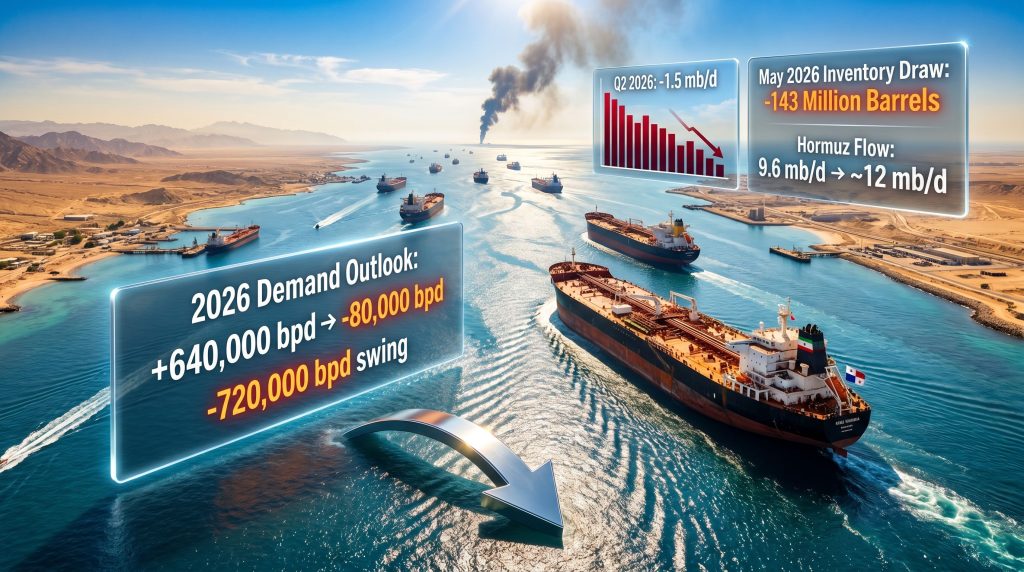
The IEA characterised the resulting supply shock as the most severe on record, and the demand response has matched that severity. The agency's revised 2026 global oil demand outlook moved from projected growth of approximately 640,000 barrels per day to an outright contraction of 80,000 barrels per day, a directional reversal representing a swing of roughly 720,000 bpd in a single monthly forecast update. Current crude oil prices reflect these dramatic revisions in real time.
The Mechanics of Dual Destruction
The mechanism driving this outcome operates on two fronts simultaneously. On the supply side, the Strait of Hormuz — through which approximately 20% of globally traded oil transits — came under severe operational stress from the conflict's onset on 28 February 2026. Strait throughput collapsed to a May low of just 9.6 million barrels per day, creating cascading shortages across Asian refining hubs and European spot markets.
On the demand side, the price and shortage signals radiating outward from the Gulf produced their own contraction:
- Transport fuel consumption fell as elevated pump prices suppressed driving and freight activity
- Petrochemical output contracted as naphtha and LPG feedstocks became scarce and expensive
- Airlines curtailed routes and capacity in response to jet fuel scarcity and cost pressure
- Industrial operators deferred energy-intensive activity or accelerated fuel substitution programmes
The second-quarter demand contraction reached 1.5 million barrels per day, marking the steepest quarterly decline since the COVID-19 pandemic. In a more severe scenario modelled by the IEA, the Q2 through Q4 period could see an average year-on-year contraction of as much as 5 million barrels per day.
The Supply Collapse in Numbers
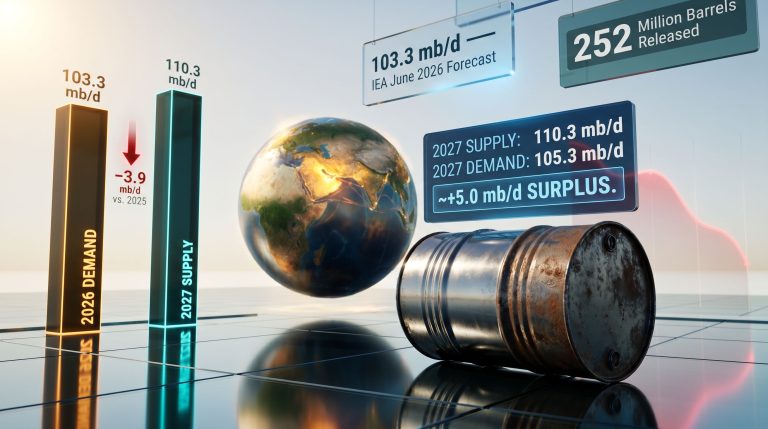
Global oil supply fell to 94.5 mb/d in May, down 600,000 bpd month-on-month. Output dropped to 13.6 mb/d in directly affected production zones, well below pre-conflict levels. For the full year 2026, the IEA now projects global supply to decline by 3.9 mb/d year-on-year to 102.4 mb/d. Monitoring crude oil price trends over recent months makes this contraction even more striking in historical context.
| Metric | Pre-Conflict Level | May 2026 Reading | Change |
|---|---|---|---|
| Global Oil Supply | ~95.1 mb/d | 94.5 mb/d | -0.6 mb/d MoM |
| Strait of Hormuz Flows | ~20 mb/d+ | 9.6 mb/d (low) | >50% reduction |
| Hormuz Flows (recovered) | ~20 mb/d+ | ~12 mb/d | Partial restoration |
| Full-Year 2026 Supply Forecast | ~106.3 mb/d | 102.4 mb/d | -3.9 mb/d YoY |
Ship-to-ship transfer operations in the Gulf of Oman provided partial relief, helping restore Hormuz throughput from its May low to approximately 12 mb/d. However, the IEA emphasised that full normalisation of shipping lanes requires formal mine clearance operations across primary transit corridors, a process measured in months rather than weeks.
The Inventory Buffer Problem
Perhaps the most concerning signal in the IEA's report involves the pace of global inventory drawdowns. These strategic and commercial stockpiles normally act as a buffer between supply disruptions and physical market stress. Their rapid depletion removes that shock absorption capacity precisely when it is most needed.
| Period | Inventory Draw | Context |
|---|---|---|
| April 2026 | -74 million barrels | Accelerating from prior months |
| May 2026 | -143 million barrels | Record single-month draw |
| Since Feb 28 conflict start | ~3.8 mb/d continuous | Approaching historic low territory |
The IEA issued a direct caution that continued erosion at this pace could drive global oil stocks to historically low levels before any market surplus emerges, creating a window of extreme price sensitivity even as the broader directional trend moves toward oversupply.
This paradox — where the market is simultaneously drawing down inventories at record speed and moving toward a structural glut — reflects the unusual timing dynamics of the conflict's resolution. The shortage phase and the surplus phase are separated by only months, with very little buffer in between.
The 2027 Glut Scenario: When Peace Creates an Oversupply Problem
The IEA's preliminary 2027 modelling introduces a dynamic that oil markets rarely encounter in such concentrated form: the resolution of a major supply shock that simultaneously unleashes a supply surge while demand recovery lags significantly behind.
| Variable | 2026 Estimate | 2027 Projection | Net Change |
|---|---|---|---|
| Global Oil Supply | 102.4 mb/d | 110.3 mb/d | +7.9 mb/d |
| Global Oil Demand | ~103.3 mb/d | 105.3 mb/d | +2.0 mb/d |
| Implied Surplus | Near-deficit | ~5 mb/d overhang | Structural imbalance |
The supply side can respond faster than the demand side for several interconnected reasons. Iranian crude exports require only the lifting of naval blockade restrictions and basic logistical coordination to resume at meaningful scale. Furthermore, Gulf producers that curtailed output during the conflict period hold significant idle capacity ready for rapid deployment. OPEC's market influence remains a pivotal force in determining how quickly that capacity is deployed and at what cost to price stability.
Demand recovery, by contrast, is governed by slower-moving forces. Behavioural changes embedded during the demand destruction phase — including fuel switching decisions, fleet electrification investments, and industrial process modifications — do not automatically reverse when prices fall. The petrochemical sector, aviation industry, and transport networks each require a sustained period of price stability before restoring prior consumption trajectories.
What Markets Are Already Pricing In
Oil markets have begun front-running the anticipated supply recovery. Brent crude fell to approximately $78.44 at the time of reporting, near a three-month low, while WTI futures for July delivery traded at approximately $75.18. Three Iranian tankers carrying nearly 5 million barrels of crude transited the U.S. Navy blockade ahead of the planned Geneva agreement signing, a development markets interpreted as confirmation of imminent export resumption.
An analyst at PVM Oil Associates observed that despite the record-scale inventory drawdowns experienced during the conflict period, oil prices had returned to levels close to their pre-war baseline. This price behaviour reflects a market consensus that Hormuz reopening is probable and that gradual supply normalisation will follow. The key unresolved variable is how quickly the physical recovery translates into incremental barrels reaching end markets.
Recovery Timeline Scenarios: Fast, Gradual, or Delayed
A ceasefire agreement does not translate automatically into restored oil flows. Several structural constraints govern how quickly the market can physically rebalance, regardless of what diplomatic agreements specify.
- Mine clearance operations across primary Hormuz shipping lanes must be completed before commercial vessels can transit safely at normal frequencies
- Tanker scheduling and port coordination require weeks of logistical reconstruction before export volumes normalise
- Marine insurance underwriting for Gulf transits must be restored by Lloyd's and other major underwriters, a process governed by risk assessment rather than political timelines
- Iranian production ramp-up faces infrastructure maintenance backlogs accumulated during the conflict period, constraining the speed of export volume recovery
- Refinery restart sequencing in affected Gulf states must precede meaningful refined product flow normalisation
| Scenario | Hormuz Recovery Timeline | 2027 Market Impact | Brent Price Implication |
|---|---|---|---|
| Fast Recovery | Full reopening by Q3 2026 | Large surplus, significant price pressure | Potential sub-$70 range |
| Gradual Recovery | Partial flows through Q4 2026 | Moderate surplus, balanced market | $75-$85 range |
| Delayed Recovery | Beyond Q1 2027 | Continued inventory stress | Price floor support above $85 |
Macro Consequences Beyond the Oil Price
Downstream Sector Pressures
The demand destruction radiating from the conflict extends well beyond crude oil consumption metrics. Several downstream sectors face compounding structural stress:
- Petrochemical manufacturing across Asia faces feedstock shortages in naphtha and LPG that constrain plastics, fertiliser, and chemical production capacity
- Aviation confronts a structural squeeze between jet fuel scarcity and demand suppression at precisely the point when post-pandemic capacity recovery was gaining momentum
- Emerging market economies that import oil face a dual burden of elevated import costs and currency depreciation that amplifies domestic inflation pressure
- Agricultural supply chains are exposed through fertiliser cost increases that feed directly into food production economics globally
The oil price war impacts flowing through these sectors underscore how interconnected global commodity markets have become.
An Accelerated Transition Window
One analytically underappreciated consequence of sustained demand destruction episodes is their tendency to compress energy transition timelines. When fuel prices remain elevated for extended periods, the economics of electrification, fuel efficiency investment, and industrial energy substitution shift materially. Fleet operators, industrial planners, and infrastructure investors recalibrate long-term capital allocation decisions based on price signals that persist for 12 to 24 months.
Consequently, energy transition pressures may accelerate adoption curves in transport electrification and industrial energy efficiency across affected regions — changes that would otherwise have unfolded over a decade. This creates a structural floor beneath any demand recovery projection: some portion of the consumption destroyed during 2026 will not return even after prices normalise.
OPEC+ Faces a Strategic Inflection Point
The post-war surplus scenario creates a significant internal tension within OPEC+. Members that curtailed production during the conflict period face revenue pressures that incentivise rapid output restoration. Iran's return to full production capacity introduces additional supply that cannot be easily absorbed within existing quota frameworks without price consequences.
Saudi Arabia and the UAE face a strategic calculation between defending price floors through continued production restraint or defending market share by allowing volumes to rise with the recovering market. The cartel's historical cohesion under supply pressure is not guaranteed to hold when the pressure reverses into a surplus environment, particularly if member states face divergent fiscal breakeven requirements. For further context, the IEA's analysis of Middle East energy dynamics provides useful structural perspective on these tensions.
The next major ASX story will hit our subscribers first
Key Takeaways for Energy Market Participants
IEA oil demand destruction from the Iran war represents a more complex market event than the supply shock framing initially suggested. In addition, several core dynamics deserve careful ongoing monitoring:
- The 2026 demand outlook has shifted from growth to contraction, driven by price-induced consumption suppression that may prove partially permanent rather than fully cyclical
- A post-war supply rebound of approximately 7.9 mb/d is projected to outpace demand recovery by roughly 3.5 to 4 times, creating a substantial 2027 overhang
- Inventory buffers drawing down at 143 million barrels per month could reach historic lows before the market transitions to surplus, sustaining near-term price volatility even as longer-term direction tilts bearish
- The physical constraints on Hormuz normalisation — including mine clearance, insurance restoration, and logistics reconstruction — mean the surplus scenario unfolds gradually rather than immediately
- Markets have already begun pricing in the peace deal resolution, with Brent near three-month lows despite inventory buffers remaining severely depleted
Tracking current crude oil prices against these evolving supply and demand fundamentals will be essential for participants navigating the months ahead.
This article contains forward-looking projections sourced from the IEA's June 2026 oil market report and publicly available market analysis. Commodity price forecasts and supply-demand projections involve material uncertainty. Nothing in this article constitutes investment advice. Readers should conduct independent research before making any investment or trading decisions.
Want to Capitalise on the Next Major Commodity Discovery Before the Market Does?
Whilst oil market dynamics reshape global energy economics, significant mineral discoveries on the ASX continue to create compelling investment opportunities — and Discovery Alert's proprietary Discovery IQ model delivers real-time alerts the moment they are announced, transforming complex data across 30+ commodities into clear, actionable insights. Explore historic discovery returns on Discovery Alert's dedicated discoveries page and begin your 14-day free trial to position yourself ahead of the broader market.