June 17, 2026
Understanding the Scale: When a Single Chokepoint Redefines Global Energy Risk
Every few decades, the global oil market confronts a disruption that exposes the fragility of infrastructure the world takes for granted. The Persian Gulf's role as the central artery of international petroleum trade has long been understood in theory. The events beginning on February 28, 2026, transformed that theoretical vulnerability into a lived market reality, triggering what the International Energy Agency (IEA) has characterised as the largest supply disruption in the history of the global petroleum market.
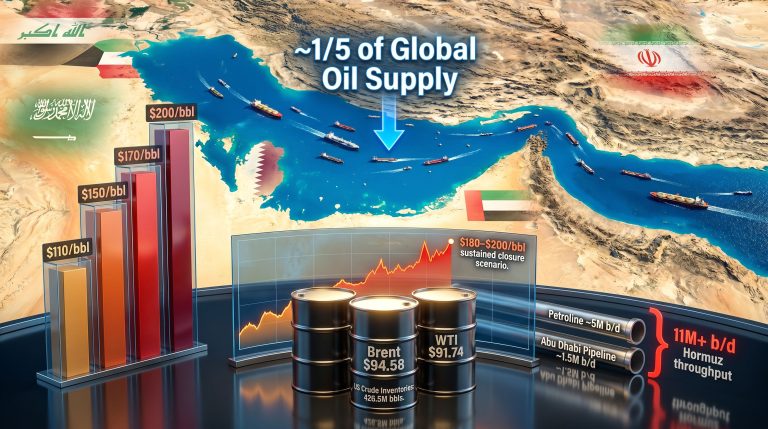
The Strait of Hormuz, at its narrowest point just 33 kilometres wide, carries an estimated 20% of all globally traded oil under normal operating conditions. When conflict between the United States and Iran resulted in a blockade of the strait, more than 14 million barrels per day (bpd) of West Asian production was effectively severed from international markets. To put this in historical context, the 1973 Arab oil embargo removed roughly 4.3 million bpd from global supply. The 1990 Gulf War caused approximately 4.5 million bpd of disruption at its peak. The 2026 Hormuz blockade dwarfed both events combined.
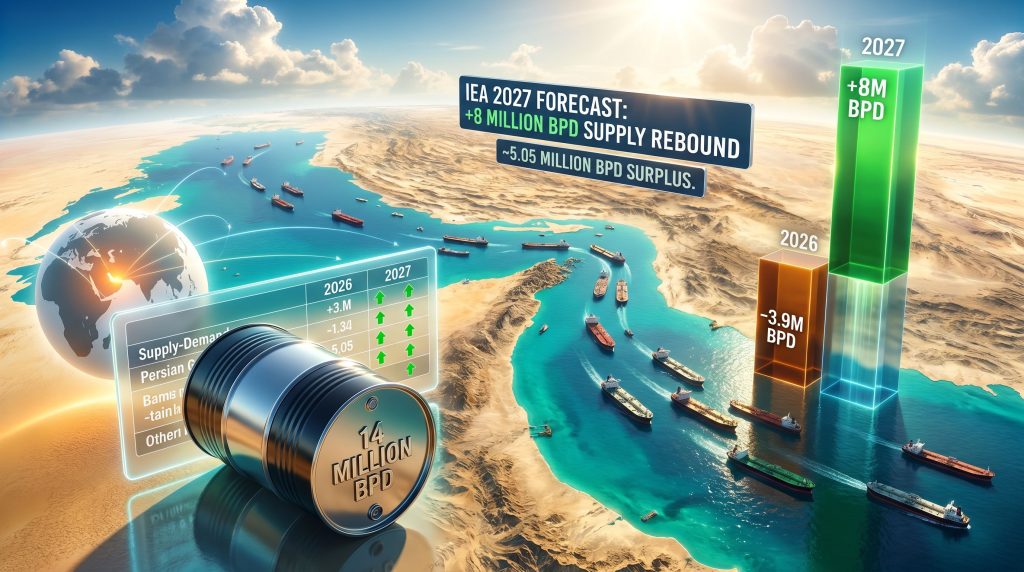
The subsequent US-Iran interim agreement, which includes Iran reopening the strait and the removal of the US naval blockade, sets the stage for one of the most consequential market recoveries in modern petroleum history. Central to that recovery narrative is the IEA 2027 oil surplus after Strait of Hormuz reopening, which projects a supply surplus of approximately 5.05 million bpd driven by the return of West Asian barrels to global trade.
When big ASX news breaks, our subscribers know first
The Anatomy of the 2026 Supply and Demand Collapse
Understanding why the IEA 2027 oil surplus after the Strait of Hormuz reopening is so significant requires first mapping the depth of the damage inflicted on both sides of the supply-demand equation during 2026. Furthermore, the crude oil price trends leading into this period had already signalled underlying market tension before the blockade crystallised.
Supply: The Scale of Production Losses
The IEA projects that global oil supply will contract by 3.9 million bpd across the full calendar year 2026. This net figure masks a starker underlying reality: the production losses concentrated in the Middle East were far larger, partially offset by rising output from the Americas. Without that Western Hemisphere buffer, the net contraction would have been considerably more severe.
Simultaneously, global oil demand fell by 1.1 million bpd over the full year. The most violent contraction occurred between April and June 2026, when demand collapsed by 5 million bpd as economic activity across multiple regions absorbed the energy price shock.
Inventory Destruction: The Hidden Crisis
Perhaps the least visible but most consequential dimension of the crisis was the pace at which global oil inventories were depleted.
- Inventories drew down at a rate of 3.8 million bpd from the start of conflict on February 28
- May 2026 alone recorded stock draws of approximately 4.6 million bpd
- The IEA explicitly warns that inventories could fall further to historic lows before the market balance shifts toward surplus
This inventory destruction is significant beyond the immediate supply concern. Strategic petroleum reserves (SPRs) exist precisely to buffer against disruptions of this kind. Once depleted, rebuilding them takes sustained time and market conditions that favour buying rather than burning. The 2027 surplus, in this context, is not merely a price-bearish signal — it represents a rare structural window for SPR replenishment across consuming nations.
The simultaneous collapse of supply, demand, and inventories created a market environment that defies clean comparison with any previous geopolitical oil shock. Traditional price-shock models built on single-variable disruptions were ill-equipped to model a crisis operating across all three market pillars at once.
Breaking Down the IEA's 2027 Oil Surplus Forecast
The Supply-Demand Arithmetic in Detail
The IEA's first-ever 2027 oil market outlook represents a structural inflection point. According to the IEA's Oil Market Report, the numbers tell a compelling story on their own.
| Metric | 2026 Estimate | 2027 Forecast |
|---|---|---|
| Supply Change (bpd) | -3.9 million | +8 million |
| Demand Change (bpd) | -1.1 million | +2 million |
| Market Balance | ~920,000 bpd deficit | ~5.05 million bpd surplus |
| Inventory Trend | Drawing at 3.8-4.6M bpd | Rebuilding phase begins |
The critical insight embedded in this table is the asymmetry between supply and demand recovery speeds. Supply is projected to rebound at four times the pace of demand. This mismatch is the mechanical engine of the surplus. When West Asian production returns to global markets, the structural overhang will not be absorbed gradually by recovering demand. Instead, it will land in a market still digesting economic damage from the conflict period.
What makes this forecast unusual in petroleum market history is the sheer magnitude of the projected overhang. A surplus of 5.05 million bpd would represent one of the largest peacetime oversupply conditions ever recorded, comparable in scale only to the 2020 COVID-era demand collapse, though operating through an entirely different mechanism.
A Timeline for the Market Turn
The transition from deficit to surplus will not happen overnight. A realistic timeline framework illustrates the sequential steps required:
- Early June 2026: Ship-to-ship transfers in the Gulf of Oman begin lifting total West Asian flows from a May low of 9.6 million bpd toward approximately 12 million bpd
- Mid-to-late 2026: Demining operations and transit arrangement negotiations proceed, but introduce persistent delay risks to full production restoration
- Late 2026: Inventories may reach historic lows before the balance tips, as the IEA explicitly cautions continued near-term stock depletion
- January 2027: Both the IEA and the US Energy Information Administration (EIA) converge on full restoration of shut-in production capacity as the most probable milestone
- Full-year 2027: Sustained surplus conditions expected to dominate, with demand recovery lagging the supply rebound by a factor of roughly four
Why the Recovery Is More Complex Than the Headlines Suggest
Operational Friction: The Demining Problem
One of the least-discussed dimensions of the Hormuz recovery is the physical complexity of demining operations. Naval mines deployed in or around the strait cannot simply be declared cleared and forgotten. Demining is a slow, methodical process requiring specialised vessels and expertise, and its pace is governed by operational reality rather than diplomatic timelines.
This creates a structural floor on how quickly full shipping resumption can occur, regardless of the political agreement in place. These oil market disruptions compound one another in ways that make linear recovery projections difficult to rely upon.
The shipping insurance market adds another layer of friction. Even when physical clearance is declared, hull and cargo underwriters apply their own risk assessments before restoring normal coverage terms. The practical effect is that tanker operators face elevated insurance premiums and passage uncertainty for an extended period after the formal reopening, which can delay commercial shipping decisions independently of geopolitical factors.
Iranian Export Restoration: The Key Swing Variable
Iranian crude exports occupy a unique position in the recovery arithmetic. Iran possesses significant production capacity, but the pace at which that capacity translates into actual export volumes depends on several sequential conditions:
- The formal and verifiable lifting of the US naval blockade
- The restoration of tanker operator confidence in Iranian port access
- The reactivation of crude offtake agreements with Asian buyers, particularly in China, India, and South Korea
- Rehabilitation of any port or pipeline infrastructure affected during the conflict period
Each of these steps involves its own timeline, and none can be meaningfully accelerated beyond what logistics and commercial negotiation allow. The aggregate effect is that Iranian export restoration will likely be gradual across 2026–2027 rather than a single step-change event.
Russia's Parallel Supply Dynamic
Russian crude and refined product exports held relatively stable at approximately 7.4 million bpd in May 2026, despite sustained Ukrainian drone strikes targeting refinery infrastructure. The attacks compelled Russia to make a strategic reallocation decision: prioritise domestic fuel supply while maximising crude exports rather than refined product exports.
This Russian supply resilience introduces a non-Middle Eastern variable into the 2027 surplus equation. If geopolitical conditions stabilise further and Russia's export capacity increases, the already-large projected surplus could widen beyond current IEA estimates.
Demand Destruction: Broader Than Expected and Slower to Heal
Geographic Spread of the Damage
The IEA's reporting indicates that demand destruction has moved well beyond the immediate conflict zone. Deliveries of major fuel categories are showing strain across almost all regions, with gasoil displaying particular weakness. This matters because gasoil is not a consumer luxury fuel — it powers freight trucks, agricultural machinery, industrial generators, and construction equipment. Weakness in gasoil demand signals second-order economic damage that runs through supply chains and into broader productivity.
The breadth of the demand weakness across fuel types suggests that the economic recovery trajectory will be uneven:
- Gasoil and industrial fuels: Likely to recover last, tied to capital investment cycles
- Transport fuels (jet and gasoline): Recovery linked to travel demand and consumer confidence
- Residual and heavy fuel oils: Dependent on power sector decisions and industrial restart activity
The OPEC vs. IEA Demand Divergence
One of the more consequential analytical tensions in the current forecasting landscape is the gap between IEA and OPEC demand projections. Reviewing OPEC demand forecasts alongside IEA data reveals a significant divergence, with OPEC's own monthly report lowering its 2026 demand growth forecast to 970,000 bpd — a considerably more conservative reading than the IEA's demand recovery narrative.
If OPEC's more pessimistic demand assessment proves accurate, the mathematics of the 2027 surplus become more extreme, not less. A weaker demand base in 2026 means a lower rebound ceiling in 2027, which would widen the supply overhang beyond the IEA's current 5.05 million bpd estimate.
Comparing the Major Forecasters on 2027
| Forecaster | 2026 Demand Change | 2027 Supply Outlook | Surplus Estimate | Recovery Timeline |
|---|---|---|---|---|
| IEA | -1.1 million bpd | +8 million bpd | ~5.05 million bpd | Full restoration by Jan 2027 |
| EIA | Broadly consistent | Consistent direction | Not separately quantified | Late 2026 to early 2027 |
| OPEC | +970,000 bpd growth | Not specified | More conservative | Not specified |
The IEA and EIA alignment on the timing of production restoration lends credibility to the core surplus thesis. Furthermore, the EIA's global oil outlook reinforces many of the IEA's directional conclusions, even where precise estimates diverge. Where meaningful disagreement exists is on the demand side, with OPEC's more conservative view representing the primary variable that could either narrow or widen the eventual surplus.
The next major ASX story will hit our subscribers first
Strategic Implications: What a 5-Million-Barrel Surplus Means in Practice
Price Pressure and OPEC+ Decision-Making
A surplus of 5 million bpd would exert substantial downward pressure on benchmark crude prices. For OPEC+ members who expanded or maintained production during the disruption period, a price normalisation cycle compresses revenue against a backdrop of elevated fiscal break-even requirements. Nations that require oil revenues above $70–80 per barrel to balance national budgets face particularly difficult choices if surplus conditions push prices significantly lower.
The strategic decision facing OPEC+ in 2027 will be whether to attempt production cuts to defend price levels or accept market share in a surplus environment. History suggests this is rarely a simple collective action problem, as member incentives frequently diverge.
SPR Replenishment: Converting Surplus into Strategic Asset
The IEA frames the 2027 surplus constructively as an opportunity to rebuild depleted inventories and create new strategic reserves. This framing reflects an energy security policy perspective that moves beyond the simple bearish price narrative.
Countries that drew down SPRs to manage the 2026 crisis face a genuine urgency to replenish before the next disruption cycle. A surplus environment provides lower-cost acquisition conditions and market willingness to sell. The strategic calculus for major consuming nations is therefore to use the 2027 surplus window actively, rather than waiting for market equilibrium.
Refinery and Downstream Sector Adjustments
The return of specific Middle Eastern crude grades carries technical implications for the refining sector that are less visible but economically meaningful. Gulf crude grades carry distinct sulphur content and API gravity profiles. Refiners that adapted their crude slates during the disruption period, substituting Atlantic Basin or Latin American grades, will need to reconfigure processing operations as Gulf supply returns.
Asian refining hubs, particularly in China, India, Japan, and South Korea, will be the primary recipients of returning Middle Eastern volumes. The adjustment process involves both technical reconfiguration and commercial renegotiation of term supply contracts — processes that take months rather than weeks to complete fully.
Frequently Asked Questions: IEA 2027 Oil Surplus After Strait of Hormuz Reopening
What is the IEA's 2027 oil surplus forecast?
The IEA projects global oil supply will exceed demand by approximately 5.05 million bpd in 2027, driven by an 8 million bpd supply rebound as West Asian production resumes, while global demand recovers by only 2 million bpd.
When will oil markets move into surplus after the Hormuz reopening?
The IEA forecasts surplus conditions emerging toward the end of 2026, with a significant and sustained overhang materialising across the full year 2027.
What risks could prevent the 2027 surplus from materialising?
- Prolonged demining delays limiting shipping resumption
- Unresolved vessel transit and insurance arrangements
- Slower-than-expected Iranian export restoration
- Geopolitical re-escalation in the Gulf region
- Weaker macroeconomic recovery suppressing demand rebound
Why does the OPEC forecast matter for the surplus estimate?
OPEC's 2026 demand growth forecast of 970,000 bpd is considerably more conservative than the IEA's demand recovery scenario. If OPEC's view proves more accurate, the 2027 surplus would likely exceed the IEA's current estimate, amplifying downward price pressure.
Energy Security Architecture After Hormuz: Long-Term Structural Shifts
The events of 2026 will almost certainly accelerate policy conversations around supply route diversification that have proceeded slowly for decades. The exposure of 20% of global oil trade to a single 33-kilometre chokepoint is not a new vulnerability, but its consequences have now been measured in real economic damage rather than theoretical risk assessments.
Several structural shifts are likely to gather momentum in the post-crisis period:
- Pipeline infrastructure investment: Overland routes connecting Gulf producers to non-Hormuz export terminals will attract renewed commercial and sovereign interest
- SPR adequacy standards: The rate at which inventories were drawn down during the crisis, reaching approximately 4.6 million bpd of stock draws in May 2026 alone, will prompt reviews of minimum stockholding requirements across consuming nations
- Procurement diversification: Nations most dependent on Hormuz-transiting supply have the strongest incentive to establish alternative supply relationships with producers in the Americas, West Africa, and Central Asia
- Bilateral energy security agreements: The crisis may accelerate new frameworks between major consuming and producing nations outside the Hormuz corridor
In addition, considering how resource and energy exports from nations such as Australia are shaped by these dynamics will be critical for regional policymakers navigating the post-crisis energy landscape.
Perhaps the most underappreciated long-term dimension is how accelerating energy transition trends in developed economies affect the urgency of 2027 inventory rebuilding. If the structural ceiling on oil demand is lower in future cycles due to electrification and efficiency gains, the window for cost-effective SPR expansion at surplus prices may be narrower than historical precedent suggests. For energy security planners, 2027 may represent not just a cyclical opportunity but a structurally important moment that will not repeat on the same terms.
Disclaimer: This article contains forward-looking projections sourced from IEA, EIA, and OPEC monthly reports as of June 2026. Energy market forecasts are inherently subject to revision based on geopolitical developments, operational factors, and macroeconomic conditions. Nothing in this article constitutes financial or investment advice. Readers should conduct independent research before making any energy-related investment decisions.
Want to Stay Ahead of the Next Major Resource Discovery Before the Market Moves?
While geopolitical shocks reshape global energy flows and commodity markets, Discovery Alert's proprietary Discovery IQ model scans the ASX in real time, instantly notifying subscribers of significant mineral discoveries across 30+ commodities before the broader market reacts — explore historic discovery returns on Discovery Alert's discoveries page and begin your 14-day free trial to secure a genuine market-leading edge.