June 27, 2026
The Architecture of an Oil Glut: How Chokepoint Economics Shape Global Energy Cycles
Every generation or so, global energy markets experience a structural rupture so severe that it reshapes the assumptions underpinning commodity forecasting for years afterward. The closure of the Strait of Hormuz during the Iran conflict represents precisely such a moment. However, what distinguishes this disruption from every prior supply shock is not merely its scale — it is the mechanical certainty of what follows. When the world's largest energy chokepoint reopens after a historically unprecedented blockage, the resulting supply wave does not trickle back gradually. It surges.
When that surge collides with relatively modest demand growth, the arithmetic of oil markets shifts violently from scarcity to abundance. Understanding the IEA oil glut after Hormuz recovery requires more than tracking barrels. It demands an appreciation of pipeline physics, geopolitical sequencing, fiscal breakeven mathematics, and the psychology of markets navigating a transition from the largest supply shock in recorded history toward one of the most substantial projected surpluses ever modelled by a major energy agency.
When big ASX news breaks, our subscribers know first
The Numbers Behind the Largest Supply Disruption in History
The Strait of Hormuz has always carried an outsized symbolic and strategic weight relative to its physical dimensions. At its narrowest, the waterway spans just 33 kilometres, yet under normal operating conditions it channels roughly 20 to 21 percent of global petroleum liquids — the sole maritime export corridor for Saudi Arabia, Iraq, Kuwait, the UAE, Bahrain, and Qatar combined.
The conflict elevated that latent vulnerability into an active catastrophe. The IEA estimated that the disruption blocked more than 14 million barrels per day (b/d) of Middle Eastern oil output at peak impact. To contextualise that figure:
- The 1973 Arab oil embargo removed approximately 4.3 million b/d from global supply
- The 1990 Gulf War disruption removed an estimated 4 to 5 million b/d
- The 2011 Libyan civil war affected roughly 1.6 million b/d
- The 2026 Hormuz closure removed nearly three times the Gulf War disruption in volumetric terms
No historical analogue exists at this scale. Energy security planners and market modellers had long identified Hormuz as a systemic risk, but the full realisation of that risk has forced a fundamental reassessment of how quickly supply can both disappear and return. Furthermore, crude oil price trends heading into the conflict had already signalled growing market fragility before the closure took hold.
The Emergency Reserve Response: Unprecedented in Scope
Faced with a supply void of this magnitude, IEA member nations coordinated the release of 400 million barrels from strategic petroleum reserves — the largest emergency drawdown in the agency's history. The strategic intent behind this intervention operated on three levels:
- Preventing catastrophic price spikes from destabilising major oil-importing economies already managing elevated inflation
- Providing diplomatic breathing room for ceasefire negotiations to reach a conclusion
- Offsetting the most acute phase of commercial inventory drawdowns before any market rebalancing could occur
This drawdown, while effective in blunting the worst price outcomes, created a secondary problem: the reserves that cushioned the crisis must now be rebuilt. That replenishment imperative will become a significant demand variable in the post-surplus environment.
Dissecting the IEA's 2027 Oil Market Outlook
The IEA's first formal modelling of 2027 market conditions represents one of the most consequential forward assessments the agency has ever published. The central finding is a supply-demand divergence of historic proportions, driven by the arithmetic collision between a recovering Middle Eastern supply base and relatively subdued global demand growth. According to the IEA's own analysis, global supplies have undergone a significant readjustment in response to the Hormuz shock.
| Market Variable | 2026 Estimate | 2027 Forecast | Year-on-Year Change |
|---|---|---|---|
| Global Oil Supply | ~102.4 million b/d | ~110.3 million b/d | +8.0 million b/d |
| Global Oil Demand | ~103.5 million b/d | ~105.3 million b/d | +2.0 million b/d |
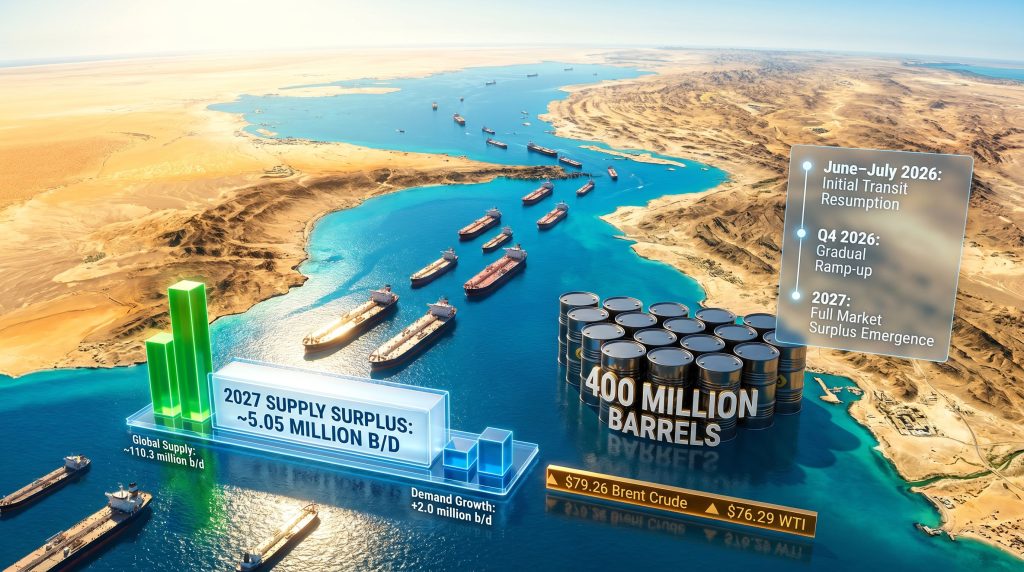
| Market Balance | ~920,000 b/d deficit | ~5.05 million b/d surplus | Swing of ~6 million b/d |
| Prior IEA 2027 Surplus Estimate (Nov 2025) | — | 4.09 million b/d | Revised upward by ~960,000 b/d |
The revised surplus figure of 5.05 million b/d is materially larger than the 4.09 million b/d the IEA had modelled in its November 2025 outlook, before the full scope of the conflict and its aftermath was incorporated into agency projections.
"The IEA noted that a large supply surplus in 2027 could provide the market with an opportunity to replenish depleted inventories or to build new strategic reserves, as countries review their energy strategies and policies in response to the crisis."
Why 2026 Remains a Deficit Year Despite the Peace Deal
A critical nuance that markets are actively grappling with is the gap between a diplomatic agreement and a physical supply restoration. The IEA's own data illustrates this lag clearly: despite the US-Iran interim agreement, the 2026 market balance remains in deficit territory, with supply running approximately 920,000 b/d below demand.
Several structural factors explain this persistence:
- Mine clearance operations along Hormuz shipping lanes are a multi-month undertaking even with modern mine countermeasure vessels deployed at full capacity
- Infrastructure inspection and recertification across Gulf export terminals cannot be compressed beyond physical and regulatory constraints
- Tanker fleet repositioning from Cape of Good Hope alternative routing back to Gulf loading terminals creates a logistical bottleneck that absorbs weeks of operational time
- War risk insurance markets at Lloyd's of London and other major marine underwriters must reassess their risk models before standard commercial shipping premiums are restored
- Hormuz throughput had recovered to only approximately 12 million b/d by early June 2026, still measurably below pre-conflict baselines after reaching a trough of 9.6 million b/d in May 2026
This gap between political resolution and physical market rebalancing is one of the least understood dynamics in the current environment. Consequently, it directly explains why oil inventories are projected to fall to historic lows before the IEA oil glut after Hormuz recovery fully materialises.
Price Dynamics: Competing Forces in an Unusual Market Structure
Oil markets as of mid-June 2026 present an analytically unusual picture. Brent crude was trading near $79.26 per barrel on June 17, while WTI was positioned at approximately $76.29 per barrel. Both benchmarks had declined roughly 5 percent in a single session following the announcement of the US-Iran peace agreement, as traders immediately priced in the prospect of supply restoration.
Yet the market has not collapsed to multi-year lows, and the structural reason lies in the two-phase dynamic currently embedded in forward curves. In addition, the trade war impact on oil pricing mechanisms has added further complexity to an already volatile pricing environment.
Phase 1 (Mid-to-Late 2026): Inventory Depletion Risk
- Strategic reserves drawn down by 400 million barrels and requiring replenishment
- Commercial inventories under sustained pressure from ongoing supply shortfalls
- Refinery throughput constrained by feedstock availability in key importing regions
- Physical tightness in prompt barrels coexisting with abundant paper supply expectations
Phase 2 (2027): Surplus and Restocking Window
- Middle Eastern barrels re-enter global markets at scale
- OPEC+ spare capacity deployment accelerates across multiple producers simultaneously
- Inventory replenishment transitions from aspiration to executable strategy
- Downward price pressure intensifies as physical glut becomes visible in storage data
This structure is producing what analysts describe as a classic contango formation in oil futures, where near-dated contracts carry a premium over forward contracts. Contango incentivises physical storage accumulation once supply becomes available, but it also signals that the market has already discounted a significant portion of the 2027 supply overhang into current forward prices.
What Historical Disruptions Suggest About Price Recovery Trajectories
| Historical Disruption | Peak Supply Removed | Post-Resolution Price Behaviour |
|---|---|---|
| 1973 Arab Oil Embargo | ~4.3 million b/d | Prices elevated for 12-18 months post-resolution |
| 1990 Gulf War | ~4-5 million b/d | Rapid normalisation within 6 months of ceasefire |
| 2011 Libya Civil War | ~1.6 million b/d | Moderate decline over 3-6 months |
| 2026 Hormuz Closure | ~14 million b/d | No direct historical precedent exists |
The absence of any comparable precedent is itself an important analytical point. The 1990 Gulf War, the most structurally similar event in modern history, saw relatively rapid price normalisation. However, that event removed roughly one-third of the barrels affected by the current closure, and it did not involve the simultaneous depletion of strategic petroleum reserves at the scale seen in 2026.
OPEC+ Strategy Under Surplus Conditions: A Structurally Difficult Position
The projected 2027 surplus creates the most complex production management challenge OPEC+ has faced in decades. OPEC market influence over price stability will be severely tested as the alliance must simultaneously navigate three competing imperatives:
- Allow member state production restoration — Gulf economies that absorbed severe revenue losses during the conflict face urgent political and fiscal pressure to ramp output back to pre-war levels as quickly as physically possible
- Defend price floors that protect the fiscal sustainability of petro-states whose national budgets depend on oil revenues consistently above $70-80 per barrel
- Manage the re-entry of Iranian barrels into a market already absorbing a massive supply wave from Saudi Arabia, Iraq, the UAE, and Kuwait simultaneously
Saudi Arabia's Fiscal Arithmetic and the Surplus Dilemma
Saudi Arabia's fiscal breakeven oil price is estimated at approximately $70-80 per barrel under current expenditure commitments, a range that encompasses the capital requirements of Vision 2030 infrastructure programmes alongside standard government obligations. A sustained Brent price in the $60-65 range — a plausible outcome if the 2027 surplus materialises at the IEA's projected scale without aggressive OPEC+ intervention — would create measurable fiscal strain requiring:
- Acceleration of non-oil revenue diversification strategies already underway
- Potential drawdown of sovereign wealth fund assets to bridge budget shortfalls
- Recalibration of capital commitments across large-scale development projects
Iran's Market Re-Entry as a Structural Supply Variable
A dimension that complicates the IEA's baseline projections is the pace and scale of Iranian crude export restoration under the terms of the interim peace agreement. Prior to the conflict, Iran was producing approximately 3.2 to 3.5 million b/d. Full restoration of Iranian export capacity could introduce an additional 1.5 to 2.5 million b/d beyond IEA baseline assumptions, creating competitive pricing pressure on Middle Eastern crude benchmarks, particularly Dubai and Oman grades that serve as reference prices for Asian buyers.
The Hormuz Recovery Timeline: A Phased Operational Analysis
Reopening the Strait of Hormuz to full commercial throughput is not a switch that can be flipped following a diplomatic agreement. It is a sequenced operational programme with hard physical constraints at each stage. Reuters reporting has confirmed that the IEA sees a gradual recovery tipping into a significant surplus by 2027.
| Phase | Estimated Timeframe | Key Milestone |
|---|---|---|
| Initial Transit Resumption | June-July 2026 | Limited commercial traffic under naval escort |
| Mine Clearance Completion | August-October 2026 | Full shipping lane certification achieved |
| Insurance Market Normalisation | September-November 2026 | Standard war risk premiums restored |
| Production Ramp-Up to Pre-Conflict Levels | Late 2026-Q1 2027 | Gulf producers reach nameplate capacity |
| Full Market Surplus Emergence | 2027 | IEA-projected 5.05 million b/d surplus materialises |
Mine clearance operations deserve particular attention as the most time-consuming constraint. Modern mine countermeasure vessels are highly capable, but systematic clearance of a waterway as strategically complex and operationally active as Hormuz involves layered verification processes, repeated sonar sweeps, and internationally coordinated certification protocols before commercial insurers will restore normal coverage.
The next major ASX story will hit our subscribers first
Macroeconomic Spillovers From a Post-Hormuz Oil Glut
The implications of a 5+ million b/d surplus extend well beyond commodity markets. Major oil-importing economies that absorbed severe terms-of-trade deterioration during the closure stand to benefit materially from a sustained price decline across several economic dimensions:
- Reduced energy import bills for Europe, Japan, South Korea, and India, all of which experienced significant current account pressure during the disruption
- Downward pressure on headline inflation, potentially expanding the policy space available to central banks considering monetary easing cycles
- Lower industrial input costs across petrochemicals, fertilisers, aviation fuel, and freight logistics, sectors where energy represents a structurally significant cost component
The Strategic Reserve Replenishment Effect
One underappreciated counterweight to downward price pressure in 2027 is the scale of strategic reserve replenishment demand. Nations that drew down reserves during the crisis face both energy security imperatives and political commitments to rebuild stockpiles. If a meaningful share of the projected 5.05 million b/d surplus is absorbed by coordinated reserve replenishment programmes rather than flowing directly into commercial markets, the price-dampening effect of the glut could be partially moderated.
This creates an interesting dynamic: the same policy response that cushioned prices during the crisis may now support them during the recovery, as governments transition from emergency drawdowns to systematic restocking. Furthermore, the broader oil price rally dynamics that preceded the conflict continue to reverberate through current pricing expectations.
Does the Crisis Accelerate Peak Oil Demand Timing?
Perhaps the most consequential long-term question is whether the Hormuz closure paradoxically accelerates the structural transition away from hydrocarbon dependency. Major importing nations that experienced first-hand the economic devastation of single-chokepoint vulnerability now face compelling strategic arguments for:
- Fast-tracking electrification of transport and industrial processes to reduce structural oil demand
- Expanding domestic renewable energy capacity as an energy security measure, not merely a climate commitment
- Diversifying energy import corridors to reduce exposure to any single maritime transit point
In addition, energy transition dynamics are now being reshaped by the geopolitical lessons of the Hormuz crisis, accelerating investment decisions that might otherwise have taken years to materialise.
The IEA oil glut after Hormuz recovery may ultimately be remembered not just as a market event, but as the policy catalyst that meaningfully shifted energy investment trajectories in the world's largest importing economies. Whether that structural shift materialises faster than the next geopolitical disruption arrives is the central uncertainty that energy markets will be navigating for years to come.
Disclaimer: This article contains forward-looking projections and market analysis based on publicly available IEA data and third-party research. Oil market forecasts are inherently uncertain and subject to revision as geopolitical, operational, and macroeconomic conditions evolve. Nothing in this article constitutes investment advice. Readers should conduct independent research and consult qualified financial advisers before making any investment decisions.
Want to Capitalise on the Commodity Opportunities Emerging From the Post-Hormuz Energy Shift?
The structural realignment of global energy markets is already reshaping investment flows across the resources sector, creating significant opportunities for well-positioned investors. Discovery Alert's proprietary Discovery IQ model delivers real-time alerts on significant ASX mineral discoveries — including those tied to the commodities driving the energy transition — ensuring subscribers can identify actionable opportunities ahead of the broader market. Explore historic examples of major discovery returns and begin your 14-day free trial at Discovery Alert to position yourself at the forefront of the next major market move.