June 27, 2026
The Geopolitical Blank Spot: Latin America's Absence from Pax Silica
Imagine a coalition designed to control the supply chain foundations of artificial intelligence — the minerals, the energy, the manufacturing, the logistics — and then picture the region sitting on more than half the world's lithium reserves being entirely absent from it. That is precisely the strategic anomaly defining Pax Silica's membership map as of mid-2026. Understanding why this gap exists, and what closing it would actually require, reveals one of the most consequential unresolved questions in global critical minerals demand and geopolitics.
When big ASX news breaks, our subscribers know first
Understanding Pax Silica: Architecture, Purpose, and the Coalition's Four Pillars
Launched in December 2025 under US leadership, Pax Silica is structured around a principle fundamentally different from conventional trade agreements. Rather than organising members by geography or tariff schedules, it functions as a capability-alignment coalition — each member is admitted based on what specific gap they fill across four interconnected domains: critical mineral access, energy supply reliability, advanced manufacturing capacity, and logistics network resilience.
This architectural logic matters enormously for understanding Latin America's position. The coalition is not built on diplomatic proximity or shared history; it is built on what a nation contributes to a collective technology stack. That framing simultaneously explains why the region is absent today and why it may become impossible to exclude in the near future.
Current Membership at a Glance
| Region | Membership Status | Entry Period |
|---|---|---|
| Japan, South Korea, Singapore | Founding Members | December 2025 |
| Israel | Founding Member | December 2025 |
| Qatar, UAE | Full Members | January 2026 |
| India | Full Member | February 2026 |
| UK, Germany, Greece | Full Members | 2026 |
| Canada, Taiwan, OECD | Observer Status | 2026 |
| Latin America | No Signatories or Observers | None |
Critical Gap: As of June 2026, not a single Latin American country holds membership or observer status within Pax Silica, despite the region controlling a disproportionate share of the raw material inputs the coalition was created to secure.
The US State Department has publicly indicated that membership expansion remains active through 2026, which means a finite strategic window is open — but it will not remain open indefinitely.
Why Latin America's Mineral Endowment Makes Exclusion Strategically Unsustainable
The physical geography of critical mineral concentration does not respect coalition boundaries. Latin America holds reserves that no amount of diplomatic engineering can replicate elsewhere, and Pax Silica's core mandate — securing the full input chain for AI hardware — runs directly through the Andes. Furthermore, the scale of the resource base makes the region's absence from the coalition an increasingly difficult position to maintain.
The Lithium Triangle: A Resource Reality That Reshapes Coalitions
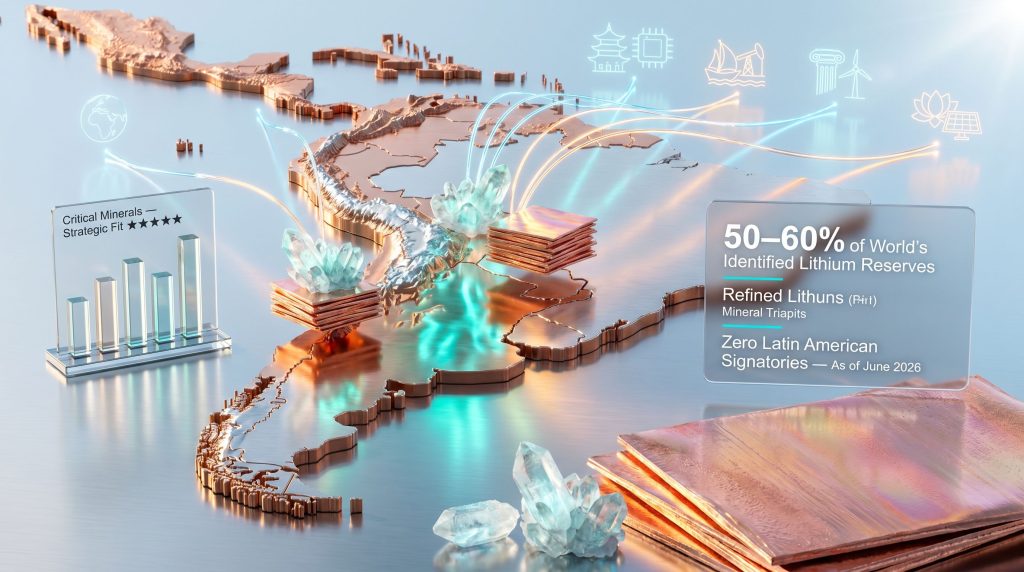
The so-called Lithium Triangle, encompassing northern Chile, northwestern Argentina, and southwestern Bolivia, contains an estimated 50 to 60 percent of the world's identified lithium reserves. This is not a marginal figure. It means that any coalition attempting to build a resilient battery supply chain for AI infrastructure and electric vehicles without engagement from this region is working against fundamental geology.
What makes this resource particularly significant to Pax Silica's mandate is the distinction between lithium grades. Battery-grade lithium hydroxide and lithium carbonate — the refined forms required for high-energy-density battery cells used in AI server cooling systems and electric vehicle packs — demand specific brine chemistry that the Atacama and Puna salars provide at concentration and purity levels that very few global deposits can match. The lithium brine operations in Chile's Salar de Atacama, for instance, produce lithium at lithium carbonate equivalent grades that are substantially higher than hard-rock spodumene operations in Australia, making South American brine the preferred upstream feedstock for Asian cathode manufacturers.
Copper's Role in the AI Infrastructure Build-Out
Lithium dominates headlines, but copper may be the more immediately critical mineral for Pax Silica's near-term AI infrastructure objectives. Data centres, semiconductor fabrication plants, and the transmission networks that connect them are extraordinarily copper-intensive. A single large-scale AI data centre can require thousands of tonnes of copper wiring, busbars, and heat exchange components.
The Chile copper market outlook remains central to this discussion. Chile and Peru collectively account for a dominant share of global copper cathode production. Chile alone has historically represented approximately 25 to 28 percent of global refined copper output, with Peru contributing a further significant share. These are not easily substitutable volumes, and no coalition member currently within Pax Silica holds comparable copper reserves or production infrastructure.
Capability Mapping: Where Latin America Fits Across the Four Pillars
| Pax Silica Pillar | Latin America's Position | Strategic Fit |
|---|---|---|
| Critical Minerals | Dominant globally in lithium and copper; growing rare earth and niobium output | ⭐⭐⭐⭐⭐ |
| Energy Supply | Expanding renewables base; grid reliability issues persist in several markets | ⭐⭐⭐ |
| Advanced Manufacturing | Limited semiconductor or precision electronics manufacturing | ⭐⭐ |
| Logistics and Supply Chain | Improving port infrastructure; significant bottlenecks remain inland | ⭐⭐⭐ |
The Country-by-Country Strategic Calculus
Not all Latin American nations carry equal strategic weight for Pax Silica. The coalition's capability-alignment logic means entry discussions would be highly country-specific.
Chile presents the strongest case for early engagement. Its institutional stability, existing free trade architecture with major Pax Silica members, and world-class copper and lithium export infrastructure make it a natural first-mover candidate. The political environment, while more complex following recent constitutional debates, remains substantially more predictable than most regional peers.
Brazil occupies a uniquely ambiguous position. As the region's largest economy, it holds significant rare earth deposits and is the world's dominant producer of niobium — a critical material for high-strength steel alloys used in infrastructure and aerospace applications. However, Brazil's active participation in BRICS and its cultivation of close economic ties with China create genuine geopolitical friction with the coalition's alignment requirements.
Argentina contains extraordinary lithium resources, particularly within the Argentina lithium brine market across Jujuy and Salta provinces, notably in the Salar de Olaroz and Salar del Rincón deposits. Despite this resource wealth, Argentina's history of policy reversals, currency controls, and sovereign debt crises has historically deterred the long-term capital commitments that strategic mineral partnerships require.
Mexico presents a logistics argument more than a mineral one. Its proximity to US manufacturing corridors and established automotive supply chain integration makes it relevant to Pax Silica's manufacturing and logistics pillars. However, the 2022 lithium nationalisation legislation, which placed lithium resources under state control through Litio para México, creates a structural barrier to the export conditionality that coalition membership would likely require.
Panama deserves attention for a reason often overlooked: the canal. Even without significant mineral resources, Panama's role as the primary maritime chokepoint for transoceanic supply chains connecting Latin American mineral exports to Asian processors gives it genuine strategic leverage within any Pax Silica logistics framework.
What Membership Would Actually Demand: The Sovereignty Trade-Off
Investor Perspective: Pax Silica is not a development fund or a foreign aid mechanism. It is a supply chain security arrangement, and membership comes with obligations that many Latin American governments would find domestically contentious.
The membership obligations likely include three categories of commitment that each carry significant political cost:
- Export conditionality — Members would face expectations to prioritise copper cathode and lithium carbonate exports toward coalition-aligned buyers, reducing market flexibility and potentially constraining the volume available to China, currently the dominant purchaser of Latin American mineral output.
- Investment screening — Coalition norms would almost certainly require some degree of restriction on Chinese capital participation in strategic mining, port, and logistics infrastructure — a demand that cuts directly against the deep investment presence Chinese state enterprises have built across the region over two decades.
- Technology governance alignment — Membership would likely require adoption of US-compatible AI export control frameworks and supply chain transparency standards, representing a meaningful constraint on technological sovereignty.
For governments facing domestic constituencies deeply suspicious of US economic influence — a sentiment with deep historical roots across much of Latin America — these obligations represent genuine political obstacles, not merely negotiating friction.
Three Strategic Scenarios for Latin American Entry
Scenario One: Chile as Mineral Bridge Member (Assessed as Higher Probability)
Chile enters through a structured supply security arrangement covering copper and lithium output directed toward coalition buyers. Entry is framed as an economic partnership rather than a security alignment, allowing the Chilean government to manage domestic nationalist opposition. Consequently, Chile secures preferential access to allied-nation capital for processing infrastructure development, and gains price stability through long-term offtake certainty.
Scenario Two: Brazil as Strategic Observer (Assessed as Moderate Probability)
Brazil joins at observer level without committing to full export conditionality, paralleling the arrangement extended to Canada and Taiwan. This allows Brazil to maintain BRICS engagement while establishing a formal channel within the coalition's governance structure. The outcome is limited immediate impact, but positions Brazil for full membership if its geopolitical alignment shifts following future electoral cycles.
Scenario Three: Regional Exclusion Persists Through 2027 (Assessed as Moderate to Higher Probability)
The combination of resource nationalism, Chinese capital dependencies, and coalition reluctance to absorb politically complex partners delays any Latin American engagement beyond the current strategic window. In this scenario, Latin American minerals continue flowing to non-coalition buyers, while Pax Silica develops alternative supply chain strategies that reduce the coalition's dependence on regional exports.
The next major ASX story will hit our subscribers first
The China Dimension: Why This Is the Hardest Variable to Resolve
Any honest analysis of joining Pax Silica in Latin America must confront the China dependency problem directly. Over the past two decades, Chinese state-affiliated enterprises have invested heavily across the region's mining, port, rail, and energy sectors. This capital has been consequential: it funded infrastructure that would not otherwise have been built, created employment in economies that needed it, and established trading relationships that now represent essential revenue streams for multiple governments.
Pax Silica's implicit requirement to restrict Chinese access to strategic minerals and infrastructure is therefore not a marginal diplomatic adjustment. For countries like Bolivia, Ecuador, and to a degree Peru, Chinese capital is not a peripheral consideration but a structural feature of economic planning. The broader metals and mining geopolitics at play here make this tension especially difficult to resolve.
The more sophisticated strategic calculation for Latin American governments may be to use the existence of Pax Silica as leverage with China rather than as an invitation to alignment. Nations that can credibly signal the option of coalition entry may be able to extract better terms from Chinese partners without actually joining — a dual-track approach that preserves optionality while maximising near-term economic returns.
The Timing Imperative: Why 2026 to 2027 Is the Critical Window
Global critical minerals demand is projected to accelerate substantially through the late 2020s, driven by large language model expansion, autonomous system deployment, and semiconductor fabrication capacity growth. The copper and lithium demand curves embedded in that buildout are not linear — they are front-loaded toward the years when new data centre construction, grid expansion, and battery factory commissioning peak.
Nations that secure structured supply agreements with Pax Silica members before that demand peak gains full momentum may benefit from the investment certainty and technology transfer provisions that coalition membership enables. Those that delay risk being relegated to commodity-price-exposed export relationships, supplying raw materials at volatile spot prices while coalition members capture higher-margin processing and manufacturing value.
The coalition's expansion timeline indicates that the window identified by the US State Department for Pax Silica membership closes progressively as internal norms harden and alternative sourcing strategies mature. Early engagement at even observer level preserves influence over those norms before they become entrenched institutional standards that later entrants must accept without modification.
Strategic Takeaway: For Latin American governments weighing the question of joining Pax Silica, the decision is less about whether to engage and more about when and at what terms. The longer the delay, the weaker the negotiating position becomes as coalition alternatives develop and demand-side urgency dissipates.
Frequently Asked Questions: Pax Silica and Latin America
Has Any Latin American Country Joined Pax Silica?
No. As of June 2026, no Latin American nation holds membership or observer status within Pax Silica. Current membership is concentrated across the Gulf states, East Asia, Europe, India, and Israel.
Which Country in Latin America Is Most Likely to Join Pax Silica First?
Chile is the most strategically compatible candidate, given its established copper and lithium export infrastructure, institutional stability relative to regional peers, and existing free trade agreements with Pax Silica member nations including the United States and Japan.
What Would Latin America Gain from Joining Pax Silica?
Potential benefits include preferential access to allied-nation investment capital for mining and processing infrastructure, technology transfer opportunities that could accelerate the transition from raw commodity export to value-added processing, and greater participation in AI supply chain value chains at higher margin points.
What Are the Risks of Membership for Latin American Nations?
Key risks include:
- Reduced export market diversification, particularly exposure if Chinese demand decreases
- Domestic political opposition rooted in resource nationalism and historical anti-US sentiment
- Potential retaliatory trade or investment measures from non-coalition partners
- Sovereignty constraints on investment screening and export policy
Why Is Latin America Not Already in Pax Silica?
The coalition's initial membership was built around existing US allies with established technology governance alignment. Latin America's complex geopolitical positioning, including significant economic interdependencies with China and varying intensities of resource nationalism, created friction that slowed early engagement. The US has signalled intent to expand membership through 2026, leaving the question open rather than resolved.
Readers seeking deeper analysis of Latin American infrastructure investment, critical mineral sector developments, and regional business intelligence can explore the analytical resources available through BNamericas at bnamericas.com.
Want to Track the Next Major Critical Minerals Discovery Before the Market Does?
Discovery Alert's proprietary Discovery IQ model instantly scans ASX announcements across more than 30 commodities — including lithium and copper at the centre of the Pax Silica supply chain debate — delivering real-time alerts on significant mineral discoveries directly to subscribers. Explore historic discoveries and their remarkable returns, then begin your 14-day free trial to position yourself ahead of the market.