July 31, 2026
When Geological Dominance Meets Operational Reality: The Greenbushes Crisis Explained
Hard-rock lithium mining operates on a deceptively simple premise: find the richest ore body, process it efficiently, and deliver product at the lowest possible cost. For most of the past decade, the Greenbushes mine in Western Australia appeared to validate this formula perfectly. IGO Greenbushes systemic problems were nowhere in sight as the operation sat atop one of the world's most mineralised lithium pegmatite systems, generating roughly A$10.7 billion in cumulative profits between 2020 and 2025 and delivering a net profit of A$623.8 million in 2025 alone.
Yet in a single trading session in April 2026, IGO Limited (ASX: IGO) shed approximately 18% of its market value, closing at A$7.01 in what analysts described as the company's worst single-day fall in over a decade. The share price had briefly touched an intraday decline of 19% before partially recovering. The paradox was acute: lithium prices had roughly doubled during the March quarter of 2026, and IGO's group revenue had expanded by approximately 45% quarter-on-quarter. A rising commodity price tide was lifting the entire sector, and yet the owner of the world's largest hard-rock lithium operation was being punished severely.
Understanding why requires unpacking a single word that management used in its investor communications: systemic. Furthermore, it requires an appreciation of how quickly market sentiment can shift when a mine's operational narrative changes at a fundamental level.
When big ASX news breaks, our subscribers know first
The Operational vs. Systemic Distinction: Why Language Matters to Markets
In mining operations, the classification of a problem carries enormous financial weight. The industry broadly recognises two categories of operational difficulty, and the distance between them is measured not in severity but in time horizon and structural depth.
An operational problem is discrete and time-bound. Equipment breaks down, an unexpected weather event disrupts haulage, or a temporary shift in mining sequence produces lower-grade feed for a quarter. These situations are resolved through maintenance cycles, scheduling adjustments, or minor capital expenditure. Markets tolerate them because they are legible and bounded.
A systemic problem, however, is categorically different. It is embedded within the mine's processes, workforce practices, maintenance culture, or infrastructure design. It cannot be resolved by swapping a piece of equipment or waiting for weather to clear. Systemic problems require structured remediation programs spanning multiple quarters, often involving external consultants, capital investment, and changes to operational philosophy at an organisational level.
When IGO's management disclosed that the challenges at Greenbushes were systemic in nature — covering safety compliance, feed grade deterioration, processing recovery rates, and plant reliability simultaneously — the market interpreted this as a statement that prior guidance assumptions were architecturally flawed, not temporarily disrupted. That distinction reset every financial model built on Greenbushes returning to form within one or two reporting periods. As noted by Mining Weekly, the world's biggest lithium mine was facing a downgrade driven squarely by these systemic issues.
The Four Pillars of Greenbushes' Systemic Challenges
| Challenge Category | Description | Investor Impact |
|---|---|---|
| Safety Performance | Ongoing compliance gaps across site operations | Regulatory exposure, potential production stoppages |
| Feed Grade Deterioration | Lower lithium oxide content in ore being processed | Reduced spodumene concentrate output per tonne mined |
| Recovery Rate Decline | Processing inefficiencies reducing conversion yield | Higher unit cost per tonne, lower margin per tonne sold |
| Plant Reliability | Unplanned downtime and maintenance execution failures | Volume shortfalls compounding fixed cost dilution |
The compounding nature of these four pillars is what distinguishes the Greenbushes mine controversy from a standard operational setback. Each pillar amplifies the others: lower feed grades mean the processing plant must handle more ore volume to produce the same concentrate output, placing additional strain on plant reliability. Meanwhile, unplanned downtime reduces throughput further, and safety compliance issues can trigger operational restrictions that constrain mining rates independently of equipment performance.
A critical technical detail that deepened investor concern was the Q3 spodumene output figure: approximately 351,000 tonnes, which was essentially flat quarter-on-quarter. On its surface, this looks stable. However, Greenbushes had recently commissioned newer processing infrastructure specifically designed to increase throughput. When new capacity additions fail to generate volume uplift, it signals that upstream constraints — whether in mining operations, ore handling, or feed consistency — are neutralising the benefit of capital expenditure. That pattern is precisely what systemic problem classification predicts.
The FY2026 Guidance Revision: Quantifying the Damage
The mechanics of the guidance downgrade illustrate why the market reaction was so severe relative to the headline percentage cut.
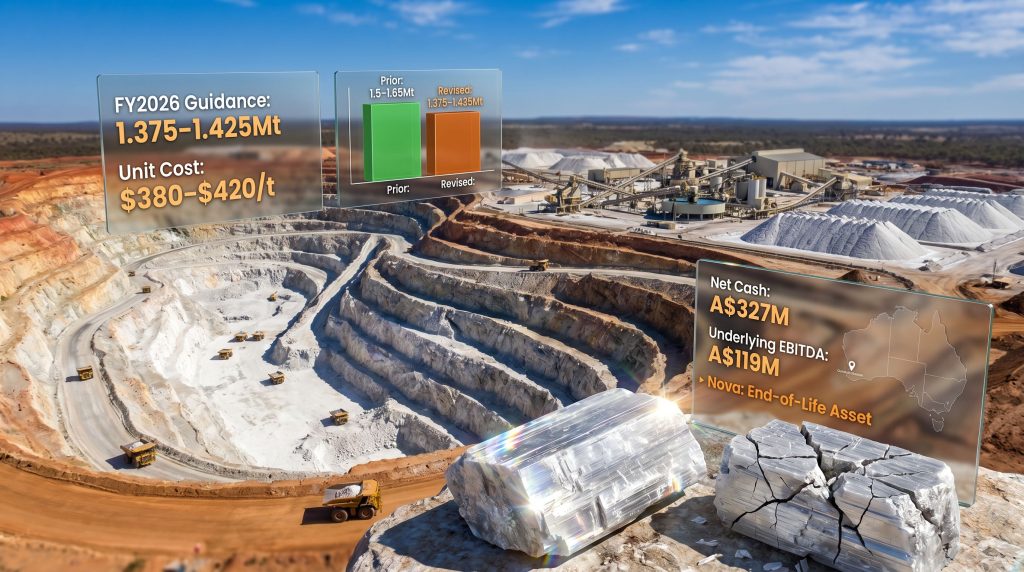
IGO revised its FY2026 spodumene concentrate production guidance from a prior range of 1.5 to 1.65 million tonnes to a new range of 1.375 to 1.425 million tonnes. At the midpoints, this represents a reduction of approximately 11%, from 1.575 million tonnes to 1.4 million tonnes.
Simultaneously, unit cash cost guidance was revised upward from A$310 to A$360 per tonne to a new range of A$380 to A$420 per tonne — a midpoint increase of approximately 19 to 25% depending on the comparison point used. Consequently, lithium stock performance across the sector was affected as investors reassessed exposure to hard-rock lithium producers.
Investor Warning: The cost guidance revision is not simply a reflection of lower output volumes. It signals that Greenbushes' vaunted low-cost operating model is conditionally dependent on hitting volume targets. When systemic problems constrain throughput, the cost advantage that defines the mine's competitive positioning begins to erode.
The mathematics of this dynamic are instructive. Hard-rock lithium mines carry substantial fixed cost bases: permanent workforces, depreciation on processing infrastructure, environmental compliance obligations, and site management overhead. These fixed costs must be absorbed across every tonne produced. When throughput falls by 11%, fixed cost per tonne rises by roughly 12.5% from the same absolute overhead base.
Combined with rising variable costs driven by processing inefficiencies, the total unit cost impact of 19 to 25% is mathematically consistent with an operation experiencing simultaneous volume and efficiency deterioration. The deeper concern for long-term investors is what this implies about Greenbushes' cost leadership position globally. The new unit cost guidance midpoint of approximately A$400 per tonne places Greenbushes closer to industry median cost levels, meaning the structural margin of safety that defined its investment thesis is currently being compressed.
Cost Structure Sensitivity at Different Volume Levels
| Annual Production Scenario | Fixed Cost Per Tonne (Estimated) | Total Unit Cost Trajectory | Cost Leadership Status |
|---|---|---|---|
| 1.65M tonnes (prior upper guidance) | Lower absorption rate | A$310-360 range | Clear low-cost leader |
| 1.4M tonnes (new midpoint guidance) | Higher absorption rate | A$380-420 range | Approaching industry median |
| Below 1.3M tonnes (adverse scenario) | Significantly elevated | Potentially above A$450 | Cost advantage eliminated |
IGO's Balance Sheet: Resilient for Now, But Built on Temporary Foundations
IGO reported underlying group EBITDA of A$119 million and a net cash position of A$327 million for the most recent quarter. These numbers provided reassurance that the company is not facing an immediate liquidity crisis and does not need emergency capital market access to fund its operational remediation programs.
However, the source of this financial strength demands careful examination. A significant proportion of the group's current earnings quality is attributable to the Nova nickel-copper operation, which delivered strong production and cash generation during the quarter. The fundamental problem is that Nova is an end-of-life asset approaching closure. Its cash generation is finite and non-renewable within IGO's portfolio.
This creates what might be described as a temporal mismatch risk: the financial buffer that makes IGO's balance sheet look robust today will not exist in the medium-term planning horizon when Greenbushes and the Kwinana project challenges must carry the portfolio's entire operational and financial load.
The Kwinana refinery adds a second layer of complexity. The facility is operating at approximately 50% of its nameplate capacity and remains loss-making. Downstream lithium hydroxide processing economics are challenging at sub-scale utilisation rates because, like hard-rock mining, refinery operations carry significant fixed costs that require high throughput rates to absorb efficiently.
The cash position buys time. But time alone does not fix a mine operating below its engineered parameters. Execution capability, not financial reserves, is the variable that will determine whether Greenbushes recovers its cost leadership position.
Regulatory and Legal Risks: The Multi-Front Exposure
The operational picture at Greenbushes is further complicated by external pressures that extend well beyond mine throughput metrics.
Community complaints related to dust pollution have been documented from local residents in the Greenbushes area, with concerns raised about effects on residential properties, vegetation, and a nearby primary school. In mining operations, environmental complaints of this nature carry a dual risk profile:
- Reputational risk, which can affect social licence to operate and complicate future approvals
- Regulatory risk, where escalating complaints can trigger formal investigations or operational restrictions imposed by state environmental authorities
Separately, Windfield Holdings, the corporate vehicle through which Greenbushes operates, is subject to an Australian Taxation Office transfer pricing audit covering the period from 2020 to 2024. The audit examines whether inter-company pricing arrangements between related entities appropriately reflected arm's-length commercial terms. Transfer pricing audits in mining are common but consequential: adverse findings can result in material back-tax liabilities, interest charges, and penalties that affect distributions to shareholders.
| Risk Category | Base Case Scenario | Adverse Scenario |
|---|---|---|
| ATO Transfer Pricing Audit | Minor adjustments, limited financial impact | Material back-tax liability affecting Windfield distributions |
| Dust Pollution Complaints | Voluntary mitigation measures implemented | Regulatory-imposed operational restrictions or production curtailments |
| Systemic Mine Issues | Resolved within 2-3 quarters with remediation programs | Persist into FY2027, requiring capital expenditure and further guidance cuts |
The intersection of operational underperformance, environmental scrutiny, and a tax audit creates a multi-dimensional risk profile that is qualitatively different from a standard commodity-driven investment thesis. Investors evaluating IGO must price not just lithium market exposure but also execution risk, regulatory risk, and tax risk simultaneously.
Geological Strength as a Long-Term Anchor: The Underground Resource Dimension
It would be misleading to characterise the Greenbushes situation as a fundamental asset failure. The geological reality underpinning the mine remains exceptionally strong. Recent mine planning updates delineated a newly defined underground mineral resource of 132 million tonnes at 1.5% Li₂O, alongside adjustments to the open-pit design that reflect an evolving extraction strategy as the operation matures.
This underground resource delineation is strategically significant for several reasons that are not widely appreciated by generalist investors. In addition, it highlights why understanding underground lithium mining is increasingly important for evaluating long-term asset value. Underground lithium mining introduces distinct cost and capital structures that differ materially from conventional open-cut operations:
- Grade continuity at depth: A resource grade of 1.5% Li₂O for an underground resource is commercially meaningful, though it typically requires higher processing selectivity and underground mining costs relative to open-cut operations
- Life extension optionality: Underground resources provide a pathway to extend mine life well beyond the current open-pit schedule, supporting very long-term production profiles
- Future capital requirements: Transitioning from open-cut to underground extraction requires substantial capital investment in shaft infrastructure, ventilation, and ore handling systems — costs not yet fully incorporated into market models
Greenbushes' geological quality remains a genuine competitive advantage in the global lithium sector. The current operational crisis reflects execution failures layered on top of a world-class ore body, not geological deterioration of the resource itself. This distinction matters enormously for investors assessing whether the current problems are recoverable.
The next major ASX story will hit our subscribers first
Peer Comparison: When Execution Quality Becomes the Differentiator
The most instructive comparison available during the April 2026 reporting period came from PLS Group (ASX: PLS), formerly known as Pilbara Minerals. While IGO's share price was collapsing on IGO Greenbushes systemic problems disclosures, PLS Group reported a 52% jump in quarterly revenue on the same lithium price tailwind that was benefiting IGO's group revenue line.
| Metric | IGO (Greenbushes Focused) | PLS Group |
|---|---|---|
| Q3 Revenue Growth | ~45% group-level | ~52% quarterly revenue |
| Operational Status | Systemic issues formally disclosed | Operationally stable |
| Guidance Trajectory | Downgraded approximately 11% | Maintained or improving |
| Risk Profile | Operational, regulatory, and tax complexity | Lower multi-factor risk |
| Cost Leadership | Currently under pressure | More stable cost trajectory |
This comparison crystallises a principle that commodity investors frequently underestimate during price recovery cycles: execution quality, not asset quality, determines which producers capture the most value when prices rise. Both companies accessed identical lithium price movements during the quarter. The difference in shareholder outcomes was entirely attributable to the operational reliability gap between the two operations.
For investors specifically seeking exposure to a lithium price recovery, the PLS Group comparison suggests that operational certainty currently commands a premium in the market. IGO's asset base may be geologically superior, but superior geology does not automatically translate into superior shareholder returns when systemic execution failures intercept the commodity tailwind before it reaches the bottom line.
Three Scenarios for IGO and Greenbushes Over the Next 12 to 18 Months
The range of plausible outcomes for IGO reflects genuine uncertainty about the pace and completeness of the Greenbushes operational remediation. Three scenarios frame the investment decision:
Scenario 1: Rapid Operational Stabilisation (Optimistic)
- Remediation programs deliver measurable feed grade and plant reliability improvements within two reporting quarters
- Unit costs begin recovering toward the A$350 to A$370 per tonne range as volume improves
- Nova's remaining cash generation bridges the gap while Kwinana progresses toward breakeven utilisation
- Market re-rates IGO as operational credibility is restored, share price recovers materially
Scenario 2: Prolonged Remediation (Base Case)
- Systemic issues require three to five quarters to meaningfully resolve, with continued guidance uncertainty through FY2027
- Nova closes on schedule, removing the financial buffer before Greenbushes fully stabilises
- Kwinana remains sub-scale and loss-making through FY2026
- Range-bound share price, elevated beta to lithium price movements, potential for further guidance revisions
Scenario 3: Structural Deterioration (Adverse)
- Remediation programs prove insufficient, with problems more deeply embedded than current disclosures indicate
- ATO audit produces a material financial liability affecting Windfield distributions
- Environmental scrutiny triggers formal operational restrictions at the mine level
- Strategic review of asset ownership structure becomes necessary, potentially involving capital raising or partnership restructuring
Disclaimer: The scenario analysis above represents a forward-looking framework based on publicly available information and should not be construed as financial advice. Actual outcomes will depend on operational, regulatory, and market developments that cannot be predicted with certainty. Investors should conduct their own due diligence and seek professional financial advice before making investment decisions.
Key Takeaways: What the IGO Greenbushes Systemic Problems Signal for Investors
The IGO Greenbushes systemic problems situation delivers several critical lessons that extend beyond the immediate investment case. Furthermore, these lessons are particularly relevant given the broader lithium market downturn that has placed additional pressure on producers already dealing with operational headwinds:
- Geological quality and operational execution are separate variables that must be evaluated independently when assessing mining investments
- An 11% production guidance cut combined with a 19-25% unit cost increase represents a qualitatively different risk signal than a standard guidance miss, because it indicates cost leadership status is conditionally rather than structurally held
- Fixed cost leverage in hard-rock lithium mining means that volume shortfalls amplify per-unit cost increases disproportionately, creating non-linear downside risk when throughput targets are missed
- End-of-life asset dependency at the group level creates temporal risk: IGO's current balance sheet strength is partially a function of Nova's remaining production life, not a permanent financial characteristic
- Multi-front risk profiles involving simultaneous operational, regulatory, and tax exposures require investors to apply higher discount rates to near-term cash flow projections than commodity price models alone would suggest
- In a rising lithium price environment, execution quality is the primary differentiator between producers that fully monetise the commodity cycle and those that see price recovery benefits absorbed by operational headwinds
The Greenbushes mine remains one of the most geologically significant lithium assets on the planet. Whether that geological advantage translates into sustained shareholder value over the next two years depends entirely on whether IGO's management team can deliver a structural operational turnaround at the same scale and quality that the resource itself represents.
Want to Spot the Next Major Mineral Discovery Before the Market Does?
While IGO navigates systemic operational challenges at Greenbushes, Discovery Alert's proprietary Discovery IQ model scans ASX announcements in real time, instantly identifying significant mineral discoveries with the potential for transformative returns — explore historic examples of exceptional discovery outcomes and begin your 14-day free trial to position yourself ahead of the market.