
June 23, 2026
Modern financial systems face unprecedented stress as geopolitical tensions reshape the global economic landscape. The interconnected nature of today's markets means that regional conflicts can rapidly cascade into worldwide economic disruptions, affecting everything from commodity prices to capital flows. Understanding these transmission mechanisms becomes critical as policymakers navigate an increasingly complex web of economic vulnerabilities and potential recession triggers, particularly as the IMF warns of recession due to Middle East conflict.
Current IMF Economic Projections Under Geopolitical Stress
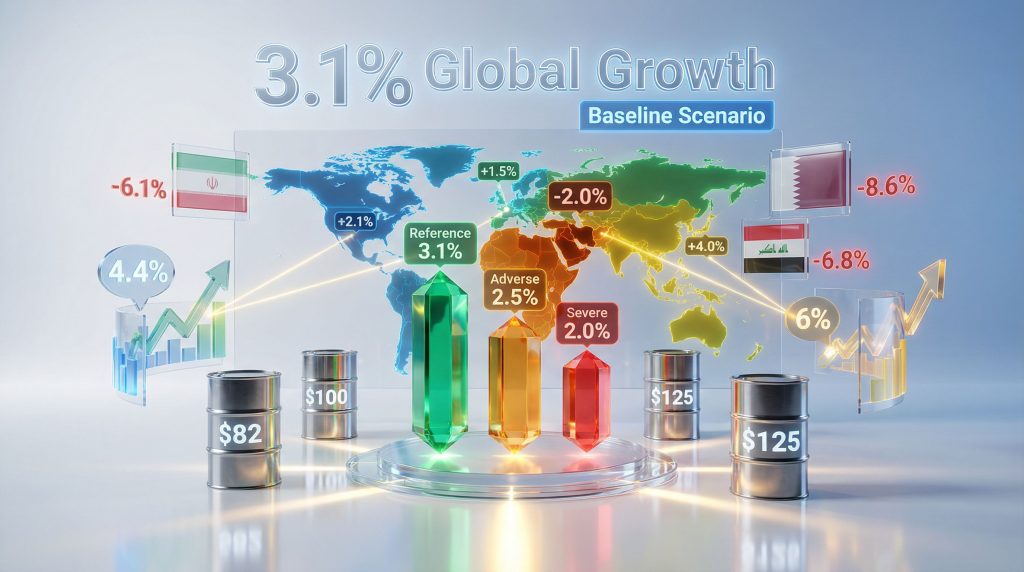
The International Monetary Fund has fundamentally restructured its global economic outlook, presenting three distinct scenarios that demonstrate how geopolitical instability can cascade through interconnected financial systems. Under the baseline projection, worldwide GDP expansion now sits at 3.1% for 2026, representing a 0.2 percentage point reduction from earlier forecasts.
Key Growth Scenario Breakdown:
- Reference Scenario: 3.1% global growth (short-lived conflict assumption)
- Adverse Scenario: 2.5% global growth (extended regional instability)
- Severe Scenario: 2.0% global growth (widespread economic disruption)
The most concerning element involves the severe scenario threshold, where growth approaching 2.0% historically signals recession conditions. According to IMF analysis, this level has been reached only four times since 1980, including the 2008 financial crisis and 2020 pandemic periods. The IMF warns of recession due to Middle East conflict as this severe scenario would constitute a close call for a global recession, with growth below 2.0% historically marking severe economic downturns.
Pierre-Olivier Gourinchas, IMF Chief Economist, emphasised that without Middle East conflict disruptions, the organisation would have upgraded global growth by 0.1 percentage point to 3.4% for 2026. This upgrade would have reflected continued technology investment momentum, lower interest rates, reduced US tariff impacts, and fiscal support measures across select economies.
The contrast between potential outcomes highlights how geopolitical risks now pose significantly larger economic threats than initial trade war economic impacts implemented in 2025. Energy market disruptions emanating from conflict zones create multiplicative transmission effects through global financial systems, representing the primary downside risk to baseline forecasts.
When big ASX news breaks, our subscribers know first
Energy Price Volatility and Economic Transmission Mechanisms
Commodity price fluctuations serve as primary channels through which geopolitical instability transmits economic stress across interconnected global markets. Current energy price scenarios demonstrate the multiplicative effects of supply disruption, with oil price dynamics projecting ranges dramatically based on conflict duration and intensity assumptions.
Energy Price Impact Framework:
| Scenario | 2026 Oil Price | 2027 Oil Price | Economic Impact |
|---|---|---|---|
| Reference | $82/barrel | Stable decline | 4.4% global inflation |
| Adverse | $100/barrel | $75/barrel | Extended regional disruption |
| Severe | $110/barrel | $125/barrel | 6.0% global inflation |
These price differentials create direct cost-push inflation through transportation, production, and energy-intensive manufacturing sectors. The severe scenario inflation rate of 6.0% compared to 4.4% in stable conditions represents a 1.6 percentage point differential that fundamentally alters central banking policy calculations.
Historical context reveals that Brent crude futures currently trade around $100 per barrel, significantly above the IMF's January 2026 forecast of approximately $62 per barrel for the year. This dramatic revision demonstrates how quickly energy market fundamentals can shift during geopolitical crises.
Energy-Inflation Transmission Channels:
- Direct Cost Channel: Immediate increases in production costs across energy-intensive sectors
- Financial Conditions Channel: Corporate profit margin compression triggering credit market repricing
- Wage-Price Spiral Channel: Worker purchasing power erosion leading to wage demands and pricing adjustments
- Expectations Channel: Sustained price elevation shifting long-term inflation expectations
The IMF's analysis indicates that prolonged energy price elevation creates self-reinforcing inflationary spirals through both direct cost impacts and expectations effects. When businesses and workers adjust pricing and wage behaviour based on sustained energy cost increases, inflation becomes embedded in broader economic structures, requiring more aggressive policy responses.
Regional Economic Vulnerability Analysis
Economic resilience varies dramatically across geographic regions, with energy dependency and proximity to conflict zones creating differentiated exposure patterns. The Middle East and Central Asia region faces the most severe projected contraction, with 2026 GDP growth falling by two full percentage points to 1.9%.
Regional Impact Assessment:
| Region | Growth Reduction | 2026 Baseline Growth | Primary Risk Factors |
|---|---|---|---|
| Middle East & Central Asia | -2.0 percentage points | 1.9% | Infrastructure damage, export disruptions |
| Emerging Markets Overall | -0.3 percentage points | 3.9% | Energy dependency, capital flight |
| Euro Zone | -0.2 percentage points | 1.1% | Energy import reliance |
| United States | -0.1 percentage points | 2.3% | AI investment offsetting effects |
Individual Country Economic Projections:
- Iran: -6.1% GDP contraction (direct conflict zone impact)
- Qatar: -8.6% GDP decline (energy export disruption)
- Iraq: -6.8% economic contraction (infrastructure vulnerability)
- India: +6.5% growth (upgraded by 0.1 percentage point due to strong end-2025 momentum)
The divergent outcomes reflect varying degrees of energy import dependency, geographic proximity to instability, and economic structural resilience. India represents the exceptional emerging market performer, receiving growth upgrades despite regional proximity due to reduced energy import intensity, bilateral trade improvements reducing US tariff exposure, and strong domestic economic momentum.
Economic Recovery Trajectory: Under short-lived conflict assumptions, the Middle East and Central Asia region demonstrates rapid recovery potential, with 2027 GDP growth rebounding to 4.6%, representing a 0.6 percentage point upgrade from previous forecasts.
European economies face particular constraints due to legacy energy vulnerabilities inherited from previous geopolitical disruptions. The eurozone's energy import dependence limits policy flexibility and increases recession risk from additional supply shocks, constraining growth to 1.1% in 2026.
Monetary Policy Framework Under Crisis Conditions
Central banking strategies become critical during energy-driven inflationary periods, with policymakers confronting complex trade-offs between supporting economic activity and maintaining price stability. The IMF framework suggests monetary authorities may "look through" short-lived energy price surges if inflation expectations remain properly anchored.
Policy Response Decision Matrix:
- Short-term Energy Spike: Maintain current rates (de facto monetary easing)
- Sustained Price Increases: Gradual policy tightening to anchor expectations
- Severe Inflationary Spiral: Aggressive rate increases despite growth costs
The critical determinant involves inflation expectation anchoring rather than absolute price levels. When economic actors maintain confidence that central banks will restore price stability, temporary energy shocks can be accommodated without structural policy tightening. However, if expectations become unanchored and shift structurally higher, aggressive monetary restriction becomes necessary regardless of associated growth sacrifices.
Pierre-Olivier Gourinchas warned that severe scenarios may require "more pain than in 2022" when referring to the monetary tightening cycle needed to control inflation. This suggests potentially greater policy restriction and larger GDP growth sacrifices than experienced during the previous inflation control period, highlighting the severity of the IMF warns of recession due to Middle East conflict scenario.
Federal Reserve Positioning Advantages
The US Federal Reserve maintains several strategic advantages that provide greater policy flexibility compared to other central banks:
- Continued artificial intelligence data centre investment momentum
- Lagged effects from 2024-2025 interest rate cuts
- Fiscal policy support from tax reduction measures
- Lower direct energy import exposure than European counterparts
These offsetting factors provide the Federal Reserve with greater policy flexibility compared to central banks operating under existing energy import constraints and elevated baseline energy costs, as discussed in our comprehensive recession risk analysis.
Fiscal Policy Interventions and Market Stability
Government spending responses during energy crises present both stabilisation opportunities and inflationary risks, requiring careful calibration to avoid exacerbating underlying economic pressures. The IMF emphasises targeted, temporary interventions rather than broad-based subsidy programmes that distort market mechanisms.
Fiscal Response Framework Principles:
- Targeted Support: Focus assistance on most vulnerable populations rather than universal subsidies
- Temporary Duration: Avoid creating permanent fiscal commitments during crisis periods
- Market Preservation: Maintain price signals necessary for demand adjustment and supply response
- Fiscal Buffer Protection: Preserve government financial capacity for extended crisis management
The organisation warns against extensive fuel subsidies that can create regional market distortions. When one country implements broad subsidy programmes, neighbouring economies unable to match subsidy levels may experience fuel shortages, potentially destabilising regional energy distribution networks.
Implementation Risk Factors:
- Cross-border fuel shortage creation from subsidy competition
- Fiscal framework deterioration compromising long-term stability
- Market signal distortion reducing private sector supply response
- Political pressure for subsidy programme extension beyond crisis periods
Government officials face legitimate pressure to protect vulnerable populations from energy cost increases, but poorly designed interventions may amplify rather than mitigate economic stress through unintended consequences. Furthermore, these decisions require careful consideration of tariff impact insights when evaluating broader economic policy coordination.
Structural Economic Transformation Under Persistent Risk
Beyond immediate recession threats, sustained geopolitical tensions reshape fundamental economic architecture through accelerated supply chain diversification, enhanced energy security investments, and financial system risk management evolution. These structural adjustments create both transition costs and long-term resilience benefits.
Structural Transformation Investment Areas:
- Energy Infrastructure Modernisation: Renewable capacity expansion and grid resilience enhancement
- Supply Chain Geographic Diversification: Critical input sourcing across multiple regions
- Financial System Architecture: Enhanced stress testing and capital requirement frameworks
- Strategic Reserve Accumulation: Emergency commodity stockpiles and financial buffers
Countries with stronger institutional foundations and diversified economic structures demonstrate superior capacity to weather external shocks while maintaining growth momentum. The current environment accelerates existing trends toward economic resilience building rather than pure efficiency optimisation.
Technology Sector Resilience Factors
Artificial intelligence and automation investments continue demonstrating growth momentum despite broader economic stress, providing partial economic offsets in advanced economies. These technology investments create productivity improvements that can partially compensate for energy cost increases, particularly in service sectors with lower direct energy intensity.
According to Reuters reporting on the latest IMF outlook, technology sector resilience remains a critical factor in determining which economies can best navigate the challenging period ahead as the IMF warns of recession due to Middle East conflict.
The next major ASX story will hit our subscribers first
Investment Strategy Implications During Economic Uncertainty
Financial markets respond to recession probability through systematic asset reallocation, with defensive positioning becoming increasingly attractive as economic uncertainty intensifies. The relationship between geopolitical risk and market volatility creates distinct investment landscape characteristics requiring strategic adjustment.
Investment Environment Characteristics:
- Defensive Asset Demand: Increased allocation toward government bonds and precious metals
- Energy Sector Volatility: High risk-return profiles for well-positioned energy companies
- Technology Investment Resilience: Continued strength in AI and automation sectors
- Emerging Market Selectivity: Enhanced scrutiny based on energy import dependency
Portfolio managers increasingly emphasise geographic diversification and energy exposure management as primary risk factors. Emerging market investments require careful evaluation of individual country energy import profiles, fiscal capacity, and institutional resilience rather than broad regional allocation strategies.
Market Psychology Dynamics
Investor sentiment shifts toward risk aversion during extended uncertainty periods, creating potential opportunities in fundamentally sound assets experiencing temporary price pressure. However, timing considerations become critical as market volatility increases during geopolitical stress periods.
The current environment rewards investors capable of distinguishing between temporary market disruption and fundamental economic deterioration, requiring enhanced analytical frameworks incorporating geopolitical risk assessment alongside traditional financial metrics. These considerations align with broader investment strategy fundamentals during periods of heightened uncertainty.
Consequently, investors must carefully balance defensive positioning with selective opportunities that emerge from market dislocations. Investment decisions should be based on individual circumstances and risk tolerance, with consideration of professional financial advice. Past performance does not guarantee future results, and geopolitical events can create unpredictable market conditions.
Are You Positioning Your Portfolio for Potential Market Disruptions?
Financial markets face unprecedented challenges as geopolitical tensions reshape global economic landscapes, creating both risks and opportunities for savvy investors. Discovery Alert's proprietary Discovery IQ model identifies emerging investment opportunities in ASX-listed companies that could benefit from supply chain shifts and energy security investments, helping subscribers navigate volatile market conditions with confidence.