May 22, 2026
Understanding In-Situ Copper Recovery Technology
The Taseko Mines Florence Copper project represents a pivotal moment in mining industry innovation as Arizona's subsurface geology demonstrates the technical superiority of in-situ copper recovery (ISCR) over conventional mining approaches. This revolutionary technology eliminates the need for traditional excavation by injecting carefully formulated acid solutions directly into copper-bearing rock formations, allowing metal extraction to occur within the natural geological matrix.
ISCR operates through a sophisticated chemical process where oxidizing solutions are pumped through injection wells into fractured ore zones. The acidic solution dissolves copper minerals on contact, creating copper sulfate-rich pregnant solutions that are then pumped to the surface through recovery wells. This subsurface processing method fundamentally transforms how copper deposits can be economically developed without the massive environmental footprint of open-pit operations.
Environmental advantages of ISCR technology extend far beyond reduced surface disturbance. Traditional copper mining requires extensive overburden removal, creating massive waste rock piles and tailings facilities that can persist for decades. In contrast, ISCR operations maintain the natural landscape while accessing copper resources through a network of strategically placed wellfields that occupy minimal surface area.
The precision of subsurface processing allows for selective copper extraction while leaving other minerals and rock formations largely undisturbed. This targeted approach minimises water consumption, eliminates dust generation, and preserves wildlife habitats that would otherwise be destroyed through conventional mining methods. Furthermore, modern mine reclamation innovations can be integrated more effectively with ISCR operations.
When big ASX news breaks, our subscribers know first
Why Arizona's Geology Creates Perfect ISCR Conditions
Arizona's Pinal County hosts unique geological conditions that make it exceptionally suited for in-situ copper recovery operations. The region's fractured granodiorite porphyry formations contain extensive copper mineralisation within permeable rock structures that facilitate effective solution circulation. These geological characteristics create natural pathways for acid solutions to contact copper-bearing minerals while maintaining sufficient permeability for efficient fluid recovery.
Hydrogeological factors in the Florence area provide critical advantages for ISCR implementation. The copper-bearing formations sit within a well-defined hydrogeological system where groundwater flow patterns can be precisely controlled. This natural containment allows operators to manage solution chemistry and prevent unwanted migration of process fluids beyond the target zones.
The mineralisation patterns at Florence Copper extend through approximately 400-foot thick copper zones with consistent grade distribution. This substantial thickness provides excellent resource continuity and allows for efficient well spacing that maximises copper recovery while optimising capital investment in wellfield infrastructure.
However, the porphyry copper deposit structure creates natural fracture networks that enhance solution penetration throughout the ore body. These fractures, formed through geological processes over millions of years, provide the permeability essential for effective acid solution circulation and copper dissolution.
How Does Metso's SX-EW Technology Transform Copper Production?
Metso's VSF®X modular system represents a breakthrough in solvent extraction plant design, specifically engineered for maximum throughput optimisation while maintaining operational flexibility. The system's modular architecture allows for staged capacity expansions and simplified maintenance procedures that minimise production downtime during equipment servicing.
The chemical processes within the solvent extraction circuit convert copper sulfate solutions from the wellfield into concentrated copper electrolyte through a series of extraction and stripping stages. Organic extractants selectively capture copper ions from the pregnant leach solution, concentrating them in a clean electrolyte that feeds directly to the electrowinning facility.
Consequently, integration between extraction circuits and electrowinning facilities at Florence Copper creates a seamless production flow from wellfield to finished cathode. The system design eliminates intermediate storage requirements and maintains optimal solution chemistry throughout the process, ensuring consistent copper recovery and product quality.
Process optimisation within the VSF®X system utilises advanced automation and control systems that continuously monitor solution chemistry, flow rates, and extraction efficiency. This real-time optimisation maximises copper recovery while minimising reagent consumption and energy requirements. Additionally, effective waste management solutions are integrated throughout the process.
Electrowinning Operations and Cathode Quality Standards
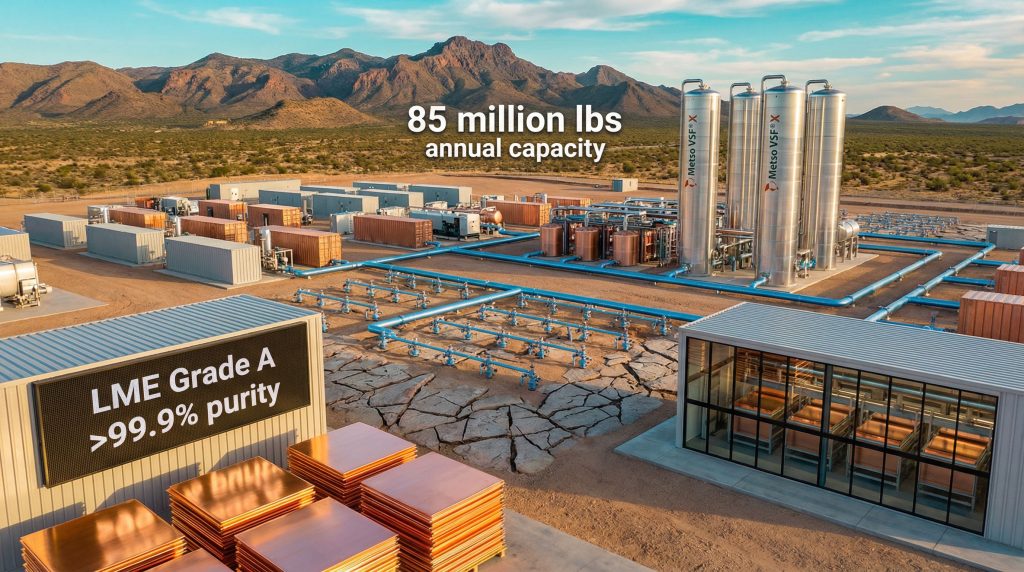
LME Grade A copper cathode production at Florence Copper requires electrochemical copper deposition that achieves purity levels exceeding 99.9% copper content. The electrowinning process applies controlled electrical current to copper electrolyte solutions, causing pure copper to deposit onto cathode starter sheets with exceptional uniformity and quality.
Power consumption efficiency in modern electrowinning operations typically ranges from 1,800 to 2,200 kilowatt-hours per tonne of copper produced. Advanced cell designs and optimised electrolyte chemistry minimise energy requirements while maximising current efficiency and copper deposition rates.
Quality control protocols ensure international market acceptance through rigorous testing of cathode chemistry, physical properties, and surface characteristics. Each production lot undergoes comprehensive analysis for trace impurities including arsenic, bismuth, lead, and other elements that could affect downstream processing applications.
Critical Quality Metric: LME Grade A specifications require copper content of minimum 99.95%, with strict limits on harmful impurities that could compromise the cathode's suitability for high-grade manufacturing applications.
For instance, the electrowinning facility's design incorporates automated cathode harvesting and processing systems that maintain product integrity from deposition through packaging. This automation reduces contamination risks while ensuring consistent cathode dimensions and surface quality that meet international trading standards.
Production Metrics and Financial Performance Analysis
The Taseko Mines Florence Copper project's production profile positions it as a significant contributor to North American copper supply, with nameplate capacity reaching 85 million pounds annually. This production level places the operation among mid-tier copper producers while maintaining the operational advantages of lower-cost in-situ recovery technology.
| Performance Metric | Specification | Industry Context |
|---|---|---|
| Annual Capacity | 85 million lbs (40,000 tonnes) | Mid-tier US producer ranking |
| Product Quality | LME Grade A cathode | Premium market specification |
| Technology Type | In-situ copper recovery | First US commercial ISCR |
| Production Timeline | 22-year mine life | Extended operational duration |
| Market Position | Domestic supply security | Strategic mineral independence |
The project's estimated total production potential exceeds 1.7 billion pounds of copper over the mine life, representing substantial value creation in a market increasingly focused on supply security and environmental responsibility. This production volume positions Florence Copper as a cornerstone asset for North American copper supply chains.
Operating cost advantages stem from ISCR technology's inherent efficiency compared to conventional mining methods. Energy consumption per pound of copper produced is significantly lower than traditional mining due to eliminated requirements for ore hauling, crushing, and grinding operations that consume substantial energy in conventional facilities.
Capital investment efficiency benefits from the modular design of both the wellfield infrastructure and processing facilities. The initial capital deployment of approximately $204 million creates a platform for potential future expansions while maintaining operational flexibility to respond to market conditions.
Cost Structure Analysis and Competitive Positioning
Energy efficiency metrics for ISCR operations demonstrate significant advantages over traditional copper mining methods. The elimination of crushing, grinding, and material handling equipment reduces power consumption per tonne of copper produced by an estimated 30-40% compared to conventional sulfide ore processing facilities.
Water consumption reduction benefits become particularly valuable in Arizona's arid climate, where water resources command premium pricing and regulatory scrutiny. ISCR operations recycle process solutions continuously, minimising fresh water requirements compared to traditional mining that often requires substantial water for dust control, ore processing, and tailings management.
Labour productivity advantages of automated ISCR operations create sustainable cost benefits throughout the mine life. The wellfield requires minimal manual intervention once established, with most operational activities focused on solution chemistry monitoring and equipment maintenance rather than labour-intensive material handling operations.
Maintenance cost structures favour ISCR technology through simplified equipment requirements and reduced mechanical wear compared to traditional mining equipment. Processing facilities operate with fewer moving parts and less abrasive material handling, extending equipment lifecycles and reducing replacement capital requirements.
The next major ASX story will hit our subscribers first
How Florence Addresses Critical US Copper Supply Challenges
Domestic production gap analysis reveals that the Taseko Mines Florence Copper project represents the first new greenfield US copper production since 2008, highlighting the critical importance of this project for national supply security. The United States currently imports approximately 75% of its copper consumption, creating strategic vulnerabilities that domestic production helps address. This development significantly impacts global copper supply chains and provides opportunities for investors exploring copper investment strategies.
Supply chain security implications extend beyond simple import substitution to include reliable access to high-quality copper for critical infrastructure development. Florence Copper's location within established transportation networks provides efficient distribution to major consumption centres while reducing supply chain complexity and costs.
The project's timing aligns with accelerating copper demand driven by electrification trends and renewable energy infrastructure development. Electric vehicle production alone requires approximately 180 pounds of copper per vehicle, while wind turbines contain up to 15 tonnes of copper each, creating sustained demand growth that favours domestic supply sources.
Market positioning advantages include potential protection from trade disruptions and tariff policies that increasingly favour domestic mineral production. As geopolitical tensions affect global supply chains, domestic copper sources provide greater supply certainty for critical applications.
Environmental and Regulatory Framework Success
Arizona DEQ Aquifer Protection Permit requirements establish comprehensive monitoring protocols that ensure groundwater protection throughout the operational period. The permit framework includes continuous monitoring of solution chemistry, groundwater quality, and containment system integrity with strict enforcement mechanisms.
EPA Underground Injection Control authorisation, renewed through January 2026, provides regulatory certainty for continued operations while establishing technical standards for injection well construction and operation. This federal oversight ensures compliance with national groundwater protection standards.
Environmental impact comparison demonstrates ISCR's superior environmental profile through multiple metrics:
• Land Use Reduction: Approximately 95% smaller surface footprint compared to equivalent open-pit operations
• Waste Elimination: No overburden removal or tailings facility requirements
• Air Quality: Minimal dust generation and equipment emissions
• Wildlife Preservation: Minimal habitat disruption with continued ecosystem function
Historic preservation compliance includes coordination with tribal authorities and archaeological assessments that preserve cultural resources while enabling resource development. Community engagement protocols ensure ongoing communication with local stakeholders throughout the operational period.
Strategic Position Transformation for Taseko Mines
Production portfolio diversification through the Taseko Mines Florence Copper project creates a 120% increase in Taseko's total copper output from 2024 baseline levels. This dramatic expansion transforms the company from a single-asset operation to a diversified North American copper producer with enhanced market presence.
Geographic risk management benefits from dual-jurisdiction operations spanning Canada and the United States. This diversification reduces regulatory risk while providing access to different market conditions and potential currency hedging opportunities that strengthen overall corporate resilience.
Technology diversification advantages position Taseko with expertise in both conventional mining and advanced ISCR methods. This dual capability creates competitive advantages for future project evaluations and potential technology licensing opportunities.
Revenue stability improvements result from extended mine life and predictable production profiles that characterise ISCR operations. The 22-year projected mine life provides long-term cash flow visibility that supports strategic planning and capital allocation decisions.
Global Implications for ISCR Technology Adoption
Precedent-setting significance of Florence Copper extends beyond North America to global copper development opportunities. As the first commercial-scale ISCR operation at a previously undeveloped deposit, Florence demonstrates the viability of this technology for similar geological settings worldwide.
Investment confidence building results from successful technology validation at commercial scale. Financial markets and mining companies can now evaluate ISCR projects with greater confidence in technical feasibility and economic returns, potentially accelerating adoption of similar projects globally.
Technology transfer potential creates opportunities for Metso and other technology providers to expand ISCR applications in suitable geological environments. The proven success at Florence provides a reference case for similar developments in South America, Africa, and Asia where comparable geological conditions exist.
Regional economic development implications include direct employment of over 800 Arizona workers throughout the construction and operational phases. These high-skilled positions provide career advancement opportunities in advanced mining technologies while generating substantial economic multiplier effects in Pinal County.
Metso Partnership and Operational Excellence
Technology integration capabilities demonstrate through Metso's Mesa, Arizona service centre create rapid response infrastructure for ongoing operational support. This proximity ensures minimal downtime during maintenance activities while providing continuous process optimisation support throughout the equipment lifecycle.
Aftermarket services infrastructure includes 24/7 technical support capabilities that monitor critical process parameters and provide immediate intervention when operational adjustments are required. This proactive support model maximises production uptime and equipment performance.
Predictive maintenance protocols utilise real-time data analytics to identify potential equipment issues before they impact production. These advanced monitoring systems optimise maintenance scheduling while minimising unplanned shutdowns that could affect cathode production targets.
Equipment upgrade pathways provide future expansion capabilities through modular system design. As production requirements evolve or capacity increases become economically attractive, the existing infrastructure can accommodate enhancements without major operational disruptions.
Long-Term Implications for US Copper Mining
Industry transformation potential extends beyond individual project success to fundamental changes in how copper deposits are evaluated and developed. ISCR technology opens previously uneconomic resources to commercial development while reducing environmental permitting challenges that have delayed traditional mining projects.
Regulatory framework evolution supports innovative extraction methods through refined permitting processes and environmental standards specifically adapted to ISCR technology. This regulatory development creates pathways for accelerated project approvals compared to conventional mining proposals.
Investment capital allocation shifts toward lower-impact mining technologies reflect evolving investor priorities that emphasise environmental, social, and governance considerations. ISCR projects attract capital more readily due to reduced environmental footprints and community acceptance factors.
Strategic resource security considerations position domestic copper production as increasingly valuable amid global supply chain uncertainties. Florence Copper demonstrates that advanced technology can unlock domestic resources while maintaining competitive economics and environmental responsibility.
Technology export potential creates opportunities for US-developed ISCR expertise to support similar projects internationally. This technological leadership in sustainable mining methods strengthens American competitiveness in global mining technology markets while generating export revenue opportunities.
Disclaimer: This analysis includes forward-looking statements about production capabilities, market conditions, and technological performance that involve inherent uncertainties. Actual results may vary from projections due to operational, market, or regulatory factors beyond current knowledge.
Looking for the Next Breakthrough in Copper Technology?
Discovery Alert's proprietary Discovery IQ model delivers real-time notifications on significant ASX mineral discoveries, including advanced copper extraction technologies and breakthrough mining innovations that could transform the industry. Stay ahead of market-moving announcements by exploring Discovery Alert's historic discoveries that have generated substantial returns, then begin your 14-day free trial today to position yourself at the forefront of mining technology investments.