June 19, 2026
Understanding In Situ Recovery Technology for Uranium Extraction
Modern uranium extraction methodologies continue evolving beyond conventional underground mining approaches, with in situ recovery uranium mining Canada representing a paradigm shift in resource development strategies. This extraction technique utilises chemical dissolution processes that eliminate traditional shaft construction and underground workforce deployment, fundamentally altering operational frameworks across global uranium market volatility.
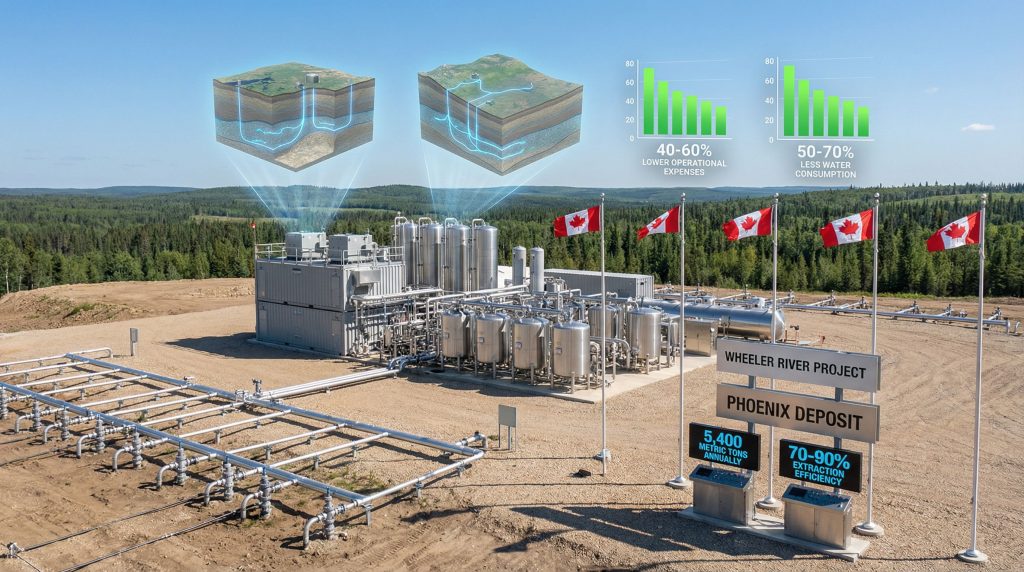
The process involves injecting specialised chemical solutions directly into subsurface ore formations through carefully positioned wellbore systems. These solutions dissolve uranium minerals within their natural geological setting, creating pregnant solutions that flow to surface processing facilities for concentrate recovery. Unlike traditional mining operations requiring extensive excavation infrastructure, ISR maintains the ore body's structural integrity while selectively extracting target minerals.
Chemical Dissolution Mechanisms in Canadian Geology
Canadian ISR operations utilise either acid-based or alkaline lixiviant chemistry depending on host rock characteristics. In sandstone aquifer systems typical of Saskatchewan's Athabasca Basin, solution chemistry optimisation becomes critical for achieving selective uranium dissolution while preventing unwanted reactions with surrounding geological formations.
The injection well network distributes chemical solutions throughout permeable zones containing uranium mineralisation. Recovery wells positioned strategically around injection points collect the uranium-bearing pregnant solution, which flows to surface processing facilities for uranium oxide (U₃O₈) precipitation and concentration.
Surface processing infrastructure converts the recovered pregnant solution into marketable uranium concentrate through precipitation, washing, and drying operations. This process eliminates the need for conventional crushing, grinding, and flotation circuits required in traditional uranium mills.
Hydrogeological Requirements for Northern Saskatchewan
Successful ISR implementation in Canada requires specific aquifer characteristics that support controlled solution flow while preventing environmental migration. Permeable sandstone formations must demonstrate adequate porosity and transmissivity for solution circulation while maintaining sufficient containment properties to prevent excursions beyond designated mining zones.
Groundwater flow patterns within target aquifers require comprehensive characterisation to ensure predictable solution movement and recovery efficiency. Hydraulic conductivity measurements, gradient analysis, and aquifer boundary identification form the foundation for well field design and operational control strategies.
The Athabasca Basin's geological setting provides favourable conditions for ISR application, with uranium deposits hosted in sandstone formations that demonstrate appropriate permeability characteristics for solution circulation while maintaining structural competency for long-term operations.
When big ASX news breaks, our subscribers know first
Economic Drivers Behind Canada's ISR Adoption Strategy
Canada's transition toward in situ recovery uranium mining Canada reflects significant economic advantages compared to conventional extraction methodologies. Financial modelling demonstrates substantial operational cost reductions through eliminated waste rock handling, reduced labour requirements, and simplified surface infrastructure needs.
Traditional underground mining operations require extensive shaft construction, underground development, ore transportation systems, and large-scale surface processing facilities. ISR eliminates these capital-intensive components while maintaining comparable production capacity through optimised well field design and solution chemistry management.
Operational Cost Structure Analysis
Labour efficiency improvements represent a primary economic driver for ISR adoption. Conventional underground operations require large workforces for development, production, and maintenance activities across multiple operational levels. ISR operations utilise smaller technical teams focused on surface-based monitoring, solution management, and processing operations.
Infrastructure requirements demonstrate significant capital expenditure reductions compared to traditional mining approaches. ISR eliminates needs for:
- Shaft construction and underground development
- Extensive ventilation and underground utility systems
- Large-scale crushing and grinding circuits
- Tailings management facilities
- Waste rock disposal areas
Timeline advantages accelerate project development through streamlined construction phases. ISR projects typically progress from construction commencement to commercial production within shorter timeframes due to reduced surface infrastructure complexity and eliminated underground development requirements.
Environmental Cost Benefits and Sustainability Metrics
Water consumption optimisation provides measurable environmental advantages through closed-loop solution circulation systems. ISR operations recycle process solutions multiple times before requiring makeup water additions, contrasting with conventional operations that consume substantial water volumes for ore processing and dust suppression.
Tailings elimination represents a fundamental environmental advantage, as ISR produces no solid waste streams requiring long-term management. Conventional uranium mills generate significant tailings volumes that require perpetual containment and monitoring, creating ongoing environmental liabilities.
Surface disturbance minimisation preserves ecosystem integrity through well field layouts that maintain existing topography and vegetation patterns. ISR operations typically disturb less than 10% of the surface area required for equivalent conventional mining operations.
Carbon footprint analysis indicates substantial emissions reductions through eliminated diesel fuel consumption for underground equipment, reduced transportation requirements, and simplified processing circuits requiring lower energy inputs per unit of uranium produced. Furthermore, renewable energy mining initiatives enhance sustainability.
Leading ISR Implementation Projects in Canada
The Wheeler River project represents Canada's inaugural commercial-scale ISR uranium operation, marking a significant milestone in the nation's nuclear fuel supply chain development. Located approximately 600 kilometres north of Saskatoon within Saskatchewan's Athabasca Basin, this operation demonstrates the technical and economic viability of in situ recovery uranium mining Canada applications.
Wheeler River Technical Specifications and Production Capacity
The Phoenix deposit contains identified mineral resources totalling 70.5 million pounds U₃O₈, comprising measured resources of 30.9 million pounds and indicated resources of 39.7 million pounds. These resource estimates position Wheeler River as a significant contributor to global uranium supply chains over extended operational timeframes.
Production capacity projections indicate annual uranium oxide output reaching 5,400 metric tons during peak operational periods. This production level places the operation among globally competitive uranium producers while utilising extraction methodologies that minimise environmental impact compared to conventional mining approaches.
Operational timeline projections target commercial production commencement by mid-2028, following construction activities authorised through Canadian Nuclear Safety Commission licensing approved in February 2026. The construction license remains valid through February 2031, providing adequate timeframe for infrastructure development and commissioning activities.
Recovery efficiency expectations vary based on geological conditions and solution chemistry optimisation, with ISR operations globally demonstrating recovery rates between 70-90% depending on ore characteristics and operational parameters.
Athabasca Basin ISR Development Potential
The Wheeler River site encompasses two distinct high-grade uranium deposits: the Phoenix deposit discovered in 2008 and the Gryphon deposit identified in 2014. Both deposits demonstrate geological characteristics suitable for ISR application within the broader Athabasca Basin framework.
Regional geological assessments identify additional uranium deposits with potential ISR applicability, including the Tthe Heldeth Túé and Midwest Main deposits. These resources represent future development opportunities that could expand Saskatchewan's ISR-based uranium production capacity over long-term planning horizons.
The Athabasca Basin's established uranium mining infrastructure provides logistical advantages for ISR project development through existing transportation networks, skilled workforce availability, and regulatory frameworks adapted to uranium extraction operations. Additionally, Canada mining leaders continue driving innovation across the sector.
Joint venture structure combines Denison Mines Corp. as operator with 90% ownership and JCU (Canada) Exploration Company Limited holding 10% interest. This partnership model demonstrates investor confidence in ISR technology application within Canadian geological settings.
Regulatory Framework Governing ISR Operations in Canada
Canada's regulatory oversight for in situ recovery uranium mining operates through comprehensive federal and provincial coordination mechanisms designed to ensure environmental protection while enabling responsible resource development. The Canadian Nuclear Safety Commission (CNSC) serves as the primary federal authority for uranium mining activities, implementing licensing frameworks specific to ISR operational requirements.
CNSC Licensing Phases and Approval Processes
The Wheeler River project received its site preparation and construction license in February 2026, representing the first Canadian ISR operation to achieve federal regulatory approval. This milestone followed a comprehensive seven-year engagement process involving technical reviews, environmental assessments, and stakeholder consultations.
Licensing validity extends through February 2031, providing sufficient timeframe for construction activities and operational commissioning. The five-year license term reflects CNSC's approach to uranium mining project oversight, requiring periodic review and renewal based on operational performance and compliance verification.
Environmental assessment requirements encompass comprehensive evaluations of:
- Groundwater protection protocols and monitoring systems
- Aquifer containment verification and excursion prevention
- Surface water protection and discharge management
- Air quality monitoring and emissions control
- Wildlife habitat preservation and ecosystem protection
Provincial and Indigenous Consultation Integration
Saskatchewan provincial authorities coordinate with federal regulators to ensure integrated approval processes that address both nuclear safety and provincial environmental protection requirements. This coordination eliminates regulatory overlap while maintaining comprehensive oversight of ISR operations.
Indigenous consultation processes recognise First Nations and Métis communities as essential stakeholders in uranium development decisions. The seven-year Wheeler River approval process incorporated extensive community engagement, traditional knowledge integration, and partnership development agreements.
"The regulatory framework demonstrates Canada's commitment to responsible uranium development through comprehensive oversight mechanisms that balance economic development opportunities with environmental protection requirements."
Long-term stewardship planning addresses post-operational site restoration and groundwater quality restoration. ISR operations must demonstrate aquifer restoration capabilities and long-term environmental monitoring commitments before receiving operational licenses.
Technical Challenges and Solutions for Canadian ISR
In situ recovery uranium mining Canada faces unique technical challenges related to harsh climate conditions, complex hydrogeology, and remote operational environments. Successful ISR implementation requires specialised solutions addressing these operational constraints while maintaining environmental protection standards.
Hydrogeological Complexity Management
Athabasca Basin aquifer systems demonstrate complex geological characteristics requiring detailed characterisation and modelling for successful ISR application. Multi-layered sandstone formations with varying permeability zones necessitate sophisticated well field design and solution flow management strategies.
Aquifer characterisation involves extensive drilling programmes to define:
- Permeability distribution across target ore zones
- Hydraulic conductivity measurements for flow prediction
- Aquifer boundary identification for containment design
- Geochemical baseline conditions for monitoring protocols
Solution chemistry optimisation addresses the interaction between lixiviant solutions and host rock mineralogy. Canadian uranium deposits often occur in complex geological settings requiring customised solution formulations to maximise uranium dissolution while minimising unwanted chemical reactions.
Operational Risk Mitigation in Sub-Arctic Conditions
Northern Saskatchewan's sub-Arctic climate presents unique operational challenges requiring specialised equipment and procedures. Winter temperatures reaching -40°C necessitate comprehensive winterisation strategies for surface processing equipment and wellhead infrastructure.
Equipment winterisation includes:
- Heated enclosures for critical processing components
- Insulated piping systems with freeze protection
- Cold-weather solution chemistry modifications
- Emergency backup power systems for extreme weather events
Remote operation capabilities become essential for maintaining operational continuity during harsh weather periods. Advanced automation systems enable remote monitoring and control of ISR operations from centralised control facilities located in more accessible areas.
Excursion prevention protocols address the risk of solution migration beyond designated mining zones. Comprehensive monitoring well networks detect any solution movement outside approved boundaries, triggering immediate corrective actions to protect groundwater resources.
Global ISR Performance Benchmarking and Market Position
Canadian ISR operations enter a global market where in-situ leach mining accounts for more than 50% of worldwide uranium production, demonstrating the method's economic viability and environmental acceptability across diverse geological settings.
International Operational Comparisons
Kazakhstan leads global ISR uranium production, utilising alkaline lixiviant solutions in rolled sandstone deposits. Kazakh operations demonstrate recovery efficiencies averaging 75-85% with operational costs significantly below conventional mining approaches.
United States ISR operations in Wyoming and Texas provide operational benchmarks for North American geological conditions. These operations utilise both acid and alkaline leaching systems depending on host rock mineralogy and groundwater chemistry.
| Country | Annual ISR Production | Recovery Efficiency | Primary Lixiviant |
|---|---|---|---|
| Kazakhstan | 15,000+ tonnes U₃O₈ | 75-85% | Alkaline (CO₂/O₂) |
| United States | 1,500+ tonnes U₃O₈ | 70-90% | Acid/Alkaline |
| Canada | 5,400 tonnes U₃O₈* | 70-90%* | Alkaline* |
*Projected figures based on Wheeler River project specifications
Competitive Advantages in Global Markets
Canadian ISR operations benefit from established nuclear fuel cycle infrastructure and proximity to North American nuclear reactor markets. Saskatchewan's existing uranium mining expertise provides workforce development advantages and regulatory familiarity that accelerate ISR implementation.
Quality specifications for Canadian uranium concentrate meet international standards for nuclear fuel fabrication. ISR-produced uranium oxide demonstrates equivalent purity levels compared to conventional mining products, ensuring market acceptance across global nuclear fuel supply chains.
Supply chain integration opportunities exist through established relationships between Canadian uranium producers and international nuclear utilities. Long-term supply contracts provide market stability and revenue predictability for ISR operations.
Export potential extends beyond North American markets through established trade relationships and transportation infrastructure connecting Saskatchewan uranium producers to global markets via port facilities and international shipping networks. Moreover, U.S. uranium production highs indicate growing regional demand.
The next major ASX story will hit our subscribers first
Economic Impact Projections for Canada's Uranium Industry
The introduction of in situ recovery uranium mining Canada represents a transformative development for Saskatchewan's economy and Canada's position in global nuclear fuel markets. Economic impact analysis encompasses direct operational benefits, regional development opportunities, and strategic supply chain implications.
Production Capacity and Market Share Analysis
Wheeler River's projected annual production of 5,400 metric tons U₃O₈ represents approximately 15% of Canada's historical uranium output during peak production periods. This production capacity positions Canada to maintain significant global market share while utilising environmentally superior extraction technologies.
Global uranium market dynamics indicate growing demand driven by nuclear power expansion programmes worldwide. Canada's ISR production capacity aligns with projected supply requirements for both domestic nuclear reactor programmes and international export markets.
Revenue generation potential for Saskatchewan's economy includes:
- Direct operational revenue: Estimated $400-600 million annually at current uranium prices
- Provincial royalty income: 5-12% of gross production value
- Federal tax contributions: Corporate income tax and export revenues
- Indirect economic multiplier effects: Supply chain and service sector benefits
Investment and Employment Development
Capital investment requirements for Wheeler River development total approximately $300-400 million for construction and commissioning activities. This investment level demonstrates investor confidence in ISR technology application within Canadian regulatory and geological frameworks.
Employment creation encompasses direct operational positions and indirect economic benefits throughout regional supply chains. ISR operations typically require 100-150 direct employees during peak operational periods, with additional employment in support services and supply chain activities.
Skills development opportunities focus on specialised technical positions including:
- Hydrogeological specialists for aquifer management
- Solution chemistry technicians for process optimisation
- Environmental monitoring specialists for compliance verification
- Automation systems operators for remote operation capabilities
Payback period calculations indicate project profitability within 5-7 years based on current uranium price projections and operational cost estimates. This financial performance supports additional ISR project development throughout the Athabasca Basin.
Long-Term Strategic Implications for Canadian Mining
The successful implementation of ISR technology in Canada's uranium sector establishes precedents for industry transformation and sustainable resource development practices. Strategic implications extend beyond immediate operational benefits to encompass long-term competitive positioning and technological leadership opportunities.
Industry Transformation and Technology Adoption
The shift from conventional underground mining to ISR methodology represents fundamental changes in operational requirements, workforce skills, and infrastructure development strategies. This transformation creates opportunities for technology transfer and expertise development that position Canada as a leader in sustainable uranium extraction.
Workforce transition programmes must address the evolution from traditional mining skills to ISR-specific technical competencies. Educational institutions and industry partnerships develop specialised training programmes focused on hydrogeology, solution chemistry, and remote operation technologies.
Infrastructure development needs adapt to ISR operational requirements through:
- Reduced surface facility footprints compared to conventional operations
- Specialised well field construction capabilities for injection and recovery systems
- Advanced monitoring and automation systems for remote operation capabilities
- Environmental remediation technologies for post-operational site restoration
Strategic Resource Development Integration
Canada's nuclear energy expansion plans require reliable domestic uranium supply sources to support reactor construction programmes and fuel security objectives. ISR production capacity contributes to supply chain resilience while maintaining environmental sustainability standards.
Integration with Small Modular Reactor (SMR) deployment strategies creates opportunities for coordinated nuclear fuel cycle development. Canadian ISR operations provide fuel supply security for domestic SMR programmes while supporting export opportunities to international markets.
Sustainable development goals alignment demonstrates Canada's commitment to responsible resource extraction practices. ISR technology supports environmental stewardship objectives while maintaining economic competitiveness in global uranium markets. Additionally, mining evolution trends support technological advancement.
Future Technology Evolution in Canadian ISR Operations
Technological advancement opportunities in in situ recovery uranium mining Canada focus on operational optimisation, environmental protection enhancement, and economic efficiency improvements. Innovation pathways include automation integration, monitoring system advancement, and solution chemistry optimisation.
Automation and Remote Operation Development
Advanced monitoring systems utilise real-time data analytics for optimising solution circulation patterns and maximising uranium recovery efficiency. Machine learning algorithms analyse operational data to predict optimal injection rates, solution chemistry adjustments, and recovery well performance.
Remote operation capabilities enable centralised control of multiple well fields from regional control centres, reducing operational costs while maintaining safety standards. Satellite communication systems provide reliable data transmission from remote operational sites to control facilities.
Integration with renewable energy systems reduces operational carbon footprints through:
- Solar power systems for remote wellhead monitoring equipment
- Wind energy integration for processing facility power requirements
- Battery storage systems for operational continuity during power interruptions
- Hybrid power generation combining conventional and renewable energy sources
Solution Chemistry and Recovery Enhancement
Solution chemistry improvements focus on maximising uranium extraction efficiency while minimising environmental impact. Advanced lixiviant formulations incorporate selective dissolution agents that target uranium minerals while avoiding reactions with non-target minerals.
Recovery enhancement technologies include:
- Ion exchange resin optimisation for uranium concentration improvement
- Precipitation chemistry refinement for higher product purity
- Solution recycling enhancement for reduced fresh water consumption
- Waste solution treatment for environmental protection compliance
Regulatory Evolution and Best Practices
Continuous improvement in environmental protection standards reflects operational experience and technological advancement. Regulatory frameworks evolve to incorporate lessons learned from initial ISR operations while maintaining comprehensive environmental protection requirements.
International cooperation opportunities include technology sharing agreements with established ISR operators, research collaboration with academic institutions, and participation in global uranium industry working groups focused on operational best practices.
Knowledge sharing initiatives establish Canada as a centre of excellence for ISR technology development and application. Technical conferences, research publications, and industry partnerships disseminate Canadian expertise to international markets while attracting investment and talent.
"Investment Disclaimer: The uranium mining industry involves significant technical, environmental, and market risks. Production projections, cost estimates, and financial performance expectations are subject to geological uncertainty, regulatory changes, and market volatility. Investors should conduct comprehensive due diligence and consider professional advice before making investment decisions in uranium mining projects."
The evolution of in situ recovery uranium mining Canada represents a strategic transformation toward sustainable resource development practices that balance economic objectives with environmental stewardship. As operational experience develops and technology advances, ISR methodology positions Canada as a leader in responsible uranium extraction while maintaining competitive advantages in global nuclear fuel markets.
Ready to Discover Canada's Next Uranium Mining Revolution?
In situ recovery technology is transforming Canada's uranium mining landscape, creating significant opportunities for savvy investors tracking emerging developments in this critical sector. Discovery Alert's proprietary Discovery IQ model delivers instant notifications on substantial ASX mineral discoveries, including uranium breakthroughs, ensuring subscribers receive rapid insights into actionable trading opportunities before they reach broader market attention. Begin your 14-day free trial today and position yourself ahead of the market as this revolutionary mining technology creates new investment opportunities across the resources sector.