June 11, 2026
The Hidden Tax on India's Aluminium Manufacturers
When a country's tariff system charges more to import a raw material than to import the finished product made from that raw material, something structurally contradictory is at play. This is not a theoretical edge case in India's aluminium sector. The question of whether India should lower import duty on primary aluminium has become one of the most contested industrial policy debates of 2026, affecting thousands of downstream manufacturers, most of them small and medium enterprises navigating structural cost disadvantage every single day.
When big ASX news breaks, our subscribers know first
What Is the Inverted Duty Structure and Why Does It Cripple Downstream Processors?
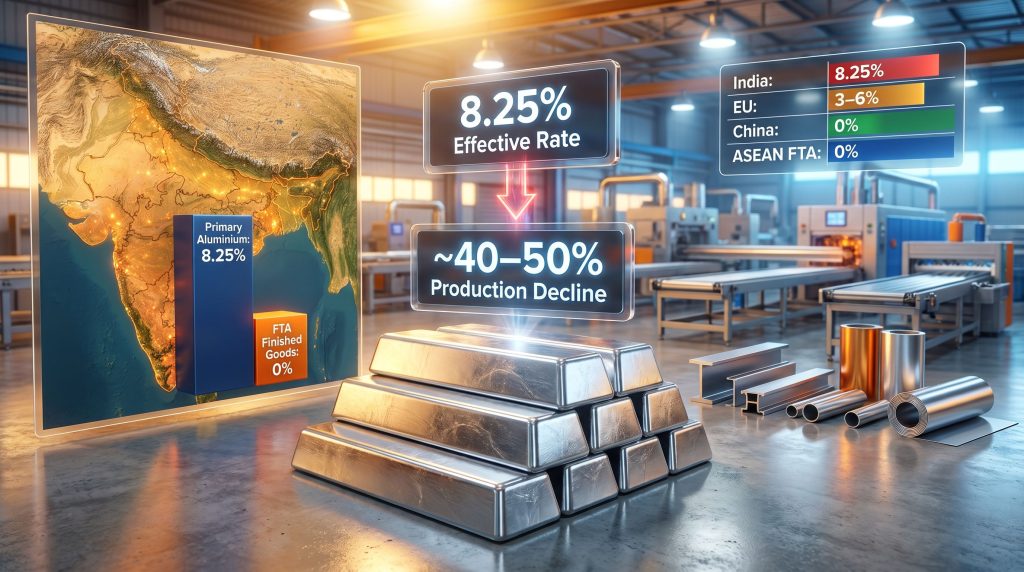
India currently applies a basic customs duty of 7.5% on primary aluminium, with an effective rate of approximately 8.25% once applicable surcharges are included. On its face, this appears modest. The problem lies not in the absolute rate but in what it is compared to: the duty applied to finished aluminium goods entering India under Free Trade Agreements, which in many cases is zero or near zero.
This creates what trade economists call an inverted duty structure. The term refers specifically to a situation where import duties on upstream raw materials or intermediate inputs are set higher than the duties applied to downstream finished goods. In a logical tariff architecture, the opposite should hold. Finished goods should face higher tariffs than raw materials, incentivising domestic value addition at each stage of manufacturing.
When the logic is inverted, the tariff system inadvertently subsidises importers of finished goods while penalising domestic processors who must buy their inputs at a higher cost. Furthermore, understanding the broader import tax structure in India reveals that this structural contradiction extends across multiple commodity sectors, not just aluminium.
"An inverted duty structure does not merely distort pricing. It systematically erodes the competitive foundation of domestic manufacturing by embedding a structural cost disadvantage that no operational efficiency gain can fully offset."
For an Indian aluminium extruder or fabricator, this means purchasing primary aluminium at a landed cost that includes the 8.25% duty, then competing in the local market against finished aluminium products that entered at zero duty. The margin compression this creates is not cyclical. It is structural and persistent.
How Global Disruptions Are Compounding India's Existing Tariff Problem
India's downstream aluminium sector entered 2026 already under structural cost pressure from the inverted duty configuration. What has transformed a chronic problem into an acute crisis is the convergence of several external shocks operating simultaneously.
The ongoing conflict in West Asia has disrupted a supply corridor that Indian manufacturers depend on heavily. Approximately 30% of India's aluminium scrap imports transit through the West Asia region, according to industry stakeholders. When that corridor becomes unreliable, processors either pay elevated spot premiums to source scrap from alternative origins or face direct material shortfalls.
Simultaneously, global aluminium prices have experienced significant volatility. Because domestic Indian primary aluminium producers largely price their output at import-parity levels, international price spikes transmit directly into local raw material costs. This import-parity pricing mechanism means that even manufacturers sourcing domestically cannot escape the impact of elevated global benchmarks.
Energy supply has added a third layer of disruption. Aluminium extrusion operations rely on LPG and Piped Natural Gas as critical process energy inputs. Constraints on both supply chains have forced some extrusion facilities to reduce throughput or suspend operations entirely. The cumulative effect has been severe: production activity in certain downstream segments reportedly declined by approximately 40 to 50 percent over a two-month period in 2026, a figure cited at a formal industry roundtable attended by multiple national trade associations.
| Disruption Factor | Nature of Impact | Estimated Scale |
|---|---|---|
| West Asia conflict | Scrap import corridor at risk | ~30% of scrap imports affected |
| Import-parity pricing | International price volatility transmitted domestically | Full pass-through mechanism |
| LPG and PNG constraints | Extrusion operations disrupted | Widespread across segment |
| FTA finished goods competition | Zero-duty imports displacing domestic processors | Ongoing structural disadvantage |
| Production decline | Output contraction across downstream MSMEs | ~40-50% over two months |
The Policy Divide: Upstream Producers vs. Downstream Processors
One of the most important nuances in this debate is that India's aluminium sector does not speak with a single voice on import duty reform. The calls to lower the duty on primary aluminium come predominantly from downstream manufacturers and MSME processors. The calls to raise it, to levels of 10% to 12.5%, come from primary aluminium producers and domestic smelters.
This divergence reflects a genuine structural tension within the value chain:
-
Primary producers operate large, capital-intensive smelting facilities. Their economics depend on protecting the domestic price of primary aluminium from being undercut by cheaper imports. A higher MFN duty insulates their margin and justifies continued upstream investment.
-
Downstream processors and MSMEs consume primary aluminium as their principal raw material input. For them, the duty represents a cost that erodes competitiveness, particularly when finished aluminium products from FTA partner countries enter at zero duty. Aluminium supply chain leaders operating at scale can absorb these pressures more readily than smaller processors.
-
Policymakers must weigh the employment intensity and investment scale of upstream smelting against the far larger number of jobs embedded in the downstream MSME segment, which is more fragmented, more labour-intensive, and more directly exposed to raw material cost volatility.
"The aluminium tariff debate in India is not simply about one number. It is about which part of the value chain the government chooses to protect, and which it chooses to make globally competitive."
Analytical frameworks developed by trade policy researchers, including work cited in connection with the CUTS-CITEE framework on tariff rationalisation, support the case that reducing duties on industrial raw material inputs stimulates downstream output and employment at a multiplier that typically exceeds the protection value offered to upstream producers. However, this view is contested by the smelting industry, which argues that upstream capacity security is a prerequisite for any downstream ambition.
Specific Policy Measures Industry Bodies Are Requesting
The demands being advanced by India's downstream aluminium associations are both immediate and structural. They were formally articulated at a roundtable that brought together organisations including the Federation of Indian Micro Small and Medium Enterprises, the Aluminium Secondary Manufacturers Association, the Aluminium Extrusion Manufacturers Association of India, and the India SME Forum. The breadth of participation lends institutional weight to the reform agenda.
The near-term requests include:
-
A reduction in the import duty on primary aluminium to lower the landed cost of raw materials for domestic processors
-
Temporary loan moratoriums for cash-flow-constrained MSMEs unable to service existing debt obligations amid rising input costs
-
Debt restructuring support mechanisms targeted at smaller manufacturers
-
Emergency relief measures for firms whose operations have been directly disrupted by supply-chain dislocations
-
Diversification of energy supply pathways to reduce dependence on constrained LPG and PNG inputs
The longer-term structural agenda includes strengthening domestic supply chains, securing bauxite and alumina feedstock access, and reviewing the FTA frameworks that currently allow finished aluminium goods to enter India at preferential duty rates that undercut domestic processors.
How India's Aluminium Duty Compares Internationally
Situating India's tariff within a global context reveals that its effective rate of 8.25% on primary aluminium sits above the median for economies with significant downstream manufacturing ambitions. Furthermore, global commodity market tariffs are increasingly being scrutinised across multiple industries as governments reassess trade policy frameworks in a volatile geopolitical environment.
| Country or Region | Approximate Primary Aluminium Import Duty | Context |
|---|---|---|
| India | ~8.25% effective (7.5% BCD + surcharge) | Downstream lobby seeks reduction; upstream seeks increase to 10-12.5% |
| European Union | 3-6% (product-form dependent) | CBAM carbon cost layer added from 2026 |
| China | 0% on imports (net exporter) | Export taxes applied instead to manage domestic surplus |
| United States | 0-10% (Section 232 national security tariffs apply selectively) | Strategic framing used to justify elevated rates |
| ASEAN FTA partners (India) | 0% on many finished aluminium products | Creates the inverted duty dynamic for Indian processors |
The comparison with ASEAN FTA partners is particularly instructive. India has signed preferential trade agreements that allow finished aluminium goods to enter at zero or negligible duty rates. Yet the raw material those finished goods are made from faces an 8.25% duty if an Indian manufacturer imports it. This asymmetry is not a loophole. It is a structural feature of how the tariff schedule has been layered over time, and it is one that competitors in FTA partner countries can exploit by completing the manufacturing step abroad and then shipping the finished product into India duty-free.
The next major ASX story will hit our subscribers first
The MSME Vulnerability and the CBAM Double Squeeze
India's downstream aluminium processing sector is dominated by small and medium enterprises that share several structural characteristics making them acutely vulnerable to current conditions. They are:
-
Working-capital intensive, with thin balance sheets that offer limited buffer against raw material price spikes
-
Energy dependent, particularly for extrusion operations that require consistent and affordable gas supply
-
Limited in hedging capacity, meaning they cannot lock in raw material costs through futures markets the way larger integrated producers can
-
Highly fragmented, which reduces bargaining power with both suppliers and customers
-
Export-oriented in many cases, which exposes them to an additional and growing compliance burden: the EU's Carbon Border Adjustment Mechanism
CBAM, which began its transitional phase in 2023 and is entering full implementation in 2026, applies a carbon cost to imports of carbon-intensive goods entering the European market. Aluminium is one of the primary sectors covered. Indian exporters targeting European customers must now calculate, verify, and report the embedded carbon content of their products. For smaller MSMEs operating on thin margins without specialist sustainability staff, CBAM compliance represents a material additional cost arriving precisely when domestic input costs are also at their most elevated.
"The interaction between domestic tariff pressure on raw material inputs and CBAM compliance costs on the export side creates a structural double squeeze for Indian downstream aluminium MSMEs. Rising costs at the input end, and rising compliance barriers at the output end, compress the viable operating window from both directions simultaneously."
What a Duty Reduction Would Actually Deliver
The practical economic effect of reducing India's effective import duty on primary aluminium from the current 8.25% toward a lower benchmark — say a 5% effective rate — would flow through the downstream manufacturing sector in several ways.
First and most directly, the landed cost of primary aluminium for domestic processors would fall. For a downstream MSME consuming 500 tonnes of primary aluminium per month, even a 3 percentage point reduction in the effective duty rate translates to a meaningful per-tonne cost saving. At typical current aluminium prices, this saving can represent the difference between operational profitability and production curtailment for capital-constrained smaller manufacturers.
Second, the competitive gap between domestic processors and FTA-origin finished goods importers would narrow. While it would not be eliminated entirely, the reduction in the absolute cost disadvantage would allow more domestic manufacturers to remain price-competitive. In addition, Australia's experience with its own resource and energy exports illustrates how tariff architecture and global pricing mechanisms interact to determine competitive positioning across interconnected commodity markets.
Third, and less quantifiably but potentially most significantly, reduced input costs would ease the liquidity pressure that is currently impairing loan servicing across the MSME segment. When input cost stress subsides, manufacturers can redirect cash flow toward debt obligations, working capital replenishment, and ultimately capacity maintenance or expansion.
The counterargument, which carries legitimate weight, is that duty reduction could expose domestic primary aluminium producers to greater import competition, potentially displacing domestic smelting output and reducing the upstream investment case. The policy question is fundamentally one of industrial strategy: whether India's aluminium growth model prioritises upstream smelting capacity or downstream processing competitiveness, recognising that these objectives are not always simultaneously achievable under a single tariff framework.
Long-Term Reforms Beyond the Tariff Debate
Securing Supply Chain Foundations
While the question of whether India should lower import duty on primary aluminium dominates near-term industry discussion, several structural reforms carry greater long-term significance. India holds substantial bauxite reserves, but translating geological endowment into reliable, cost-competitive alumina supply for domestic smelters requires sustained investment and regulatory coordination at the state level, where mining approvals are administered.
Energy and Trade Architecture
Transitioning extrusion operations toward more stable and cost-competitive energy sources, including renewable electricity where process heat requirements permit, would reduce structural vulnerability over time. The asymmetric treatment of finished aluminium products under existing FTAs also warrants comprehensive review, as the current framework creates structural incentives to offshore the manufacturing step entirely.
Building MSME Compliance Capacity
As CBAM and similar carbon border mechanisms expand globally, building shared compliance infrastructure and carbon accounting capabilities within industry associations would reduce the per-unit compliance cost burden on smaller manufacturers. This is particularly relevant given that the broader shift toward critical raw materials transition is reshaping how governments think about strategic industrial inputs, aluminium among them.
Frequently Asked Questions: India's Aluminium Import Duty Debate
What is the current import duty on primary aluminium in India?
India applies a basic customs duty of 7.5% on primary aluminium, yielding an effective rate of approximately 8.25% inclusive of applicable surcharges.
Why are Indian MSMEs seeking a reduction in this duty?
Downstream processors rely on primary aluminium as a core input. The 8.25% effective duty raises their raw material cost while many finished aluminium products enter India at zero duty under FTAs, creating a structural cost disadvantage that compresses margins and threatens viability for smaller manufacturers.
What is an inverted duty structure?
An inverted duty structure arises when import duties on raw materials or intermediate inputs are higher than duties on finished goods made from those inputs. In India's aluminium sector, primary aluminium faces an 8.25% effective duty while many finished aluminium products enter at zero duty under FTAs. Analysis from ET Edge Insights on India's aluminium duty positioning confirms this structural anomaly relative to global norms.
Do all aluminium industry participants want lower duties?
No. Primary aluminium producers and smelters have historically advocated for higher duties, in the range of 10% to 12.5%, to protect domestic smelting economics. The call for lower duties comes specifically from downstream processors and MSMEs seeking cheaper raw material access.
What is CBAM and how does it affect Indian aluminium exporters?
The EU's Carbon Border Adjustment Mechanism applies a carbon cost to imports of carbon-intensive goods, including aluminium, entering the European market. Indian exporters must report and verify the embedded carbon content of their products, adding compliance costs that disproportionately burden smaller manufacturers without dedicated sustainability infrastructure.
Key Issues at a Glance
| Issue | Current Status | Industry Position |
|---|---|---|
| Primary aluminium import duty | ~8.25% effective rate | Downstream seeks reduction; upstream seeks increase to 10-12.5% |
| FTA finished goods duty | Zero or near-zero for many products | Review and rebalancing requested |
| MSME production levels | Down approximately 40-50% over recent two-month period | Emergency relief and structural support required |
| Aluminium scrap supply via West Asia | ~30% of imports at risk from regional conflict | Supply chain diversification needed |
| CBAM compliance burden | Growing for EU-facing exporters | Compliance infrastructure support requested |
| Energy input stability | LPG and PNG constraints disrupting extrusion operations | Alternative energy access required |
| Loan servicing capacity | Impaired by rising operating costs across MSME segment | Moratoriums and restructuring support sought |
This article is intended for informational purposes only and does not constitute financial, investment, or policy advice. References to production declines, duty rates, and trade flow figures are drawn from industry reporting as of mid-2026 and may be subject to revision. Readers should consult primary policy and regulatory sources for current and binding tariff schedules.
Want To Stay Ahead of the Commodity Shifts Reshaping Global Markets?
Discovery Alert's proprietary Discovery IQ model delivers real-time alerts on significant ASX mineral discoveries, transforming complex commodity data into actionable investment insights — explore historic discoveries and their market returns to understand the scale of opportunity, then begin your 14-day free trial at Discovery Alert to position yourself ahead of the market.