
June 10, 2026
The Hidden Material Gap Reshaping India's Automotive Ambitions
The story of a nation's industrial maturity can often be read through the materials embedded in its vehicles. For decades, the progressive substitution of steel with aluminium across global automotive platforms has served as a reliable proxy for engineering sophistication, regulatory ambition, and manufacturing depth. Mature markets did not arrive at 200+ kg of aluminium per vehicle overnight — they were pulled there by decades of tightening emissions legislation, fuel economy mandates, and the relentless physics of weight reduction, where every kilogram saved translates directly into efficiency gains and reduced lifecycle emissions.
India sits at a fascinating inflection point within this long-run trajectory. Its automotive sector is producing vehicles at a scale that commands global attention, yet the material intensity embedded within each of those vehicles tells a far more nuanced story — one where volume and depth are advancing at very different speeds. Understanding India aluminium use per vehicle in transportation requires examining both the global benchmarks and the structural forces shaping domestic adoption.
When big ASX news breaks, our subscribers know first
The Global Benchmark: What the World's Vehicles Actually Contain
From 35 kg to 210 kg: Five Decades of Material Evolution
Tracing the history of aluminium adoption in global automotive manufacturing reveals one of the most significant material substitution stories in industrial history. In the 1970s, the average vehicle contained roughly 35 kg of aluminium, confined primarily to engine blocks and a handful of structural castings. By the mid-2020s, that figure had grown to approximately 210 kg per vehicle across the global fleet, representing nearly a six-fold increase driven by intersecting technological, regulatory, and commercial forces.
European passenger cars averaged 205 kg of aluminium per vehicle in 2022, with forecasts pointing to 237 kg by 2026 and 256 kg by 2030 as fuel economy regulations intensify and electric vehicle architecture becomes mainstream across the continent. These are not theoretical projections but engineering trajectories already locked in through committed platform development cycles across major original equipment manufacturers (OEMs).
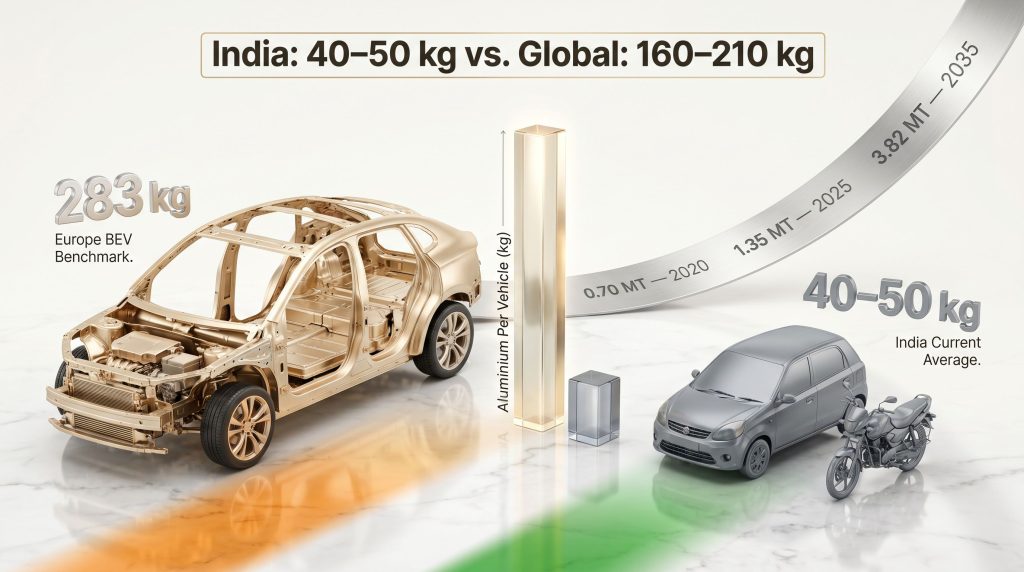
The arrival of battery electric vehicles has added a structurally distinct demand layer. In Europe, BEVs averaged approximately 283 kg of aluminium per vehicle in 2022, compared to just 169 kg in conventional petrol and diesel models. This 67% differential is not incidental. It reflects the engineering reality of EV design, where substantial battery mass must be offset by lightweighting the rest of the vehicle structure, and where thermal management systems, battery enclosures, and structural underbody components all draw heavily on aluminium alloys. Furthermore, aluminium usage in cars has spiked sharply as electrification accelerates across the automotive sector globally.
At the sectoral level, global transportation aluminium consumption reached 25.9 million tonnes in 2022, rising to an estimated 26.3 million tonnes in 2023, with passenger cars representing the largest single end-use category within that total.
The six-fold increase in average aluminium content per vehicle over five decades represents one of the most consequential material transitions in modern manufacturing, driven not by preference but by the compounding pressure of fuel economy regulation, safety standards, and now electric vehicle architecture requirements.
A Benchmark Comparison by Market
| Market / Segment | Aluminium Per Vehicle (kg) | Notes |
|---|---|---|
| Europe (All Vehicles, 2022) | ~205 | Rising to 256 kg by 2030 |
| Europe (BEV, 2022) | ~283 | vs. 169 kg for ICE equivalents |
| Europe (ICE, 2022) | ~169 | Conventional petrol/diesel |
| Global Average (All Segments) | ~160–210 | Industry-wide composite |
| India (Fleet Average) | ~40–50 | Across all vehicle categories |
India Aluminium Use Per Vehicle in Transportation: Confronting the Structural Gap
A Four-to-One Intensity Deficit
When measured against global benchmarks, India's aluminium use per vehicle in transportation reveals a gap that is simultaneously striking and instructive. Indian vehicles currently contain an estimated 40–50 kg of aluminium per unit on a fleet-weighted average basis, placing India at roughly one-quarter to one-third of the global norm of 160–210 kg.
This figure demands careful contextualisation. India manufactured more than 28 million vehicles in FY2023–24, making it one of the world's most prolific automotive producers by volume. The gap is therefore not a function of insufficient production scale. It is a material intensity problem, rooted in the composition of the fleet, the maturity of the supply chain, and the regulatory environment governing vehicle design.
Breaking down the gap by vehicle segment clarifies where the greatest disparities lie:
| Vehicle Segment | India Avg. (Est.) | Global / European Benchmark | Intensity Gap |
|---|---|---|---|
| Passenger Cars (ICE) | ~80–100 kg | ~169 kg (Europe) | ~70–90 kg |
| Passenger Cars (BEV) | Emerging / Nascent | ~283 kg (Europe) | Substantial |
| Two-Wheelers | ~10–20 kg | ~15–25 kg | Moderate |
| Commercial Vehicles | ~60–90 kg | ~120–150 kg | ~60 kg |
| Fleet Average (All Segments) | ~40–50 kg | ~160–210 kg | ~120–160 kg |
The fleet-weighted average is pulled sharply downward by the dominance of two-wheelers, which account for approximately 75% of India's total vehicle production but contain only a fraction of the aluminium found in passenger cars. This compositional reality is central to understanding why India's aggregate aluminium consumption growth has vastly outpaced per-vehicle intensity improvements.
Strong Aggregate Growth Masks a Deeper Penetration Challenge
India's Transportation Aluminium Demand: Impressive Headline, Structural Ceiling
India's total aluminium consumption in the transportation sector grew from 0.70 million tonnes in 2020 to 1.35 million tonnes in 2025, nearly doubling over five years at a compound annual growth rate of approximately 14%, according to AL Circle industry data. Projections point to 3.82 million tonnes by 2035, representing continued strong sectoral demand growth through the next decade.
Compared against the global backdrop, India's growth rate appears remarkable. Global transportation-sector aluminium consumption expanded from 22.57 million tonnes in 2020 to 27.1 million tonnes in 2025, reflecting a far more modest CAGR of 3.73%. India's sectoral growth rate is therefore more than 3.7 times faster than the global average over the same period.
| Metric | India | Global |
|---|---|---|
| 2020 Consumption | 0.70 MT | 22.57 MT |
| 2025 Consumption | 1.35 MT | 27.1 MT |
| CAGR (2020–2025) | ~14% | ~3.73% |
| 2035 Projection | 3.82 MT | N/A |
Yet this headline growth rate, compelling as it appears, is primarily a reflection of expanding vehicle production volume rather than deepening aluminium penetration within individual vehicles. India is building more vehicles, consuming more aluminium in aggregate, but not yet engineering substantially more aluminium into each unit. Closing the per-vehicle gap requires a different category of intervention than simply scaling output capacity.
India's transportation aluminium consumption is growing at nearly four times the global rate. But the critical distinction is that this growth is volume-driven. Until per-vehicle intensity increases substantially, India's fleet will remain structurally light on aluminium relative to its global peers, regardless of how many vehicles roll off the line.
Five Structural Barriers Limiting India's Per-Vehicle Aluminium Intensity
Understanding why India aluminium use per vehicle in transportation sits so far below global norms requires examining five distinct but interrelated structural forces.
1. Market Composition and Price Sensitivity
India's automotive market is structurally differentiated from European or North American markets in ways that directly suppress per-vehicle aluminium content. The fleet is overwhelmingly composed of entry-level passenger cars, two-wheelers, and three-wheelers — categories where the delivered cost per vehicle is a primary competitive constraint. OEMs operating in these segments face intense pressure to minimise material costs, and aluminium's higher base price relative to steel makes broad substitution economically challenging without corresponding regulatory or efficiency incentives.
Two-wheelers, while containing only 10–20 kg of aluminium per unit, represent the dominant volume segment. Their sheer numerical weight in the production mix pulls the fleet-average aluminium content figure sharply downward, masking whatever progress is being made in higher-content segments.
2. The Lightweighting Adoption Curve
Lightweighting — the systematic engineering substitution of heavier structural materials with aluminium alloys to reduce vehicle mass — is a discipline that European and North American manufacturers have refined over several decades. The practice is embedded in their regulatory compliance strategies, platform development philosophies, and supplier relationships. The aluminium benefits in transport are well documented, particularly in reducing overall vehicle weight and lifecycle emissions.
In India, lightweighting remains in earlier stages of adoption across most vehicle categories. The Corporate Average Fuel Economy (CAFE) standards introduced by the Indian government represent an important regulatory signal, but they have not yet generated the same intensity of demand-pull for aluminium substitution that equivalent European emissions regulations have created. As CAFE standards tighten through the late 2020s, this dynamic is expected to shift.
3. Manufacturing Capability and Supplier Ecosystem Depth
Aluminium-intensive vehicle design depends on a sophisticated ecosystem of Tier-1 and Tier-2 suppliers capable of producing precision die-castings, extruded structural sections, and rolled sheet components to automotive-grade specifications. This supplier ecosystem is less developed in India relative to the scale of the country's vehicle production base.
Key capability gaps include:
- High-pressure die-casting facilities for complex structural castings
- Aluminium extrusion capacity dedicated to automotive structural applications
- Sheet metal stamping expertise for aluminium body panels, which behave differently from steel during forming
- Quality management systems aligned to automotive OEM specifications for aluminium components
Technology transfer through joint ventures with established global aluminium component manufacturers is accelerating this capability development. However, the process requires sustained investment and time to reach critical mass at the scale India's vehicle production demands. In addition, the broader battery metals investment landscape increasingly intersects with aluminium as EV adoption accelerates.
4. Recycling Infrastructure and the Secondary Aluminium Cost Equation
One of the most underappreciated barriers to aluminium adoption in cost-sensitive vehicle segments is the relative underdevelopment of India's automotive aluminium recycling infrastructure. In mature markets, secondary (recycled) aluminium typically costs substantially less than primary aluminium, improving the economics of aluminium-intensive design by reducing the blended material cost for OEMs.
India's end-of-life vehicle (ELV) collection and processing infrastructure remains fragmented, limiting the availability of high-quality automotive aluminium scrap at the volumes needed to support a mature closed-loop recycling economy. Without this infrastructure, the cost advantage of secondary aluminium is largely unavailable to Indian OEMs, making the business case for aluminium substitution in price-sensitive segments more difficult to construct.
The development of formal ELV policies and scrap processing infrastructure is therefore not merely an environmental consideration but a direct enabler of faster aluminium adoption across the vehicle fleet. Furthermore, the aluminium supply leaders globally are investing in recycling and secondary supply chains to address precisely this kind of structural bottleneck.
5. Policy Architecture and Incentive Alignment
India's existing policy landscape for electric mobility — including the FAME scheme and the PM E-DRIVE initiative — provides meaningful incentives for electrification but does not yet explicitly reward lightweighting through material substitution. A vehicle that incorporates 50 additional kilograms of aluminium receives no direct policy recognition for the associated efficiency gains, unlike in certain European regulatory frameworks where material composition influences compliance calculations.
Filling this policy gap through targeted production-linked incentives (PLI) for lightweight automotive components, or through regulatory mechanisms that link aluminium content to emissions compliance credits, could meaningfully accelerate adoption. This aligns closely with the broader role of critical minerals in energy transition frameworks, where material efficiency is increasingly recognised as a policy priority. The absence of such instruments represents a structural policy misalignment that the industry has identified as a key constraint.
The EV Transition as a Structural Catalyst for Higher Aluminium Intensity
How Electric Vehicle Architecture Changes the Material Calculus
The global shift toward electric vehicles introduces a powerful structural driver for higher per-vehicle aluminium intensity that operates independently of regulatory lightweighting mandates. EV architecture creates a natural and unavoidable demand pull for aluminium across multiple vehicle systems simultaneously.
The physics are straightforward. A typical electric vehicle battery pack weighs between 300–600 kg depending on chemistry and capacity, substantially increasing total vehicle mass relative to conventional ICE designs. To recover acceptable range performance, EV designers must aggressively lightweight every other vehicle system. Aluminium, with its superior strength-to-weight ratio, becomes the material of choice for body structures, suspension components, thermal management systems, and battery enclosures.
The global data confirms this relationship. European BEVs average 283 kg of aluminium per vehicle compared to 169 kg for ICE equivalents — a differential of approximately 114 kg per vehicle that can be directly attributed to EV-specific architectural requirements. Consequently, battery storage expansion is intensifying demand for lightweight materials across the entire EV supply chain.
For India, the implications are significant:
- As domestic OEMs develop EV-specific platforms rather than adapting ICE architectures, aluminium intensity in the four-wheeler segment should rise substantially
- The rapidly growing EV two-wheeler segment already incorporates aluminium in frames, motor housings, and battery casings, though the per-unit content remains modest compared to four-wheeled EVs
- EV three-wheelers, a segment gaining traction in India's commercial and last-mile logistics sectors, represent an intermediate opportunity for aluminium intensity improvement
If India's passenger EV fleet were to reach European-equivalent aluminium intensity of approximately 283 kg per BEV, even a modest 10–15% BEV share in the four-wheeler segment could meaningfully lift the national fleet-weighted average from the current 40–50 kg range. The EV transition is therefore not just a powertrain story for India — it is a materials story.
A Less Widely Recognised Dynamic: The Battery Enclosure Opportunity
One aspect of EV-driven aluminium demand that receives less attention in mainstream analysis is the battery enclosure and thermal management segment. Modern EV battery packs require precisely engineered aluminium enclosures that serve multiple functions simultaneously: structural protection, thermal regulation, electromagnetic shielding, and crash energy management.
These components demand sophisticated aluminium alloy specifications, typically from the 6000 or 7000 series, with tight tolerances and complex geometries that can only be produced by advanced die-casting or extrusion facilities. As Indian OEMs develop or source EV-specific battery pack architectures, investment in domestic capability to manufacture these components could simultaneously drive per-vehicle aluminium content higher while building indigenous supply chain depth. Moreover, initiatives such as low-carbon aluminium investment signal that the global industry is aligning capital towards precisely the next-generation smelting and component technologies that India's EV sector will increasingly require.
The next major ASX story will hit our subscribers first
A Strategic Framework for Closing the Gap
Policy, Industry, and Market Levers Working in Concert
Bridging India's per-vehicle aluminium intensity deficit to closer to global norms by 2035 requires coordinated action across three distinct intervention domains.
Policy Levers:
- Strengthening CAFE standards to establish binding fuel economy targets that create genuine demand for lightweighting across all vehicle categories, not just premium segments
- Introducing aluminium-specific content incentives within EV and clean mobility policy frameworks, recognising that material substitution delivers measurable emissions benefits independent of powertrain type
- Establishing formal end-of-life vehicle regulations that create structured aluminium scrap recovery and recycling mandates, improving the economics of secondary aluminium for cost-sensitive applications
- Expanding PLI scheme eligibility to explicitly cover lightweight automotive components, creating investment incentives for domestic aluminium die-casting and extrusion capacity
Industry Levers:
- Scaling domestic aluminium die-casting, extrusion, and sheet rolling capacity dedicated to automotive specifications
- Developing India-specific lightweighting roadmaps through structured OEM-aluminium producer partnerships that define material substitution targets by vehicle segment and timeline
- Expanding closed-loop recycling agreements between vehicle manufacturers and aluminium smelters to improve secondary aluminium economics across the supply chain
- Accelerating technology transfer arrangements with established global aluminium component manufacturers through joint ventures or licensing agreements
Market Levers:
- Premium and mid-market passenger vehicle segments adopting aluminium-intensive body-in-white and structural component designs as standard rather than optional specifications
- New EV platform architectures being designed from the ground up with aluminium-intensive specifications rather than adapted from ICE platform heritage
- Consumer education initiatives highlighting the performance, safety, and efficiency benefits associated with aluminium-intensive vehicle construction
India's Aluminium-Per-Vehicle Trajectory: Key Milestones to Watch Through 2035
The pathway toward higher aluminium intensity in Indian vehicles will unfold across three distinct phases, each with identifiable catalysts and inflection points.
| Phase | Timeframe | Key Drivers | Expected Outcome |
|---|---|---|---|
| Early Transition | 2025–2027 | EV platform launches; CAFE standard tightening | Rising aluminium content in four-wheeler EVs; incremental gains in ICE vehicles |
| Capability Scaling | 2027–2030 | Tier-1 supplier capacity growth; ELV recycling infrastructure; potential PLI expansion | Accelerating per-vehicle content gains across mid-market segments |
| Convergence Phase | 2030–2035 | EV penetration deepening; lightweighting becoming standard | Fleet average approaching 80–120 kg; total consumption approaching 3.82 MT |
The transition will not be linear. Specific inflection points — including the launch of aluminium-intensive EV platforms by domestic OEMs, regulatory announcements tightening CAFE standards, and formal ELV policy implementation — will act as discrete step-changes rather than gradual progressions. Investors and industry observers tracking India's aluminium story should focus less on aggregate consumption headlines and more on these per-vehicle intensity milestones as indicators of structural depth.
Frequently Asked Questions: India Aluminium Use Per Vehicle in Transportation
What is the current aluminium content per vehicle in India?
India's vehicles currently contain an estimated 40–50 kg of aluminium per unit on a fleet-weighted average basis across all segments, compared to a global industry average of approximately 160–210 kg per vehicle.
Why does India use less aluminium per vehicle than other major markets?
The primary drivers include the dominance of cost-sensitive two-wheelers and entry-level vehicles in the production mix, a less mature lightweighting supply chain, evolving fuel economy regulations, underdeveloped automotive aluminium recycling infrastructure, and policy frameworks that do not yet directly incentivise material substitution.
How fast is India's total transportation aluminium consumption growing?
India's transportation-sector aluminium demand grew at a CAGR of approximately 14% between 2020 and 2025, rising from 0.70 million tonnes to 1.35 million tonnes, significantly outpacing the global CAGR of 3.73% over the same period, according to AL Circle industry data.
Will India's EV transition increase aluminium use per vehicle?
Yes. Electric vehicles structurally require substantially more aluminium than conventional ICE vehicles due to battery architecture requirements. Globally, BEVs average approximately 283 kg of aluminium versus 169 kg for petrol and diesel equivalents. As India's EV fleet expands, the national fleet-weighted average aluminium content per vehicle should increase meaningfully.
What is India's transportation aluminium demand forecast through 2035?
India's transportation-sector aluminium consumption is projected to reach 3.82 million tonnes by 2035, reflecting continued strong demand growth driven by vehicle production expansion and gradual increases in per-vehicle aluminium intensity across the fleet.
What is the single most important factor that could accelerate per-vehicle aluminium intensity in India?
The combination of strengthened CAFE standards and native EV platform development represents the most powerful near-term catalyst. Regulatory pressure creates binding demand for lightweighting, while ground-up EV platform design enables OEMs to specify aluminium intensity from the outset rather than incrementally substituting materials within existing architectures.
This article contains forward-looking statements and projections based on industry data and analyst forecasts. Actual outcomes may differ materially from projections due to changes in regulatory environments, technological developments, market conditions, and other factors. Nothing in this article constitutes investment advice.
Want to Track the Resource Discoveries Powering the EV and Aluminium Revolution?
As India's electric vehicle transition accelerates demand for aluminium and critical materials, Discovery Alert's proprietary Discovery IQ model delivers real-time ASX mineral discovery alerts, turning complex resource data into actionable investment insights — explore historic discoveries and their returns or start your 14-day free trial today to position yourself ahead of the market.