July 9, 2026

The Structural Forces Reshaping Indo-Pacific Energy Trade
Energy security has never been a purely economic calculation. For import-dependent nations operating in geopolitically volatile regions, it is increasingly a question of national resilience. Across the Indo-Pacific, the architecture of energy supply is being rebuilt from the ground up, driven not by price signals alone but by the hard lessons of supply chain fragility, geographic concentration risk, and the growing recognition that energy flows can be used as instruments of geopolitical leverage.
Within this context, India Australia energy trade and LNG cooperation has moved from the margins of bilateral diplomacy to its very centre. The two nations now find themselves aligned not just on commodity exchange but on the deeper strategic logic of supply chain diversification, rules-based trade, and long-term energy cooperation across fossil fuels, nuclear energy, and the emerging low-carbon economy.
Understanding what this partnership actually represents, and where it is headed, requires moving beyond headline announcements to examine the underlying mechanics, the historical volatility, and the structural opportunities that make this one of the most consequential bilateral energy relationships of the coming decade.
When big ASX news breaks, our subscribers know first
West Asian Instability and the Case for Geographic Diversification
India's energy import dependency is substantial. The country relies on external suppliers for the overwhelming majority of its crude oil and natural gas requirements, and a significant portion of those imports have historically transited through or originated from the West Asian region. When instability disrupts shipping lanes, creates pricing shocks, or introduces counterparty risk, the downstream consequences for India's energy system are immediate and material.
The ongoing turmoil in West Asia has accelerated a strategic conversation that Indian policymakers had been having in quieter tones for years: the concentration of energy imports in a single geopolitical region is a structural vulnerability, not merely a commercial inconvenience. Furthermore, geographic diversification of supply is not optional; it is a risk management imperative.
Australia's position in this calculus is significant. It offers political stability, transparent regulatory frameworks, adherence to international trade norms, and substantial reserves across multiple energy categories. For India, building a deeper energy relationship with Australia is not simply about securing an alternative LNG supplier. It is about constructing a more resilient overall import portfolio that is less exposed to regional shocks.
The LNG supply outlook for the Indo-Pacific further reinforces Australia's strategic value. As analysts at IEEFA have noted, pooling public finance across bilateral clean energy initiatives could meaningfully accelerate this transition.
The recommitment by both nations to open markets and rules-based trade is not diplomatic boilerplate. It represents a deliberate strategic choice to anchor bilateral energy flows within a framework that is insulated from the kind of supply weaponisation risk that state-controlled energy exporters can introduce.
A Two-Decade History of LNG Cooperation: Key Milestones
The India Australia energy trade and LNG cooperation story is longer and more complex than many observers appreciate. It has moved through phases of early ambition, commercial disappointment, and now renewed strategic commitment.
| Year | Milestone | Details |
|---|---|---|
| 2001 | Early Infrastructure Discussions | Proposals for an LNG receiving terminal in Orissa to be supplied by Australian gas |
| 2009 | First Long-Term LNG Contract | AUD $25 billion agreement between ExxonMobil (Australia) and Petronet LNG for 1.5 million tonnes per annum from the Gorgon project over a 20-year term |
| 2012-2015 | Trade Gap Period | Indian LNG imports from Australia fell to zero, exposing fragility in early bilateral energy flows |
| 2019 | Import Contraction | Australian LNG imports to India declined by approximately 29%, driven by pricing and contract structure issues |
| 2020-21 | Further Volume Decline | A further approximately 19% reduction in import volumes highlighted the need for stabilised long-term supply arrangements |
| 2026 | Strategic Recommitment | High-level bilateral summit in Melbourne reaffirms LNG cooperation, uranium exports, and clean energy collaboration |
The volatility embedded in this timeline is instructive. The period between 2012 and 2015, when Indian imports from Australia effectively collapsed to zero, revealed a critical weakness in the early commercial architecture of the relationship. Without durable long-term contracts anchored by appropriate pricing mechanisms, bilateral energy flows are highly susceptible to spot market arbitrage and demand-side switching.
The Gorgon Project and the Commercial Template It Created
The AUD $25 billion agreement between ExxonMobil's Australian operations and Petronet LNG, India's largest LNG importer, remains the foundational commercial reference point for bilateral LNG trade. Structured to deliver 1.5 million tonnes per annum over a 20-year period from the Gorgon LNG project off Western Australia, the deal established the template for how long-duration, large-volume LNG contracts between the two countries could be structured.
The Gorgon project itself is one of the largest natural gas developments in Australian history, combining substantial upstream reserves with world-class liquefaction infrastructure. Its role as the anchor supply source for Indian imports reflects both its scale and its ability to underwrite the kind of long-term offtake commitments that major importers like Petronet require.
Long-term LNG contracts serve a dual purpose: they provide importing nations with price certainty and supply predictability, while simultaneously giving producing nations the revenue visibility needed to justify the enormous capital expenditure required for upstream development and liquefaction infrastructure.
The 2.5 MTPA Deal: Still on the Table
Reports have emerged of India's interest in finalising a significantly expanded 25-year supply agreement targeting 2.5 million tonnes per annum of Australian LNG. This would represent a meaningful step up from the volumes established under the original Gorgon contract and would cement Australia's position as a long-term strategic supplier rather than a supplementary source.
The principal obstacle to finalising such an agreement has been Australia's domestic environmental regulatory framework. The approval processes required for expanding or establishing new LNG export infrastructure have introduced delays that create uncertainty for international buyers evaluating the bankability of long-term supply commitments. From an Indian buyer's perspective, regulatory risk in the supplying country is a real constraint on deal structuring.
Despite these hurdles, the commercial and strategic logic of a long-duration agreement remains compelling for both sides. For India, locking in substantial volumes at agreed pricing terms provides insulation against LNG spot market volatility, which can be extreme. For Australian producers, a 25-year offtake commitment provides the foundation for capital allocation decisions on upstream projects that require decades to generate returns.
Trade Agreements as the Commercial Foundation
What the ECTA Actually Delivers
The Australia-India Economic Cooperation and Trade Agreement (ECTA), which entered into force in 2022, created a preferential commercial environment for bilateral energy trade that is structurally different from what existed before. The headline benefit for LNG is a 0% tariff lock on Australian LNG entering India, a meaningful reduction from the duties that had previously added friction to bilateral flows.
However, the ECTA's significance extends beyond the tariff schedule. According to the Australian DFAT ECTA outcomes, it includes provisions designed to facilitate investment flows across the energy value chain, and it establishes a structured framework for critical minerals and energy security cooperation, which is increasingly central to the bilateral relationship as both nations navigate the energy transition.
The CECA Layer: Deepening Integration
Negotiations toward a Comprehensive Economic Cooperation Agreement (CECA) represent the next stage of bilateral economic integration. Where the ECTA focused primarily on trade in goods and tariff reduction, the CECA is designed to go deeper into investment facilitation, services, and supply chain integration across upstream, midstream, and downstream energy sectors.
Both governments have signalled clearly that private sector partnerships are the execution mechanism through which diplomatic commitments translate into operational energy infrastructure. Government-to-government frameworks establish the enabling conditions; it is corporate investment, project finance, and commercial contracting that actually move molecules.
Beyond LNG: The Full Spectrum of Energy Cooperation
Uranium Exports: A Historic Milestone
One of the most strategically significant developments confirmed at the 2026 bilateral summit was the finalisation of the administrative arrangements required to enable Australian uranium exports to India for civil purposes. This activates the framework established under the Australia-India Nuclear Cooperation Agreement and brings International Atomic Energy Agency (IAEA) safeguards into the operational picture.
The context matters enormously here. Australia holds approximately 28% of the world's known uranium reserves, making it one of the most consequential potential suppliers for any nation seeking to expand its civil nuclear capacity. Indeed, Australia's global uranium supply dominance is a factor that directly shapes India's long-term nuclear fuel cycle planning.
India has outlined ambitious plans to expand its civil nuclear generating capacity over the coming decades. Access to a reliable, safeguard-compliant source of uranium from a politically stable jurisdiction addresses a genuine supply gap in India's nuclear fuel cycle planning.
Critical Minerals: The Emerging Pillar
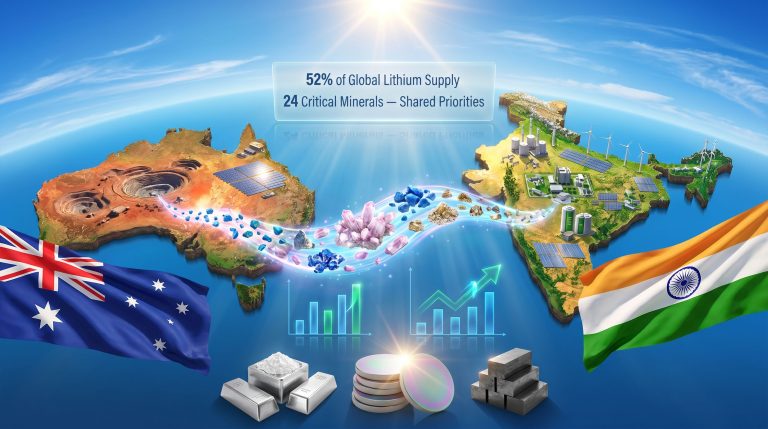
The critical minerals dimension of India Australia energy trade and LNG cooperation is perhaps the most underappreciated aspect of the bilateral relationship. As India accelerates its renewable energy deployment and electric vehicle manufacturing ambitions, the critical minerals demand is set to grow at rates that dwarf current supply chain capacity.
| Critical Mineral | Australia's Global Ranking | India's Strategic Need |
|---|---|---|
| Lithium | Top 3 global producer | EV battery supply chains, grid-scale storage |
| Cobalt | Significant reserves | Battery cathode manufacturing |
| Uranium | Approx. 28% of global known reserves | Civil nuclear energy expansion |
India has set a target of meeting 50% of its energy needs through renewable sources by 2030. Achieving that target requires deploying solar, wind, and storage infrastructure at scale, all of which depend on critical minerals that Australia produces in globally significant quantities. Furthermore, India's lithium supply strategy increasingly points toward Australian sources as a cornerstone of its battery supply chain ambitions.
Clean Energy and Low-Carbon Fuels
Both governments have expressed alignment on accelerating renewable energy deployment and clean energy collaboration. Australia's formal acknowledgement of India's Global Biofuels Alliance initiative is a notable signal. The Alliance, which India launched with considerable diplomatic effort, is designed to accelerate the adoption of biofuels globally and establish India as a hub for biofuel production and trade.
Australia's recognition of this initiative opens a potential collaboration pathway in low-carbon fuels, extending beyond LNG and uranium into green hydrogen, ammonia, and sustainable aviation fuel sectors where both countries have emerging interests.
The Relationship India and Australia Have With Other LNG Suppliers
Understanding the competitive landscape is essential to evaluating how India Australia energy trade and LNG cooperation sits within India's broader energy strategy. India sources LNG from multiple suppliers, including Qatar, the United States, and a range of spot market participants.
Australia's competitive positioning relative to these suppliers involves several factors:
- Geographic proximity reduces shipping times and freight costs compared to Atlantic Basin suppliers
- Political alignment within the Quad framework provides a layer of strategic trust that purely commercial relationships lack
- Reserve depth across LNG, uranium, and critical minerals makes Australia a potential one-stop strategic energy partner rather than a single-commodity supplier
- Pricing structure remains a point of competition, particularly against Middle Eastern suppliers with different cost bases and contract flexibility
The 29% decline in Australian LNG imports to India in 2019, and the subsequent 19% contraction in 2020-21, demonstrate that commercial factors can override strategic alignment in the short term. India's buyers are sophisticated market participants who will pursue spot market optionality when contract terms make it attractive to do so.
The next major ASX story will hit our subscribers first
Scenario Analysis: Three Possible Trajectories
| Scenario | Key Drivers | Likely Outcome |
|---|---|---|
| Accelerated Integration | CECA finalised, 2.5 MTPA LNG deal signed, uranium exports scale rapidly | Australia becomes India's second-largest LNG supplier by 2035 |
| Steady Incremental Progress | ECTA delivers gradual trade growth, critical minerals become dominant growth vector | Partnership deepens at measured pace without transformative volume increases |
| Stagnation Risk | Environmental regulatory delays, pricing disputes, or geopolitical realignment | Trade volumes remain volatile; India pivots toward US LNG and Middle Eastern suppliers |
The most likely near-term trajectory sits between the first and second scenarios. The bilateral political commitment is genuine and deepening. The commercial obstacles are real but not insurmountable. The critical minerals opportunity may ultimately prove to be the fastest-moving dimension of the relationship, given India's renewable energy timeline and Australia's existing production infrastructure.
Frequently Asked Questions: India-Australia Energy Trade
What LNG does Australia supply to India?
The primary commercial arrangement is the Gorgon project supply agreement between ExxonMobil's Australian operations and Petronet LNG, delivering 1.5 million tonnes per annum over a 20-year term. India has been pursuing an expanded arrangement targeting 2.5 million tonnes per annum under a 25-year framework, though this has not yet been finalised.
What is the value of the India-Australia LNG agreement?
The 2009 Gorgon project contract is valued at AUD $25 billion over its 20-year term. Expanded negotiations targeting 2.5 MTPA over 25 years would represent a materially larger commercial commitment, the precise value of which depends on pricing mechanisms agreed between the parties.
Can Australia export uranium to India?
Yes. The finalisation of administrative arrangements announced at the 2026 bilateral summit activates the framework under the Australia-India Nuclear Cooperation Agreement, subject to IAEA safeguards. Australian uranium can now be exported to India for peaceful civil nuclear purposes.
How does the ECTA affect bilateral LNG trade?
The ECTA locks in a 0% tariff on Australian LNG entering India, removes a layer of commercial friction that previously added cost to bilateral flows, and establishes investment facilitation provisions and a critical minerals cooperation framework that extends the relationship beyond simple commodity exchange.
Why did Indian LNG imports from Australia decline between 2019 and 2021?
The declines reflected a combination of spot market pricing dynamics, contract structure issues, and India's willingness to seek more competitive terms from alternative suppliers. This volatility underscores why both governments are now prioritising long-term contract frameworks over spot market dependency.
Key Metrics to Watch Going Forward
For analysts and observers tracking the evolution of India Australia energy trade and LNG cooperation, the following indicators will define the trajectory of the partnership:
- Progress toward a finalised 25-year, 2.5 MTPA LNG supply agreement and the resolution of any outstanding environmental approval requirements
- The pace and volume of uranium exports under the newly activated administrative arrangements
- Investment flows into Indian LNG regasification infrastructure and whether Australian capital plays a meaningful role
- Critical mineral supply chain agreements formalised under both the ECTA and the forthcoming CECA
- India's renewable energy capacity additions through 2030 and the corresponding pace of critical mineral procurement from Australian sources
- The timeline and scope of the CECA negotiations and which energy value chain segments they prioritise
Readers interested in ongoing developments in India-Australia energy trade and LNG cooperation can follow related reporting through ETEnergyWorld's Oil & Gas coverage at energy.economictimes.indiatimes.com.
Disclaimer: This article contains forward-looking analysis, scenario projections, and references to negotiations that have not yet been finalised. Readers should not interpret this content as investment advice. All financial figures, trade volumes, and policy frameworks cited are based on publicly available information and are subject to change. The scenario analysis presented reflects analytical assessments and does not constitute a prediction of outcomes.
Want to Capitalise on the Next Major ASX Resource Discovery?
The structural shifts reshaping Indo-Pacific energy trade — spanning LNG, uranium, and critical minerals — signal profound opportunities across Australia's resource sector, and Discovery Alert's proprietary Discovery IQ model instantly translates significant ASX mineral announcements into actionable insights for investors at every level. Explore how historic mineral discoveries have generated substantial returns and begin your 14-day free trial today to position yourself ahead of the market.