July 13, 2026
The Quiet Reshaping of Global Automotive Aluminium Flows
Across the global manufacturing landscape, a fundamental rebalancing is underway. For decades, Europe and North America anchored automotive production volumes and, by extension, set the tempo for industrial aluminium consumption. That architecture is now fracturing. Western OEMs are navigating structural demand softness, cost pressures, and shifting consumer preferences, while a new centre of gravity is solidifying in Asia. At the centre of this rebalancing sits India, a market whose automotive growth story is no longer emerging — it has arrived.
Understanding what this means for the India auto industry aluminium supply chain requires looking beyond headline production figures. It demands a closer examination of how aluminium intensity per vehicle is changing, who is supplying material to meet that demand, and what systemic risks could interrupt a trajectory that many industry analysts now regard as one of the most significant commodity demand stories of the decade.
When big ASX news breaks, our subscribers know first
India's Ascent to the Top Tier of Global Vehicle Manufacturing
India's transformation into the world's fourth-largest vehicle producer did not happen by accident. The 1991 de-licensing of the automotive sector cracked open a market that had been heavily protected, inviting foreign investment and spurring domestic manufacturing capability that compounded over three decades. The "Make in India" policy framework reinforced this trajectory, creating a self-reinforcing cycle where domestic investment attracted international partners, which in turn deepened the supply chain and raised manufacturing sophistication.
The post-pandemic recovery phase was decisive. While Western automotive markets absorbed the combined shock of semiconductor shortages, inflation, and shifting consumer financing conditions, India's production volumes rebounded with unusual speed, cementing its position among the top four producing nations globally. Furthermore, the aluminium sector investment flowing into Asia during this period reinforced the momentum behind regional manufacturing expansion.
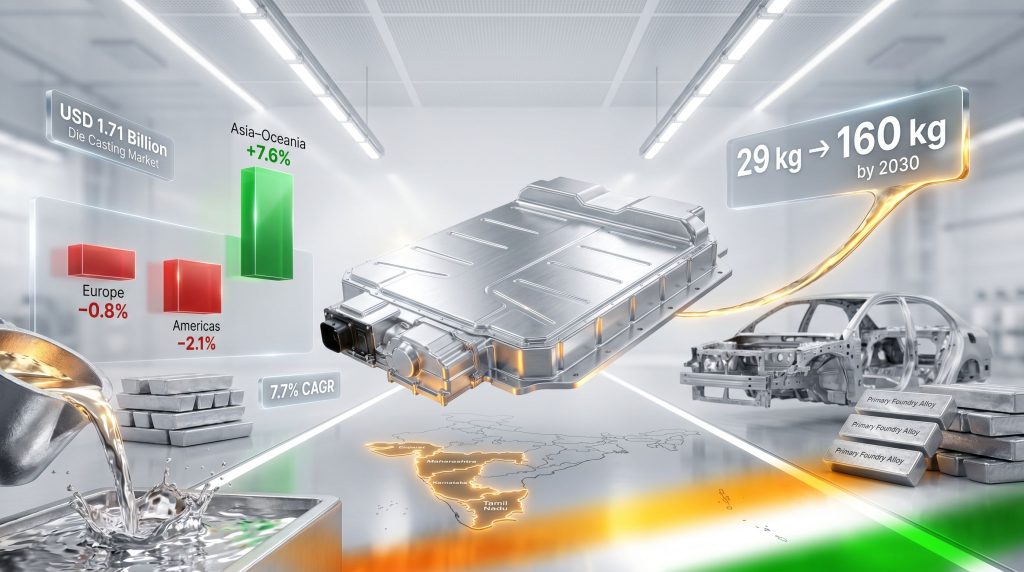
The production divergence between regions is now measurable and stark. According to data from the International Organisation of Motor Vehicle Manufacturers, vehicle output across Asia-Oceania grew by 7.6% in 2025 compared to the prior year. Europe contracted by 0.8% over the same period, while the Americas declined by 2.1%. These are not cyclical fluctuations — they reflect structural shifts in where automotive manufacturing capacity is being built and sustained.
| Region | 2025 Production Trend | Forward Outlook |
|---|---|---|
| Asia-Oceania | +7.6% YoY | Continued expansion led by India and Southeast Asia |
| Europe | -0.8% YoY | OEM cost pressures and softening domestic demand |
| Americas | -2.1% YoY | Geopolitical headwinds and inflationary drag |
| India (standalone) | Strong positive growth | Confirmed fourth-largest producer globally |
The Aluminium Intensity Story: Why Per-Vehicle Content Is the Variable That Matters Most
Raw production volume tells only part of the story. The more consequential metric for aluminium markets is how much of the metal goes into each vehicle rolling off Indian assembly lines, and how rapidly that figure is changing.
As of 2024, average aluminium content per Indian-manufactured vehicle sits at approximately 29 kilograms. By 2030, that figure is projected to reach roughly 160 kilograms — a more than fivefold increase within six years. This is not a gradual evolution. It represents a step-change in material intensity driven by converging regulatory, technological, and market forces:
-
BS-VI emission compliance is engineering-level pressure on vehicle mass. To meet stricter tailpipe standards, OEMs must reduce kerb weight, and aluminium delivers the most commercially viable path to meaningful mass reduction at scale.
-
Electric vehicle platform architecture requires high-strength, lightweight battery enclosures and structural frames. Aluminium's strength-to-weight ratio makes it the default choice for EV underpinning, particularly as range efficiency becomes a competitive differentiator. In addition, EV battery supply growth is accelerating demand for lightweight structural materials across Asian manufacturing platforms.
-
Advanced safety feature integration including ADAS systems, crumple zones, and electronic stability controls adds aluminium-intensive components that were largely absent from entry-level Indian vehicles a decade ago.
At the sector level, India's automotive industry already accounts for approximately 40% of the country's secondary aluminium demand as of 2023. That share is forecast to rise to 40-45% by 2028, with total secondary aluminium demand projected to reach 2.4-2.5 million tonnes by that year, growing at a compound annual rate of 7-11% from 2023 to 2028.
Die Casting: The Sub-Sector Driving the Hardest Growth
Within the broader aluminium-automotive relationship, die casting represents the highest-intensity application segment. India's automotive aluminium die casting market was valued at USD 1.71 billion in 2025, expanding at a 7.7% CAGR. Passenger cars account for 54.8% of total segment demand, with applications concentrated in powertrain housings, transmission cases, structural brackets, and battery enclosures.
Die casting is particularly important because it locks in aluminium consumption at a component-level depth that is difficult to substitute once an OEM's engineering specifications are set. Once a powertrain housing is designed around a die-cast aluminium specification, the material choice persists across the production run of that model generation. For a deeper look at India's automotive aluminium demand, the dynamics at play extend well beyond simple volume metrics.
The shift toward die-cast aluminium components in Indian vehicle manufacturing is as much a design-cycle lock-in as it is a material preference. Engineering specifications once embedded in a model platform typically persist for five to seven years, meaning today's die casting commitments are tomorrow's guaranteed demand volumes.
Domestic Supply Localisation: Breaking the Import Dependency Cycle
For much of India's automotive expansion, the country relied heavily on imported aluminium alloys to supply technically demanding applications. That dependency is now unwinding. Vedanta Aluminium, India's largest primary aluminium producer, has moved decisively into automotive-grade alloy supply, now providing Primary Foundry Alloy and Cylinder-Head Alloy directly to domestic OEMs — grades that previously had to be sourced from international suppliers at significant import premiums.
Jindal Aluminium has similarly expanded its automotive-grade portfolio, supplying tier-1 auto component manufacturers across the rolled and extruded product categories. Together, these developments represent a structural inflection point for the India auto industry aluminium supply chain. The top aluminium producers operating globally are increasingly viewing India as both a growth market and a competitive manufacturing base.
| Supplier Category | Role in Auto Supply Chain | Strategic Significance |
|---|---|---|
| Vedanta Aluminium | Primary foundry and cylinder-head alloys | Eliminated import reliance for key technical grades |
| Jindal Aluminium | Automotive-grade rolled and extruded products | Tier-1 supplier to domestic OEMs |
| Secondary/Recycled Smelters | Secondary alloy supply for casting operations | Approximately 45% recycled content across alloy mix |
| Import Channels | Scrap and semi-finished products | Declining share as localisation matures |
The localisation of premium foundry alloys carries implications beyond simple cost arithmetic. It reduces exposure to freight volatility, compresses lead times for OEM procurement teams, and enables more responsive just-in-time supply relationships — a capability increasingly demanded by vehicle manufacturers managing tighter production schedules.
Global Tier-1 Suppliers Pivoting Toward India
The signal that India's automotive market has reached genuine global relevance is visible in how international tier-1 suppliers are repositioning their commercial strategies. Swedish passive safety systems developer Autoliv reported 38% organic sales growth in India, a figure its leadership attributed to the rising safety content embedded in Indian vehicles alongside sustained light vehicle production growth. This is a remarkable growth rate for a mature safety systems company, and it reflects the genuine acceleration happening at the OEM level.
American automotive electronics specialist Visteon Corporation and advanced driver-assistance systems maker Mobileye Global have each identified India as a priority expansion market. The demand signals flowing from domestic OEMs for integrated safety architectures, electronic stability systems, and ADAS capabilities are drawing global technology suppliers into deeper Indian market commitments.
On the OEM side, Renault is actively evaluating India as a dual-purpose manufacturing hub covering both ICE and EV production. Renault's global leadership has communicated an ambition to make India one of the brand's top three global markets by 2030, targeting a 5% market share and envisioning import sourcing from India valued at approximately EUR 2 billion (USD 2.34 billion) by the same date. Domestic players Tata Motors and Mahindra and Mahindra are simultaneously expanding their EV portfolios while elevating electronics and safety content in ICE models, both pathways that directly increase per-vehicle aluminium intensity.
Supply Chain Risk: Where the Vulnerabilities Lie
No growth story unfolds without friction, and India's aluminium automotive supply chain carries identifiable risks that warrant serious assessment.
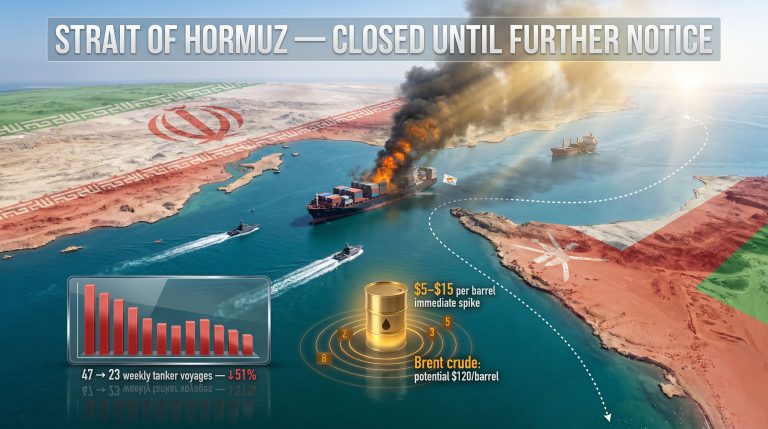
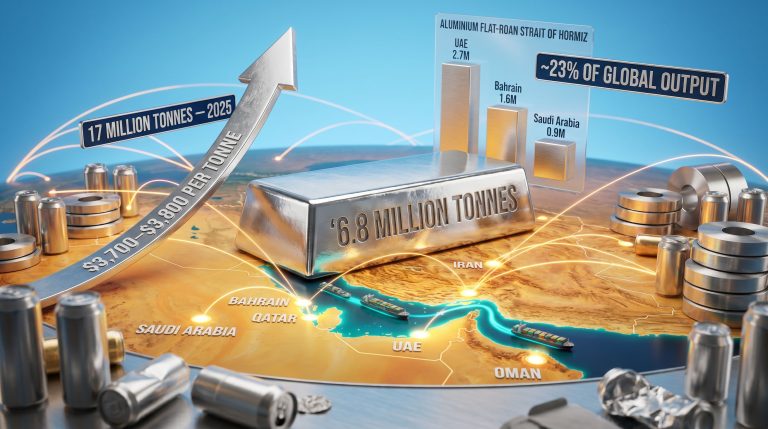
Maritime and geopolitical disruption represent the most immediate pressure point. Ongoing Middle East tensions have introduced freight cost volatility and shipping lane uncertainty that directly affects the economics of aluminium scrap imports. India's secondary aluminium smelters depend on imported scrap to supplement domestic collection volumes, and elevated logistics costs compress their operating margins while weakening pricing power in local semi-finished markets. Consequently, the aluminium tariff impacts emanating from shifting trade policy add a further layer of uncertainty to import cost modelling.
Recycled content dependency is a medium-term structural variable. Current recycled content across automotive aluminium alloys averages approximately 45%. India's 2025 End-of-Life Vehicle (ELV) Rules are expected to improve domestic scrap recovery rates substantially, with recycled content share projected to reach 60% as formal dismantling infrastructure scales and the policy framework matures. However, the transition timeline carries uncertainty — the effectiveness of the ELV framework depends on implementation quality and enforcement consistency at the state level.
| Risk Factor | Current Status | Mitigation Pathway |
|---|---|---|
| Scrap import disruption | Elevated due to maritime tensions | ELV Rules scaling and domestic scrap development |
| Import dependency on alloys | Declining through localisation | Vedanta and Jindal domestic supply programs |
| Margin compression for importers | Active pressure | Structural shift toward domestic sourcing contracts |
| Geopolitical freight costs | Structurally elevated | Coastal cluster logistics optimisation |
The next major ASX story will hit our subscribers first
India's Export Ambition: Capturing ASEAN's China-Plus-One Demand
Beyond domestic consumption, India is building credibility as an aluminium automotive component exporter. Maharashtra-Gujarat and Tamil Nadu-Karnataka coastal manufacturing clusters are leveraging port proximity to compete on cost-efficient export economics, with shipments flowing through Chennai, Ennore, and Mundra ports.
Aluminium auto-part exports from India grew 21% year-on-year in 2024, with approximately two-thirds of those volumes directed toward ASEAN markets actively pursuing supply chain diversification away from Chinese manufacturing. This "China-plus-one" sourcing dynamic is not a temporary arbitrage opportunity. It reflects a durable structural reconfiguration of Asian industrial supply chains, driven by geopolitical risk management at the procurement level across Japanese, South Korean, and Southeast Asian manufacturing networks.
India's competitive positioning in this environment rests on several reinforcing factors: competitive labour costs, improving metallurgical capabilities at domestic producers, a growing tier-1 and tier-2 component ecosystem with international quality certifications, and government export incentive frameworks that reduce the cost gap relative to alternative sourcing destinations. Furthermore, global aluminium suppliers entering India are recognising the country's dual role as both a consumption market and an export manufacturing hub of growing strategic importance.
Aluminium vs. Steel in Indian Vehicles: The Economics Are Shifting
Steel remains deeply embedded in Indian automotive manufacturing, but the economic and regulatory calculus increasingly favours aluminium penetration across specific applications. In addition, growing battery materials demand is accelerating the transition toward aluminium-intensive platform architectures, particularly in EV segments where energy density and structural efficiency are paramount.
| Attribute | Aluminium | Steel |
|---|---|---|
| Weight Reduction | 30-50% lighter per equivalent component | Baseline reference |
| BS-VI Compliance Benefit | High — direct mass reduction contribution | Moderate |
| EV Platform Suitability | High — battery enclosures and structural frames | Limited for lightweight applications |
| Domestic Supply Maturity | Rapidly improving | Well-established |
| Recyclability | High — closed-loop circular potential | High |
| Cost Trajectory | Declining with localisation scale | Stable |
The total cost of ownership calculation is shifting as domestic aluminium supply scales and import premiums compress. For EV applications specifically, the performance economics of aluminium are compelling enough that the material cost premium over steel becomes difficult to justify avoiding, particularly when battery range sensitivity is factored into vehicle design decisions.
Frequently Asked Questions
What percentage of India's aluminium demand comes from the automotive sector?
The automotive sector accounts for approximately 40% of India's secondary aluminium demand as of 2023, with projections indicating a rise to 40-45% by 2028 as vehicle manufacturing volumes continue expanding.
How much aluminium does an Indian vehicle contain today versus future projections?
Average aluminium content per vehicle in India sits at around 29 kg as of 2024. This is projected to reach approximately 160 kg by 2030, reflecting the compounding effect of EV adoption, BS-VI emission compliance, and safety system integration.
Who are the primary domestic aluminium suppliers to India's auto sector?
Vedanta Aluminium and Jindal Aluminium are the leading domestic suppliers, now producing automotive-grade alloys including Primary Foundry Alloy and Cylinder-Head Alloy that previously required importation at significant cost premiums.
What is the size of India's automotive aluminium die casting market?
The market was valued at USD 1.71 billion in 2025, growing at a 7.7% CAGR, with passenger car applications representing 54.8% of total segment demand.
How are geopolitical tensions affecting India's aluminium automotive supply chain?
Middle East conflict and associated maritime disruptions are elevating scrap import costs and compressing margins for secondary aluminium producers. Domestic localisation programs and the 2025 ELV Rules provide structural buffers, but full insulation from import cost volatility will take time to achieve.
Is India exporting aluminium automotive components?
Yes. Aluminium auto-part exports grew 21% year-on-year in 2024, with approximately two-thirds of volumes directed toward ASEAN markets pursuing supply chain diversification from Chinese manufacturers. The broader story of the India auto industry aluminium supply chain is therefore as much about export capability as it is about domestic consumption growth.
Key Takeaways for Industry Observers
-
India's automotive sector is the fastest-growing aluminium demand driver in Asia, with structural tailwinds from EV adoption, emission regulation tightening, and safety content escalation at the OEM level.
-
The fivefold increase in aluminium per vehicle between 2024 and 2030 makes per-unit demand intensity the most critical variable to track — more so than headline production volume growth alone.
-
Die casting is the highest-growth application, expanding at 7.7% CAGR, with demand locked in through OEM engineering specifications that typically persist across full model generation cycles.
-
Domestic supply localisation through Vedanta and Jindal is reducing import vulnerability for technically critical alloy grades, altering the risk profile of the India auto industry aluminium supply chain.
-
India's coastal manufacturing clusters are positioned to capture durable ASEAN non-China sourcing demand, with export volumes already growing at a 21% annual rate.
-
The 2025 ELV Rules represent the most consequential policy development for secondary aluminium supply security, with the potential to lift recycled content from 45% to 60% as domestic scrap infrastructure scales.
This article contains forward-looking projections and market forecasts sourced from industry publications and publicly available data. Projections regarding aluminium content per vehicle, CAGR estimates, and demand forecasts represent analytical expectations and are subject to revision based on evolving regulatory, technological, and macroeconomic conditions. Nothing in this article constitutes financial or investment advice.
Want to Track the ASX Mineral Discoveries Fuelling Asia's Aluminium Supply Chain?
As India's automotive aluminium demand accelerates toward a fivefold increase in per-vehicle content by 2030, the investment opportunities emerging across ASX-listed aluminium and materials explorers are significant — Discovery Alert's proprietary Discovery IQ model delivers real-time alerts the moment major mineral discoveries hit the ASX, transforming complex data across 30-plus commodities into actionable insights for investors at every level. Explore historic discovery returns on Discovery Alert's dedicated discoveries page and begin a 14-day free trial to position ahead of the market.