July 20, 2026
The Quiet Metal Reshaping the World's Fastest-Growing Car Market
Across global manufacturing, few materials have become as strategically contested as aluminium. Its combination of low density, thermal conductivity, and corrosion resistance makes it irreplaceable in automotive design, yet the supply chains that deliver it are fragile, geographically concentrated, and increasingly stressed. For investors, procurement strategists, and industry analysts watching the India auto industry aluminium supply dynamic unfold, the structural forces now converging in the Indian market represent one of the most significant demand formation events in the metal's recent history.
Understanding why requires stepping back from any single data point and examining the interlocking system of vehicle production shifts, regulatory pressure, raw material scarcity, and industrial policy that is simultaneously pulling aluminium demand upward while constraining the supply infrastructure needed to meet it.
When big ASX news breaks, our subscribers know first
The Global Production Divergence Driving India's Ascent
Western automotive markets are not simply experiencing a temporary cyclical dip. The structural character of the decline is becoming increasingly apparent. According to data from the International Organisation of Motor Vehicle Manufacturers, vehicle output across Europe contracted by 0.8% in 2025, while production volumes across the Americas fell by 2.1% over the same period. Major manufacturers including Ford Motor Company, Stellantis, General Motors, and Volkswagen Group have all confronted a market environment defined by persistent inflation, weakening consumer demand, and the financial aftershocks of Middle East geopolitical instability.
Meanwhile, Asia-Oceania vehicle production surged 7.6% year-on-year in 2025, creating a stark divergence that is fundamentally redirecting where global automotive investment flows. India sits at the centre of this rebalancing. Decades of industrial development, anchored by the 1991 de-licensing reforms and subsequently reinforced through the Make in India initiative, built a manufacturing foundation capable of absorbing the overflow from contracting Western production bases. The post-pandemic recovery cemented India's rise to fourth-largest automobile producer globally, a position reflecting genuine industrial capacity rather than statistical opportunism.
For auto component suppliers and aluminium mining companies, this divergence creates a strategic imperative that transcends normal market cycles. When the world's largest legacy automotive markets contract simultaneously, capital and production capability migrate toward growth markets, and India's trajectory makes it the most compelling destination in that reallocation.
How Large Is India's Automotive Aluminium Market and Where Is It Heading?
Market Valuation and the 2033 Growth Corridor
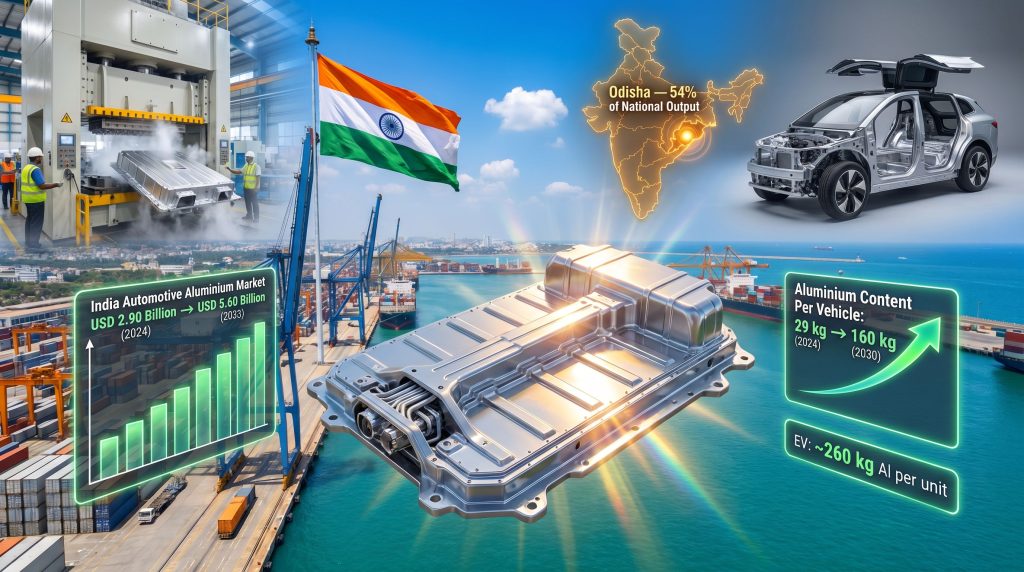
The numbers define a market at an early but accelerating growth stage. India's automotive aluminium sector was valued at approximately USD 2.90 billion in 2024 and is projected to reach USD 5.60 billion by 2033, expanding at a compound annual growth rate of 6.70%. Secondary aluminium demand, which encompasses recycled and reprocessed metal feeding the auto component supply chain, stood at approximately 1.7 million tonnes and is forecast to reach 2.4 to 2.5 million tonnes by 2033, growing at a faster 7 to 9% CAGR that reflects the specific intensity of automotive pull on recycled supply streams.
| Metric | 2024 Value | 2033 Projection | CAGR |
|---|---|---|---|
| Automotive Aluminium Market Size | USD 2.90 billion | USD 5.60 billion | 6.70% |
| Secondary Aluminium Demand | 1.7 million tonnes | 2.4-2.5 million tonnes | 7-9% |
| Automotive Share of Secondary Aluminium | ~40% | 40-45% | – |
The Aluminium Content Acceleration Curve
Perhaps the most underappreciated dynamic in the India auto industry aluminium supply story is not market size but aluminium intensity per vehicle. The average aluminium content in an Indian-manufactured vehicle stood at approximately 29 kg in 2024, a figure that appears modest by global standards but is set to undergo a dramatic transformation.
Regulatory pressure from Corporate Average Fuel Economy rules and Bharat Stage VI emissions standards is forcing vehicle manufacturers to replace heavier ferrous components with aluminium across powertrain, body, and chassis systems. The consequence is a projected aluminium content per vehicle of 160 kg by 2030, representing a more than fivefold increase within six years.
The electric vehicle dimension amplifies this curve substantially. Each EV platform requires approximately 260 kg of aluminium per unit, reflecting the metal's role in battery enclosures, structural frames, heat management systems, and body panels. With India's EV penetration forecast to reach 30% of vehicle sales by 2030, the combined effect of rising content per vehicle and rising EV share creates a demand multiplier unlike anything previously observed in the Indian automotive market.
The convergence of regulatory weight targets, EV platform architecture, and rising vehicle volumes does not produce linear demand growth. It produces exponential demand formation across a compressed timeframe, which is precisely the structural condition that attracts industrial capital at scale.
Alloy Segmentation: The Technical Underpinning
Not all aluminium demand in automotive applications is equivalent. The market is segmented by alloy chemistry, and understanding this segmentation reveals where future growth concentrates.
| Alloy Type | Market Share (2025) | Growth Rate | Primary Application |
|---|---|---|---|
| Al-Si Alloys | 63.62% | Mature | Structural castings, engine components |
| Al-Mg Alloys | Growing | 8.02% CAGR to 2031 | EV battery enclosures, lightweight structures |
Aluminium-Silicon alloys dominate current production volumes, underpinning the traditional die-casting and engine component segments. However, Aluminium-Magnesium alloys are the faster-growing segment, driven specifically by EV battery enclosure requirements. Al-Mg alloys offer superior strength-to-weight ratios and better performance under the thermal and structural stresses unique to battery pack environments. As EV production scales in India, this alloy segment is likely to grow disproportionately relative to total aluminium demand.
Who Is Driving Aluminium Demand Inside India's Auto Sector?
The Domestic OEM Concentration
Four manufacturers — Maruti Suzuki, Tata Motors, Mahindra and Mahindra, and Hyundai India — collectively account for approximately 60% of domestic secondary aluminium consumption, establishing a concentrated demand structure that gives these companies outsized influence over supply chain dynamics. Their purchasing decisions, technology roadmaps, and platform investment cycles functionally set the tempo for the entire secondary aluminium industry in India.
Tata Motors and Mahindra and Mahindra are both aggressively expanding their EV portfolios while simultaneously introducing advanced safety and electronics systems across their internal combustion model ranges. Mahindra has notably shifted toward aluminium-intensive lightweight powertrain and battery innovations, a strategic pivot that signals the company's recognition of aluminium as a core platform material rather than an incidental component.
The broader trend is toward increasing component complexity. Rising demand from domestic car manufacturers for advanced driver-assistance systems and cutting-edge safety technologies is expanding the number and complexity of aluminium-intensive components required per vehicle, compounding the intensity effect beyond simple weight reduction. Furthermore, the auto sector fuelling India's aluminium demand continues to attract new entrants across the component manufacturing ecosystem.
Global Tier-1 Suppliers Responding to India's Pull
The response from global Tier-1 suppliers confirms that the India automotive growth narrative has crossed from aspirational to operational. Several of the world's most technically sophisticated automotive component companies are actively scaling their Indian presence:
- Autoliv (Sweden): Autoliv President and CEO Mikael Bratt confirmed that the company grew sales organically by 38% in India, driven by increased safety content per vehicle and strong light vehicle production growth, a figure that stands in stark contrast to Autoliv's subdued performance across Western markets in the same period.
- Visteon Corporation (USA): Actively expanding its automotive electronics footprint in India, positioning itself to capture rising demand for digital cockpit and powertrain control systems.
- Mobileye Global (USA): Targeting India's growing ADAS adoption market as domestic vehicle safety regulations tighten.
- Renault: The French automaker is evaluating India as a dual-platform production base for both ICE and EV models. Renault's Global CEO stated during an April visit to India that the company's ambition is to make India one of Renault's top three markets globally by 2030, targeting a 5% market share and generating EUR 2 billion (approximately USD 2.34 billion) in India-origin exports by the same year.
Autoliv's 38% organic growth figure deserves particular attention. This is not market-share gain against a competitor. This is volume growth driven by structural increases in the safety content of every vehicle produced, a dynamic that, once embedded in platform design standards, becomes self-reinforcing as new model generations inherit and extend the safety specifications of their predecessors.
What Are the Critical Supply Chain Vulnerabilities Threatening India's Aluminium Sector?
The Raw Material Trilemma
The demand trajectory described above exists in direct tension with a supply chain under simultaneous stress from three distinct but interconnected pressure sources. Understanding this trilemma is essential for any honest analysis of India's aluminium growth potential.
1. Scrap Aluminium Shortage and Price Shock
Approximately 30% of India's scrap aluminium supply originates from Middle Eastern sources. The sustained geopolitical disruption in that region has triggered cascading effects through India's secondary aluminium supply chain, with scrap prices surging approximately 30% as availability constraints tightened. Some secondary aluminium producers have responded by reducing output by 20 to 40%, a contraction that directly reduces the supply of die-cast components feeding automotive assembly lines. The disruption is particularly acute for EV value chain components, where aluminium-intensive battery enclosures and structural members are disproportionately affected by scrap shortages impacting India's aluminium producers.
2. Import Duty Friction
India currently imposes a 2.5% import duty on scrap aluminium, a policy instrument originally designed to protect domestic material flows but which now compounds the cost burden on secondary producers during a period of acute feedstock scarcity. Industry bodies including the Material Recycling Association of India have formally petitioned the Prime Minister's Office to remove this duty. Simultaneously, the Aluminium Association of India has called for a 15% import duty on finished aluminium imports to shield domestic primary and secondary producers from low-cost foreign competition, creating a dual advocacy position that reflects the complexity of balancing producer protection against downstream cost competitiveness.
3. Competing Global Demand for Scrap
The third pressure source is structural rather than geopolitical. Stronger domestic scrap consumption in the United States and elevated demand from Thailand are reducing the volume of aluminium scrap available for export to India. In addition, US aluminium tariffs are reshaping global trade flows in ways that further constrain India's access to secondary feedstock. This is not a temporary reallocation — global lightweighting trends across every major automotive market are simultaneously driving scrap demand upward, meaning that India's competition for secondary aluminium feedstock will intensify regardless of how Middle East disruptions resolve.
The convergence of these three pressures creates a compounding risk scenario. Producers relying on a single scrap sourcing geography face the greatest exposure. Diversification of raw material streams is not a strategic preference in this environment; it is an operational necessity.
Why Secondary Aluminium Dominates and Why That Creates Vulnerability
A less commonly understood dimension of this supply challenge relates to why secondary aluminium is so dominant in India's automotive supply chain rather than primary metal. The answer is economic. Secondary aluminium production consumes approximately 5% of the energy required to produce equivalent volumes of primary metal from bauxite and alumina, making it substantially cheaper on a per-tonne basis.
For cost-sensitive automotive component manufacturers competing on thin margins, secondary metal is the rational commercial choice. This structural preference for recycled feedstock means that scrap availability directly constrains India's automotive aluminium supply capacity in ways that cannot easily be substituted through increased primary production without significantly altering cost structures across the entire auto component sector.
How Is India's Aluminium Production and Recycling Infrastructure Positioned?
National Production Capacity
India's position in global aluminium production is frequently underappreciated. The country ranks as the second-largest aluminium producer globally, with annual output exceeding 4 million metric tonnes. This production base is geographically concentrated, with Odisha contributing 54% of national output, underpinned by significant bauxite reserves and large-scale smelting operations anchored by Vedanta and the National Aluminium Company (NALCO).
This concentration creates both a competitive strength — in terms of scale and infrastructure density — and a strategic vulnerability, since regional disruptions or energy supply constraints in Odisha have disproportionate national consequences. Consequently, understanding the broader bauxite supply chain is critical for anyone assessing India's long-term aluminium production resilience.
India's aluminium recycling rate reached approximately 60% in 2023, a meaningful metric that positions the country as a participant in the global circular economy for aluminium. However, this recycling rate also implies that 40% of aluminium demand is still being met through primary production or imports, a ratio that creates ongoing import exposure and cost volatility that secondary-focused supply chains face when scrap markets tighten.
Die-Casting Technology and Quality Certification
The technological capabilities of India's aluminium die-casting sector are evolving rapidly but face a specific competitiveness gap relative to Chinese peers. IATF 16949 certification, the international quality management standard specific to automotive supply chains, is being achieved by an increasing number of Indian Tier-1 and Tier-2 suppliers. However, lead-time responsiveness relative to Chinese manufacturers remains a gap that procurement teams at multinational OEMs continue to flag as a constraint on India's qualification as a primary rather than supplementary supply source.
Tier-1 suppliers are addressing this partly through capacity investment, allocating up to 30% of new giga-press capacity specifically to export-qualified production runs. Giga-press technology, which produces large structural aluminium castings in a single shot rather than through multi-component assembly, is particularly relevant to EV platform manufacturing where integrated structural components are preferable to assembled alternatives from both weight and cost perspectives.
The next major ASX story will hit our subscribers first
Is India Becoming a Global Export Hub for Automotive Aluminium Components?
The China+1 Sourcing Shift
The global procurement community is actively restructuring supply chains to reduce concentration risk in China-dependent sourcing. This strategic reallocation, commonly called the China+1 framework, identifies secondary sources capable of matching Chinese quality, cost, and delivery standards across key manufactured goods categories. For automotive aluminium components, India has emerged as the primary beneficiary of this reallocation.
Several structural advantages support India's China+1 positioning:
- Competitive logistics from coastal manufacturing clusters to ASEAN destination markets
- Tariff advantages under the ASEAN-India Free Trade Agreement
- Rising quality certification rates among Indian automotive suppliers
- A large, technically trained workforce relative to other emerging manufacturing economies
- Established relationships with global OEMs through decades of component supply history
Furthermore, the emergence of leading bauxite producers investing in downstream processing creates additional upstream support for India's ambitions in this space.
Export Performance and Logistics Advantage
Aluminium auto parts exports routed through Indian coastal ports including Chennai, Ennore, and Mundra rose 21% year-on-year in 2024, with approximately two-thirds of these volumes directed toward ASEAN markets. Transit time from Indian coastal manufacturing clusters to ASEAN destinations runs 14 to 18 days, compared to approximately 21 days from Chinese inland factories when customs clearance is included.
This logistics differential, while modest in isolation, becomes strategically significant when combined with the tariff advantage provided by the ASEAN-India Free Trade Agreement, which reduces auto component tariffs to 0 to 5% for qualifying Indian-origin goods.
| Logistics Factor | India (Coastal) | China (Inland) |
|---|---|---|
| Transit Time to ASEAN | 14-18 days | ~21 days |
| ASEAN Tariff Rate | 0-5% (FTA) | Standard MFN rates |
| IATF 16949 Coverage | Growing | Extensive |
A USD 2 billion annual sourcing commitment linked to Tesla and Tata Group-aligned suppliers represents commercial validation that India's automotive aluminium component sector has reached a credibility threshold with the world's most technically demanding EV manufacturer. Agreements of this scale signal not merely transactional volume but systemic supplier qualification across quality, capacity, and logistics dimensions. Moreover, an Alcoa joint venture model of cross-border industrial collaboration is increasingly being viewed as a template for how global players might deepen their Indian manufacturing commitments.
What Government Policies Are Accelerating Aluminium Adoption in Indian Automotive?
The Regulatory Framework Driving Lightweighting
India's automotive aluminium demand is not solely a function of industrial market forces. A coherent regulatory architecture is creating structural demand pull for aluminium-intensive vehicle architectures across the domestic automotive sector:
- Bharat Stage VI Emissions Standards (BS-VI): Mandate engine efficiency improvements that intrinsically favour aluminium's thermal management properties and weight advantages over ferrous alternatives. Compliance with BS-VI is creating a regulatory necessity for lightweighting that would otherwise be a discretionary engineering choice.
- Corporate Average Fuel Economy (CAFE) Regulations: Require fleet-average fuel economy improvements across manufacturer portfolios, making aluminium substitution a compliance mechanism rather than a design preference.
- FAME Initiative (Faster Adoption and Manufacturing of Hybrid and Electric Vehicles): Directly incentivises EV production and adoption, creating downstream demand pull for the aluminium-intensive components that define EV platform architecture.
- Make in India Programme: Provides a structural framework for domestic manufacturing capacity expansion across the automotive value chain, creating conditions for investment in Indian aluminium component production infrastructure.
- Smart Cities Mission: Drives broader aluminium consumption across infrastructure and mobility applications, expanding the addressable market for Indian aluminium producers beyond the automotive sector itself.
Industry Advocacy and Policy Variables
The outcome of active industry lobbying on scrap duty reform represents one of the most significant near-term policy variables for secondary aluminium producers. The Material Recycling Association of India's petition to remove the 2.5% scrap import duty, if successful, would directly reduce input costs for secondary producers and improve the competitiveness of Indian automotive aluminium components in export markets.
The Aluminium Association of India's parallel advocacy for import protection on finished aluminium products adds a second policy dimension that could reshape domestic market dynamics. These policy outcomes are not guaranteed — they represent active advocacy rather than confirmed regulatory decisions, and the timeline for resolution remains uncertain. Investors and supply chain planners should treat these as material variables rather than assumed tailwinds.
The Strategic Outlook: Three Scenarios for India's Automotive Aluminium Supply Chain
Scenario 1: Policy Alignment Accelerates Growth
Scrap import duty removal combined with scaled domestic recycling infrastructure investment and continued FAME-driven EV adoption pulls aluminium demand ahead of baseline forecasts. India achieves a 45% automotive share of secondary aluminium by 2028, ahead of schedule, and export volumes accelerate as quality certification gaps narrow against Chinese competitors.
Scenario 2: Structural Constraints Persist
Middle East supply disruptions continue beyond current assumptions, duty reform stalls in legislative process, and scrap price inflation forces secondary producers to sustain below-capacity operations. Growth continues but tracks toward the lower end of the 7 to 9% CAGR range, with margin compression affecting auto component manufacturers throughout the supply chain.
Scenario 3: Export Surge Rebalances the Equation
China+1 sourcing momentum accelerates faster than domestic demand growth. India's coastal export infrastructure scales rapidly and giga-press capacity additions absorb raw material cost pressure through volume and efficiency gains. India becomes a net exporter of aluminium auto components to ASEAN and adjacent markets by 2028, with export revenue partially offsetting domestic supply chain cost inflation.
Frequently Asked Questions: India Auto Industry Aluminium Supply
What is the current size of India's automotive aluminium market?
India's automotive aluminium market was valued at approximately USD 2.90 billion in 2024 and is projected to reach USD 5.60 billion by 2033, growing at a compound annual growth rate of 6.70%.
Why are global auto component suppliers increasing focus on India?
Western automotive markets, particularly Europe and North America, are experiencing declining vehicle production volumes. India's light vehicle production continues to grow strongly, demonstrated by Autoliv's 38% organic sales growth in India. This performance divergence is redirecting global supplier investment toward the Indian market.
How much aluminium does an electric vehicle use compared to a conventional car?
Electric vehicles require approximately 260 kg of aluminium per unit, substantially more than conventional ICE vehicles. With India's EV penetration forecast to reach 30% by 2030, this differential is becoming a primary structural driver of aluminium demand growth.
What is causing India's scrap aluminium shortage?
Three converging factors are driving the shortage. Approximately 30% of India's scrap supply originates from the Middle East, a region experiencing significant geopolitical disruption. Competing demand from the United States and Thailand is simultaneously reducing globally available scrap export volumes. India's 2.5% import duty on scrap aluminium adds a further cost friction layer to an already constrained supply environment.
What is India's position in global aluminium production?
India is the second-largest aluminium producer globally, with annual output exceeding 4 million metric tonnes. Odisha is the dominant production region, contributing approximately 54% of national output through facilities operated by Vedanta and NALCO.
How is India positioning itself as an export hub for automotive aluminium components?
Through competitive logistics advantages to ASEAN markets, preferential tariffs under the ASEAN-India Free Trade Agreement, rising IATF 16949 quality certifications among Indian suppliers, and landmark sourcing commitments from major global EV manufacturers, India is establishing credible China+1 positioning in automotive aluminium supply chains.
Key Takeaways: India's Automotive Aluminium Supply at an Inflection Point
- India's automotive aluminium market is on a confirmed growth trajectory from USD 2.90 billion to USD 5.60 billion by 2033, underpinned by structural demand formation rather than cyclical expansion
- Aluminium content per vehicle is set to increase more than fivefold by 2030, from 29 kg to 160 kg, driven by EV adoption curves and regulatory compliance requirements across the domestic fleet
- Global Tier-1 suppliers including Autoliv, Visteon, and Mobileye are actively scaling Indian market exposure as Western automotive volumes contract, validating India's supply chain credibility
- A raw material trilemma combining scrap shortage, import duty friction, and competing global demand represents the single most material structural risk to supply chain continuity and margin stability
- India's China+1 positioning, reinforced by logistics advantages, FTA tariff access, and growing quality certification, creates a credible export growth pathway that could partially offset domestic supply pressure
- Policy outcomes on scrap duty reform and FAME programme continuation remain decisive variables in determining whether India fulfils the upper range of its India auto industry aluminium supply growth potential
This article contains forward-looking projections, market size estimates, and scenario analysis drawn from industry data and publicly reported statements. These represent informed assessments of likely market trajectories rather than guaranteed outcomes. Readers should conduct independent verification of all quantitative claims before relying on them for commercial or investment decision-making.
For ongoing coverage of India's aluminium industry dynamics and supply chain developments, AL Circle provides continuous reporting across the aluminium value chain.
Want to Capitalise on the Next Major Mineral Discovery Before the Market Moves?
India's aluminium demand surge is reshaping global commodity supply chains, and the ripple effects are already reaching ASX-listed explorers and miners. Discovery Alert's proprietary Discovery IQ model delivers real-time alerts on significant ASX mineral discoveries — instantly translating complex resource data into actionable opportunities — while its dedicated discoveries page showcases how historic finds have generated extraordinary returns for investors who positioned early. Begin your 14-day free trial today and ensure you're ahead of the market when the next major discovery is announced.