
July 23, 2026
The Execution Gap That Could Define India's Energy Future
Grid-scale energy storage markets rarely fail because of technology. They stall because the distance between policy ambition and physical infrastructure proves longer, more expensive, and more technically complex than planners anticipated. This pattern has repeated itself across emerging economies attempting rapid energy transitions, and the India Battery Energy Storage System market is now navigating precisely this dynamic at a scale that has few historical precedents.
The country has articulated some of the most ambitious renewable energy targets on the planet, yet the gap between commissioned storage capacity and what national planning bodies say is actually required reveals an uncomfortable truth: India's energy transition is, for now, overwhelmingly a pipeline story rather than a deployment story.
Understanding what drives that gap, and what would be required to close it, matters not just for energy sector participants but for anyone tracking India's trajectory as an industrial and economic power. Furthermore, it has direct implications for the broader battery metals investment landscape as demand projections shape capital allocation across global supply chains.
When big ASX news breaks, our subscribers know first
Why India's Energy Import Dependency Creates Compounding Risk
India has become the world's fourth-largest economy, but its energy foundation carries a structural fragility that intensifies as growth accelerates. Approximately 85% of the country's crude oil consumption is sourced from imports, meaning that every percentage point of GDP growth adds to the foreign exchange drain associated with energy procurement.
This is not merely a balance of payments concern; it represents a direct link between global commodity price volatility and India's domestic industrial competitiveness. Rapid urbanisation is compressing demand curves in ways that conventional grid infrastructure was not designed to handle. Peak consumption windows are shortening and intensifying, placing stress on transmission and distribution systems built for a different load profile.
The compounding effect of population-driven demand growth layered onto an import-dependent energy base creates a risk profile that scales with economic success rather than diminishing as India develops. Consequently, the intersection of critical minerals and energy security is becoming increasingly central to India's long-term industrial strategy.
At the same time, renewable capacity additions are outpacing the grid's ability to absorb intermittent generation. Solar and wind output frequently exceeds real-time demand, pushing wholesale electricity prices into negative territory during certain periods. Without storage infrastructure capable of absorbing this surplus, curtailed renewable energy represents both direct financial loss and a systemic inefficiency that undermines the economic rationale for further clean energy investment.
The Numbers Behind India's Storage Ambition
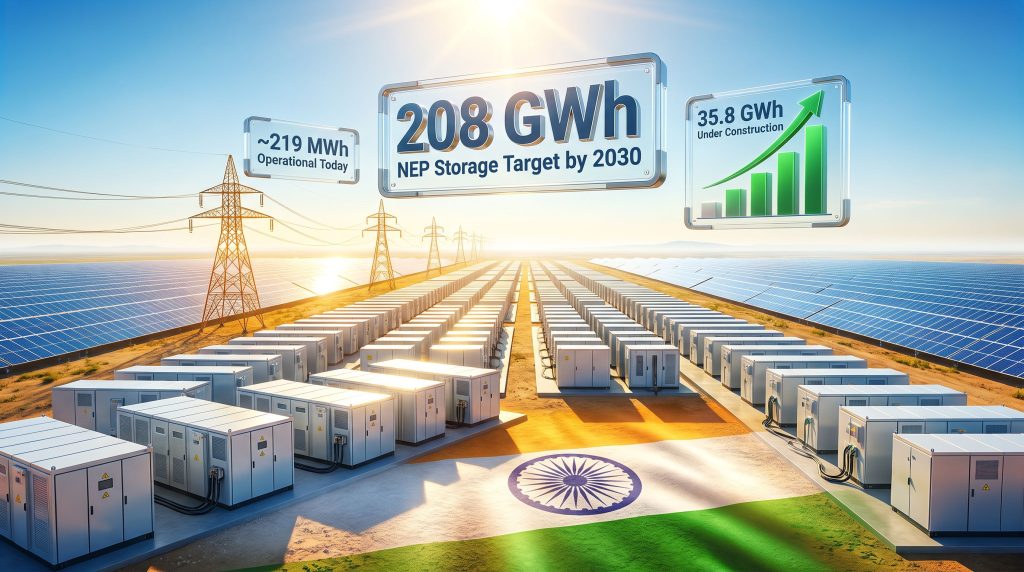
The Central Electricity Authority projects that India will require 236.2 GWh of battery energy storage capacity by 2031–32. The National Electricity Plan, as cited by the Press Information Bureau, places the 2030 requirement at 208 GWh. Both figures point toward the same structural conclusion.
Against this backdrop, the current operational reality is striking:
| Metric | Volume |
|---|---|
| BESS capacity auctioned (2022 to May 2025) | ~12.8 GWh |
| Operational BESS capacity (same period) | ~219 MWh |
| Capacity currently under active construction | 35.8 GWh |
| CEA projected storage requirement by 2031–32 | 236.2 GWh |
| NEP projected storage requirement by 2030 | 208 GWh |
The ratio between auctioned and operational capacity reveals an execution lag that exceeds 98%. India has tendered more than 58 times the storage it has actually switched on. This is not evidence of failed ambition; it reflects the genuine complexity of converting procurement decisions into functioning infrastructure at speed.
However, it does mean that the market's near-term credibility depends almost entirely on whether the 35.8 GWh currently under construction can be commissioned on schedule. According to the IEEFA's analysis of India's battery storage boom, getting execution right is the defining challenge for this market phase.
"The difference between India's base-case trajectory and its transformational storage scenario is not a technology gap. It is an execution gap, shaped by procurement timelines, financing accessibility, and the maturity of domestic manufacturing supply chains."
What Is Causing the Execution Lag?
Several structural factors are compressing the conversion rate from tender to operation:
- Tender issuance remains inconsistent across Indian states, creating uneven project pipelines that make it difficult for developers and equipment suppliers to plan capacity and capital allocation
- Projects awarded to domestic companies partnering with foreign technology providers frequently encounter localisation challenges, particularly in adapting systems engineered for temperate climates to India's high-ambient-temperature environments
- Post-commissioning service infrastructure for large-scale BESS remains thin outside major metropolitan areas, raising lifecycle cost concerns that complicate project financing
- Domestic Content Requirements create procurement complexity for developers whose preferred international equipment may not qualify under DCR thresholds in government tenders
- Skilled technical manpower for BESS installation, commissioning, and ongoing operations is in short supply across most Indian states
India's Three-Pillar Policy Architecture for BESS
The Indian government has constructed a policy framework designed to address both demand-side and supply-side barriers. Three distinct mechanisms form the core of this architecture.
Does Viability Gap Funding Actually Reduce Risk?
Viability Gap Funding reduces financial risk for early-stage BESS projects by covering a portion of capital costs that cannot be recovered through market revenues under prevailing tariff structures. This is particularly relevant for standalone utility-scale storage, where revenue streams from grid services remain less predictable than in more mature markets.
How Do Grid Integration Incentives Work?
Grid Integration Incentives include inter-state transmission charge waivers for qualifying co-located BESS projects, pairing battery storage with renewable generation at the same site. Advisories encouraging mandatory co-location of storage with new solar approvals, and progressively tightening storage obligations for power-sector entities, are creating a compliance-driven demand floor that reduces revenue uncertainty for project developers.
What Role Does the PLI Scheme Play?
The Production Linked Incentive scheme for Advanced Chemistry Cell battery manufacturing targets the most fundamental vulnerability in India's BESS supply chain: its dependence on imported battery cells. PLI support is designed to catalyse domestic cell manufacturing capacity, which currently represents the largest cost exposure and supply chain fragility point in the entire BESS value chain.
Despite this framework, regulatory gaps persist. Grid interconnection standards for large-scale standalone BESS are still maturing, and the inconsistency of tender issuance across states continues to create uneven demand signals that complicate investment planning.
The Industrial Energy Arbitrage Opportunity
One of the less widely discussed dimensions of the India Battery Energy Storage System market is the commercial and industrial segment's energy arbitrage potential. In several Indian states, the difference between peak-hour and off-peak electricity tariffs can reach 50%. This tariff differential, among the most pronounced of any major economy, creates a straightforward financial case for industrial BESS adoption independent of grid-scale policy support.
The mechanics of energy arbitrage work as follows:
- An industrial facility installs a BESS system sized to meet a meaningful portion of its peak-hour consumption requirements.
- The system charges during off-peak periods, when grid electricity is cheapest, typically overnight or during midday solar generation surpluses.
- During peak tariff windows, the stored energy displaces grid imports, and the tariff differential converts directly into cost savings without any reduction in production output.
- As a secondary benefit, displacing grid electricity during peak periods reduces reliance on fossil fuel peaker plants, lowering the carbon intensity of the facility's energy consumption.
This model is already operating at scale in China and across European industrial markets, where tariff volatility and carbon pricing have driven widespread commercial BESS adoption without subsidy dependence. India's tariff environment is, in structural terms, arguably more favourable to this model than many of the markets where it has already matured.
The next major ASX story will hit our subscribers first
Domestic Manufacturing: The Strategic Multiplier
Major Indian industrial conglomerates including Reliance Industries, JSW Group, and Tata Power have signalled strategic intent to participate in domestic BESS manufacturing. The logic extends beyond import substitution. A vertically integrated domestic supply chain captures value across the entire BESS stack rather than simply purchasing assembled systems at international prices.
It also creates the foundation for India to position itself as a regional BESS supplier to South and Southeast Asian markets as those markets begin their own storage scale-ups. In this context, India's lithium investment push is a strategic complement to domestic manufacturing ambitions, as securing upstream raw material access is essential to supply chain resilience.
A segment of innovation-focused domestic developers has invested substantially in indigenously engineered Energy Management Systems designed specifically for Indian grid conditions. EMS software built for European or Chinese grid architectures does not automatically perform optimally on India's grid, which has distinct frequency regulation characteristics, voltage profile challenges, and climate interactions.
Domestic EMS solutions built to comply with DCR requirements also offer a competitive advantage in government tenders where local content thresholds apply. Furthermore, the battery raw materials market is evolving rapidly, and India's ability to secure upstream inputs will substantially influence whether PLI-supported manufacturing achieves its intended scale.
The India Energy Storage Alliance has begun recognising domestically developed BESS technology, a signal that indigenous innovation is reaching a quality threshold that warrants industry validation. In addition, progress on an India battery-grade lithium refinery would further strengthen the country's position in the global battery supply chain.
| Manufacturer Type | Strategic Direction | Supply Chain Role |
|---|---|---|
| Large industrial conglomerates | Vertical integration into cell and module manufacturing | Reduces import dependence |
| Domestic technology developers | Indigenous EMS and system integration | Improves localisation compliance |
| Foreign OEMs with Indian joint ventures | Technology transfer with local manufacturing | Addresses DCR requirements |
| PLI-supported cell manufacturers | Advanced Chemistry Cell production | Builds foundational supply chain |
Three Scenarios for India's BESS Trajectory to 2032
Given the scale of the execution gap, scenario analysis is more instructive than single-point forecasting.
Base Case: Current Pace Continues
Commissioning rates remain constrained by grid interconnection bottlenecks, financing gaps, and procurement delays. India reaches approximately 40 to 60 GWh of operational BESS capacity by 2030, well below the 208 GWh NEP target. This scenario does not represent failure of policy intent; it reflects the friction inherent in scaling an infrastructure category from near-zero in under a decade.
Accelerated Case: Policy Execution Improves
Tender timelines compress, PLI manufacturing reaches commercial output, and VGF disbursements accelerate project financial close processes. India reaches 120 to 150 GWh by 2030, partially satisfying grid stability requirements and establishing a credible operational reference base for subsequent project financing.
Transformational Case: Manufacturing and Deployment Align
Domestic cell manufacturing under PLI reaches commercial scale, driving meaningful system cost reductions. Mandatory co-location policies and storage obligations create a reliable demand floor. India approaches or exceeds the 208 GWh NEP target by the 2030 to 2032 window, and the domestic manufacturing base creates export optionality.
How India Compares Globally
| Country or Region | Development Stage | Key Distinguishing Factor |
|---|---|---|
| China | Mature, large-scale deployment | Dominant cell manufacturing base |
| United States | Rapid scale-up driven by IRA incentives | Strong policy incentives paired with financing |
| Europe | Advanced industrial arbitrage adoption | High tariff volatility driving commercial demand |
| India | Early commercial scale-up | Massive unmet storage requirement with PLI support |
| Southeast Asia | Emerging | Grid reliability focus |
India's position differs from the US and European models in one important respect. Those markets scaled storage into existing grid infrastructure with established revenue frameworks for ancillary services. India is attempting to build storage capacity, grid services revenue frameworks, and domestic manufacturing simultaneously — a significantly more complex coordination challenge. For broader context, the Council on Energy, Environment and Water provides detailed analysis of how BESS deployment intersects with India's wider clean energy ambitions.
Frequently Asked Questions: India Battery Energy Storage System
What is BESS and why does India need it?
A Battery Energy Storage System stores electrical energy, typically sourced from renewable generation, and releases it when grid demand requires it. India requires large-scale BESS deployment to stabilise a grid increasingly powered by intermittent solar and wind output, to reduce peak-hour electricity costs for industrial consumers, and to decrease dependence on fossil fuel peaker plants that currently fill gaps in renewable generation.
How much BESS capacity does India currently have operational?
As of mid-2025, approximately 219 MWh of BESS capacity was operational in India — a fraction of the 12.8 GWh auctioned through tender processes since 2022, and substantially below the 208 to 236 GWh required by 2030 to 2032 according to national planning bodies.
What government schemes support BESS deployment in India?
The primary support mechanisms are Viability Gap Funding for utility-scale projects, inter-state transmission charge waivers for co-located storage, and the Production Linked Incentive scheme for domestic Advanced Chemistry Cell battery manufacturing.
What is energy arbitrage and how does it benefit Indian industries?
Energy arbitrage involves charging a BESS during low-tariff off-peak periods and discharging stored energy during expensive peak windows. In Indian states where peak and off-peak tariffs differ by up to 50%, this strategy generates direct electricity cost savings for industrial consumers while reducing carbon intensity by displacing fossil fuel peaker plant output.
What is India's BESS target for 2030?
The National Electricity Plan projects a requirement of 208 GWh of BESS capacity by 2030, while the Central Electricity Authority estimates 236.2 GWh by 2031–32. Both figures sit orders of magnitude above the current operational base of approximately 219 MWh.
The Next 36 Months as a Market-Defining Window
The 35.8 GWh currently under active construction represents the most consequential near-term test of India's ability to translate procurement ambition into commissioned, operational infrastructure. If construction timelines are met and these projects are successfully commissioned, India will establish an operational reference base that meaningfully reduces perceived technology and execution risk for subsequent project financing rounds.
If commissioning timelines slip significantly, however, the confidence implications extend beyond individual projects. Lenders already uncertain about BESS revenue streams in an immature grid services market will find additional justification for caution. Tender issuance could slow, and private capital allocation to the sector may contract precisely when policy ambition is calling for it to expand.
The binding constraint in India's storage scale-up is not technology availability. It is the speed at which procurement processes, financing structures, workforce capabilities, and domestic manufacturing capacity can be brought into alignment with a deployment timeline that national energy planning demands.
Readers seeking detailed, ongoing coverage of India's energy storage policy framework, tender activity, and project developments can explore reporting and analysis published by the ET EnergyWorld platform at energy.economictimes.indiatimes.com, which tracks regulatory updates and market developments across India's energy transition.
This article contains forward-looking scenario projections based on publicly available planning estimates from the Central Electricity Authority and National Electricity Plan. Actual outcomes will depend on policy execution, financing conditions, manufacturing progress, and grid infrastructure development. Nothing in this article constitutes financial or investment advice.
Want to Track the Mineral Discoveries Powering the Battery Storage Revolution?
As India's BESS ambitions drive surging demand for lithium, cobalt, and other battery metals, Discovery Alert's proprietary Discovery IQ model delivers real-time notifications the moment significant ASX mineral discoveries are announced — turning complex data across 30+ commodities into actionable investment insights. Explore historic discoveries and their market returns, then begin your 14-day free trial to position yourself ahead of the next major battery metals discovery.