
July 23, 2026
When Commodities Lead, Canada's Market Follows
Global equity markets are often interpreted through the lens of technology earnings, central bank policy, and consumer sentiment. But Canada's benchmark index operates according to a fundamentally different logic. The S&P/TSX Composite Index is, at its core, a commodity index wearing an equity market's clothing. When resource prices move with conviction, the TSX tends to respond in kind, and when multiple commodity categories surge simultaneously, the conditions for record-breaking sessions emerge organically.
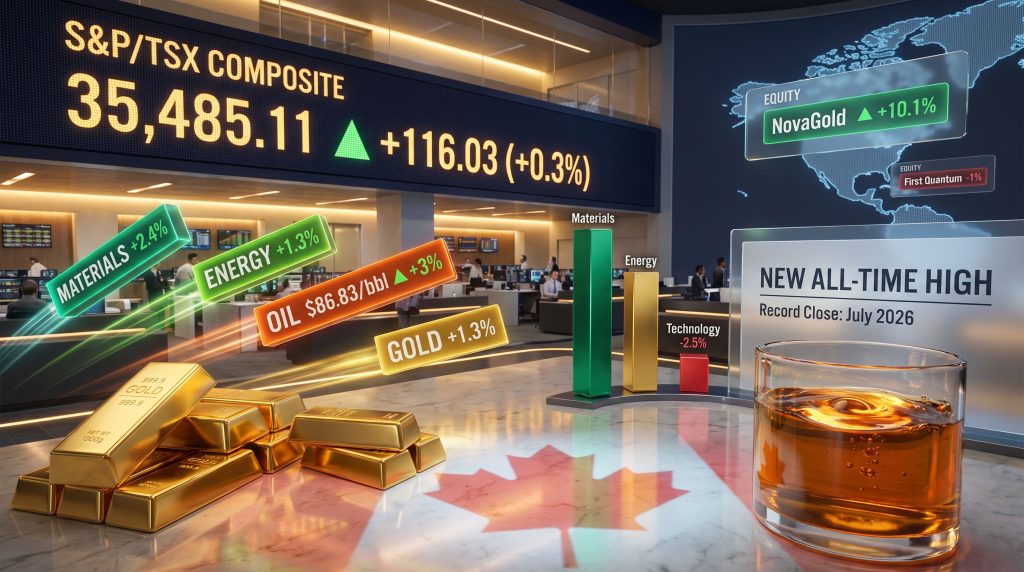
That is precisely the dynamic that unfolded on July 23, 2026, when the TSX rises to record high led by energy and mining shares became the defining financial headline across Canadian markets.
When big ASX news breaks, our subscribers know first
How the TSX Differs From Other Global Benchmarks
Understanding why Canada's index behaves differently from the S&P 500 or the FTSE 100 requires examining its structural composition. While the S&P 500 derives the majority of its market capitalisation from technology, healthcare, and consumer discretionary sectors, the TSX allocates a disproportionately large share of its weighting to energy producers and materials companies, particularly gold and base metal miners.
This architectural difference has profound implications for investors. In periods when technology dominates global sentiment, the TSX can appear to lag. However, when commodity cycles turn upward, the index can outpace its peers with striking speed. The TSX has repeatedly set new closing records during periods of synchronised commodity strength, and July 2026 proved no exception to this historical pattern.
The TSX functions less like a diversified economy index and more like a leveraged expression of global resource demand, making commodity price cycles the primary market catalyst rather than a secondary consideration.
Breaking Down the July 2026 Record Session
The S&P/TSX Composite Index closed at 35,485.11 on July 23, 2026, a gain of 116.03 points, representing a 0.3% advance that surpassed the previous record closing high set just eight days earlier on July 15, 2026. The back-to-back nature of these milestones within a single month is itself a signal worth examining. Consecutive record closes separated by days typically reflect sustained institutional conviction rather than opportunistic short-term positioning.
The session's sector performance told a more nuanced story than the headline gain suggested:
| Sector | Performance | Primary Driver |
|---|---|---|
| Materials (Metal Mining) | +2.4% | Gold price appreciation, technical momentum |
| Energy | +1.3% | Oil price surge on geopolitical supply fears |
| Technology | -2.5% | Pre-earnings risk aversion, sector rotation |
| Overall TSX Composite | +0.3% | Commodity sector leadership |
Notably, six of the TSX's ten major sectors finished in negative territory. This narrow leadership profile is a critical detail that headline readers often miss. The index's record close was powered almost entirely by two sectors, while the broader market experienced mild deterioration. This kind of concentrated rally warrants scrutiny from investors assessing whether the advance reflects genuine economic breadth or a more selective commodity-driven re-rating.
What Consecutive Record Highs Actually Signal
A record closing high is a precise technical designation. It refers specifically to the highest price at which the index has ever ended a trading session, distinct from an intraday peak that may have been subsequently reversed. When an index achieves this milestone on consecutive occasions within weeks, market analysts typically interpret it as evidence of durable institutional demand rather than speculative froth. That said, narrow sector breadth complicates the picture, and advance-decline analysis, which measures how many individual stocks are rising versus falling, becomes an essential tool for evaluating the rally's underlying health.
Gold and Oil: The Twin Engines Behind the TSX Rally
Gold's Contribution: Dollar Weakness and Technical Momentum
Gold prices advanced 1.3% during the session, underpinned by a softening US dollar and technical buying pressure. The inverse relationship between the US dollar index and gold pricing is one of the most durable correlations in financial markets. When the dollar weakens, gold denominated in US dollars becomes cheaper for international buyers, stimulating demand and pushing spot prices higher.
For TSX-listed gold producers, this dynamic creates an amplification effect that pure commodity price charts cannot fully capture. A gold producer's operating costs are often partially denominated in Canadian dollars, while revenues are generated in US dollar-priced gold. Furthermore, when gold prices rise simultaneously with a softening US dollar, and the Canadian dollar does not strengthen proportionally, the margin expansion for Canadian producers can be substantial. Understanding how gold prices affect mining equities helps explain why these equity price moves can materially exceed the underlying commodity gain.
SIA Wealth Management's chief market strategist noted that commodity prices performed broadly well across the session, with copper representing the primary exception to an otherwise constructive resource market environment. In addition, the broader record performance in 2025 demonstrated a similar pattern of gold-driven TSX outperformance during periods of dollar weakness.
Oil's Surge: Geopolitical Risk Premium and the $86.83 Barrel
Crude oil prices settled nearly 3% higher at $86.83 per barrel, with escalating tensions between the United States and Iran driving supply disruption concerns that pushed prices sharply upward. The transmission mechanism from oil prices to TSX energy equities is direct and well understood: Canadian energy producers, particularly those operating in the oil sands and conventional western Canadian basins, see immediate revenue and cash flow improvements when crude benchmarks rise.
Historical data suggests that sustained oil prices above $85 per barrel have consistently correlated with outperformance in Canadian energy equities relative to broader global indices. At $86.83, the session's close sat just above that threshold, lending weight to bullish near-term positioning in Canadian energy names.
However, geopolitically-driven oil price premiums carry inherent instability. A de-escalation in US-Iran tensions, even a diplomatic signal without formal resolution, can rapidly compress the risk premium embedded in crude pricing, reversing a significant portion of the equity gains built on that foundation. The geopolitical landscape for metals and mining more broadly reflects this same volatility dynamic across multiple commodity categories.
Major Mining Transactions That Shaped the Session
NovaGold's Donlin Gold Consolidation: A $4.2 Billion All-Stock Deal
One of the session's most consequential individual equity moves involved NovaGold Resources, whose shares surged 10.1% after the company announced an all-stock acquisition of the remaining interest in the Donlin Gold project from Paulson Advisors. The transaction creates a combined gold entity valued at approximately $4.2 billion and gives NovaGold consolidated ownership of one of the largest undeveloped gold deposits in the world, located in Alaska.
The Donlin Gold deposit is notable for several reasons that extend beyond its headline valuation:
- The project contains an estimated resource base measured in tens of millions of ounces of gold, placing it among the highest-ranked undeveloped gold assets globally by total contained metal
- Its location in Alaska positions it within a politically stable, mining-friendly jurisdiction, reducing sovereign risk relative to comparable projects in emerging markets
- As an undeveloped asset, its valuation is inherently sensitive to gold price assumptions, discount rates, and capital expenditure estimates, all of which become more favourable in a rising gold price environment
- Consolidating full ownership removes the complexity of a joint venture structure, simplifying the path to development financing and operational decision-making
The 10.1% single-session equity gain reflects not just the deal announcement but the broader market recognition that full ownership of a tier-one undeveloped gold asset carries strategic optionality that a fractional interest cannot replicate.
Cobre Panama: Resource Nationalism and the Partnership Question
While gold equities celebrated, copper-exposed names navigated a more uncertain landscape. Panama's government was reported to be evaluating the creation of a state-owned mining entity that would partner with First Quantum Minerals on the potential re-opening of the Cobre Panama copper mine, a flagship asset that had been shuttered following significant political and social opposition.
First Quantum shares declined 1% on the session, a modest move that nonetheless reflects genuine investor uncertainty about the terms, timeline, and commercial viability of any state partnership arrangement. Consequently, the broader Cobre Panama arbitration impacts continue to cast a shadow over copper-exposed equities, reinforcing the divergence between gold and base metal sentiment.
The Cobre Panama situation illustrates a broader dynamic reshaping the global mining industry: resource nationalism. Governments across Latin America and beyond are increasingly asserting greater control over mineral wealth, moving from passive royalty and tax frameworks toward direct equity participation or outright state enterprise models. For foreign operators, this introduces a new layer of complexity in project economics, as state partner requirements can affect capital allocation priorities, operational autonomy, and profit repatriation structures.
The divergence between gold equity strength, with NovaGold surging 10.1%, and copper equity softness, with First Quantum declining 1%, on the same session illustrates how commodity-specific narratives can produce sharply differentiated equity outcomes even within a single index sector.
The USMCA Renegotiation: A Persistent Discount on Canadian Equities
Trade Policy Uncertainty as a Structural Headwind
Overlaying the commodity-driven optimism was a sobering trade policy development. US Trade Representative Jamieson Greer indicated that while interim trade agreements with Canada and Mexico may be achievable within the current year, the more structurally complex elements of USMCA renegotiation, particularly stricter rules of origin requirements, are expected to extend negotiations into 2027.
This timeline matters for Canadian equity investors because prolonged trade uncertainty functions as a persistent valuation discount applied to companies with significant cross-border supply chain exposure. The market does not need a definitive negative outcome to price in risk; uncertainty itself is sufficient to suppress multiples for trade-exposed industrials. For instance, the impact on supply chains from trade wars and tariffs has already demonstrated how quickly this uncertainty translates into reduced capital expenditure planning.
Asymmetric Sector Exposure to Trade Risk
The USMCA renegotiation does not affect all TSX sectors equally. A meaningful asymmetry exists between commodity exporters and trade-dependent industrials:
- Resource exporters (gold producers, oil sands operators, potash miners) face limited direct USMCA exposure because their products are primarily priced in global commodity markets rather than bilateral trade frameworks
- Manufacturers and technology firms with integrated North American supply chains face meaningfully higher exposure to rules of origin changes, which can alter cost structures and competitive positioning
- Industrial companies reliant on cross-border component flows are particularly vulnerable to extended negotiation timelines that delay investment decisions
If USMCA renegotiation extends well into 2027, the most insulated TSX segments are precisely those that drove the July 23 record high, namely resource producers with globally priced outputs. This structural alignment between commodity strength and trade policy insulation creates a reinforcing dynamic that could sustain TSX outperformance relative to more trade-exposed indices.
The next major ASX story will hit our subscribers first
Technology's 2.5% Decline: Sector Rotation in Real Time
The TSX technology sector's 2.5% loss on the session, with Descartes Systems Group shares falling 4%, reflects the gravitational pull of major US technology earnings events. In the hours following the TSX close, several large-cap US technology companies were scheduled to report quarterly results, creating pre-earnings caution that rippled across North American technology names regardless of their individual fundamental positions.
This cross-border sentiment linkage is a feature, not a bug, of how global capital markets operate. Canadian technology equities are not isolated from US earnings cycles, and investor positioning ahead of major US reporting events routinely creates correlated moves in Canadian names.
Critically, the TSX's relatively modest technology sector weighting compared to US indices means that even a significant technology sector decline exerts limited drag on the composite index. This structural characteristic allowed the 2.5% technology loss to be more than offset by the 2.4% materials gain and 1.3% energy advance, producing a positive overall close.
Sustainability of the Rally: Key Variables to Monitor
Whether the TSX can sustain momentum above its record closing level depends on the durability of several interconnected factors:
Commodity price trajectory:
- Gold's path remains tightly linked to US dollar direction and Federal Reserve policy signals. Any communication suggesting a more hawkish stance could strengthen the dollar and compress gold pricing
- Oil's near-term direction is heavily influenced by the US-Iran geopolitical risk premium, which can dissipate quickly if diplomatic progress emerges
- Copper's relative underperformance during this session, noted by SIA Wealth Management's strategist, may signal that industrial demand expectations are diverging from precious metal and energy sentiment
Policy and regulatory developments:
- USMCA negotiation progress or setbacks will influence sentiment toward trade-exposed TSX names
- The Cobre Panama partnership structure, if formalised, will set a precedent for how resource nationalism intersects with foreign operator rights in Latin America
- Federal Reserve communications remain a primary variable for gold pricing and, by extension, TSX materials sector performance
Market structure considerations:
- Narrow breadth rallies, where gains concentrate in two sectors while six of ten decline, historically carry higher reversal risk than broad-based advances
- Advance-decline data in the days following a record close can provide early indication of whether institutional flows are broadening or rotating
Frequently Asked Questions: TSX Record Highs and Commodity Markets
Why does the TSX outperform when commodity prices rise?
The S&P/TSX Composite Index allocates a significantly larger share of its weighting to energy and materials companies than most major global indices. When commodity prices strengthen, the earnings and cash flow outlook for these resource companies improves rapidly, driving equity appreciation and lifting the overall index above what its technology and consumer sector components could achieve independently.
What distinguishes a record closing high from an intraday record?
A record closing high refers specifically to the highest price at which the index has ended a formal trading session. An intraday record, by contrast, reflects the highest price touched during a session regardless of where the index ultimately closed. Closing records are generally considered more significant because they reflect sustained conviction through the end of the trading day rather than a transient price extreme.
How does oil price movement affect Canadian equity markets?
Canada is among the world's largest oil-producing nations, and energy companies represent a substantial portion of TSX market capitalisation. Rising crude prices directly improve revenue and earnings prospects for Canadian producers, translating into higher equity valuations and upward index pressure. The relationship is particularly pronounced when oil sustains levels above approximately $85 per barrel. Reuters reporting on TSX futures movements further illustrates how oil price expectations consistently shape Canadian equity sentiment ahead of formal trading sessions.
What is the Donlin Gold project and why does it matter?
Donlin Gold is one of the largest undeveloped gold deposits in the world, located in Alaska. The project's scale and jurisdictional stability make it a highly valued undeveloped asset, and NovaGold's move to consolidate full ownership through its acquisition of Paulson Advisors' interest positions the company as a significant future producer with considerable development optionality.
What does resource nationalism mean for mining investors?
Resource nationalism describes the tendency of sovereign governments to assert greater control over mineral extraction within their borders, often through state equity participation, increased royalties, or outright nationalisation. For investors in foreign-listed mining companies operating in these jurisdictions, resource nationalism introduces additional layers of political and commercial risk that can affect project economics, operational timelines, and return profiles.
Canada's Resource Endowment in a World Repricing Hard Assets
The July 23 session encapsulates a broader investment thesis that is gaining traction in institutional circles: Canada's resource endowment is becoming increasingly valuable in a world preoccupied with energy security, critical mineral supply chain resilience, and inflationary pressures that historically favour hard assets over financial ones.
The convergence of gold strength, elevated oil pricing, and significant mining sector consolidation visible in a single trading session is not coincidental. It reflects an ongoing institutional re-rating of companies with real, extractable assets in stable jurisdictions, precisely the profile that defines a large portion of the TSX's listed companies.
Whether the current momentum represents the early stages of a sustained commodity supercycle or a cyclical peak amplified by temporary geopolitical factors remains a legitimate point of debate among analysts. What is clear is that the TSX rises to record high led by energy and mining shares precisely because its structural composition aligns naturally with periods of synchronised commodity strength, offering investors direct and liquid exposure to the commodity price thesis, with all the opportunity and volatility that entails.
Readers seeking further analysis of Canadian equity markets, commodity sector dynamics, and global mining developments can explore additional reporting and research available through Mining Weekly at miningweekly.com.
Disclaimer: This article is intended for informational purposes only and does not constitute financial advice. Forecasts, projections, and market analyses presented here involve inherent uncertainty and should not be relied upon as the basis for investment decisions. Past performance of commodity prices or equity indices does not guarantee future results. Readers should conduct their own due diligence or consult a qualified financial adviser before making investment decisions.
Want to Capitalise on the Next Major ASX Mineral Discovery Before the Broader Market Does?
Discovery Alert's proprietary Discovery IQ model delivers real-time alerts on significant ASX mineral discoveries, transforming complex resource data into actionable investment insights for both short-term traders and long-term investors — explore historic examples of exceptional discovery returns to understand the scale of opportunity, and begin your 14-day free trial at Discovery Alert to position yourself ahead of the market.