July 23, 2026
The Refining Bottleneck That Mining Alone Cannot Solve
For decades, the global mining industry has operated under a fundamental assumption: extracting ore from the ground was the hard part. Refining it into battery-grade or industrial-grade metal was simply a downstream process to be handled elsewhere. That assumption is now proving to be one of the most consequential strategic miscalculations in modern resource economics.
The reality is that China did not achieve dominance over the critical minerals supply chain by controlling the most mines. It achieved dominance by controlling the refineries. According to the International Energy Agency, China accounts for roughly 60% of global lithium refining capacity, approximately 65–70% of cobalt refining, and an estimated 85–90% of rare earth element processing. Mining activity elsewhere in the world feeds into Chinese refineries before being sold back to Western manufacturers as processed material. The extraction is global. The value capture is concentrated.
This architecture is now being stress-tested by geopolitical friction, export control policies, and the accelerating critical minerals demand surge for EV batteries and defence-grade materials. The Nth Cycle SPAC deal, announced in July 2026, represents one of the most significant capital market responses to this bottleneck yet seen.
When big ASX news breaks, our subscribers know first
Understanding the Nth Cycle SPAC Deal Structure
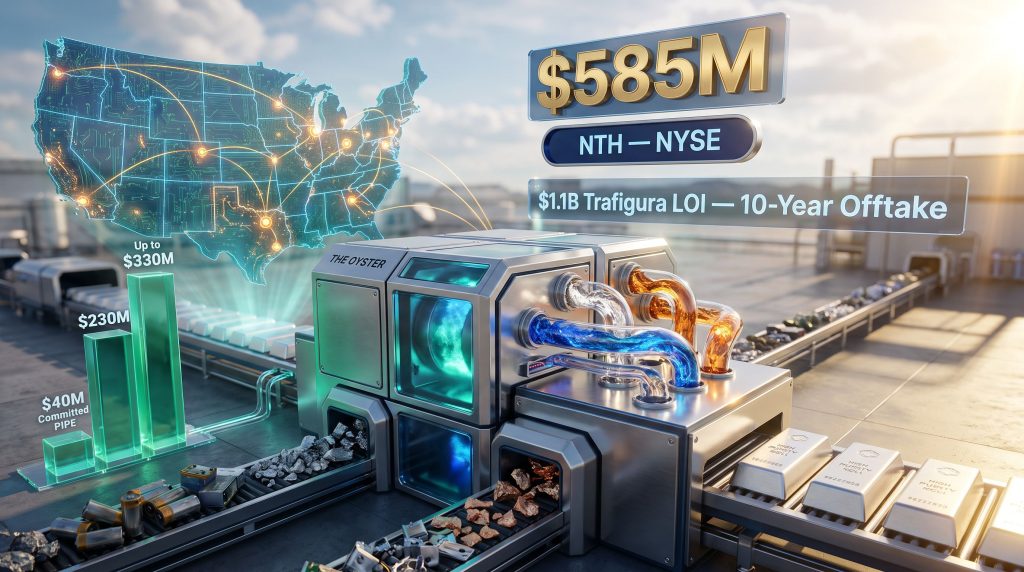
The transaction pairs Nth Cycle, a US-based critical mineral refining technology company, with Kensington Capital Acquisition Corp. VI, which trades on the NYSE under the ticker KCAC. The merger assigns the combined business an implied enterprise value of $585 million, with the resulting entity, Nth Cycle Holdings, Inc., expected to list on the New York Stock Exchange under the ticker symbol NTH.
Closing is targeted for Q4 2026, subject to shareholder and regulatory approvals. This timeline is relevant for investors assessing near-term catalysts and capital deployment schedules.
How SPAC Structures Work and Why They Appeal to Deep-Tech Companies
A Special Purpose Acquisition Company, or SPAC, is a shell company that raises capital through an IPO with the sole purpose of merging with a private company to take it public. The SPAC mechanism bypasses many of the procedural and regulatory hurdles associated with a traditional IPO, and critically, it allows the target company to present forward-looking financial projections to investors during the merger process, something not permitted under standard IPO disclosure rules.
For capital-intensive, growth-stage technology companies operating in sectors where revenue is still scaling but addressable markets are enormous, this distinction matters considerably. Nth Cycle can communicate its projected revenue trajectory and commercial pipeline to PIPE investors and public market participants in a way that a conventional IPO process would restrict.
Breaking Down the $585 Million Valuation
Enterprise value in a SPAC transaction is not simply the cash raised. It reflects an agreed-upon valuation of the target business at the time of merger, incorporating projected future cash flows, existing commercial commitments, and comparable company benchmarks. For Nth Cycle, the $585 million figure must be understood in the context of a signed letter of intent with one of the world's largest commodity trading houses, a proprietary processing technology with operational characteristics that diverge significantly from legacy refining infrastructure, and an addressable market that is expanding with every EV production ramp-up globally.
The Capital Structure: Where the Money Comes From
The financing architecture behind the Nth Cycle SPAC deal involves multiple tranches with different risk and certainty profiles.
| Capital Source | Amount | Certainty Level |
|---|---|---|
| Kensington Trust Account | Up to $230 million | Subject to shareholder redemptions |
| PIPE Financing (Total Committed + Available) | Up to $100 million | Partially committed |
| PIPE Already Committed | $40 million | Confirmed |
| Total Potential Proceeds | Up to $330 million | Combined maximum |
The trust account figure is the most variable component. In SPAC transactions, shareholders who do not wish to participate in the merger have the right to redeem their shares for a proportionate share of the trust account. If significant redemptions occur, the actual capital available from the trust can fall well below the headline $230 million figure. This is known as redemption risk, and it has been a defining characteristic of the post-2022 SPAC market correction, where several high-profile transactions saw trust proceeds shrink dramatically after shareholder redemptions.
The Role of the $40 Million PIPE Commitment
Private Investment in Public Equity, or PIPE financing, is institutional capital committed at the time of merger announcement in exchange for shares in the combined company. The $40 million already committed acts as an anchor signal. Institutional investors conducting their own independent diligence have concluded that the business is worth supporting at this valuation before the deal closes.
When anchor PIPE commitments are secured prior to announcement, they tend to reduce redemption pressure by signalling institutional confidence, which in turn can stabilise the trust account balance through to closing.
The remaining capacity of up to $100 million total in PIPE financing suggests Nth Cycle has room to bring in additional institutional partners before the transaction closes, which could further reduce the capital uncertainty inherent in the trust account mechanism.
The Oyster: A Technical Departure From Conventional Refining
Understanding why Nth Cycle commands a near-$600 million valuation requires understanding what makes its core technology fundamentally different from the refining infrastructure it is designed to replace.
How Traditional Refining Works and Why It Is Problematic
Conventional critical mineral processing relies on two primary methods:
-
Pyrometallurgical processing involves smelting ore or scrap material at extremely high temperatures, typically exceeding 1,200 degrees Celsius, to separate metals from gangue material. It is energy-intensive, produces significant greenhouse gas emissions, and requires large centralised facilities.
-
Hydrometallurgical processing, including solvent extraction and electrowinning (SX-EW), uses aqueous chemical solutions to leach and separate target metals. It is more selective than smelting but still requires substantial fixed infrastructure, significant chemical inputs, and produces liquid waste streams requiring careful management.
Both approaches carry high capital intensity, long construction lead times, and substantial environmental permitting requirements. Building a new conventional refinery from the ground up typically requires years of development, hundreds of millions to billions in capital, and carries significant operational risk during ramp-up.
What the Oyster Does Differently
Nth Cycle's flagship technology, known as The Oyster, uses a process called electro-extraction, an electrochemical approach to metal recovery that operates at ambient conditions without the extreme heat of pyrometallurgy or the large chemical reagent volumes of conventional hydrometallurgy.
The system is designed to be modular and co-locatable, meaning it can be installed directly at the site of feedstock generation, whether that is a battery recycling facility, a mining operation, or an industrial manufacturer producing scrap. This has several compounding advantages:
-
Elimination of transport costs and losses associated with shipping partially processed material to centralised refineries.
-
Dramatically reduced capital commitment per unit compared to greenfield refinery construction.
-
Faster deployment timelines, allowing the business to add capacity in response to contracted demand rather than speculative future market conditions.
-
Lower environmental footprint, reducing the regulatory permitting complexity that has historically slowed Western refinery development.
The metals recoverable through The Oyster include nickel, cobalt, copper, and rare earth elements, covering a substantial portion of the battery supply chain and defence-critical material requirements simultaneously. Furthermore, the technology's compatibility with the battery recycling process means it sits at a particularly strategic intersection of the circular economy and critical mineral supply chains.
Feedstock Flexibility as a Strategic Moat
One aspect of the Oyster model that deserves particular attention from an investor perspective is its feedstock agnosticism. The system can process material from battery recyclers, mining operations, and industrial manufacturers. This multi-source feedstock capability reduces single-point dependency, which is a significant structural advantage over refiners tied to specific mining operations or single commodity streams.
In an era where feedstock availability, grade consistency, and supply chain disruption are all live risks, a processing technology that can draw from multiple input streams has a meaningful resilience advantage. Consequently, this flexibility also directly addresses growing energy security concerns that Western governments have raised in response to concentrated Chinese refining capacity.
The Trafigura Offtake: Quantifying Commercial Validation
Perhaps the most significant data point in the Nth Cycle commercial case is the letter of intent for a 10-year offtake agreement with Trafigura, one of the world's largest independent commodity trading and logistics companies. The implied value of this arrangement is approximately $1.1 billion over the agreement's duration. Indeed, Trafigura's offtake commitment represents a particularly powerful form of third-party commercial endorsement.
What an LOI Means Versus a Binding Contract
It is important to apply precise language here. A letter of intent is not a binding offtake agreement. It represents a documented commercial intention between two parties, typically outlining key terms such as volume, pricing mechanism, duration, and quality specifications, while leaving formal contractual execution to a subsequent binding agreement. The conversion of an LOI to a binding contract typically requires:
-
Satisfactory completion of due diligence by both parties
-
Agreeing and executing definitive contract documentation
-
Meeting any conditions precedent, which may include achieving specific production milestones or completing the SPAC transaction itself
Despite these caveats, an LOI from a counterparty of Trafigura's scale and sophistication is not a casual commercial gesture. Commodity trading houses do not sign 10-year supply commitments lightly. The implied annual revenue run-rate from this agreement alone is approximately $110 million per year, which provides meaningful context for how the $585 million enterprise valuation was constructed.
What Trafigura's Participation Signals to the Market
Trafigura operates across the full commodity spectrum and has deep expertise in metal supply chains, including processed critical minerals. Its participation as a prospective offtake partner signals that the output quality and delivery reliability of The Oyster system has been evaluated to a standard that a sophisticated physical commodity trader finds commercially acceptable. This is a form of third-party technical validation that carries weight beyond what any company's own marketing materials can provide.
SPAC Market Context: What the Post-2022 Correction Means for Nth Cycle
The SPAC market experienced a severe correction from its 2021 peak, with many transactions collapsing due to excessive redemptions, overinflated valuations, and targets that lacked genuine commercial traction. By 2024 and into 2025, the SPAC structure had become considerably more disciplined, with successful transactions characterised by:
-
Anchor PIPE commitments secured before announcement
-
Revenue-generating or contract-backed targets rather than pre-revenue concepts
-
Realistic valuation benchmarks with identifiable near-term milestones
-
Experienced SPAC sponsors with sector-relevant networks
The Nth Cycle deal exhibits several of these characteristics. The $40 million committed PIPE, the Trafigura LOI providing forward revenue visibility, and the operational status of The Oyster technology all position this as a materially more substantive transaction than the speculative SPAC listings that defined the 2020–2021 boom. However, investors should note that even well-structured transactions carry execution risk in the current environment.
The next major ASX story will hit our subscribers first
Risks Every Investor Should Evaluate
No analysis of the Nth Cycle SPAC deal is complete without a clear-eyed assessment of material risks.
SPAC Mechanics Risks
-
Redemption erosion: If a significant proportion of Kensington shareholders elect to redeem ahead of the vote, the trust account contribution could fall well below $230 million, altering the capital deployment plan.
-
Dilution from sponsor promotes: SPAC sponsors typically receive a promote, often 20% of the post-merger equity, for facilitating the transaction. This represents dilution to all other shareholders and should be factored into per-share valuation analysis.
-
Regulatory and shareholder approval timelines: A Q4 2026 target close is a projection, not a guarantee. Regulatory review timelines or shareholder dynamics could extend this.
Technology Commercialisation Risks
-
Scaling modular electrochemical systems from demonstrated pilot capacity to commercial throughput volumes involves engineering challenges that cannot always be fully anticipated at the pilot stage.
-
Feedstock quality variability, particularly from battery recycling streams where chemistry and contamination profiles differ between battery generations, can affect recovery rates and output purity.
-
Established hydrometallurgical refiners are not static competitors. Some incumbents are actively investing in cleaner, more modular processing approaches. In addition, technologies such as direct lithium extraction illustrate how rapidly the broader processing technology landscape is evolving, meaning competitive benchmarks may shift over the course of Nth Cycle's commercialisation journey.
Market Risks
-
Critical mineral prices, particularly cobalt and nickel, have exhibited significant volatility in recent years. Refining margins are directly exposed to price cycles in the underlying commodities.
-
Geopolitical developments affecting trade flows, export restrictions, or feedstock access could alter the competitive dynamics Nth Cycle is positioning against. Furthermore, the broader landscape of critical raw materials policy across the EU and US continues to evolve rapidly, with regulatory shifts capable of either accelerating or complicating market entry for new refining entrants.
Disclaimer: This article is for informational purposes only and does not constitute financial advice. Investors should review all relevant regulatory filings, including any Form S-4 or proxy statement filed with the SEC, before making investment decisions. Forward-looking statements regarding revenue, valuations, and commercial agreements involve material uncertainties.
Frequently Asked Questions: Nth Cycle SPAC Deal
What will Nth Cycle Holdings trade as after the merger?
The combined entity will trade on the New York Stock Exchange under the ticker symbol NTH, with the deal expected to close in Q4 2026.
What is the enterprise value assigned in the Nth Cycle SPAC deal?
The transaction implies an enterprise value of $585 million for Nth Cycle.
How much capital could Nth Cycle raise through this transaction?
Total potential proceeds reach up to $330 million, comprising up to $230 million from the Kensington trust account and up to $100 million in PIPE financing, with $40 million of that PIPE already committed.
What is The Oyster technology?
The Oyster is Nth Cycle's proprietary modular electro-extraction system that recovers high-purity critical metals, including nickel, cobalt, copper, and rare earth elements, from recycled and industrial waste feedstocks without requiring conventional large-scale refinery infrastructure.
What is the Trafigura arrangement and is it binding?
Nth Cycle has disclosed a letter of intent for a 10-year offtake agreement with Trafigura valued at approximately $1.1 billion. An LOI is not a binding contract and its conversion to a definitive agreement would require further steps by both parties.
Why is Nth Cycle using a SPAC rather than a traditional IPO?
The SPAC route provides faster market access and allows Nth Cycle to share forward-looking financial projections with investors, which is not permitted under standard IPO disclosure frameworks. This makes the structure particularly suited to growth-stage technology companies with strong commercial pipelines but still-scaling revenues.
Want to Know Which ASX Companies Are Developing the Next Generation of Critical Mineral Assets?
Discovery Alert's proprietary Discovery IQ model scans ASX announcements in real time, turning complex mineral and resource data into clear, actionable insights for both short-term traders and long-term investors — the same kind of edge that matters when capital is flowing into critical mineral supply chains. Explore historic discoveries and the returns they generated on Discovery Alert's dedicated discoveries page, and begin your 14-day free trial to position yourself ahead of the market.