June 12, 2026
Understanding India's Expanded Battery Manufacturing Incentive Framework
The global transition toward electrified transportation systems has fundamentally altered how nations approach industrial policy design. Countries worldwide are recognising that battery manufacturing capabilities represent critical infrastructure for future economic competitiveness, similar to how steel production defined industrial prowess in the 20th century. This strategic shift has prompted governments to develop comprehensive policy frameworks that address both immediate market failures and long-term geopolitical supply chain vulnerabilities.
India's recent expansion of customs duty relief measures represents a sophisticated approach to industrial ecosystem development that extends far beyond traditional automotive applications. The customs duty exemption on lithium batteries for EV infrastructure demonstrates how emerging economies can leverage targeted fiscal policy to accelerate technology adoption whilst simultaneously building domestic manufacturing capabilities across multiple industrial sectors.
When big ASX news breaks, our subscribers know first
Comprehensive Scope of India's Battery Manufacturing Duty Relief Programme
India's Union Budget 2026-27 significantly expanded the scope of customs duty exemptions for lithium-ion battery manufacturing, extending coverage until March 2028. The framework now encompasses both electric vehicle applications and battery energy storage systems, creating opportunities across diverse industrial sectors.
Core Exemption Categories Include:
• Capital goods for lithium-ion cell production – Manufacturing equipment specifically designed for battery cell assembly and processing
• Battery energy storage system components – Specialised machinery for grid-scale and industrial energy storage applications
• Critical mineral processing equipment – Refining and processing machinery for lithium, rare earth elements, and other strategic materials
• Component assembly infrastructure – Automated systems and precision manufacturing tools for battery pack integration
The policy framework provides manufacturers with unprecedented visibility into long-term regulatory conditions. According to SIAM President Shailesh Chandra, the continued exemption of basic customs duty on capital goods used for manufacturing lithium-ion batteries, along with the extension of concessional duty benefits for lithium-ion cells and their parts used in manufacturing batteries for electric and hybrid vehicles for a further two years till March 2028, will enable creation of a robust EV ecosystem in the country.
This regulatory certainty addresses a critical market failure where manufacturers previously hesitated to make substantial capital investments due to unpredictable policy environments. The March 2028 timeline provides sufficient planning horizons for companies to complete facility construction, equipment installation, and workforce development programmes.
Comparative Analysis of Global Battery Manufacturing Incentive Structures
India's approach to battery manufacturing incentives reflects broader trends in industrial policy competition among major economies. Each region has developed distinct mechanisms for supporting domestic battery production capabilities, creating a complex landscape of regulatory frameworks.
| Region | Primary Mechanism | Duration | Strategic Objective | Coverage Scope |
|---|---|---|---|---|
| India | Customs duty exemptions + CAPEX support | Until March 2028 | Domestic ecosystem building | Full manufacturing chain + BESS |
| China | Production subsidies + SOE coordination | Ongoing | Global market leadership | Entire value chain integration |
| European Union | Green Deal financing + member state programmes | Varies by country | Climate transition compliance | Focus on sustainability standards |
| United States | IRA tax credits + domestic content requirements | Through 2032 | Supply chain independence | Critical mineral security emphasis |
The Indian framework distinguishes itself through its emphasis on capital goods exemptions rather than direct production subsidies. This approach reduces upfront investment barriers whilst avoiding market distortions that can emerge from ongoing operational support. Deloitte Partner Harpreet Singh noted that the extension of customs duty exemptions on lithium-ion cells and key inputs used in lithium battery and EV manufacturing till March 31, 2028 provides much-needed policy continuity to the electric mobility ecosystem.
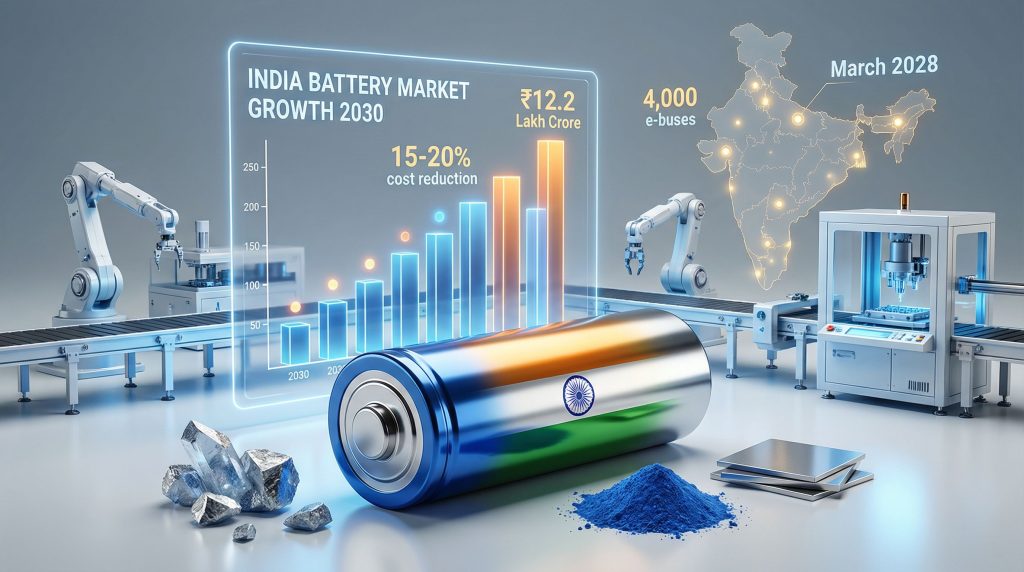
India's ₹12.2 lakh crore capital expenditure target for 2026-27 represents approximately $146.4 billion in infrastructure investment, creating substantial downstream demand for battery systems across multiple sectors. This figure represents an increase of ₹1 lakh crore from the previous fiscal year, demonstrating the government's commitment to sustained industrial development.
Economic Impact Analysis of Extended Duty Relief Measures
The extended customs duty exemption on lithium batteries for EV infrastructure creates multiple pathways for manufacturing cost reduction and competitive positioning improvements. Industry projections suggest these measures could reduce overall battery production costs by 15-20% compared to scenarios with full duty burdens, though this estimate requires verification through detailed cost structure analysis.
Primary Cost Reduction Mechanisms:
• Direct capital equipment savings – Elimination of import duties on specialised manufacturing machinery reduces initial investment requirements
• Working capital optimisation – Manufacturers avoid tying up significant financial resources in duty payments and related financing costs
• Accelerated depreciation benefits – Lower equipment costs enable faster capital recovery through improved depreciation schedules
• Supply chain integration advantages – Domestic manufacturers gain cost competitiveness relative to import-dependent competitors
Mahindra Group CEO & MD Anish Shah emphasised that the Budget focuses on enhancing India's competitiveness in the world, takes meaningful steps towards self-reliance and enables a wider participation in the benefits of economic growth. This perspective highlights how battery manufacturing incentives support broader economic development objectives beyond the automotive sector.
The policy framework particularly benefits micro, small, and medium enterprises (MSMEs) by reducing barriers to entry in battery component manufacturing. ACMA President Vikrampati Singhania highlighted that the sustained focus on MSMEs, clean mobility, and export facilitation will help the auto component industry navigate global headwinds whilst positioning India as a competitive and trusted manufacturing and sourcing destination.
Manufacturing Investment Decision Impact:
The March 2028 policy certainty enables manufacturers to commit to multi-year capital investment programmes without regulatory uncertainty. Companies can now proceed with:
• Long-term equipment procurement contracts with global suppliers
• Workforce development and training programme investments
• Research and development facility establishment
• Supply chain partnership agreements with automotive and industrial customers
Sectoral Applications Beyond Traditional Automotive Markets
The expansion of duty exemptions to battery energy storage systems represents a strategic recognition that lithium-ion battery technologies serve critical functions across multiple industrial sectors. This broadened scope creates opportunities for manufacturers to diversify revenue streams whilst supporting India's broader energy security objectives.
Grid-Scale Energy Storage Applications
India's renewable energy expansion requires substantial battery storage capacity to manage intermittent solar and wind generation. The duty exemption framework supports development of:
• Frequency regulation systems that maintain grid stability during demand fluctuations
• Peak-shaving installations that reduce strain during high electricity consumption periods
• Renewable integration platforms that store excess generation for later distribution
• Transmission infrastructure support systems that enhance grid reliability across long distances
The allocation of 4,000 e-buses for Purvodaya (Eastern) and Northeastern states demonstrates government commitment to expanding battery applications beyond private vehicle markets. This procurement represents approximately 80,000-120,000 kWh of total battery capacity, assuming average bus configurations of 20-30 kWh per vehicle.
Industrial and Commercial Sector Opportunities
FADA President CS Vigneshwar highlighted that the push for green mobility is further strengthened by the provision of 4,000 e-buses for the Northeast and Purvodaya regions, and the exclusion of biogas value from central excise duty on blended CNG. These measures, alongside the India Semiconductor Mission 2.0, will help stabilise the supply chain for modern vehicles.
Key industrial applications include:
• Manufacturing facility backup power systems ensuring operational continuity during grid disruptions
• Data centre uninterruptible power supply installations supporting India's growing digital infrastructure
• Telecommunications tower battery systems providing reliable connectivity in remote areas
• Mining and extractive industry off-grid power solutions for remote operations
Critical Mineral Processing and Supply Chain Security Implications
The inclusion of critical mineral processing equipment in duty exemption coverage addresses fundamental supply chain vulnerabilities that have historically constrained India's battery manufacturing ambitions. This strategic focus on upstream value chain development represents a sophisticated understanding of global resource geopolitics.
Strategic Mineral Processing Capabilities
Tsuyo Manufacturing CEO Vijay Thakur noted that the push for advanced electronics, rare-earth supply security, and EV component support will significantly benefit domestic electric motor manufacturing for two-wheelers, three-wheelers, and commercial EVs. The startup also appreciates the REPM scheme's emphasis on the critical minerals transition, reinforcing a circular economy and enhancing sustainability across the e-mobility value chain.
The framework specifically supports development of:
• Lithium extraction and refining infrastructure reducing dependence on processed imports from China and Chile, including plans for a battery-grade lithium refinery
• Rare earth element processing facilities supporting permanent magnet manufacturing for electric motors
• Cobalt and nickel supply chain development ensuring stable raw material access for high-energy-density batteries
• Recycling and circular economy systems creating secondary material sources whilst reducing environmental impact through advanced battery recycling process technologies
Geopolitical Supply Chain Diversification
The emphasis on domestic critical mineral processing capabilities reflects broader concerns about supply chain concentration in geopolitically sensitive regions. Current lithium processing remains heavily concentrated in China, creating potential vulnerabilities for countries dependent on battery imports.
India's approach of combining upstream mineral processing with downstream battery manufacturing creates multiple strategic advantages:
• Reduced import dependence for both raw materials and finished battery products
• Enhanced negotiating power with global suppliers through domestic alternative capabilities
• Technology absorption opportunities through foreign direct investment in processing facilities
• Export potential development for both processed materials and finished battery systems
The next major ASX story will hit our subscribers first
Multi-Fuel Transition Strategy and Biogas Integration
The simultaneous introduction of biogas-blended CNG excise duty relief demonstrates India's sophisticated understanding that energy transition requires multiple parallel technology pathways. This approach reduces pressure on any single technology whilst providing flexibility during the transition period.
Complementary Technology Framework
The biogas integration measures create strategic advantages by:
• Diversifying transportation fuel options reducing dependence on single technology pathways
• Supporting rural economy integration through biogas production opportunities
• Providing commercial vehicle alternatives where battery weight remains challenging for heavy-duty applications
• Creating lower infrastructure investment requirements for remote areas with limited electrical grid access
This multi-technology approach reflects pragmatic recognition that different applications require different optimal solutions. Furthermore, whilst battery electric vehicles excel in urban passenger transportation, biogas-blended CNG may prove more suitable for heavy freight, rural transportation, and industrial applications with high energy density requirements.
Long-Term Manufacturing Competitiveness and Export Potential
India's comprehensive battery manufacturing incentive framework positions the country to capture a significant share of the projected $400+ billion global battery market by 2030. This market size estimate reflects growing demand across automotive, grid storage, consumer electronics, and industrial applications worldwide.
Competitive Advantage Development
Mercedes-Benz India MD and CEO Santosh Iyer noted that the Budget's strong focus on infrastructure development, with addition of Rs 1 lakh crore in capex, is a step in the right direction developing the country's evolving mobility ecosystem. Better highways and improved intercity connectivity have historically driven luxury car demand in India, whilst simultaneously supporting the implementation of lithium industry tax breaks and other supportive measures.
The framework creates sustainable competitive advantages through:
• Scale economy achievement via domestic market development and export capacity building
• Technology ecosystem development attracting foreign investment and knowledge transfer
• Supply chain integration reducing transportation costs and improving response times
• Skilled workforce development creating human capital advantages for advanced manufacturing
Regional Export Market Opportunities
India's geographic position provides natural advantages for serving South Asian, Southeast Asian, and Middle Eastern markets with growing battery demand. The domestic manufacturing capabilities developed through these incentive programmes create export potential across multiple product categories.
Key export opportunities include:
• Automotive battery systems for neighbouring countries' emerging EV markets
• Grid storage solutions supporting renewable energy expansion across South Asia
• Industrial battery applications serving growing manufacturing sectors in the region
• Critical mineral processed materials for global battery manufacturing supply chains
The regulatory framework's extension through March 2028 provides sufficient time for manufacturers to establish production capabilities, achieve scale economies, and develop export market relationships. This timeline alignment supports India's broader economic diplomacy objectives whilst creating sustainable revenue streams for domestic manufacturers.
Investment and Partnership Implications
The comprehensive nature of India's battery manufacturing incentives creates attractive conditions for various types of business arrangements, from wholly domestic ventures to complex international partnerships involving technology transfer, joint venture structures, and supply chain integration agreements.
Global companies evaluating India market entry can leverage the regulatory framework to establish cost-competitive manufacturing operations whilst accessing both domestic demand and regional export opportunities. The customs duty exemption on lithium batteries for EV infrastructure enables long-term strategic planning and capital allocation decisions that support sustained industrial development objectives, particularly when combined with mining decarbonisation benefits.
The policy certainty through 2028 enables manufacturers to make informed decisions whilst benefiting from India's comprehensive EV policy framework and understanding the broader implications of government import duty reforms on EV batteries.
Disclaimer: This analysis is based on publicly available information and industry projections. Market forecasts, cost reduction estimates, and competitive positioning assessments involve inherent uncertainties and should be verified through independent research. Investment decisions should consider multiple factors beyond regulatory incentives, including market conditions, technological developments, and company-specific circumstances.
Looking for Investment Opportunities in India's Expanding Battery Manufacturing Sector?
Discovery Alert's proprietary Discovery IQ model delivers real-time alerts on significant ASX mineral discoveries, instantly empowering subscribers to identify actionable opportunities in critical minerals and battery materials ahead of the broader market. Begin your 14-day free trial today and secure your market-leading advantage in the rapidly evolving energy transition sector.