July 9, 2026
India's Battery Storage Tariff Crisis: How a Race to the Bottom Is Reshaping the Sector
Auction-driven energy markets have a well-documented tendency to produce prices that reflect competitive pressure rather than economic reality. When developers compete intensely for contracts, the natural incentive is to bid as low as possible to win, with the hope that costs will fall far enough to make the numbers work later. In India's battery energy storage system (BESS) sector, that gamble has not paid off — and the consequences are now rippling through the country's entire storage pipeline at a critical moment for its renewable energy ambitions. Understanding India battery storage tariffs requires examining both the structural forces and the global supply dynamics that have reshaped this market.
When big ASX news breaks, our subscribers know first
How India's BESS Auction Market Created a Structural Pricing Problem
India's rapid push to deploy large-scale battery storage was shaped by competitive state-level tenders that prioritised low tariff discovery above project economics. Between 2023 and 2025, this process produced a dramatic compression in awarded tariffs, as developers consistently undercut each other to secure long-term offtake agreements.
The logic behind the underbidding was not irrational at the time. Battery cell prices had been falling steadily for years, driven largely by Chinese manufacturing scale and export incentive programmes that kept landed costs artificially low for international buyers. Indian developers priced future projects on the assumption that this trajectory would continue.
What emerged instead was a dangerous misalignment between tariff outcomes and the actual cost of delivering storage capacity:
| Metric | 2023 to 2025 Change |
|---|---|
| BESS Tariff Decline | Approximately 71% |
| Battery Pack Price Decline | Approximately 36% |
| Gap Between Tariff and Cost Reality | Approximately 35 percentage points |
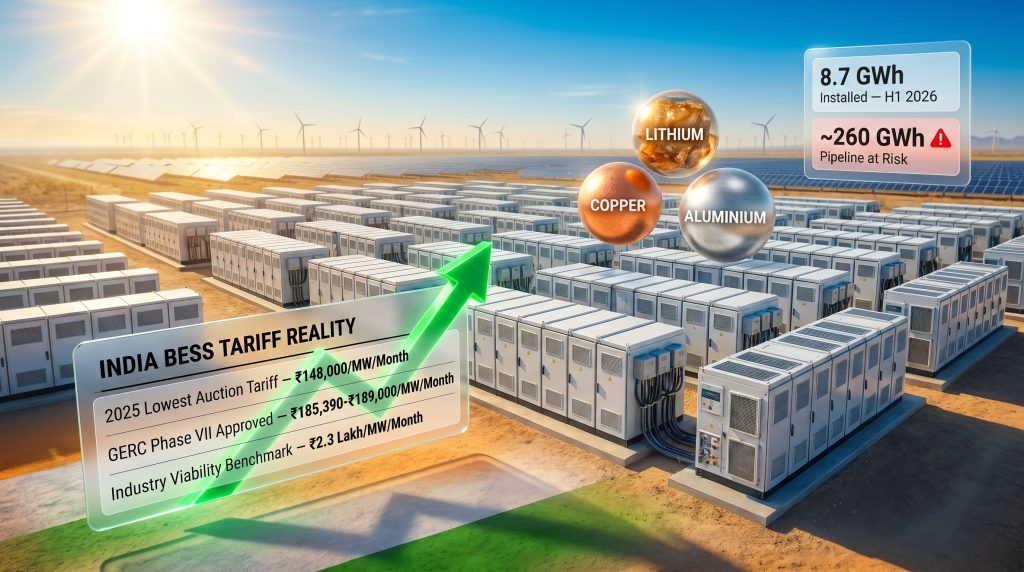
The lowest tariff recorded in 2025 reached ₹148,000 (approximately $1,549) per MW per month, a figure that has since been widely identified as economically indefensible under current input cost conditions. According to Asesh Chakrabarti, Deputy General Manager at State Bank of India, this figure simply cannot be sustained given where battery prices stand today. The number was never a reflection of viable project economics — it was a competitive artefact produced by auction design incentives that rewarded aggression over accuracy.
Key Insight: When tariff compression outpaces genuine cost reduction by nearly 35 percentage points over two years, the gap must eventually close. The question is whether it closes through project failure, tariff renegotiation, or regulatory correction. India is currently navigating all three simultaneously.
The Cost Shock That Broke the Model
China's Export Incentive Withdrawal and Its Ripple Effects
The single most consequential external factor reshaping India battery storage tariffs has been China's withdrawal of its battery export incentive regime. China accounts for the overwhelming majority of global lithium-ion cell supply, and its export pricing had long been shaped in part by domestic subsidy structures that made cells significantly cheaper for overseas buyers than the underlying production economics would otherwise support.
Once those incentives were removed, the cost floor shifted. Landed battery cell costs in India moved from approximately $42/kWh to around $55/kWh — an increase of more than 30% within a compressed timeframe. For projects that were contracted at tariffs based on the previous cost environment, this shift has turned viable-looking spreadsheets into loss-making scenarios.
Critically, this is not simply a temporary supply disruption. It represents a structural repricing of Chinese battery exports that is unlikely to reverse in the near term without a new policy intervention from Beijing — and there is no current indication of that occurring. Furthermore, developments within the Chinese battery sector will continue to influence how these global supply dynamics evolve.
Commodity Price Pressure Across the Battery Supply Chain
The China factor has been compounded by broader commodity price movements affecting three key battery input materials. These pressures across battery raw materials have amplified the stress on project economics considerably:
- Lithium — the core cathode material in most BESS configurations, which has experienced supply tightness driven by geopolitical disruption, including conflict in the Middle East affecting trade route stability and raw material flows from key producing regions
- Copper — essential for battery interconnects, cabling, and grid connection infrastructure, with prices influenced by global manufacturing demand and supply constraints
- Aluminium — used extensively in cell casings and thermal management systems, where price movements add meaningful cost pressure at scale
The compounding effect of Chinese export repricing on top of raw material inflation has created a cost environment that is materially different from the one that existed when most 2025 auction contracts were priced and awarded.
When Suppliers Stop Honouring Fixed-Price Commitments
One of the most structurally damaging consequences of this repricing has been the breakdown of supplier pricing commitments. Multiple battery cell suppliers have declined to honour earlier fixed-price agreements with Indian project developers, citing the changed cost environment.
State Bank of India, which is the country's largest institutional lender to the BESS sector, has confirmed that several battery storage projects that had already secured debt financing are now stalled because suppliers will not stand behind previously agreed pricing. This creates a cascading problem: projects are contracted, financed, and permitted, but cannot proceed to construction because the supply agreements underpinning their economics have effectively collapsed.
The Scale of India's Battery Storage Ambition — and the Risk of Failure
Installed Capacity Growth That Masks Deep Fragility
India's installed BESS capacity expanded at a remarkable pace in the first half of 2026, surging from 0.78 GWh at the end of 2025 to approximately 8.7 GWh by mid-2026, according to data from the India Energy Storage Alliance (IESA). Total installed capacity is projected to reach around 10 GWh by year-end.
| Period | Installed BESS Capacity |
|---|---|
| End of 2025 | 0.78 GWh |
| First Half of 2026 | 8.7 GWh |
| Projected End of 2026 | ~10 GWh |
That growth rate is extraordinary by any measure. However, it must be contextualised against India's approximately 283 GW of renewable energy generation capacity, against which 10 GWh of storage represents a small fraction of what is ultimately needed to deliver firm, dispatchable clean power at scale.
A 260 GWh Pipeline Under Financial Stress
The broader development pipeline tells a more sobering story. Approximately 260 GWh of battery storage projects are currently at various stages of development across India. Of the capacity awarded through 2025 auctions, industry analysis indicates that roughly 75% of allocated 2-hour BESS capacity is now classified as financially at-risk or no longer economically viable under current conditions.
The benchmark tariff identified by industry analysts as the minimum threshold for project viability sits at approximately ₹2.3 lakh (around $2,449) per MW per month. The gap between this figure and the tariffs at which much of the pipeline was contracted represents a fundamental threat to large-scale project delivery.
Warning Signal: If three-quarters of India's contracted 2-hour storage pipeline cannot achieve financial close or proceed to construction, the country's grid stabilisation strategy faces a serious delivery shortfall at precisely the moment when renewable penetration demands reliable storage backstop capacity.
Tariff Correction: Are Regulators Finally Catching Up?
The GERC Phase VII Decision as a Sector Inflection Point
The Gujarat Electricity Regulatory Commission (GERC) provided a meaningful signal of directional change when it approved tariffs for standalone BESS capacity under its Phase VII procurement round, covering 1.665 GW of projects. The approved tariff range spans from ₹185,390 (approximately $2,034) to ₹189,000 (approximately $2,074) per MW per month — a substantial upward correction from the 2025 auction floor.
| Tariff Reference Point | ₹ per MW/Month | USD Equivalent |
|---|---|---|
| 2025 Lowest Auction Tariff | ₹148,000 | ~$1,549 |
| GERC Phase VII Lower Bound | ₹185,390 | ~$2,034 |
| GERC Phase VII Upper Bound | ₹189,000 | ~$2,074 |
| Industry Viability Benchmark | ₹230,000 | ~$2,449 |
While the GERC-approved range represents meaningful progress, it is worth noting that even the upper end of the approved band falls short of the industry's stated viability threshold of ₹2.3 lakh per MW per month. The gap between regulatory approval and economic sufficiency has narrowed, but it has not yet closed.
What the GERC decision does achieve is an important precedent. It signals to other state regulators and central procurement agencies that the era of sub-₹150,000/MW/month tariffs is over, and that a rational repricing of storage procurement is underway. Whether other state-level regulators move quickly enough to follow that lead remains an open question.
The Case Made by Developers and Lenders for a Genuine Reset
Mahindra Susten, the clean energy subsidiary of the Mahindra Group, has been among the most prominent voices articulating the industry's position. The company's leadership has argued that storage tariffs must be designed to reflect the full economic lifecycle of a project, including financing costs, construction timelines, quality standards, and the long-term operational performance requirements of assets that need to function for ten to fifteen years.
This is not simply a plea for higher revenue. The underlying argument is that artificially suppressed tariffs do not lower the true cost of storage. They redistribute risk, shifting it from developers to lenders, from lenders to grid operators, and ultimately from grid operators to electricity consumers who may face reliability shortfalls if underfinanced projects fail to deliver.
Debamalya Sen, President of the India Energy Storage Alliance, has noted that the sharp tariff declines of recent years were premised on an expectation of continued battery cost reduction — an expectation that has not materialised. The critical question now is how many of those contracted projects can realistically survive. Analysts reviewing the viability of standalone battery storage tariffs have reached similarly cautious conclusions.
What a Financially Sustainable BESS Tariff Actually Requires
The Full-Cost Stack That Tariff Design Must Cover
Understanding why India battery storage tariffs need to rise requires mapping the full cost structure of a BESS project. Each element below represents a real and unavoidable economic commitment:
- Battery cell procurement — currently approximately $55/kWh landed in India, up more than 30% from recent lows
- Balance of system costs — inverters, thermal management, civil works, and protection systems, typically representing 30 to 40% of total project cost for standalone installations
- Financing costs — debt servicing in a global interest rate environment that remains elevated, with Indian project debt typically requiring minimum debt-service coverage ratios of 1.2x to 1.3x
- Operations and maintenance — ongoing costs across a 10 to 15-year asset life that are often underestimated in competitive bid models
- Degradation provisions — lithium-ion cells lose capacity over time, and tariffs must account for this performance decline to ensure contracted energy delivery is maintained across the project life
- Currency risk — battery cells are primarily priced in US dollars or Chinese yuan, while storage revenue is received in Indian rupees, creating structural foreign exchange exposure that must be reflected in project economics
How Lenders Evaluate BESS Project Bankability
The process by which institutional lenders assess whether a BESS project is financeable follows a structured logic that reveals exactly where the current tariff environment breaks down:
- Establish the baseline cell cost at current market rates, inclusive of import duties, freight, and logistics to the project site
- Model balance-of-system and EPC costs to arrive at a total installed cost per kWh of storage capacity
- Apply debt-service coverage ratio requirements, typically 1.2x to 1.3x minimum, to determine the revenue needed to service project debt
- Stress-test against multiple tariff scenarios, including downside cases where battery costs remain elevated and currency movements are unfavourable
- Compare the minimum bankable tariff against the awarded contract tariff to identify whether a viability gap exists
- Assess restructuring options where gaps exist, including tariff revision petitions, viability gap funding mechanisms, or renegotiated supply agreements
At current cost levels, step five consistently reveals gaps for projects awarded under 2025 auction conditions — which is precisely why State Bank of India is reporting that financed projects are stalling.
The next major ASX story will hit our subscribers first
Structural Solutions: What the Sector Needs Beyond Tariff Correction
Domestic Manufacturing as a Medium-Term Cost Hedge
India's Production Linked Incentive (PLI) scheme for advanced chemistry cell manufacturing represents the country's most credible long-term mechanism for reducing dependence on imported cells. By incentivising domestic production of lithium-ion cells, the PLI programme aims to gradually replace the import exposure that currently makes Indian BESS projects vulnerable to Chinese export policy changes and global commodity cycles.
However, the timeline reality is that domestic cell manufacturing at competitive scale remains several years away. In the interim, projects must continue to source cells internationally, leaving them exposed to the same cost volatility that has destabilised the current pipeline. Near-term policy tools to bridge this gap include import duty structure adjustments, government-backed procurement aggregation to improve buyer leverage, and targeted viability gap funding for projects that are strategically important but temporarily uneconomic.
The Argument for a National BESS Tariff Framework
The current state-by-state approach to storage tariff setting creates significant inconsistency. Different regulatory commissions apply different cost assumptions, accept different risk allocations, and move at different speeds. This patchwork produces investor uncertainty, complicates cross-state project development strategies, and makes it difficult for lenders to apply consistent credit analysis across the pipeline.
A centrally coordinated minimum viable tariff framework, informed by transparent real-time input cost data, would address several of these problems simultaneously. Mechanisms similar to fuel cost pass-through provisions in thermal power tariff structures have been proposed as models for how battery cost indexation could work in practice, allowing tariffs to move with input costs rather than being fixed at auction prices that may quickly become outdated.
Whether political and regulatory will exists to implement such a framework remains uncertain. But the cost of inaction is becoming increasingly visible in the form of stalled projects, stressed lenders, and a development pipeline that is delivering far less than contracted. In this context, broader shifts in the global lithium market will continue to shape India's strategic options going forward.
Frequently Asked Questions: India Battery Storage Tariffs
Why are India battery storage tariffs rising in 2026?
Tariffs are rising because battery cell costs increased sharply from approximately $42/kWh to $55/kWh, driven primarily by China's withdrawal of export incentives and elevated commodity prices for lithium, copper, and aluminium. The ultra-low tariffs awarded through 2025 auctions cannot be sustained under current cost conditions.
What is the current benchmark tariff for BESS projects in India?
The Gujarat Electricity Regulatory Commission approved tariffs of approximately ₹185,390 to ₹189,000 per MW per month for 1.665 GW of standalone BESS capacity in 2026. Industry analysis suggests a minimum viable tariff of around ₹2.3 lakh (approximately $2,449) per MW per month for projects to remain financially sustainable.
How much battery storage capacity does India have installed?
As of mid-2026, India has approximately 8.7 GWh of installed battery storage capacity, up from 0.78 GWh at the end of 2025. This remains a small fraction of India's approximately 283 GW renewable generation base.
What share of India's contracted BESS pipeline is considered at financial risk?
Approximately 75% of allocated 2-hour BESS capacity from 2025 auctions is currently classified as financially at-risk or unviable when assessed against current input costs and benchmark viability tariffs.
What role does Chinese battery supply play in Indian project economics?
China is the dominant global supplier of lithium-ion cells. The withdrawal of Chinese export incentives has directly raised landed costs for Indian developers, making previously contracted project tariffs no longer economically defensible and creating supply agreement failures that are stalling financed projects. Innovations in direct lithium extraction may, in the longer term, help diversify supply options and reduce this dependence.
How does India's lithium supply strategy factor into the BESS tariff problem?
India's lithium supply strategy is central to addressing the long-term cost pressures underlying the tariff crisis. By securing upstream supply agreements with lithium-producing nations, India aims to reduce its vulnerability to price shocks originating from Chinese export policy changes.
Key Takeaways
- The 2025 tariff floor of ₹148,000/MW/month has been rendered unviable by a 30%+ rise in battery cell costs driven by Chinese export policy changes and raw material inflation
- Regulatory bodies such as GERC are approving higher tariffs in the ₹185,000 to ₹189,000/MW/month range, marking a meaningful directional shift
- Up to 75% of the 2025 BESS auction pipeline faces financial viability challenges, representing a systemic risk to India's storage deployment targets
- India's 260 GWh development pipeline and its renewable energy transition goals are directly contingent on resolving the gap between contracted tariffs and actual project economics
- Long-term structural solutions require domestic manufacturing scale-up under the PLI scheme, smarter auction design with cost-reflective floor tariffs, and potentially a national tariff framework with input cost indexation mechanisms
This article contains forward-looking analysis based on publicly available information, industry commentary, and regulatory decisions current as of the time of writing. Storage sector economics, input costs, and regulatory outcomes are subject to change. Nothing in this article constitutes financial or investment advice.
Want to Track the ASX Opportunities Emerging From the Global Battery Storage Shake-Up?
As India's BESS tariff crisis reshapes global battery supply chains and commodity demand for lithium, copper, and aluminium, significant mineral discoveries on the ASX are likely to follow — and Discovery Alert's proprietary Discovery IQ model ensures subscribers receive real-time alerts the moment those discoveries are announced, turning complex data across 30+ commodities into actionable insights. Explore historic examples of mineral discovery returns and begin your 14-day free trial to position yourself ahead of the market.