July 9, 2026
The Structural Case for Physical Commodity Ownership in a Fractured Supply World
The industrialisation waves of the 20th century produced commodity super cycles that were largely single-sector affairs, driven by construction booms, automotive expansion, or military procurement. The cycle unfolding today is structurally different in one critical respect: demand acceleration is simultaneous across multiple sectors, each with independent urgency. Artificial intelligence infrastructure, electric vehicle battery buildout, electrification grid expansion, and defence procurement are all competing for the same constrained pool of critical materials at the same time.
This convergence creates a supply-demand architecture that is fundamentally harder to resolve than any previous commodity cycle. Mining development timelines of seven to fifteen years cannot respond to demand curves that are moving on eighteen-month policy and technology cycles. The result is a structural gap that is widening, not narrowing.
Layered on top of this physical scarcity is a geopolitical concentration problem that amplifies procurement risk across the entire critical minerals complex. Approximately one in three strategic resources relied upon by EU member states depends on a single nation for either primary sourcing or downstream processing. This dependency, long treated as an acceptable economic efficiency, has been reframed by governments as a national security vulnerability, particularly following episodes such as the Strait of Hormuz closure, which served as a sharp reminder of how geopolitical events can instantly convert commodity access from a commercial consideration into a sovereign priority.
The commodity super cycle thesis, then, is not purely a demand narrative. It is equally a story about a supply architecture that was optimised for globalised efficiency rather than resilience, and which is now being stress-tested against a new set of priorities. It is within this structural context that tokenized physical metals on metals.io emerges as a genuinely relevant financial infrastructure innovation, not simply a technology experiment.
When big ASX news breaks, our subscribers know first
Why Traditional Access to Physical Commodities Is Broken
For institutional investors, family offices, and sovereign funds, physical commodity ownership has historically been accessible through specialist brokers, direct warehouse relationships, or exchange-traded instruments that typically require minimum allocations exceeding $10,000 and operate within narrow market hours. For retail investors, those pathways have largely not existed at all.
The consequences of this access gap are significant. When the Democratic Republic of Congo imposed cobalt export restrictions in 2025, capping output at less than half of the prior year's production levels, cobalt prices increased by approximately 160%. Investors who understood the fundamental supply shock had no clean mechanism to act on that insight. The only practical route was equity exposure to cobalt mining companies, which introduced a full spectrum of equity market risks, management execution risk, jurisdictional risk, and balance sheet risk, all of which are entirely disconnected from cobalt price fundamentals.
The same structural access gap applied to nickel. When Indonesia, which expanded its nickel market share from roughly 2% to approximately 60% over a decade through new high-pressure acid leach (HPAL) processing technology, subsequently cut its export quotas by approximately one-third, the market transition from oversupply toward price recovery was identifiable to informed investors. Yet no physical nickel exchange-traded fund with meaningful retail depth existed to capture that thesis efficiently. Furthermore, the Indonesian nickel industry continues to face complex challenges that reinforce the case for diversified physical exposure.
The absence of clean physical exposure pathways means that some of the most asymmetric commodity opportunities in a generation have been systematically inaccessible to most of the investor population.
This is the precise problem that tokenized physical metals on metals.io is designed to address.
What Tokenized Physical Metal Actually Means
The most persistent misconception about tokenized physical commodities is that they represent another form of speculative cryptocurrency. This misunderstanding matters because it leads investors to apply entirely the wrong analytical framework.
According to McKinsey's explainer on tokenization, tokenization refers to the process of issuing a digital representation of a real asset on a blockchain. In the case of physical metals, a tokenized physical metal token represents beneficial ownership of an allocated, physically stored commodity. The blockchain is the settlement and transfer mechanism. The asset is the metal itself.
Price behaviour tracks physical commodity spot markets because the token structure includes redemption rights, which are the mechanism by which the token value stays anchored to the underlying material. Without redemption rights, a token's pricing would depend entirely on market consensus, making it structurally equivalent to a perpetual futures contract.
The distinction is not subtle. Consider this comparison across key dimensions:
| Dimension | Tokenized Physical Metal | Speculative Crypto Token |
|---|---|---|
| Asset backing | Allocated physical commodity in regulated storage | No underlying real-world asset |
| Price driver | Spot commodity market pricing | Market sentiment and liquidity cycles |
| Redemption rights | Physical delivery available (subject to minimum lot sizes) | Not applicable |
| Regulatory framework | FCA-authorized issuance layer | Varies widely; often unregulated |
| Bankruptcy protection | Bankruptcy-remote legal structure | No equivalent protection |
| Custody verification | Named institutional custodians with monthly attestations | Typically none |
The legal structure underpinning metals.io products draws on centuries-old trust law frameworks applied to digital asset architecture. All products operate within bankruptcy-remote legal structures, meaning that if the platform operator or regulated issuer encountered insolvency, token holders would retain rights to their allocated physical assets. Ownership is legally separated from operational risk. This is the critical structural distinction between tokenized physical ownership and exchange-held crypto positions, where assets can become part of a bankruptcy estate.
The Metals.io Platform: Architecture, Assets, and Custody Design
From Uranium.io to a Multi-Metal Infrastructure Layer
Metals.io evolved from Uranium.io, a single-commodity proof-of-concept that demonstrated tokenization could work for the most custody-complex commodity in existence. Nuclear material conversion facilities operate under highly regulated frameworks with a very small number of viable custodians globally. The fact that this model worked for uranium, where custody arrangements are constrained to facilities such as Cameco's regulated conversion infrastructure, validated the thesis that the approach could scale across the broader critical minerals spectrum.
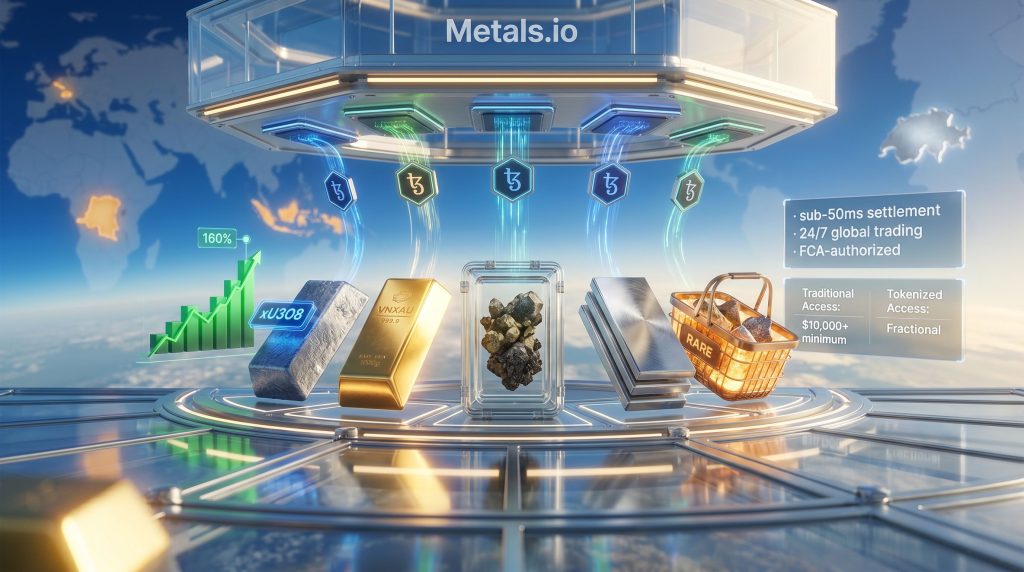
The formal launch of metals.io in March 2026 marked the transition to a unified multi-metal platform. The regulated issuance layer is provided by Archax Ltd, which is FCA-authorized in the United Kingdom. FCA authorization imposes a substantive compliance rulebook, providing token holders with a regulated framework that represents one of the more rigorous digital asset issuance standards currently available globally.
The platform operates on the Tezos blockchain, which provides sub-50ms transaction latency, enabling near-instant settlement confirmation. This infrastructure supports 24/7 global trading, removing the market-hours constraint that limits traditional commodity exchanges. Tokens can also function as collateral within decentralised finance (DeFi) protocols, with uranium already live in this capacity and expansion planned across the broader asset suite.
Current Asset Suite
| Token Symbol | Underlying Asset | Storage Location | Primary Use Case |
|---|---|---|---|
| xU3O8 | Uranium ore concentrate | Cameco regulated conversion facility | Nuclear energy security |
| VNXAU | Allocated physical gold | Precious metals vaults, Switzerland and Liechtenstein | Monetary protection |
| RARE | Strategic metals basket (hafnium, rhenium, indium, neodymium oxide, praseodymium oxide) | Institutional commodity warehouses | AI, semiconductors, renewable energy magnets |
| Cobalt token | Physical cobalt | Steinweg warehouse network | EV batteries, aerospace superalloys |
| Nickel token | Physical nickel | Steinweg warehouse network | EV battery range extension, stainless steel |
Why Custody Architecture Is the Foundation of Everything
The custody design philosophy at metals.io operates on a single governing principle: every metal receives the custody arrangement that its physical market reality demands. This means partnering with established custodians rather than creating proprietary storage infrastructure.
Steinweg, the custodian for cobalt and nickel tokens, is a name that any participant in the physical commodities and logistics world will recognise immediately. The company handles metals on behalf of the world's largest trading houses and industrial players. When cobalt or nickel is described as sitting in a Steinweg warehouse, it communicates a specific and verifiable standard of documentation, storage protocols, and handling practices that the institutional commodity market has relied upon for decades.
Trust in commodity markets is built over decades. Technology platforms that enter this space benefit from borrowing the institutional credibility of established custodians, while contributing the settlement and access layer that modernises how those assets are distributed.
Smart contract architecture enforces a hard constraint that underpins the entire system: new tokens cannot be minted until corresponding physical material is confirmed in storage. This structural rule prevents token supply from exceeding physical reserves and keeps token pricing anchored to spot market reality. Proof of reserves is published on the metals.io website on a monthly basis, with a roadmap objective of real-time verification as traditional warehouse providers modernise their reporting infrastructure.
Cobalt and Nickel: The Investment Case for Each Metal
Cobalt: The World's Most Geographically Concentrated Critical Metal
No critical metal exhibits more extreme geographic concentration than cobalt. The Democratic Republic of Congo accounts for approximately 75% of global cobalt production, and in 2025 it demonstrated its willingness to exercise that market power by imposing export caps at less than half of prior-year output levels. Cobalt prices responded with an increase of approximately 160%, moving the market from a position of oversupply to a condition that analysts now characterise as a forecast genuine deficit within an eighteen-month window.
What makes cobalt's demand profile resilient is its diversification across applications where substitution is either difficult or impossible:
- EV batteries: primary growth driver aligned with accelerating electric vehicle adoption curves.
- Consumer electronics: ubiquitous in smartphones, laptops, and personal computing devices globally.
- Aerospace superalloys: jet engine components where cobalt's thermal and mechanical properties have no viable substitute. This demand is non-discretionary and not linked to economic cycles.
The combination of concentrated, politically manageable supply and diversified, sticky demand creates the conditions for a structural deficit that is unlikely to self-correct quickly. New cobalt supply from outside the DRC would require significant capital investment and multi-year development timelines.
The investor access problem is equally stark. No physical cobalt ETF with meaningful market depth exists. There is no established retail dealer market for physical cobalt. Prior to tokenization, the only practical exposure pathway involved equity positions in mining companies, introducing equity market risk that is entirely disconnected from cobalt price fundamentals.
Nickel: The Battery Range Metal Governed from Jakarta
Nickel's market narrative is structured differently from cobalt's. It is primarily a recovery play on the world's most important battery metal, with supply concentration functioning as a government-controlled price lever.
Indonesia's trajectory in nickel is one of the most dramatic supply-side transformations in modern commodity markets. Leveraging new HPAL processing technology, Indonesia expanded its global nickel market share from approximately 2% to roughly 60% over a decade. This market flooding strategy suppressed global nickel prices for an extended period. The subsequent policy reversal, cutting export quotas by approximately one-third, shifted the market dynamic and initiated a price recovery trajectory.
The two distinct demand pillars for nickel are worth understanding separately:
- Stainless steel: the largest volume application, relatively stable, and cyclically sensitive to industrial activity levels.
- EV batteries (NMC chemistry): the fastest-growing application, where nickel enables greater energy density and extended driving range in lithium-nickel-manganese-cobalt battery chemistries. Range anxiety remains the primary consumer barrier to EV adoption, and nickel is the element that directly addresses it.
The supply governance dynamic is unusually transparent: Jakarta's quota decisions function as a de facto price management mechanism for a metal that is critical to the global energy transition. This is a supply lever controlled by a single government actor, applied to a commodity with accelerating structural demand. Consequently, Australia's critical minerals sector is increasingly positioning itself to benefit from these supply disruptions as an alternative sourcing destination.
The Four-Question Verification Framework for Tokenized Commodities
Before allocating capital to any tokenized physical commodity product, a structured verification process is essential. The history of digital asset markets includes numerous examples of products that claimed physical backing without the architecture to substantiate it.
Investor Verification Framework: Apply these four questions to any tokenized commodity product before investing:
- Where is the metal physically stored, and with which named custodian?
- Who has independently verified the reserves, and how frequently?
- Who regulates the token issuer, and under which legal jurisdiction?
- Can the token be redeemed for physical delivery of the underlying commodity?
Breaking down each criterion:
Named custodian: Vague custody disclosures such as "stored in a secure facility" are a significant red flag. A credible product names the custodian explicitly, enabling independent verification by anyone familiar with the relevant physical commodity market. Metals.io examples include Cameco for uranium, Steinweg for cobalt and nickel, and allocated precious metals vaults in Switzerland and Liechtenstein for gold.
Reserve verification cadence: Monthly attestation represents the current industry standard. Real-time verification remains a roadmap objective. Smart contract architecture prevents token supply from exceeding confirmed physical reserves.
Regulatory authorization: Archax Ltd serves as the regulated issuance layer for metals.io, operating under FCA authorization in the United Kingdom. Jurisdiction matters significantly in digital asset issuance, and FCA authorization represents one of the more substantive compliance frameworks globally.
Redemption rights: Redemption rights are what anchor token value to physical commodity spot prices. Without them, the pricing mechanism is entirely market-sentiment dependent. Minimum lot sizes apply, set by warehouse providers, which is relevant for institutional redemption. Retail investors primarily benefit from secondary market liquidity, which tracks spot pricing because the redemption mechanism exists as an underlying anchor.
The next major ASX story will hit our subscribers first
How to Access Tokenized Metals on Metals.io
Step-by-Step Onboarding for Individual Investors
- Navigate to metals.io to explore the full asset catalogue, custody documentation, and published proof of reserves.
- Connect an existing wallet if you have an EVM-compatible wallet such as MetaMask, or connect any equivalent EVM wallet directly.
- Register via email if you do not have an existing wallet. Metals.io will provision a custodial wallet upon email registration.
- Complete the KYC verification process, designed to be completed in minutes, comparable to onboarding on a standard trading application.
- Fund your account using standard banking or payment rails. No specialist brokerage account or prior commodity trading experience is required.
- Select and purchase from the available asset suite: uranium, gold, rare earth basket, cobalt, and nickel. Fractional ownership is available, removing the high minimum investment thresholds that historically made physical commodity access the domain of specialist institutional buyers.
Institutional and Producer Pathways
For institutions, family offices, and larger allocators, a direct contact pathway is available on the metals.io platform. Conversations are available regarding ETF-compatible structures, larger allocation frameworks, and bespoke integration options for highly regulated institutional investors.
For producers and traders, the tokenization model opens a structurally interesting distribution channel. A mining or processing company can transfer physical metal into the Steinweg warehouse structure and receive tokens in kind, precisely as they would transfer metal to any conventional buyer. Those tokens can then be traded on the secondary market, used for physical delivery, or applied within the DeFi collateral ecosystem.
The thesis is that if a liquid tokenized secondary market develops sufficient depth, the bilateral off-take dependency that constrains junior miner financing could be materially reduced, since output could be distributed to a broad open market rather than a single counterparty. This represents a potential reduction in the off-take risk premium currently embedded in junior miner financing costs.
The Longer-Term Vision: Digital Settlement Infrastructure for Critical Commodity Markets
The near-term pipeline for metals.io includes palladium, with warehouse relationships already established, and an expansion into base industrial metals that extends the critical minerals coverage into higher-volume commodity categories. Furthermore, the energy security implications of these developments are increasingly shaping how governments and institutional investors think about physical commodity access.
The medium-term strategic direction involves deeper integration with traditional finance, including ETF product development where tokenized commodity baskets serve as foundations for regulated fund structures. This pathway could allow highly regulated institutional allocators to gain physical commodity exposure without the operational complexity of direct physical ownership.
The long-term vision is more structurally ambitious: to become the default digital settlement infrastructure for physical commodity spot markets globally. This mirrors the original thesis developed for uranium.io and applies it across the full critical and industrial metals spectrum. The secondary market depth objective is not merely a liquidity goal. It is a capital formation enabler for the supply side of the commodity super cycle, which represents one of the most persistently cited constraints on the supply response that the current demand environment demands.
| Dimension | Traditional Access | Tokenized Access via Metals.io |
|---|---|---|
| Minimum investment | Often $10,000+ via specialist brokers | Fractional, accessible from small ticket sizes |
| Trading hours | Exchange hours only | 24/7 global |
| Settlement speed | T+2 standard | Near-real-time via Tezos infrastructure |
| Custody transparency | Opaque for retail investors | Named custodians, published proof of reserves |
| Redemption rights | Physical delivery complex and costly | Built into token structure |
| DeFi utility | Not applicable | Collateral use in DeFi protocols (uranium live) |
| Regulatory framework | Varies by jurisdiction and broker | FCA-authorized issuance via Archax Ltd |
Frequently Asked Questions
Is tokenized physical metal the same as buying a crypto token?
No. Tokenized physical metal represents beneficial ownership of an allocated, physically stored commodity. The blockchain is the settlement and transfer mechanism. Price behaviour tracks physical commodity spot markets, not crypto market sentiment, because redemption rights anchor the token to the underlying material.
What happens to my metals if the platform ceases operations?
All metals.io products are held in bankruptcy-remote legal structures. Token holders retain rights to their allocated physical assets independently of the platform operator's financial status.
Can I take physical delivery of tokenized metals?
Yes, subject to minimum lot sizes set by the relevant warehouse provider. Redemption rights are a structural feature of the token design, not an optional add-on.
How do I know the physical metal exists?
Proof of reserves is published on the metals.io website on a monthly basis from warehouse provider attestations. Smart contract architecture prevents token supply from exceeding confirmed physical holdings.
Do I need an existing crypto wallet?
No. Metals.io will provision a wallet upon email registration for investors with no prior blockchain experience.
What are the primary risk factors?
Key considerations include commodity price volatility driven by geopolitical events and export policy changes, smart contract technical risk, secondary market liquidity risk for less-traded metals, and potential regulatory changes affecting the issuance framework.
Risk Disclosure: Investing in tokenized physical commodities involves material risks including commodity price volatility, geopolitical supply disruptions, smart contract vulnerabilities, and secondary market liquidity constraints. Past price movements in cobalt, nickel, uranium, or any other commodity are not indicative of future performance. This article is for informational purposes only and does not constitute financial advice. Investors should conduct independent due diligence and consult a qualified financial adviser before allocating capital to any investment product.
Want to Identify the Next Major ASX Mineral Discovery Before the Market Does?
Discovery Alert's proprietary Discovery IQ model scans ASX announcements in real time, instantly converting complex mineral data across 30+ commodities into clear, actionable insights for both short-term traders and long-term investors — explore historic discoveries and their extraordinary returns to understand what's at stake, then start your 14-day free trial at Discovery Alert to position yourself ahead of the next significant find.