July 9, 2026
When Portfolio Strategy Meets Planetary Scarcity: The Kasiya Question
There is a rarely discussed paradox at the heart of the global energy transition: the minerals most urgently needed to decarbonise the world economy are controlled, processed, or dominated by a single country. China's grip on graphite processing alone covers an estimated 70% to 80% of global capacity, while its influence over titanium feedstock supply chains runs nearly as deep. For Western governments and industrial buyers watching this concentration with growing alarm, the search for credible alternatives has become less a preference and more a strategic imperative.
Into this context emerges a deposit in the landlocked highlands of central Malawi that, by almost any geological and commercial measure, demands serious attention. The Rio Tinto Kasiya project dynamic — specifically the decision by Rio Tinto to forgo operational leadership while retaining financial exposure — offers one of the most instructive case studies in how major mining capital is navigating the tension between commodity-specific strategy and the broader geopolitical scramble for critical minerals demand.
When big ASX news breaks, our subscribers know first
Understanding What Kasiya Actually Is: Geology, Grade, and Scale
Before examining the commercial and strategic architecture around Kasiya, it is worth grounding the analysis in the deposit's geology, because the physical characteristics of this resource are what make the strategic conversation meaningful.
Kasiya sits approximately 40 kilometres northwest of Lilongwe in Malawi's Central Region, spanning the Lilongwe and Dowa districts. The deposit is hosted within a laterite profile — a deeply weathered surface layer formed over millions of years through tropical weathering of underlying igneous and metamorphic rocks. This geological setting is critical for two reasons.
First, the mineralisation is remarkably shallow and unconsolidated. There is no hard rock to blast, no underground development required, and no complex comminution circuit needed to liberate the ore. The deposit responds to large-scale dry mining using draglines and haul trucks, a method more analogous to mineral sands operations in Australia or South Africa than to conventional hard-rock mining. This has profound implications for capital intensity and operating costs.
Second, the co-location of rutile and graphite within a single contiguous ore body is geologically unusual. These two minerals typically require separate geological settings. Their co-occurrence at Kasiya means a single mining operation can generate two distinct revenue streams simultaneously, reducing the effective per-unit cost of extracting either commodity. This structural cost advantage is not always appreciated by investors more accustomed to conventional hard-rock or underground mining economics.
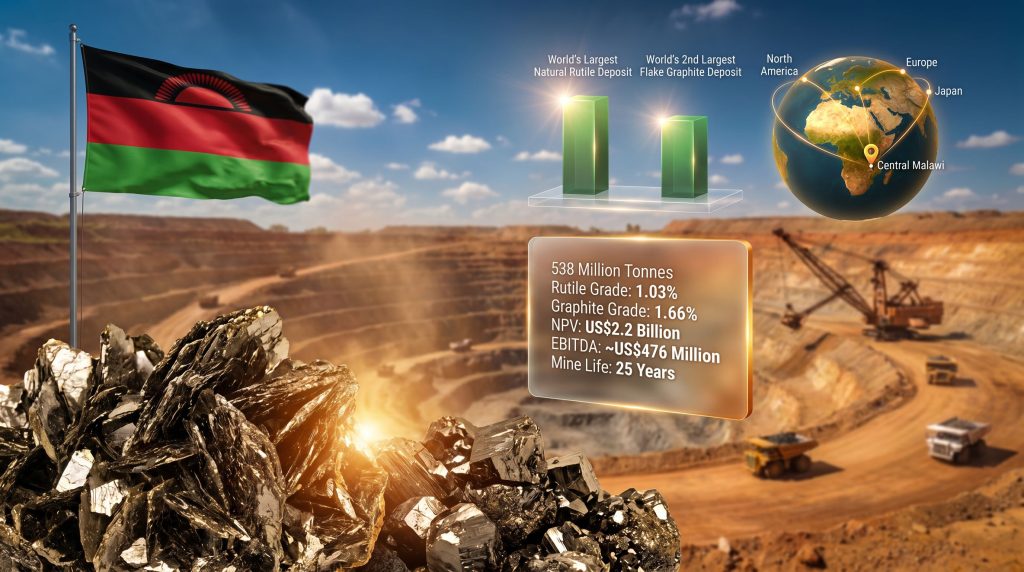
Kasiya Project Metrics at a Glance
| Metric | Data |
|---|---|
| Total Probable Reserves | 538 million tonnes |
| Rutile Grade | 1.03% |
| Total Graphite Carbon Grade | 1.66% |
| Contained Rutile | 5.5 million tonnes |
| Contained Graphite | 8.9 million tonnes |
| Global Rutile Ranking | World's largest known natural rutile deposit |
| Global Graphite Ranking | World's second-largest flake graphite deposit |
| Projected Mine Life | 25 years |
| Pre-Tax NPV (DFS, April 2026) | US$2.2 billion |
| Estimated Annual EBITDA | ~US$476 million |
| Peak Throughput | 24 million tonnes per year by Year 5 |
Source: Kasiya Definitive Feasibility Study, April 2026
Natural Rutile vs. Synthetic Alternatives: Why Grade Matters
A point frequently overlooked outside specialist circles is that not all titanium feedstocks are equal. The titanium dioxide pigment and metal industries consume several feedstocks, including ilmenite, synthetic rutile, slag, and natural rutile. Natural rutile sits at the top of this hierarchy by titanium dioxide content, typically grading above 94% TiO2 compared to ilmenite's typical range of 45% to 65%.
For defence-grade applications, aerospace alloys, and specialty welding electrodes, natural rutile is often the only acceptable feedstock because synthetic alternatives introduce trace contaminants that compromise the mechanical and chemical properties of finished titanium products. This means natural rutile commands a structural price premium over lower-grade feedstocks, and that premium is not cyclical; it is embedded in specifications written into defence and aerospace procurement contracts.
"The defence and aerospace sectors specify natural rutile over synthetic alternatives not merely for cost reasons but because titanium metal produced from high-grade natural feedstocks achieves superior strength-to-weight ratios and corrosion resistance properties critical for aircraft components and military hardware."
The Capital Cost Journey: From Pre-Feasibility to Definitive Study
One of the more informative data trails in Kasiya's development history is the evolution of capital cost estimates across successive study phases. This trajectory matters because it signals whether a project is becoming more or less economically defined over time.
| Study Phase | Capital Expenditure Estimate | Key Scope Changes |
|---|---|---|
| Pre-Feasibility Study (September 2023) | US$597 million | Baseline development concept |
| Optimised Pre-Feasibility Study (January 2025) | US$665 million | Seven optimisation areas including mining method, plant location, and water management infrastructure |
| Definitive Feasibility Study (April 2026) | Confirmed world-scale production potential | Full engineering and cost validation completed |
The increase from the original pre-feasibility estimate to the optimised study reflects scope refinement rather than cost blowout. Completing a definitive feasibility study involves iterative engineering work on water management, plant siting, and optimal mining methods — and when this is done thoroughly, the capital estimate often rises modestly before stabilising. This is a normal and healthy pattern in mining project development.
Rio Tinto's Calculated Withdrawal: Reading Between the Lines
Rio Tinto's decision regarding the Kasiya operatorship warrants careful interpretation. The company entered its initial position in July 2023, acquiring a 15% equity stake in Sovereign Metals for A$40.4 million, representing a premium of approximately 43% to the prevailing share price at the time. That level of entry premium signals genuine strategic conviction, not a passive financial investment.
The company subsequently exercised options to lift its stake to 19.76% through an additional A$18.5 million investment in July 2024, and contributed more than A$60 million in total capital and technical resources, including support for pilot mining programmes and the April 2026 Definitive Feasibility Study.
Rio Tinto's decision not to exercise the operatorship option was explicitly characterised as a portfolio prioritisation decision, with the company affirming that it did not reflect any change in Kasiya's underlying fundamentals, economics, or strategic importance. This distinction is material for investors trying to interpret the signal correctly.
Rio Tinto's Core Commodity Focus vs. Kasiya's Output
| Commodity | Rio Tinto Core Strategy | Kasiya Project |
|---|---|---|
| Iron Ore | Primary pillar | Not applicable |
| Copper | Primary pillar | Not applicable |
| Aluminium | Primary pillar | Not applicable |
| Lithium | Primary pillar | Not applicable |
| Natural Rutile | Outside current focus | Primary output |
| Flake Graphite | Outside current focus | Primary output |
Rio Tinto retains its 18.2% shareholding in Sovereign Metals and the right to appoint a board director while that holding remains above 15%. This structure transforms the relationship from development partnership to strategic minority investment, preserving upside exposure without operational commitment.
"In mining, a major retaining a double-digit minority stake after declining operatorship is not a red flag. It is often a signal that the major views the asset as strategically valid but outside its current capital allocation window. The retained position prevents the major from being locked out if market conditions shift."
Sovereign's Independent Commercial Strategy: Three Pillars
With operatorship now resting entirely with Sovereign Metals, the company's commercial roadmap centres on three interconnected pillars.
1. Binding Offtake Conversion
Sovereign holds memoranda of understanding with both Mitsui and Co. of Japan and Traxys North America, the latter covering the marketing of 40,000 to 80,000 tonnes of graphite per year into U.S. and allied markets. Converting these MOUs into legally binding offtake agreements is the single most important near-term commercial milestone, as binding offtake forms the foundation upon which project financing can be structured.
2. Development Finance Architecture
The company's active collaboration agreement with the International Finance Corporation, the private sector lending arm of the World Bank Group, provides a credible pathway toward construction-phase financing. IFC involvement typically signals to other institutional lenders that a project has met a rigorous environmental, social, and governance assessment threshold, which can materially reduce the cost and complexity of assembling a project finance syndicate.
3. U.S. Government Engagement Through Project Vault
Kasiya's inclusion in the U.S. Government's Project Vault initiative places it within a framework designed to identify and support critical mineral developments in non-Chinese jurisdictions. This inclusion makes the project eligible to engage with development finance mechanisms including potential support from the U.S. International Development Finance Corporation. It is important to note that inclusion in this framework does not constitute confirmed government funding or project-specific support, but it does position Sovereign to pursue such mechanisms through established channels.
Scenario Analysis: Three Pathways to Production
Assessing Kasiya through a scenario lens reveals the range of outcomes available to Sovereign Metals over the next three to five years.
Scenario 1: Accelerated U.S. Partnership (Base Case)
- Binding offtake agreements with Traxys and Mitsui are executed within 12 to 18 months
- IFC financing commitment anchors construction-phase capital
- U.S. development finance supplements the capital structure
- Construction commences late 2026 with first production achievable within the decade
Scenario 2: Financing Delay (Downside Case)
- Commodity price softness or geopolitical uncertainty extends MOU-to-offtake conversion timelines
- Construction is deferred beyond 2027, extending the pre-production period
- Rio Tinto's retained stake provides institutional credibility but no operational acceleration mechanism
Scenario 3: Strategic Acquisition (Upside Case)
- A Western-aligned industrial group, battery materials processor, or government-backed entity acquires a major stake or full control of Sovereign Metals
- Kasiya becomes embedded within a vertically integrated supply chain serving U.S. or European defence and energy storage sectors
- Compressed development timeline driven by end-user demand certainty rather than market-driven offtake negotiation
"The dual-commodity profile of Kasiya creates an unusual situation where the project could theoretically attract separate strategic investors for each commodity stream — one aligned with titanium and aerospace supply chains, another with battery materials and EV manufacturing. This kind of commodity-split financing structure is not common in mineral sands development but is not without precedent in projects serving multiple industrial end-markets."
The next major ASX story will hit our subscribers first
Africa's Rising Strategic Value in the Critical Minerals Contest
Understanding why Malawi matters in this context requires stepping back to examine the structural forces reshaping strategic mineral supply chains globally. The United States has committed US$300 million to diversify away from Chinese critical mineral sources, and similar EU programmes are simultaneously active. This capital, when deployed, favours projects that can demonstrate bankable feasibility, credible offtake frameworks, and alignment with Western supply chain security objectives.
Malawi's entry into this conversation through Kasiya is significant because the country has not historically been regarded as a major mining jurisdiction. The project's advancement could, furthermore, catalyse broader foreign direct investment into Malawi's infrastructure and extractive sector, creating a development multiplier effect beyond the mine gate.
African mining finance trends increasingly reflect this new reality, with African producers holding verified, large-scale deposits of U.S.-designated critical minerals now able to access financing terms that would have been unavailable five years ago. The geopolitical re-rating of African mineral endowment is not theoretical; it is being priced into project valuations and financing conversations in real time.
Frequently Asked Questions: Rio Tinto, Kasiya, and Malawi's Critical Minerals Future
What makes Kasiya the world's largest natural rutile deposit?
The April 2026 Definitive Feasibility Study confirmed probable reserves of 538 million tonnes grading 1.03% rutile, translating to approximately 5.5 million tonnes of contained rutile. This contained metal figure exceeds any other known natural rutile deposit globally.
Is Rio Tinto still involved in the Kasiya project?
Yes. Rio Tinto retains an 18.2% equity stake in Sovereign Metals and the right to appoint a board director provided its holding remains above 15%. The company contributed more than A$60 million to Kasiya's development before concluding its operational collaboration.
Why does natural rutile command a premium over synthetic titanium feedstocks?
Natural rutile typically grades above 94% TiO2, compared to 45% to 65% for ilmenite and variable grades for synthetic alternatives. For aerospace and defence applications where feedstock purity directly determines the performance properties of finished titanium products, natural rutile is frequently the only specification-compliant option available.
Why is graphite classified as a critical mineral?
Flake graphite is the dominant anode material in lithium-ion batteries powering electric vehicles and grid-scale energy storage. China controls an estimated 70% to 80% of global graphite processing capacity, creating a single-point-of-failure vulnerability that has led the U.S. and EU to formally designate natural graphite as a critical mineral and fund alternative supply development.
What is the projected financial return from Kasiya?
The April 2026 Definitive Feasibility Study estimated a pre-tax net present value of US$2.2 billion and annual EBITDA of approximately US$476 million across a 25-year mine life.
What does it mean that Kasiya requires no drilling or blasting?
Unlike hard-rock mining operations, Kasiya's mineralisation is hosted in a shallow, unconsolidated laterite profile. This means extraction uses draglines and haul trucks rather than explosives and crushers, substantially reducing both capital requirements and environmental footprint relative to conventional open-pit mines of comparable output scale.
What the Kasiya Situation Signals for Critical Minerals Markets
The strategic architecture around the Rio Tinto Kasiya project reveals several dynamics that extend well beyond a single mining development. Consequently, the following observations carry relevance for investors, policymakers, and industrial buyers alike:
- World-class resource quality does not guarantee a development operator: Kasiya's exceptional geological and economic credentials have not automatically attracted a major miner to assume operational leadership, confirming that commodity strategy and capital allocation frameworks shape development timelines as powerfully as deposit merit
- Minority stakes by major miners function as credibility anchors: Rio Tinto's retained 18.2% position validates Kasiya's economics in the eyes of other institutional investors even without operational involvement
- Dual-commodity deposits carry structural financing advantages: The ability to serve both the titanium feedstock and battery materials markets from a single operation creates multiple offtake pathways and diversifies counterparty risk in project finance structures
- Western development finance is reshaping African project economics: The combination of IFC engagement, U.S. strategic frameworks, and Japanese trading house interest represents a financing coalition that would have been difficult to assemble around an African critical minerals project a decade ago
- Africa's mineral endowment is being re-rated in real time: Malawi's emergence as a potential anchor supplier of two U.S.-designated critical minerals reflects a structural shift in how global capital perceives African resource projects in the context of energy security pressures and energy transition supply security
Disclaimer: This article is intended for informational purposes only and does not constitute financial or investment advice. Forward-looking statements, scenario projections, and financial estimates referenced herein are subject to material risks, uncertainties, and assumptions that may cause actual outcomes to differ significantly from those described. Readers should conduct their own due diligence and seek independent professional advice before making any investment decisions.
Want to Stay Ahead of the Next Major Critical Minerals Discovery?
Discovery Alert's proprietary Discovery IQ model delivers real-time alerts the moment significant ASX mineral discoveries are announced, transforming complex geological and commodity data into actionable investment insights for both short-term traders and long-term investors — explore Discovery Alert's discoveries page to understand how historic finds have generated extraordinary returns, and begin your 14-day free trial today to position yourself ahead of the broader market.