June 24, 2026
The Chokepoint That Cannot Be Bypassed: Understanding the Strait of Hormuz's Grip on Global Energy
For centuries, maritime chokepoints have shaped the outcome of trade, conflict, and economic power. Few waterways in recorded history have concentrated so much strategic leverage into so narrow a passage as the Strait of Hormuz. At its tightest point, this corridor measures roughly 33 kilometres wide, yet it carries a weight so disproportionate to its physical dimensions that any disruption reverberates through commodity markets, agricultural supply chains, and national energy budgets within hours. The story of India-bound vessels crossing Strait of Hormuz after Iran-US MoU demonstrates precisely how fragile that leverage can become when geopolitical hostilities overwhelm commercial necessity.
When big ASX news breaks, our subscribers know first
Why the Strait of Hormuz Remains the World's Most Critical Energy Chokepoint
Geography That Holds Global Oil Markets Hostage
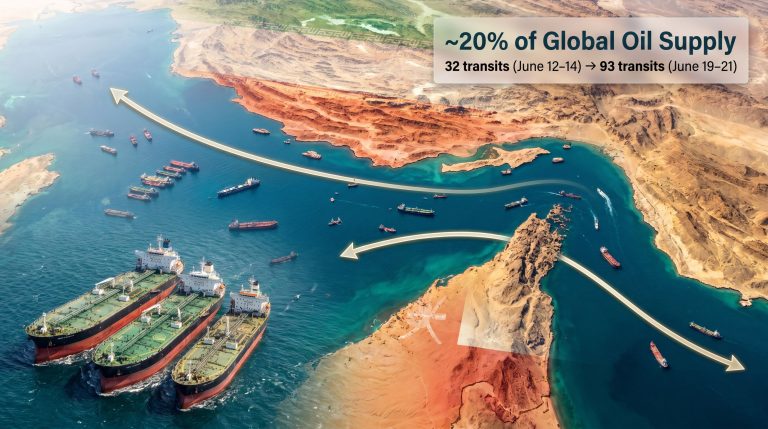
The Strait of Hormuz sits between the southern coast of Iran and the northern tip of Oman, acting as the sole maritime gateway connecting the Persian Gulf to the Gulf of Oman and, beyond that, the Arabian Sea. Every barrel of crude oil produced by Saudi Arabia, Iraq, Kuwait, the UAE, and Iran that leaves by sea must pass through this corridor. No large-scale alternative pipeline network exists that can replicate the volume capacity of this waterway for the full range of Gulf exporters.
The U.S. Energy Information Administration has historically estimated that approximately 20% of global petroleum liquids transit the Strait annually, representing roughly 17 to 21 million barrels per day under normal operating conditions. Considering crude oil geopolitical risks, even a partial closure lasting 48 to 72 hours is sufficient to trigger measurable crude price volatility on international markets, as traders reprice supply-chain risk before physical shortages materialise.
What the Shipping Freeze Cost India
In the months leading up to June 17, 2026, the Strait became operationally hazardous for commercial shipping as Iran-US hostilities escalated. Indian energy importers absorbed the consequences across multiple sectors simultaneously:
- Crude oil procurement delays disrupted refinery scheduling at major Indian state-owned processors
- LPG supply chains faced tightening inventory positions at import terminals
- Fertilizer feedstock arrivals fell behind the agricultural calendar's demand curve
- War-risk insurance premiums surged to levels that made many commercial voyages economically unviable
London market underwriters, who function as the de facto gatekeepers of commercial shipping normalisation through high-risk waterways, effectively priced numerous voyages out of existence during peak hostilities. The central shipping lanes became a no-go zone not only because of physical danger but because the insurance cost alone rendered cargo economics untenable.
What Did the Iran-US MoU Actually Agree To?
Core Terms of the June 17 Agreement
The memorandum of understanding was electronically signed on June 17, 2026, with formal implementation initiated on June 18 following authorisation by U.S. President Donald Trump. The agreement carried several distinct components with immediate commercial consequences:
- Iran committed to diluting its stockpile of highly enriched uranium as a central non-proliferation concession
- The United States lifted its naval blockade of Iran and waived U.S.-backed sanctions, restoring Iran's ability to sell crude oil on global markets without restriction
- Iran agreed to waive tariffs and insurance fees on transiting vessels for an initial 60-day window
- The U.S. sanctions waiver took effect immediately, signalling to tanker operators that Persian Gulf routing was commercially viable again
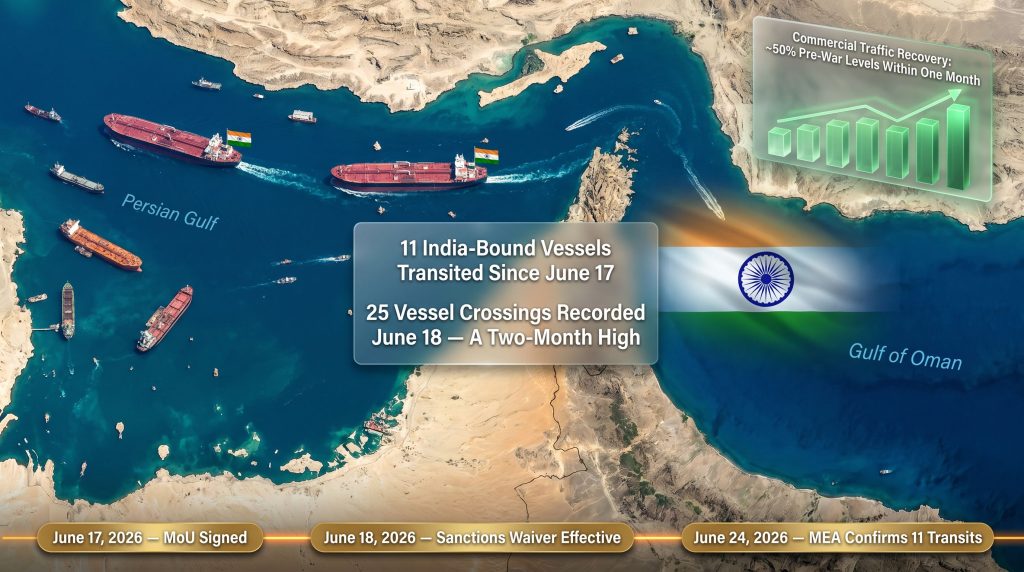
The commercial signal was rapid. On June 18 alone, maritime tracking data recorded 25 commercial vessel crossings through the Strait, representing more than five times the daily average recorded during peak hostilities in early June. That single-day figure marked a two-month high for transit activity through the waterway.
The 60-Day Uncertainty Window
While the agreement restored commercial viability in the short term, the temporary nature of the fee waiver creates a structural planning problem for shipping operators and cargo owners. Furthermore, the oil price disruption impact of any breakdown in the MoU framework would be felt almost immediately across global commodity markets.
"The 60-day fee waiver is the commercial hinge of this agreement. Shipping companies will not commit to fully normalised routing until long-term toll and insurance frameworks are confirmed. The period between now and the waiver's expiry represents the most consequential planning window for India's energy logistics strategy."
Key uncertainties that remain unresolved include:
- Whether Iran retains the authority to impose transit fees once the waiver expires and at what level
- Whether the MoU constitutes a binding treaty or a provisional framework subject to unilateral revision
- How U.S. and Iranian interpretations of the sanctions waiver terms may diverge over time
- The legal standing of the agreement under international maritime law
Shipping operators and marine insurers are treating the MoU as a conditional reopening rather than a full normalisation, which explains why vessel behaviour in the strait remains cautious despite the technical resumption of traffic.
India-Bound Vessels Crossing the Strait of Hormuz After the Iran-US MoU
The MEA's Official Transit Count as of June 24, 2026
India's Ministry of External Affairs spokesperson Randhir Jaiswal confirmed at a press briefing that 11 India-bound vessels had successfully transited the Strait of Hormuz in the period following the MoU's signing on June 17. The cargo breakdown across those 11 vessels reflects the breadth of India's import dependency on Persian Gulf supply chains:
| Vessel Type | Flag | Cargo | Quantity |
|---|---|---|---|
| Crude oil tankers | Indian-flagged | Crude oil | 3 vessels x 285,000 MT each |
| LPG carrier | Foreign-flagged | Liquefied petroleum gas | 1 vessel |
| Crude oil tanker | Foreign-flagged | Crude oil | 1 vessel |
| Bulk carriers | Foreign-flagged | Fertilizer | 6 vessels |
As of the same briefing, 10 Indian-flagged vessels remained stationed in the Persian Gulf region awaiting transit clearance, while an additional 2 Indian vessels had crossed from the Arabian Sea side into the Persian Gulf, moving in the inbound direction.
The three Indian-flagged crude tankers alone, each loaded with 285,000 metric tons, represent a substantial immediate volume recovery for Indian refiners that had been running on depleted procurement pipelines for weeks.
Named Vessels and Symbolic Milestones
Among the India-bound vessels crossing Strait of Hormuz after Iran-US MoU are the Pushpak and the Paramel, both Indian-flagged tankers. A Liberian-flagged tanker carrying Saudi Arabian crude, captained by an Indian crew, completed the first India-bound voyage through the strait since the closure and docked in Mumbai, representing a symbolic restoration of the energy corridor that Indian refiners depend upon.
Notably, vessels associated with U.S., Israeli, and European commercial interests continue to face operational restrictions within the strait, underscoring that the current reopening is selective rather than universal. This distinction matters for global oil market participants assessing how quickly full transit normalisation can be achieved. Observers monitoring current crude oil markets will recognise that selective reopening introduces its own form of pricing distortion.
Strait of Hormuz Reopening: A Comparative Timeline of Key Milestones
| Date | Event | Significance |
|---|---|---|
| Pre-June 17, 2026 | Strait largely non-operational due to hostilities | Global oil supply disruption; Indian vessels stranded |
| June 17, 2026 | Iran-US MoU signed electronically | Formal framework to cease hostilities and reopen waterway |
| June 18, 2026 | Trump signs agreement; sanctions waiver takes effect | Iran authorised to sell oil freely; 25 vessel crossings recorded |
| June 18, 2026 | Liberian-flagged tanker docks in Mumbai | First India-bound vessel completes transit post-MoU |
| June 24, 2026 | MEA confirms 11 India-bound transits completed | Partial normalisation confirmed; 10 vessels still waiting |
| 60 days post-MoU | Iran's tariff and fee waiver expires | Critical renegotiation window for long-term transit framework |
What Are the Navigation Risks Still Facing Ships in the Strait?
Mined Lanes, Routing Restrictions, and Transponder Behaviour
The physical hazards within the strait extend beyond geopolitical risk. The central shipping lanes remain partially compromised due to mine-laying activity during the conflict period. Commercial vessels are being redirected to northern or southern corridor alternatives, which adds transit time and fuel costs to every voyage. Iran has designated specific approved corridors, and compliance with these routing requirements creates bottleneck conditions during periods of elevated traffic volume.
A particularly notable behavioural signal is the widespread use of Automatic Identification System (AIS) transponder suppression. Multiple vessels are operating with AIS switched off or in restricted broadcast mode as a precautionary measure, which complicates maritime tracking and raises its own set of regulatory questions under international conventions on vessel safety and collision avoidance.
The Insurance Market's Role in Determining When True Normalisation Arrives
The London market's war-risk underwriting community operates on observed evidence rather than political announcements. Premium recalibration following a geopolitical event of this magnitude requires a sustained track record of incident-free transits before actuarial models justify lower rates. Industry estimates suggest that meaningful premium reductions will require at least four to six weeks of clean transit data following the MoU.
"For Indian energy importers, the true cost of the Strait of Hormuz disruption is not the closure alone. It is the insurance market's inherent lag in recognising the reopening. War-risk premiums will remain structurally elevated for weeks even after the MoU takes hold, creating a hidden surcharge on every barrel of crude that transits the waterway during this transition period."
This lag dynamic is frequently underappreciated by commodity market participants who focus on headline diplomacy rather than the operational mechanics of commercial shipping. The insurance premium cycle is a second-order effect of the hostilities, but its cost impact on delivered crude prices for Indian importers is measurable and persistent well beyond the formal cessation of conflict.
The next major ASX story will hit our subscribers first
What Does This Mean for India's Energy Security Strategy?
Structural Dependence and the Agricultural Dimension
India's reliance on Persian Gulf crude is well documented, but the cargo composition of the 11 transiting vessels highlights a dimension that receives considerably less attention: fertilizer supply chain vulnerability. Six of the 11 vessels carried fertilizer cargo as bulk carriers. India's kharif and rabi crop cycles are acutely sensitive to the timing of fertilizer availability. Delays in import delivery during planting windows carry direct food security implications that extend the Hormuz disruption well beyond energy sector economics.
The fertilizer import reliance dimension also reveals something important about the geometry of India's Persian Gulf dependency. It is not simply a hydrocarbons story. The same waterway that carries crude oil and LPG also carries the ammonia, urea, and potash derivatives that underpin agricultural productivity for hundreds of millions of people.
Diversification Imperatives Exposed by the Closure
The months-long shipping disruption accelerated several strategic discussions that had been moving slowly in Indian policy circles. In addition, the disruption revealed how LNG supply implications extend well beyond energy pricing into broader infrastructure and security policy debates:
- Strategic petroleum reserve (SPR) adequacy: The episode exposed gaps in India's buffer capacity and strengthened the case for expanding the SPR programme beyond its current three-site configuration
- Alternative sourcing traction: West African, American, and Russian crude supplies via non-Hormuz routing gained operational traction during the closure as Indian refiners scrambled to maintain throughput
- Bilateral infrastructure dialogue: The disruption is expected to intensify discussions between India and Gulf Cooperation Council members on alternative pipeline and port infrastructure that could reduce single-chokepoint exposure over the medium term
- Diplomatic signalling: The MEA's active and public communication on vessel transit status represents an unusual level of government engagement in energy corridor logistics, signalling that New Delhi treats the Strait of Hormuz as a matter of national security rather than purely commercial concern
Three Conditions Required Before Shipping Fully Resumes
Analysts tracking the commercial recovery of the Strait of Hormuz identify three sequential conditions that must be met before traffic normalises at pre-war levels:
- Mine clearance or verified safe routing through the central lanes, reducing the navigational risk premium that is currently forcing vessels onto longer and costlier alternative corridors
- War-risk insurance premium normalisation by London market underwriters, which requires a minimum four to six week observation window of incident-free transits to trigger meaningful rate reductions
- Long-term transit framework agreement between Iran and the international shipping community before the 60-day fee waiver expires, providing the commercial certainty that vessel operators and cargo owners need to commit to normalised routing schedules
Maritime analysts project the Strait could recover to approximately 50% of pre-war traffic volumes within one month if the MoU holds without major incidents. Full normalisation across all vessel categories and flag states is expected to require several additional weeks, given the compounding uncertainties across insurance, navigation, and political dimensions.
Frequently Asked Questions: India-Bound Vessels and the Strait of Hormuz After the Iran-US MoU
How many India-bound vessels have crossed the Strait of Hormuz since the Iran-US MoU?
As of June 24, 2026, 11 India-bound vessels had successfully transited the Strait of Hormuz following the signing of the Iran-US MoU on June 17, according to a confirmed statement from India's Ministry of External Affairs spokesperson Randhir Jaiswal. Eleven India-bound ships safely transited the waterway after the U.S. and Iran reached their agreement, marking a significant milestone in the partial reopening of this critical corridor.
What types of cargo were the 11 transiting vessels carrying?
The cargo mix included crude oil aboard three Indian-flagged tankers each carrying 285,000 metric tons, one foreign-flagged LPG carrier, one foreign-flagged crude oil tanker, and six foreign-flagged bulk carriers transporting fertilizer to Indian ports.
How many Indian ships are still waiting in the Persian Gulf?
As of the latest MEA briefing, 10 Indian-flagged vessels remain in the Persian Gulf region. The Indian government has expressed confidence they will complete their strait transit in the near term, though no firm date has been publicly committed to.
Is the Strait of Hormuz fully open to all shipping?
Not universally. While commercial traffic has resumed for India-bound and many other vessels, ships associated with the United States, Israel, and European interests continue to face restrictions. The central navigation lanes remain hazardous due to mines, and vessels are being directed through alternative approved corridors.
What did Iran agree to regarding shipping fees under the MoU?
Iran agreed to waive tariffs and insurance fees on transiting vessels for a 60-day period from the MoU's signing date. The long-term framework governing transit fees beyond this window has not yet been finalised, creating a critical commercial planning uncertainty for shipping operators.
When will the Strait of Hormuz return to normal traffic levels?
Maritime analysts project the Strait could reach approximately 50% of pre-war traffic volumes within one month if the MoU is implemented without significant disruptions. However, full normalisation is expected to require several additional weeks due to ongoing insurance recalibration, mine clearance requirements, and unresolved long-term transit framework negotiations. The experience of India-bound vessels crossing Strait of Hormuz after Iran-US MoU offers an early but cautiously optimistic indicator of what that recovery trajectory may look like.
Disclaimer: This article contains forward-looking projections and timeline estimates based on publicly available information and analytical assessments as of June 24, 2026. Geopolitical developments are inherently unpredictable and actual outcomes may differ materially from projections. Nothing in this article constitutes financial, investment, or commercial navigation advice.
Want to Stay Ahead of the Commodity Market Disruptions That Affect ASX Mining and Resources Stocks?
When geopolitical events like the Strait of Hormuz crisis ripple through global energy and fertiliser supply chains, the flow-on effects reach ASX-listed resources companies quickly — and Discovery Alert's proprietary Discovery IQ model scans ASX announcements in real time, delivering instant alerts on significant mineral discoveries so investors can act before the broader market catches up. Explore historic discoveries and the returns they generated to understand the opportunity, then begin your 14-day free trial to position yourself ahead of the next major market move.