June 24, 2026
When Complacency Becomes a Crisis: The Energy Security Calculus That Failed
For decades, energy planners in import-dependent nations operated under a quiet assumption: the Strait of Hormuz, despite sitting at the centre of the world's most volatile region, would never actually close. History seemed to support this view. Tankers moved through its narrow passage with remarkable consistency regardless of regional conflict, sanctions regimes, or political brinkmanship. Reserves were maintained at levels calibrated to absorb temporary disruptions, not full cessations. That assumption has now been broken, and the strategic petroleum reserves expansion after the Strait of Hormuz crisis represents the most significant reshaping of global energy security architecture in a generation.
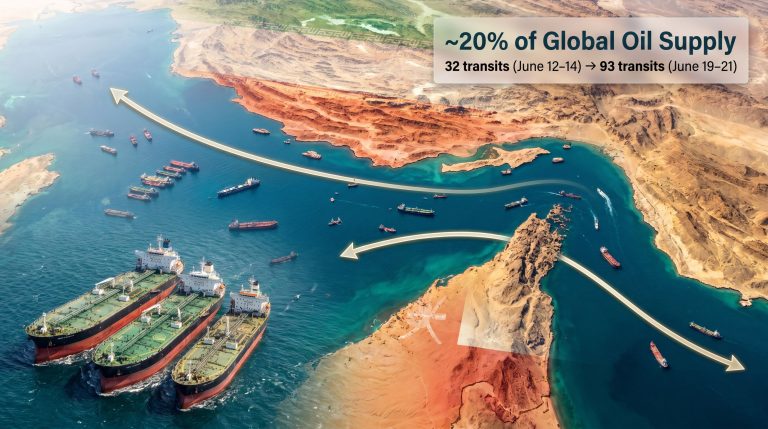
The consequences are not abstract. Nearly four months of severely disrupted traffic through a passage that ordinarily handles roughly 20% of global petroleum flows has left storage infrastructure depleted across the developed world, exposed critical gaps in Asia-Pacific supply chains, and triggered capital commitments from governments that had previously treated reserve-building as a compliance exercise rather than a strategic imperative.
When big ASX news breaks, our subscribers know first
The Anatomy of a Supply Shock: What the Hormuz Closure Actually Meant
Understanding why this crisis cut so deeply requires a clear-eyed look at what the Strait of Hormuz actually does in the global energy system. It is not simply a shipping lane; it is the arterial passage through which crude oil, condensate, liquefied natural gas, and refined petroleum products flow from the Persian Gulf to consuming nations across Asia, Europe, and beyond.
When traffic through the Strait stalled, the immediate effect was the stranding of more than 10 million barrels per day of crude and condensate within the Persian Gulf, creating a structural supply shortfall estimated between 9 and 11 million barrels per day. To put that figure in context, it is roughly equivalent to simultaneously removing the entire export output of Saudi Arabia and Iraq from global markets. Research into the Strait of Hormuz crisis underscores how US-Iran tensions have historically amplified these supply disruptions far beyond their physical dimensions.
The price response was swift and severe:
- Crude benchmarks surged past $100 per barrel, with forward market pricing pointing toward $150 per barrel
- U.S. retail gasoline prices exceeded $5 per gallon by mid-June 2026
- Asia-Pacific economies, structurally dependent on Gulf crude, faced the sharpest price dislocations
- Refinery feedstock shortages cascaded through downstream markets, triggering fuel rationing across multiple jurisdictions
The crisis also exposed a dynamic that energy traders rarely discuss publicly: the non-linear relationship between chokepoint severity and futures market volatility. Once market participants recognised that the disruption was not a brief incident but a sustained closure, the psychological amplification effect drove prices well beyond what physical supply fundamentals alone would have justified. Furthermore, the current crude oil price environment heading into the crisis had already placed pressure on import-dependent economies before the Strait closed.
Why Existing Strategic Reserves Could Not Absorb the Shock
Strategic petroleum reserves were designed for supply disruptions, not supply eliminations. The architecture of most national SPR systems reflects a 1970s-era policy framework built around the International Energy Agency's benchmark requirement of 90 days of net import coverage. That standard was calibrated against oil embargoes and production cuts, not the complete physical inaccessibility of the world's most critical maritime corridor.
When the IEA coordinated its largest-ever collective reserve release of 400 million barrels across member states, including a U.S. contribution of approximately 172 million barrels, the intervention was historically unprecedented. It was also structurally insufficient.
The fundamental mismatch: A 400-million-barrel coordinated release provides roughly 40 days of buffer against a 10-million-barrel-per-day shortfall. When the disruption extends beyond that window, the reserve system does not stabilise markets; it simply delays the depletion curve.
The table below captures the reserve positions of key nations before the crisis took hold, illustrating why the gap between policy benchmarks and reality proved so consequential:
| Country / Bloc | Estimated Reserve Volume | Days of Import Coverage |
|---|---|---|
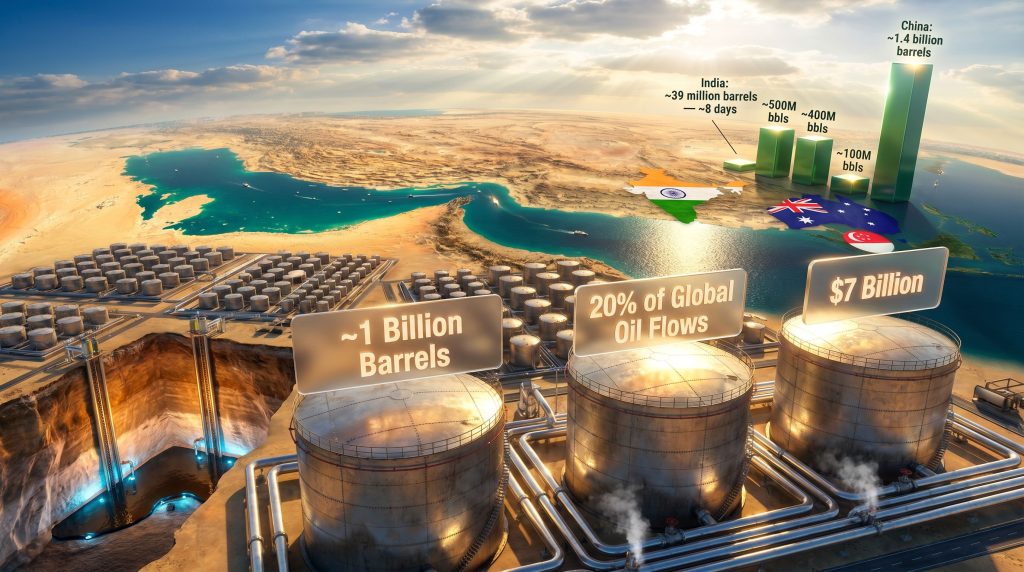
| China | ~1.4 billion barrels (strategic + commercial) | Largest globally |
| United States (SPR) | ~300 million barrels (post-drawdown) | Below historical norms |
| India | ~39 million barrels (5.33 million metric tons) | ~8 days |
| Australia | Below IEA 90-day minimum | Chronically non-compliant |
| IEA Collective | 400 million barrels released | Crisis drawdown event |
India's situation deserves particular attention. As the world's third-largest crude oil importer, holding just eight days of national consumption in strategic storage is not a minor compliance shortfall; it is a structural vulnerability that the Hormuz crisis converted into an acute national security problem. China, by contrast, held approximately 36 times India's strategic reserve volume, a disparity that translated directly into divergent economic outcomes during the disruption.
The U.S. SPR reached its lowest level since 1983 following crisis drawdowns. A critical but underappreciated technical constraint compounds this problem: the U.S. reserve cannot be drawn below approximately 150 million barrels without risking physical damage to the underground salt cavern storage infrastructure that houses it. The floor is not a policy choice; it is an engineering reality.
Simultaneously, crude oil inventory at Cushing, Oklahoma, the designated delivery point for NYMEX WTI futures contracts, fell to approximately 20 million barrels, approaching the operational stress threshold below which physical delivery against futures contracts becomes genuinely difficult. This disconnect between financial market pricing mechanisms and physical crude availability represents one of the less-discussed structural risks the crisis revealed.
The Bypass Route Illusion: Why Pipelines Cannot Replace Hormuz
A common assumption among casual observers is that bypass pipelines offer a meaningful alternative to Strait of Hormuz transit. The reality is more constrained.
Saudi Arabia's East-West Pipeline (Petroline) and the UAE's Abu Dhabi Crude Oil Pipeline to Fujairah were specifically engineered for Hormuz bypass scenarios. However, their combined throughput capacity represents only a fraction of the 10-plus million barrels per day that ordinarily moves through the Strait. Additional constraints compound the problem:
- Terminal capacity at alternative export points cannot scale rapidly to absorb diverted volumes
- Tanker availability at non-Hormuz ports tightened dramatically as vessel operators entered what the market calls dark mode, effectively suspending normal commercial operations amid escalating risk
- Major tanker tenders by international oil companies failed to secure vessels, with freight rates spiking to reflect the concentration of geopolitical risk
- Iraq's emerging Syria oil route, while operationally significant, is subject to transit-nation political complexity that multiplies supply chain uncertainty
Iraq's decision to maintain its Syria oil route even after the tentative Hormuz reopening signals a broader strategic recalibration underway among Gulf producers: permanent infrastructure redundancy, rather than emergency improvisation, is now the planning baseline.
The Global Race to Build Strategic Petroleum Reserves: Country by Country
The strategic petroleum reserves expansion after the Strait of Hormuz crisis is not a uniform policy response. Each nation's approach reflects its specific structural vulnerabilities, fiscal capacity, and geopolitical positioning.
India: Rebuilding From Eight Days of Cover
India's current SPR infrastructure consists of three underground facilities with a combined capacity of 5.33 million metric tons, equivalent to approximately 39 million barrels. Against the IEA's 90-day benchmark, India holds fewer than eight days of cover. The government has directed state-owned Oil and Natural Gas Corporation (ONGC) to design, construct, and fill an entirely new strategic reserve site, with an estimated capital commitment of approximately $1.6 billion.
Notably, India's response extends beyond physical infrastructure. Despite the tentative reopening of the Hormuz passage, India is not rushing to return to its pre-crisis dependence on Middle Eastern crude sourcing. This deliberate hesitation signals a structural preference shift toward supply diversification, with U.S. LPG imports already reaching record highs in the aftermath of the disruption. The policy debate over whether India should seek IEA membership and formally adopt the 90-day coverage obligation has also intensified, though no formal commitment has been announced.
Australia: A Structural Overhaul Worth AUS$10 Billion
Australia's energy security situation during the crisis exposed multiple compounding vulnerabilities simultaneously. In addition, the broader context of Australia's resource and energy export challenges had already flagged these systemic weaknesses well before the Hormuz disruption materialised:
- An IEA member state that has persistently failed to meet the 90-day reserve obligation
- Domestic refining capacity reduced to two operational facilities, one of which was offline due to fire damage during the disruption
- Emergency jet fuel sourced from China as domestic supply chains collapsed
The federal government has committed AUS$10 billion (approximately US$7 billion) to remedying this structural fragility. The programme operates on two parallel tracks:
- A Minimum Stockholding Obligation requiring industry participants to maintain minimum fuel volumes at all times
- The Boosting Australia's Diesel Storage Program, targeted specifically at diesel reserve infrastructure given diesel's centrality to agricultural, mining, and defence logistics
Australia's crisis experience also crystallised an important policy debate that extends well beyond its borders: the difference between holding crude oil in strategic reserves versus holding refined products. Crude storage is cheaper per barrel and offers greater flexibility in theory, but it is only useful if domestic refining capacity exists to convert it into usable fuel under crisis conditions. Australia had the crude import relationships but not the refining throughput to convert supply access into pump-level relief.
Policy Warning: Nations that hold crude-only strategic reserves but lack domestic refining capacity face a critical conversion bottleneck during supply crises. Australia's emergency jet fuel sourcing from China during the Hormuz disruption illustrates this vulnerability directly. Future reserve design must account for the full crude-to-product supply chain, not just upstream storage volume.
Singapore: Underground Expansion at a Land-Constrained Hub
Singapore occupies a unique position in global energy markets as both a major oil trading hub and one of the world's most land-constrained urban environments. In April 2026, Minister Tan See Leng announced that Singapore would explore additional underground spaces to expand national fuel reserves. The engineering challenge of expanding storage beneath a densely built city-state is non-trivial, but Singapore's role as a regional fuel distribution node means its reserve levels affect supply chain stability across the entire Southeast Asian region.
Pakistan: Hosting Gulf Producer Reserves at Gwadar
Pakistan's approach is structurally distinct from every other nation in this expansion wave. Rather than building its own government-funded reserves, Pakistan is inviting Persian Gulf oil producers to establish crude storage buffers within Pakistani territory at a planned Energy City near Gwadar Port. Under the terms being discussed, Pakistan retains first-access rights to those stored volumes in declared national emergencies.
This model is geopolitically layered. The China-Pakistan Economic Corridor (CPEC) infrastructure context makes Gwadar a node of strategic interest to multiple regional powers simultaneously. Whether Gulf producers will commit capital to store crude in Pakistan under these terms remains an open question, but the framework itself represents an innovative alternative to conventional state-funded SPR construction.
Saudi Arabia: The Producer-Side Storage Logic
Aramco Chairman Yasir Al-Rumayyan publicly confirmed that Saudi Arabia is seriously considering expanding its global storage facilities, noting that the company already operates storage assets predominantly concentrated across Asia. The strategic rationale is distinct from an importer's reserve-building logic.
For an exporter, pre-positioning crude in key consumer markets achieves two objectives simultaneously: it maintains market access when future chokepoint disruptions prevent export, and it stabilises prices by ensuring supply is available near demand centres before a crisis fully develops. Producer-side storage and importer-side reserves are not competing strategies; they are complementary layers of the same global resilience architecture.
Quantifying the Storage-Driven Demand Wave
The conventional framework for forecasting oil demand focuses almost entirely on consumption: industrial output, vehicle miles travelled, aviation fuel burn, petrochemical feedstock requirements. The post-Hormuz storage expansion wave introduces a demand category that sits entirely outside this framework.
According to Reuters calculations cited in reporting by OilPrice.com, the combined storage needs across new capacity building, IEA member replenishment, and broader inventory rebuilding could total approximately 1 billion barrels over a multi-year horizon.
| Demand Driver | Volume Estimate | Timeline |
|---|---|---|
| New strategic capacity filling (India, Australia, Singapore, Pakistan) | ~500 million barrels | 2027-2030 |
| IEA coordinated SPR replenishment | ~400 million barrels | 2026-2027 |
| Global inventory rebuild (summer drawdown reversal) | ~100+ million barrels | 2026 |
| Total Estimated Storage Demand | ~1 billion barrels | 2026-2030 |
This demand is not sensitive to consumption forecasts or electric vehicle penetration rates. It will materialise as infrastructure is commissioned and policy mandates take effect, creating a structural price floor beneath oil markets for years regardless of how demand trends evolve on the consumption side.
The phasing matters for investors and energy planners:
- Near-term (2026-2027): U.S. SPR replenishment targeting roughly 200 million barrels; Japan and other IEA members begin replacing coordinated release volumes
- Medium-term (2027-2029): India's ONGC facility construction and filling; Australia's diesel storage infrastructure commissioning
- Longer-term (2029+): Singapore's underground expansion; Pakistan's Gwadar Energy City; Saudi Aramco's expanded global storage network
The next major ASX story will hit our subscribers first
The ASEAN Reckoning and the Case for Regional Reserve Frameworks
Southeast Asian economies sit at the intersection of maximum structural exposure and minimum reserve preparedness. High import dependency, limited domestic production, and underdeveloped strategic stockpile infrastructure made ASEAN nations among the most acutely affected by the Hormuz disruption. Consequently, the LNG supply implications for the region have also sharpened the urgency of building more robust energy reserves across ASEAN capitals.
Policy conversations are now accelerating across ASEAN capitals around three potential responses:
- Regional emergency fuel-sharing mechanisms analogous to the IEA's coordinated release framework
- Joint storage facility development to pool infrastructure investment across smaller economies
- Coordinated reserve standards establishing minimum coverage benchmarks across member states
The IEA model itself, built around the 90-day coverage requirement and coordinated release protocols, was designed for a group of largely Western, high-income economies. Applying that architecture to the diverse economic realities of ASEAN nations requires adaptation, but the Hormuz crisis has made the absence of any such framework impossible to ignore.
China's reserve asymmetry relative to its regional neighbours introduces an additional geopolitical dimension. Holding approximately 1.4 billion barrels of combined strategic and commercial stocks, China absorbed the Hormuz disruption with far less immediate market exposure than India or Australia. That buffer, accumulated over years of deliberate reserve-building, functioned as genuine strategic leverage during the crisis, and other regional powers are now drawing the obvious conclusion.
What the Storage Expansion Wave Means for Oil Market Dynamics
The post-Hormuz storage expansion wave introduces a demand category that sits entirely outside traditional consumption frameworks. Furthermore, the trade war effects on oil markets have added an additional layer of complexity to an already volatile pricing environment, making reserve adequacy an even more pressing strategic concern.
Storage filling is non-discretionary once policy mandates are enacted. It does not respond to high prices by delaying purchases in the way consumption demand might. It does not decline when economic growth slows. It is driven by security imperatives, policy timelines, and infrastructure commissioning schedules. This makes it a uniquely durable source of oil market support.
For market participants, the key analytical implication is that the physical oil market will absorb incremental storage-filling demand progressively through the late 2020s, even as the consumption outlook remains uncertain. Nations that failed to maintain adequate reserves before the crisis are now legally and politically committed to closing that gap, and those commitments translate directly into barrel demand. The strategic petroleum reserves expansion after the Strait of Hormuz crisis will therefore act as a persistent structural force shaping supply and price dynamics well into the next decade.
Disclaimer: This article is intended for informational purposes only and does not constitute financial or investment advice. Oil market forecasts, reserve volume estimates, and price projections involve significant uncertainty and should not be relied upon as the basis for investment decisions. All figures and timelines referenced reflect publicly available reporting and analysis as of mid-2026 and are subject to revision as conditions evolve.
Frequently Asked Questions: Strategic Petroleum Reserves After the Hormuz Crisis
What triggered the global strategic petroleum reserve expansion debate?
The closure of the Strait of Hormuz, which ordinarily handles roughly 20% of global oil flows, stranded more than 10 million barrels per day of crude in the Persian Gulf. The resulting supply shock depleted existing reserves faster than policymakers had modelled, triggering a structural reassessment of reserve adequacy across import-dependent nations. The Asian nations facing LNG and tariff pressures were among the first to escalate their reserve-building commitments in response.
How much oil is needed to fill new strategic reserve capacity globally?
According to Reuters calculations, filling new storage capacity across India, Australia, Singapore, Pakistan, and other nations, combined with IEA member replenishment obligations and broader inventory rebuilding, could require approximately 1 billion barrels of crude and refined products over a multi-year period.
Why is India's strategic reserve considered inadequate?
India's current SPR capacity holds approximately 39 million barrels, equivalent to roughly eight days of national consumption. The IEA benchmark requires 90 days of import coverage. As the world's third-largest crude importer, this gap represents a significant national energy security vulnerability.
What is Australia doing to improve its fuel security?
Australia has committed AUS$10 billion (approximately US$7 billion) to building domestic fuel stockpiles through a minimum stockholding obligation for industry and a dedicated diesel storage infrastructure programme. The crisis exposed Australia's dependence on imported refined products and the fragility of its two-refinery domestic processing base.
Can alternative pipelines replace the Strait of Hormuz?
No. While Saudi Arabia's East-West Pipeline and the UAE's Fujairah bypass pipeline provide partial rerouting capacity, their combined throughput cannot substitute for the 10-plus million barrels per day that ordinarily transit the Strait. Alternative routing provides relief at the margins but cannot offset a full closure at scale. The Strait of Hormuz and global oil markets analysis from the Brookings Institution provides a comprehensive breakdown of precisely why this chokepoint remains irreplaceable in the current infrastructure landscape.
Why is Saudi Arabia expanding its own storage capacity if it is an exporter?
Saudi Aramco's consideration of expanded global storage reflects a producer-side strategy: by pre-positioning crude in key consumer markets, Saudi Arabia can maintain market access and price stability during future chokepoint disruptions, reducing the risk that buyers are permanently redirected to alternative suppliers. In this way, the strategic petroleum reserves expansion after the Strait of Hormuz crisis benefits producers and importers alike, reinforcing a more resilient global energy system for all participants.
Want to Stay Ahead of the Next Major Commodity Shift?
The Hormuz crisis has fundamentally reshaped energy security economics, and the ripple effects across oil, gas, and resource markets create precisely the kind of high-conviction investment landscape where Discovery Alert's proprietary Discovery IQ model delivers its sharpest edge — scanning ASX announcements in real time to surface actionable mineral discovery opportunities before the broader market reacts. Explore how historic discoveries have generated substantial returns and begin your 14-day free trial to position yourself ahead of the next major market move.