June 19, 2026
When Supply Chain Paperwork Moves Markets: The Hidden Fragility of Global Bullion Trade
Precious metals investors spend considerable energy analysing central bank policy, geopolitical risk, and currency dynamics. Far less attention flows toward the administrative plumbing that keeps physical bullion moving across borders. Yet in early 2026, a regulatory timing gap in one of the world's most consequential commodity import markets demonstrated, with striking clarity, that bureaucratic process failures can produce market consequences structurally indistinguishable from deliberate trade restrictions.
Understanding what happened in India during the weeks spanning late March and mid-April 2026, and why it matters for anyone tracking the India bullion import freeze and gold silver prices, requires looking first at the mechanics of how physical metal actually reaches consumers, and what happens when that mechanism stalls.
When big ASX news breaks, our subscribers know first
India's Structural Role in Global Precious Metals Demand
To appreciate the market significance of any disruption to Indian bullion flows, the starting point is India's position within the global precious metals demand architecture. India ranks as the world's second-largest consumer of gold and holds the distinction of being the single largest buyer of silver on a global basis. Unlike major gold-consuming nations that maintain domestic production capable of offsetting some import dependence, India sources virtually all of its precious metals demand from external suppliers, making its import infrastructure a critical node in the global supply chain.
This near-total import dependency creates a structural characteristic that distinguishes India from other large commodity consumers: any disruption to the regulatory authorisation framework governing imports immediately translates into a physical supply constraint rather than simply a demand-side shift. There is no meaningful domestic buffer to absorb the gap.
India's demand profile adds additional complexity. Furthermore, silver supply deficits have been a persistent structural concern entering this period:
- Gold consumption is deeply embedded in cultural, religious, and ceremonial practice, generating relatively inelastic seasonal demand
- Silver demand spans both investment and industrial applications, including electronics, solar panels, and traditional silverware
- Price sensitivity is high, meaning elevated domestic premiums can suppress discretionary purchases even when underlying demand intent remains strong
- The rural economy represents a significant portion of gold demand, with savings-oriented gold buying serving as a de facto financial instrument for households with limited banking access
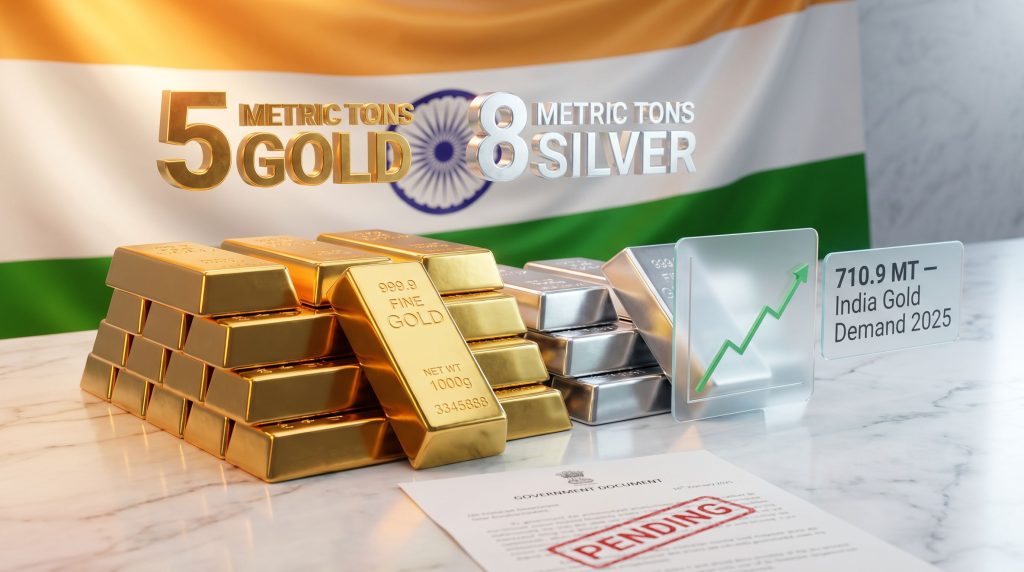
Against this backdrop, it is also important to note that Indian gold demand had already been under pressure entering 2026. According to World Gold Council data, India's gold consumption declined to approximately 710.9 metric tons in 2025, the lowest level recorded in five years. Elevated domestic prices and shifting consumer behaviour were cited as contributing factors, meaning the import freeze compounded a demand environment that was already softening rather than interrupting a period of robust growth.
The Administrative Gap That Stopped Bullion Flowing
India's bullion import system operates through a framework of authorised importers, with the Directorate General of Foreign Trade (DGFT), operating under the Ministry of Commerce and Industry, responsible for issuing and renewing lists of banks approved to conduct precious metals imports. This authorisation list is renewed on an annual basis aligned with the Indian fiscal year.
The disruption that emerged in 2026 was not the product of deliberate trade policy. Rather, it arose from a timing mismatch: the previous fiscal year's authorisation list expired on 31 March 2026, and the DGFT did not release an updated list of authorised importers immediately thereafter. This created a regulatory vacuum during which Indian banks, operating under uncertainty about their import authorisation status, elected to suspend new bullion import orders rather than proceed without confirmed clearance.
The practical result was measurable and swift. According to Reuters reporting on the import standstill, approximately 5 metric tons of gold and 8 metric tons of silver accumulated at Indian customs facilities, held pending the formal issuance of new import authorisations. The standstill lasted an estimated 17 days, with around 18 banks formally reauthorised in the period around 17 April 2026.
It is worth noting a discrepancy between sources covering this event. While the DGFT-linked timeline suggests approximately 17 days of disruption, some market commentary referenced a significantly longer disruption period of approximately five weeks. Readers should treat both figures as subject to further verification against official DGFT documentation and customs data. This distinction matters because the duration of the freeze has direct bearing on the severity of its physical supply impact.
The critical insight here is institutional in nature. Banks operating within a regulatory framework designed to minimise import compliance risk will almost universally choose inaction over proceeding under legal uncertainty. Even a brief administrative gap is sufficient to freeze import activity entirely, because the downside risk of unauthorised imports vastly outweighs the commercial cost of a temporary pause.
How Physical Premiums Become the Market's Early Warning System
When import supply contracts sharply against a backdrop of existing domestic demand, the first and most visible market response is the escalation of physical premiums. In precious metals markets, a physical premium represents the differential between the price paid for metal in the domestic market and the prevailing international spot price. Under normal operating conditions, this premium reflects legitimate costs such as shipping, insurance, customs duties, and dealer margins.
When import authorisation freezes, that premium structure breaks down. Domestic supply tightens faster than demand responds, and buyers willing to pay above the international spot price signal the scale of the physical shortage. For market participants tracking conditions in real time, rising domestic gold and silver premiums in India serve as a leading indicator of supply stress, often preceding broader price movements in international spot markets.
| Market Signal | Normal Operating Conditions | During Import Authorisation Freeze |
|---|---|---|
| Domestic Gold Premium | Low to moderate above spot | Sharply elevated |
| Silver Physical Availability | Adequate for demand | Constrained, selective |
| Bank Import Order Activity | Active and ongoing | Suspended pending clearance |
| ETF Metal Redemptions | Minimal, routine | Rising as offset mechanism |
| Customs Metal Inventory | Clearing regularly | Accumulating in backlog |
Reports during the 2026 disruption indicated that some Indian market participants turned to exchange-traded fund metal holdings as a partial workaround, redeeming ETF units to access physical metal and compensate for the absence of fresh imports. This ETF-to-physical conversion mechanism functions as a short-term pressure valve but carries inherent limitations at scale.
The aggregate metal holdings within Indian precious metals ETFs represent a fraction of normal weekly import volumes, meaning this workaround can bridge days of disruption rather than weeks. Once ETF metal reserves are drawn down, domestic supply stress intensifies further without any alternative relief mechanism readily available.
The Macroeconomic Context Behind India's Import Vulnerability
India's administrative import freeze did not occur in isolation. Several structural macroeconomic pressures were operating simultaneously, and together they help explain both why the disruption had the market impact it did and why the risk of more deliberate import management in the future deserves serious attention from precious metals investors.
Currency and trade deficit dynamics play a central role. Precious metals imports represent one of the most significant contributors to India's current account deficit. During periods when the Indian rupee comes under depreciation pressure, the cost of import-heavy categories including gold and silver rises in local currency terms, which simultaneously increases the trade deficit impact of those flows. Entering 2026, the rupee was performing among the weaker currencies across the Asian region, adding fiscal sensitivity to the timing of bullion imports.
Energy import cost pressures represent a second dimension. Elevated global energy prices, amplified by geopolitical tensions in commodity-producing regions, significantly increase India's overall import expenditure. When the foreign exchange cost of energy imports rises, governments and central banks managing currency reserves face implicit tradeoffs around discretionary import categories. Precious metals, while culturally important, lack the non-discretionary character of energy supply, making them a category where administrative friction can be tolerated, or even tacitly welcomed, during periods of external pressure. In addition, central bank gold and silver trends have been a persistent driver of global demand, adding further complexity to how institutional actors respond to supply constraints.
This creates a dynamic that precious metals investors should factor into their risk frameworks:
- A genuine administrative delay and a more deliberate, policy-motivated slowdown can produce identical near-term market effects
- India has clear structural incentives to periodically manage its bullion import pace without formal prohibition
- Distinguishing between accidental and intentional disruption is difficult in real time and may only become clear retrospectively
- The precedent of import freezes, even administrative ones, normalises temporary supply disruptions as a market variable
Silver's Particular Vulnerability to Indian Supply Disruptions
While the gold market is most frequently referenced in discussions of Indian precious metals demand, the silver dimension of the 2026 import freeze deserves focused attention. India's position as the world's largest single buyer of silver creates asymmetric sensitivity in global silver markets that does not have a precise parallel in gold.
Silver operates simultaneously as a monetary metal, a store of value, and an industrial input. Its applications in photovoltaic solar cells, consumer electronics, electrical contacts, and medical equipment mean that disruptions to Indian import flows interact with both the monetary and industrial demand components of the global market. A freeze that reduces India's silver import pace creates measurable tightening of available physical inventory at the global level, because no other single buyer can absorb the volume that India represents.
Furthermore, silver's market depth is considerably shallower than gold's, meaning physical supply disruptions translate into price volatility more rapidly and with greater magnitude. The 8 metric tons of silver accumulating at Indian customs during the 2026 freeze represented not just an Indian supply problem but a visible reduction in global silver market throughput. Monitoring the gold-silver ratio analysis during periods like this provides valuable context for understanding relative price stress between the two metals.
India's outsized share of global silver demand means that even administratively driven, short-duration freezes create measurable inventory effects that ripple across international spot and futures markets. Silver investors monitoring Indian import authorisation cycles are, in effect, watching one of the most powerful physical demand signals available in the global metals complex.
The next major ASX story will hit our subscribers first
Scenario Pathways: What Resolution and Escalation Both Mean for Prices
The trajectory of gold and silver prices following a supply disruption of this nature depends heavily on how quickly and completely the import mechanism normalises, and whether administrative delays evolve into more deliberate policy instruments.
| Scenario | Key Trigger Conditions | Gold Price Implication | Silver Price Implication |
|---|---|---|---|
| Rapid Normalisation | Full bank reauthorisation, imports resume at or above prior pace | Short-term premium compression, modest price consolidation | Partial reversal of freeze-related price support |
| Prolonged Administrative Delay | Additional procedural hurdles, partial reauthorisation only | Sustained domestic premium elevation, continued spot price support | Acute physical tightness, sharper price floor formation |
| Deliberate Policy Restriction | Freeze evolves into formal import quota or restriction | Strong bullish catalyst for international gold prices | Potential for significant price dislocation given India's market share |
Please note: These scenario projections represent analytical frameworks for understanding potential market pathways and should not be construed as investment advice or price forecasts. Precious metals markets are subject to numerous interacting variables, and outcomes may differ materially from any scenario outlined above.
The Just-in-Time Problem: Why Bullion Supply Chains Lack Resilience
One of the less-discussed structural vulnerabilities revealed by the India bullion import freeze and gold silver prices dynamic is the extent to which modern bullion supply chains have been optimised for efficiency at the expense of resilience. The logic of just-in-time commodity delivery, borrowed from manufacturing sector practice, reduces the carrying costs of maintaining buffer inventories but eliminates the buffers that absorb disruption.
When a major demand node such as India experiences even a brief regulatory interruption, the absence of meaningful inventory buffers at intermediate points in the supply chain means the disruption transmits rapidly to both domestic premiums and international pricing. There is no warehouse of pre-cleared metal waiting to bridge the gap. Consequently, the supply chain behaves as though the disruption were structural because, functionally, it is.
This has practical implications for different categories of market participant. Precious metals market disruptions of this kind affect each participant type differently:
- Physical bullion dealers and refiners face immediate margin pressure as domestic premiums rise faster than their inventory was priced
- ETF operators experience redemption pressure from market participants seeking to access physical metal outside normal import channels
- Futures market participants must recalibrate basis relationships between physical premiums and paper price contracts
- Central banks and large institutional holders face mark-to-market effects as spot prices respond to physical supply stress
- Retail investors encounter wider bid-ask spreads and reduced product availability from local dealers
Historical precedent from prior Indian import disruptions, including the significant import duty increases and gold control measures implemented in 2013 that contributed to gold smuggling increases, demonstrates that India-driven supply chain interruptions can generate durable changes in market structure, not just temporary price spikes.
What Investors and Market Participants Should Track
Near-Term Monitoring Priorities
For those actively tracking the relationship between the India bullion import freeze and gold silver prices, the most actionable real-time signals include:
- Domestic gold and silver premiums in Indian markets relative to London and New York spot prices
- Volume of metal cleared from customs following DGFT reauthorisation, as a measure of backlog absorption pace
- Indian ETF redemption data as an indicator of physical supply stress continuing beyond official reauthorisation
- DGFT official announcements regarding any changes to the authorised importer list structure or annual renewal timeline
As Business Standard reported on the ongoing standstill, the disruption threatened broader supply stability beyond the immediate customs backlog, underlining the importance of monitoring official reauthorisation progress closely.
Medium-Term Strategic Considerations
Beyond the immediate disruption, several structural factors warrant ongoing attention:
- Whether India's trade deficit trajectory and currency management pressures create conditions for more explicit import management policies targeting bullion
- The interaction between Indian demand recovery and global central bank gold accumulation, which has been a persistent structural demand driver
- Silver's growing industrial demand from renewable energy deployment, which increases the global cost of any disruption to Indian silver flows
- Whether the DGFT reauthorisation process is modified to eliminate the annual expiry gap that created the 2026 disruption
The 2026 India bullion import freeze ultimately serves as a case study in a form of market risk that receives insufficient attention in conventional precious metals analysis. Physical supply chain integrity, including the regulatory and administrative frameworks governing import authorisation in major demand nations, represents a source of market volatility that operates independently of macroeconomic data, monetary policy, and geopolitical sentiment. However, gold in volatile markets has consistently demonstrated its capacity to respond sharply to physical supply disruptions, reinforcing why that administrative layer warrants dedicated and ongoing monitoring.
Want to Stay Ahead of the Next Precious Metals Market Disruption?
Discovery Alert's proprietary Discovery IQ model delivers real-time alerts on significant ASX mineral discoveries — including those tied to gold and silver — transforming complex market signals into actionable investment insights the moment they emerge. Explore historic discoveries and their market returns to understand the scale of opportunity that informed positioning can unlock, and begin your 14-day free trial at Discovery Alert to ensure you're never on the wrong side of the next major market shift.