
July 1, 2026
The Chemistry Problem at the Heart of Industrial Decarbonisation
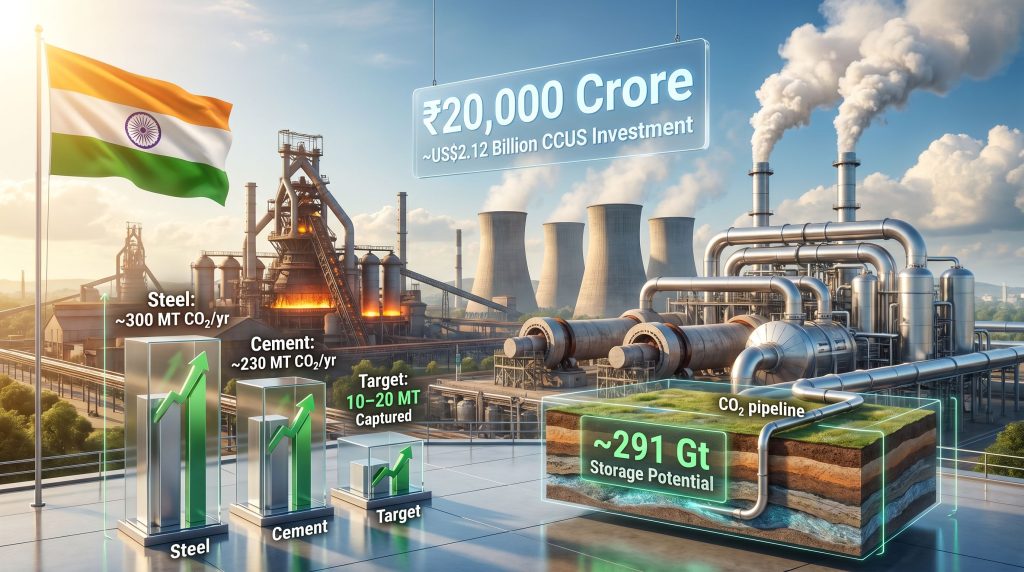
Every tonne of cement produced anywhere in the world releases carbon dioxide not because of how it is made, but because of what it is made from. When limestone is heated to produce the calcium oxide that forms the basis of clinker, the chemical reaction itself liberates CO₂ locked inside the rock for millions of years. No solar panel, wind turbine, or battery storage system changes that equation. This is the structural problem sitting beneath India's industrial emissions challenge, and it explains why the country's ₹20,000 crore India carbon capture investment, equivalent to roughly US$2.12 billion, is not simply a policy gesture but a technical necessity.
Understanding the distinction between energy emissions and process emissions is the starting point for evaluating whether this commitment can deliver on its ambitions.
When big ASX news breaks, our subscribers know first
Why Electrification Cannot Solve India's Industrial Emissions Problem
The global energy transition narrative is built on a compelling premise: replace fossil fuel combustion with clean electricity, and emissions fall. This logic works well for power generation, road transport, and heating. It breaks down, however, in cement kilns, steel blast furnaces, and chemical processing facilities.
The calcination reaction in cement production converts calcium carbonate (CaCO₃) into calcium oxide (CaO), releasing CO₂ as an unavoidable chemical byproduct. According to Chemistry World, approximately 50 to 55% of cement's total CO₂ emissions originate from this process, with fuel combustion accounting for only 30 to 35%. Electrifying the kiln with renewable power addresses the combustion fraction but leaves the majority of emissions entirely intact.
Steel production faces a parallel structural barrier. Blast furnace ironmaking requires a reducing agent to strip oxygen from iron ore, a role traditionally filled by coke derived from metallurgical coal. The chemistry of iron oxide reduction generates CO₂ regardless of the energy source powering the facility. Consequently, even a steel mill running on 100% renewable electricity through electric arc furnaces still faces process-emission challenges when producing primary steel from raw ore rather than scrap.
These are the sectors that define India's hard-to-abate emissions challenge:
- Steel production generates approximately 300 million tonnes (MT) of CO₂ annually, representing around 33% of India's industrial emissions, according to the Council on Energy, Environment and Water (CEEW)
- Cement production generates approximately 230 MT of CO₂ annually, accounting for roughly 25% of industrial emissions (CEEW)
- Combined, steel and cement contribute 19% of India's total national greenhouse gas emissions and 53% of all industrial sector emissions
- Over 90% of energy inputs across both industries currently derive from coal, petroleum coke, and other fossil fuel sources
- Demand projections from the Energy and Resources Institute (TERI) and the World Business Council for Sustainable Development (WBCSD) indicate steel and cement demand could grow three to four times by 2050
Without intervention, emissions from these two sectors alone could nearly triple by mid-century. The International Energy Agency (IEA) identifies CCUS as a critical and largely irreplaceable solution for sectors where process emissions are chemically unavoidable at the scale India requires. Furthermore, the critical minerals transition needed to support clean industrial processes makes this investment even more strategically significant.
Breaking Down the ₹20,000 Crore CCUS Commitment
Finance Minister Nirmala Sitharaman's Union Budget 2026-27 announcement earmarked ₹20,000 crore across five years for Carbon Capture, Utilisation and Storage technologies. This represents India's largest-ever public financial allocation to CCUS, and notably includes US$55 million in dedicated revenue expenditure for fiscal year 2026-27 as a newly created budget line with no historical precedent in Indian fiscal planning.
The strategic intent is clearly defined: bridge the gap between laboratory-scale pilots and commercially viable industrial deployment. The roadmap, which aligns with India's national CCUS strategy released in December 2025, is structured across three distinct phases:
| Phase | Timeline | Strategic Focus |
|---|---|---|
| Phase 1 | 2025–2030 | Research, pilot projects, technology validation |
| Phase 2 | 2030–2035 | Industrial integration, regulatory framework development |
| Phase 3 | 2035–2045 | Full commercial-scale deployment and capacity expansion |
The five target sectors receiving investment attention span the full breadth of India's industrial carbon intensity:
| Sector | Core Emissions Challenge | Strategic Importance |
|---|---|---|
| Steel | Blast furnace process emissions, coal dependency | Core infrastructure driver |
| Cement | Calcination releases CO₂ regardless of fuel type | Construction and urbanisation backbone |
| Power | Coal-heavy generation mix, high-volume point sources | National grid backbone |
| Refining | Complex emission streams across refinery units | Domestic petroleum demand |
| Chemicals | Process and feedstock emissions | Industrial inputs and exports |
Near-term capacity projections from energy consultancy M N Dastur, cited in Business Standard, estimate that deployment could reach 10 to 15 MT of CO₂ captured annually within five years, with an optimistic scenario of up to 20 MT under efficient execution conditions.
India's Carbon Storage Geology: A Largely Untested Asset
One dimension of India's CCUS strategy that receives insufficient attention in mainstream coverage is the country's underground storage potential. The geological architecture beneath India contains several formation types capable of long-term CO₂ sequestration, though all current capacity figures remain preliminary estimates requiring rigorous site-level validation before any commercial injection programmes can proceed.
| Storage Formation | Estimated Capacity | Key Characteristics |
|---|---|---|
| Deep saline aquifers | ~291 gigatonnes (Gt) | Largest identified storage option; widespread distribution |
| Basalt formations | 97–316 Gt | Wide range reflects significant geological uncertainty |
| Coal reservoirs | 3.5–6.3 Gt | Dual-benefit pathway via coalbed methane recovery |
| Oil fields (CO₂-EOR) | ~1.2 Gt | Commercially established in upstream contexts |
Twenty-six offshore saline aquifer sites have been identified as viable storage candidates. The extraordinarily wide range in basalt formation estimates (97 to 316 Gt) reflects a critical knowledge gap: India's subsurface characterisation remains incomplete, and theoretical geological capacity should not be conflated with confirmed operational storage availability.
Important Caveat for Readers: All storage capacity estimates in India's CCUS roadmap are preliminary geological assessments. Converting theoretical storage potential into operational injection sites requires site-specific geological surveys, structural integrity assessments, and regulatory approvals. The gap between estimated and confirmed capacity can be substantial, as demonstrated by early storage assessments in other CCUS programmes globally.
The distinction between storage and utilisation also matters here. CO₂ utilisation pathways offer a commercially attractive complement to geological storage:
- Enhanced oil recovery (EOR): Using injected CO₂ to improve oil field yields, creating a revenue offset against capture costs
- Chemical conversion: CO₂ as a feedstock for methanol, ethanol, and polymer synthesis
- Building material mineralisation: CO₂ reacted into concrete and construction aggregates, permanently mineralising the carbon while strengthening the material
- Fuel synthesis: Power-to-X pathways converting captured CO₂ into synthetic fuels
These utilisation routes are strategically important because they can partially offset the high unit costs of capture, improving overall project economics without requiring immediate access to certified geological storage sites.
How India Compares to Global CCUS Momentum
India's India carbon capture investment arrives at a moment of accelerating global momentum in the CCUS sector. According to the IEA, global CCUS investment increased more than 15 times between 2020 and 2025, surpassing $5 billion in annual investment in 2025. Global operational capacity currently stands at approximately 50 MT per year, with projections indicating this will nearly double by 2030.
Over $27 billion in CCUS projects are currently in advanced planning stages globally, representing nearly double the cumulative investment in all CCUS projects recorded since 2010. More than 30 final investment decisions (FIDs) were reached in the past two years alone, a signal that private sector confidence in large-scale CCUS viability is transitioning from cautious interest to active commitment.
India's planned expansion of 10 to 20 MT annually over five years would represent 20 to 40% of today's entire global operational CCUS capacity, a substantial contribution that would nonetheless keep India in an early-stage deployment position relative to the scale ultimately required.
India's domestic CCUS activity is still largely at the pilot stage. Indian Oil Corporation Limited (IOCL) launched a CCUS facility at the Gandhar oil field in January 2026, and industrial-scale capture is planned for the Koyali refinery in Gujarat. State-owned energy companies including ONGC, HPCL, and BPCL are progressing CCUS integration into their upstream and downstream operations. In addition, India's membership in the Asia CCUS Network provides access to regional knowledge-sharing and technology transfer frameworks that can accelerate the learning curve for domestic deployment.
The Unit Economics of Scaling Carbon Capture in India
The financial calculus of CCUS deployment in India reveals both the ambition and the constraints of the ₹20,000 crore commitment. Current estimates place the cost of capturing 1 MT of CO₂ per year at between ₹900 crore and ₹1,000 crore (approximately US$95 to US$106 million at current exchange rates).
Scaling this to a 10 MT annual capacity would require approximately ₹15,000 crore in capital deployment, broadly consistent with the government's planned allocation when accounting for the remaining balance supporting regulatory infrastructure, R&D investment, and viability gap funding for early commercial projects.
A frequently raised counterpoint concerns opportunity cost. Analysis cited in Telangana Today notes that the same ₹20,000 crore allocation could alternatively fund 10 to 15 GW of utility-scale solar capacity, alongside large-scale energy efficiency programmes. Solar costs in India have declined sharply, with utility-scale projects frequently priced below ₹40 crore per MW. The broader discussion around renewable mining solutions illustrates how clean energy integration is already reshaping industrial economics across related sectors.
| Decarbonisation Pathway | Estimated Cost (India) | Applicable Sectors | Key Limitation |
|---|---|---|---|
| CCUS (10 MT capacity) | Steel, cement, chemicals, refining | High unit cost, early-stage maturity | |
| Utility-scale solar (10–15 GW) | Below ₹40 crore per MW | Power generation | Cannot address process emissions |
| Energy efficiency upgrades | Variable by facility | Cross-sector | Limited total abatement ceiling |
The critical analytical point this comparison misses is sector applicability. Solar deployment decarbonises electricity generation. CCUS targets the chemical and thermal process emissions that solar cannot reach. The two technologies are not substitutes; they address structurally different emission sources. The genuine debate is about the sequencing and proportionality of investment, not a binary choice between renewables and CCUS.
The next major ASX story will hit our subscribers first
The EU Carbon Border Adjustment Mechanism as a Commercial Forcing Function
Beyond domestic climate policy, the India carbon capture investment is being shaped by an external trade pressure mechanism that creates a direct financial penalty for inaction. The European Union's Carbon Border Adjustment Mechanism (CBAM) places carbon-equivalent import tariffs on goods based on their embedded emissions content, with steel, cement, and chemicals among the primary covered sectors.
For Indian industrial exporters, this creates a commercially consequential choice:
- Reduce embedded carbon intensity through CCUS or alternative abatement technologies, maintaining price competitiveness in European markets
- Absorb escalating CBAM charges as the mechanism's carbon price reference increases through 2030, eroding margins on EU-bound exports
- Redirect export strategy away from European markets, sacrificing access to one of the world's largest and highest-value industrial goods markets
CCUS is one of the few available technologies that can directly and measurably reduce embedded carbon in industrial goods without halting or restructuring production. A steel producer deploying CCUS at the blast furnace level can quantify and certify the CO₂ reduction per tonne of output, providing the verification data that CBAM compliance requires. Furthermore, green steel pricing dynamics are already influencing how Indian producers position themselves for European market access.
This trade-linked commercial incentive structure creates a market-driven demand for CCUS adoption that operates alongside public funding signals, potentially accelerating private sector co-investment in ways that public policy alone cannot guarantee.
The Case For and Against India's CCUS Investment
Honest analysis requires acknowledging that India's CCUS commitment attracts both compelling support and substantive criticism from credible voices across the policy, engineering, and economics communities.
The Strategic Rationale
- Process emission necessity: No commercially scalable alternative currently exists for calcination-derived cement emissions or blast furnace steel emissions at the volume India requires
- CBAM compliance: Export competitiveness in European markets demands embedded carbon reduction, not just energy decarbonisation
- Net-zero pathway requirement: India's 2070 net-zero target requires deep emissions cuts across all sectors simultaneously, including heavy industry
- Long-horizon capacity building: NITI Aayog has proposed a 750 MT per year CCUS capacity target by 2050, requiring an estimated US$100 to US$150 billion in total investment; seed-stage public funding is essential to catalyse the private capital flows that would fund this trajectory
- Carbon credit monetisation: India's developing Carbon Credit Trading Scheme could allow verified captured CO₂ to generate tradeable credits, creating a revenue mechanism for project operators and improving long-run investment economics
The Legitimate Concerns
- Carbon lock-in risk: Sustained public investment in CCUS for fossil-fuel-dependent industries may reduce economic and political pressure to accelerate the transition to genuinely clean production alternatives, potentially extending the operational lifespan of coal-dependent infrastructure
- Technology maturity uncertainty: Most large-scale CCUS projects globally remain in early commercial phases; long-term storage permanence and cost reduction trajectories carry meaningful uncertainty
- Opportunity cost: The same public capital deployed in renewable energy and industrial electrification could deliver faster, cheaper, and more certain abatement outcomes in the power sector
- Infrastructure deficit: India currently lacks the CO₂ transport pipeline networks, certified storage sites, and comprehensive regulatory frameworks that commercial-scale deployment requires
- Regulatory bottlenecks: Licensing complexity and the absence of a streamlined permitting process for geological storage sites remain unresolved structural barriers that funding alone cannot resolve
Notably, India's commitment of ₹20,000 crore to carbon capture has attracted significant international commentary, with analysts debating whether the phased approach is appropriately calibrated to the urgency of industrial abatement timelines.
The Policy Architecture India Still Needs to Build
Allocating ₹20,000 crore is a necessary but insufficient condition for CCUS success. The enabling regulatory and institutional infrastructure that transforms funding commitments into operational capture facilities requires parallel development across several dimensions:
- Systematic geological surveys to identify, characterise, and formally certify CO₂ storage basins suitable for commercial injection
- Streamlined and transparent licensing pathways for storage site development that reduce approval timelines without compromising safety standards
- Viability gap funding mechanisms to de-risk early commercial projects and attract private co-investment on commercially acceptable terms
- Integration of CCUS credits into India's Carbon Credit Trading Scheme, establishing a clear revenue pathway for project operators and standardising verification methodologies
- Alignment with the ₹1 lakh crore Research, Development and Innovation (RDI) scheme to channel private sector capital into clean technology development and demonstration
India's broader decarbonisation commitments provide the context within which CCUS must be understood. The mining decarbonisation benefits literature demonstrates how industrial decarbonisation programmes generate economic co-benefits that extend well beyond emissions reduction alone. The Paris Agreement NDC commits India to a 33 to 35% reduction in GDP emission intensity by 2030, with a net-zero by 2070 horizon that makes CCUS a structural necessity rather than an optional supplement within any technically credible decarbonisation pathway.
The broader strategic case for accelerating industrial decarbonisation is further supported by the growing body of research on green transition materials, which highlights how raw material availability will shape the pace and cost of low-carbon industrial transformation globally.
Scenarios That Will Define Success or Failure
The impact of India's CCUS commitment ultimately depends on execution quality, regulatory progress, and private sector engagement over the next two to three years. Three distinct outcomes are plausible:
| Scenario | Annual Capture by 2030 | Key Indicators |
|---|---|---|
| Conservative | 10 MT | Foundational infrastructure built; storage geology validated; investor confidence established |
| Base Case | 15 MT | Meaningful industrial abatement achieved; CBAM compliance support demonstrated for major exporters |
| Optimistic | 20 MT | India emerges as significant CCUS market; international technology partnerships and private capital attracted at scale |
A successful scale-up would demonstrate that a major emerging economy can deploy carbon capture in hard-to-abate industrial sectors without sacrificing economic growth, strengthening India's position in international climate negotiations with concrete technology deployment evidence rather than policy commitments alone. For instance, Forbes analysis of India's CCUS strategy highlights how successful execution could simultaneously advance trade competitiveness and climate credibility on the global stage.
Failure to execute, however, whether through regulatory delays, cost overruns, or storage site validation challenges, would reinforce global scepticism about CCUS viability in developing economies and potentially set back the technology's credibility precisely when its industrial applicability is most urgently needed.
This article contains forward-looking analysis including projections, scenarios, and capacity estimates sourced from third-party consultancies and research institutions. These figures are subject to significant uncertainty and should not be interpreted as confirmed outcomes. Readers conducting investment research or policy analysis are encouraged to consult primary sources including IEA reports, CEEW publications, and official Government of India budget documentation.
Want to Identify the ASX Mineral Discoveries Shaping the Low-Carbon Industrial Revolution?
Discovery Alert's proprietary Discovery IQ model delivers real-time alerts on significant ASX mineral discoveries across the critical commodities underpinning industrial decarbonisation — from the raw materials driving CCUS infrastructure to the metals essential for clean steel and cement production. Explore why major mineral discoveries can generate substantial returns and begin your 14-day free trial today to position yourself ahead of the market.