
June 21, 2026
The Hidden Vulnerability Driving India's Most Ambitious Industrial Policy Shift
When global energy supply chains fracture, the consequences for import-dependent economies are rarely abstract. They materialise in fertiliser shortfalls, chemical feedstock shortages, and industrial production disruptions that ripple through food systems and manufacturing alike. For a nation of India's scale, these vulnerabilities carry existential weight. It is precisely this structural exposure that has placed the India coal gasification incentive scheme at the centre of one of the country's most consequential industrial policy transformations in decades.
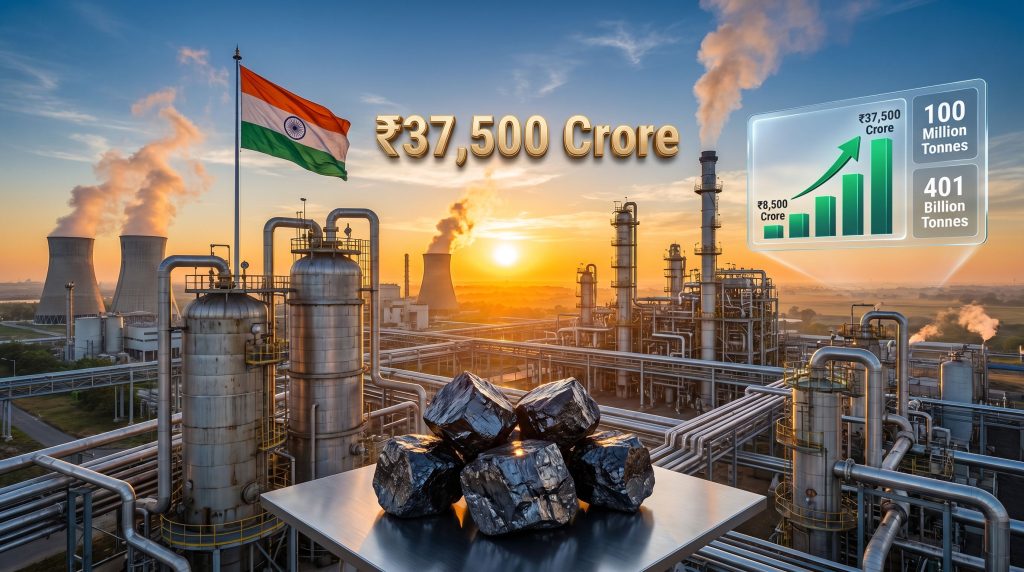
The renewed urgency behind coal gasification policy is not primarily ideological. It is logistical. India's dependence on imported LNG, ammonia, urea, and coking coal derivatives creates a persistent current account liability and a strategic fragility that domestic energy planning has long struggled to resolve. The proposed expansion of India's coal gasification incentive architecture, with a ₹37,500 crore financial outlay awaiting Union Cabinet approval, represents a direct institutional response to that fragility. Understanding the LNG import tax structure further illustrates why gasification has become such a strategic priority.
When big ASX news breaks, our subscribers know first
Why India's Coal Endowment Changes the Decarbonisation Calculus
Most Western energy policy frameworks treat coal as a stranded asset to be phased out as rapidly as the political economy permits. India's policy trajectory diverges from this model in a structurally important way. With approximately 401 billion tonnes of total coal reserves, India possesses one of the largest coal endowments on the planet. Coal currently accounts for over 55% of India's total energy mix, and India holds the position of second-largest coal producer and consumer globally, according to reporting by ET Energy World (May 3, 2026).
This reserve profile changes the strategic calculus entirely. Rather than pursuing rapid fossil fuel retirement, Indian policymakers are focused on a different objective: extracting maximum industrial value from existing reserves through chemical and fuel synthesis pathways rather than simple combustion. The question is not whether to use coal, but how to use it more intelligently.
Coal gasification sits at the intersection of resource utilisation and import substitution. By converting domestic coal into syngas (a mixture primarily of hydrogen and carbon monoxide), India can produce domestically the same suite of chemicals, fertilisers, and fuels it currently spends foreign exchange to import. This is not an environmental pivot. It is a sovereignty play.
Understanding the Original 2024 Scheme: Architecture and Intent
The foundational India coal gasification incentive scheme was approved by the Ministry of Coal on January 24, 2024, with a total financial allocation of ₹8,500 crore. The scheme operated through a three-tier structure designed to accommodate the full range of market participants, from major public sector undertakings to small-scale demonstration plants.
Original Scheme Financial Architecture
| Category | Target Beneficiary | Total Allocation | Max Per Project | Capex Support Cap |
|---|---|---|---|---|
| Category I | Public Sector Undertakings (PSUs) | ₹4,050 crore | ₹1,350 crore | 15% of capex |
| Category II | PSUs + Private Sector | ₹3,850 crore | ₹1,000 crore | 15% of capex |
| Category III | Demonstration / Small-Scale | ₹600 crore | ₹100 crore | 15% of capex |
| Total | ₹8,500 crore |
Beyond direct financial incentives, the scheme embedded several supporting policy levers designed to reduce the overall cost of project development:
- A 50% revenue share rebate on coal allocated specifically for gasification use, directly lowering effective feedstock costs for project developers
- A dedicated "Production of Syngas leading to coal gasification" sub-sector introduced within NRS (Non-Regulated Sector) linkage auctions, creating a formal procurement pathway
- Active joint venture promotion through Coal India Limited, including a flagship ₹20,000 crore CIL-BHEL collaboration in Odisha targeting large-scale syngas production
The 15% capex support ceiling maintained project-level financial discipline while meaningfully improving investment returns. For a ₹10,000 crore gasification project, this translates to ₹1,500 crore in direct incentive support, substantially de-risking early-stage capital deployment.
Round I and Round II: What Early Implementation Reveals
The original scheme's first round selected seven projects, of which three are currently under active implementation. All Round I projects carry a commissioning deadline aligned with India's 2030-31 national target window. The gap between selected and actively implementing projects highlights a pattern that is well-documented in large Indian infrastructure programmes: the administrative, regulatory, and financing processes between project award and ground-breaking frequently consume more time than anticipated.
Round II produced a notable private sector award. According to the Coal Ministry, Kartikay Vayunandana Private Limited received a Letter of Award for a coal-to-acetic acid manufacturing facility in Gadchiroli, Maharashtra, with the following project specifications:
- Capacity: 75,900 tonnes per annum (TPA)
- Project Cost: ₹793 crore
- Category: Category III (demonstration and small-scale)
- Technology Pathway: Coal-derived syngas converted to acetic acid, a globally traded industrial chemical
The Gadchiroli project is instructive precisely because it demonstrates import substitution at the product level rather than the feedstock level. India does not merely avoid importing LNG by building this plant. It builds domestic manufacturing capability in a niche chemical that would otherwise be sourced internationally.
This distinction matters for policy design. Coal gasification's import substitution value extends far beyond energy commodities into the industrial chemical supply chain, with compounding downstream benefits for manufacturing competitiveness.
The V-KALP Expansion: A Fourfold Scaling of Ambition
The proposed expansion scheme, referred to in policy discussions as V-KALP, represents the most significant scaling of India's coal gasification incentive architecture since the programme's inception. According to reporting by ET Energy World citing government sources (May 3, 2026), the Union Cabinet is expected to approve a scheme with a total financial outlay of ₹37,500 crore, and the Ministry of Coal has already prepared the Cabinet note. Furthermore, Cabinet approval is anticipated shortly, reflecting growing institutional momentum behind the programme.
Structural Comparison: Original Scheme vs. Proposed V-KALP
| Parameter | Original 2024 Scheme | Proposed V-KALP Scheme |
|---|---|---|
| Total Financial Outlay | ₹8,500 crore | ₹37,500 crore |
| Scaling Factor | Baseline | 4.4x increase |
| Structure | Three-category tiered model | Unified, no categories |
| Max Incentive Per Project (PSU) | ₹1,350 crore | ₹3,000 crore |
| Max Incentive Per Project (Private) | ₹1,000 crore | ₹3,000 crore |
| Eligibility Design | Category-based screening | Single incentive ceiling |
| Primary Target | Pilot and early commercial scale | Full commercial acceleration |
Two structural changes in V-KALP carry particular strategic significance.
First, the elimination of category divisions. The original scheme's three-tier architecture created meaningful administrative complexity. Projects needed to qualify for specific categories before accessing the relevant incentive pool. The unified structure removes this friction, potentially compressing the time between application and award. This matters enormously for project finance timelines, where lender commitments are often contingent on confirmed incentive status.
Second, the equalisation of PSU and private sector incentive ceilings at ₹3,000 crore. Under the original scheme, PSUs enjoyed a higher per-project maximum (₹1,350 crore) than private sector participants (₹1,000 crore), reflecting a policy preference for state-led deployment. The proposed equalisation signals a deliberate shift toward private sector scale-up, acknowledging that achieving the 100 million tonne national target requires mobilising capital beyond the public sector balance sheet.
Important Note: As of May 3, 2026, the V-KALP scheme had not yet received formal Union Cabinet approval. The scheme parameters discussed in this article are drawn from government sources cited by ET Energy World and should be treated as pre-approval policy details subject to final Cabinet modification.
The Import Substitution Calculus: What Coal Gasification Can Replace
The strategic rationale for scaling the India coal gasification incentive scheme rests on a straightforward arithmetic: syngas derived from domestic coal can substitute for a broad range of imported commodities, reducing both the current account deficit and geopolitical exposure. The broader context of resource and energy exports from supplier nations further underscores the vulnerability India is working to address.
Key Commodities Targeted for Domestic Substitution
| Imported Commodity | Gasification Pathway | Downstream Application |
|---|---|---|
| LNG | Syngas / Substitute Natural Gas (SNG) | Energy feedstock, industrial heat |
| Urea | Ammonia synthesis from syngas hydrogen | Agriculture, fertiliser |
| Ammonium Nitrate | Ammonia-based nitrogen synthesis | Fertiliser, industrial |
| Coking Coal (via DRI) | Syngas-based iron ore reduction | Steel manufacturing |
| Methanol / DME | Direct syngas catalytic conversion | Transport fuel, LPG substitute |
| Ammonia | Hydrogen + nitrogen via Haber-Bosch | Fertiliser, chemical industry |
Aggregate import substitution potential across these commodity categories is estimated at approximately ₹16,000 crore annually at scale, according to industry analysis cited in the policy framework. Recent geopolitical volatility affecting West Asia supply corridors has reinforced the urgency of this substitution agenda, as India's exposure to LNG and hydrocarbon supply disruptions became acutely visible to policymakers and industry stakeholders alike.
The broader framing aligns with India's Atmanirbhar Bharat (self-reliant India) industrial framework and the Viksit Bharat 2047 long-term development agenda, which targets developed-economy status by the centenary of Indian independence.
The next major ASX story will hit our subscribers first
How the Technology Works: From Coal to Chemical Value Chain
Surface vs. Underground Gasification
India's gasification programme encompasses two distinct technological pathways, each with different risk profiles and capital requirements.
Surface Coal Gasification (SCG) is the dominant commercial approach. Coal is processed above ground in purpose-built gasifiers, and the resulting syngas is purified and directed to downstream synthesis facilities. Most Round I and Round II projects operate on this pathway.
Underground Coal Gasification (UCG) is an emerging technology where the gasification reaction occurs within the coal seam itself, without surface mining. This pathway offers potential access to coal reserves that are uneconomic to mine conventionally. Following clarifications issued through September 2025 RFPs, UCG pilot projects have been confirmed as eligible under the incentive framework, broadening the technology base the scheme can support.
The Syngas Value Chain
Syngas (H₂ + CO) is an extraordinarily flexible industrial intermediate. Once produced, it can be directed to multiple downstream pathways simultaneously or sequentially, depending on market demand and project design:
- Chemicals pathway: Methanol, dimethyl ether (DME), acetic acid, and other value-added industrial chemicals
- Fertiliser pathway: Hydrogen extraction for ammonia synthesis, leading to urea and ammonium nitrate production
- Energy pathway: Hydrogen separation for direct fuel use or blending; substitute natural gas (SNG) production
- Metallurgical pathway: Direct Reduced Iron (DRI) production via iron ore reduction with syngas, displacing imported coking coal
- Petrochemical pathway: Ethylene, propylene, and other olefin precursors via methanol-to-olefins (MTO) processes
This product flexibility is one of coal gasification's most underappreciated economic attributes. A gasification facility is not locked into a single output market. Project developers can shift downstream processing emphasis as commodity prices evolve, providing a natural hedge against individual product price cycles. In addition, this adaptability creates meaningful synergies with the steel and iron ore markets, where syngas-based DRI pathways are gaining traction as alternatives to conventional coking coal inputs.
The 100 Million Tonne Target: Achievable or Aspirational?
India has established a national target of achieving 100 million tonnes of annual coal gasification capacity by 2030. The current implementation trajectory, with three projects under active development from Round I, falls well short of this ambition. Closing the gap within the target window will require simultaneous execution on multiple fronts that go beyond financial incentives alone.
Scenario Analysis: Capacity Pathways to 2030
| Scenario | Assumed Projects Funded | Average Project Capacity | Projected Total Capacity |
|---|---|---|---|
| Conservative (current pace) | 10-12 projects | 3-5 MT/year | 30-60 MT/year by 2030 |
| Moderate (V-KALP accelerated) | 20-25 projects | 4-6 MT/year | 80-150 MT/year by 2030 |
| Optimistic (full scheme deployment) | 30+ projects | 5-8 MT/year | 150+ MT/year by 2030 |
The V-KALP scheme's ₹37,500 crore outlay is explicitly calibrated to accelerate deployment toward the moderate-to-optimistic scenario range. However, financial incentives are a necessary but not sufficient condition for achieving the 100 MT target. Several non-financial constraints will determine execution velocity:
- Environmental clearance timelines: Surface gasification facilities require clearances that have historically been subject to processing delays within India's regulatory framework
- Land acquisition complexity: Integrating gasification, synthesis, and chemical processing at commercial scale requires significant contiguous land parcels in regions that may face competing use pressures
- Water resource management: Gasification and downstream synthesis processes are water-intensive, raising environmental compliance challenges in water-stressed districts
- Technology access and domestic capability: Most commercial-scale gasifier technology is currently sourced from international suppliers, creating a dependency that the incentive scheme's restriction on technology-import-only subsidies is designed to address over time
- Skilled workforce availability: Operating complex gasification and chemical synthesis facilities at scale requires technical competencies that India's current training ecosystem is not yet producing at the required rate
Analytical Perspective: The gap between financial incentive design and on-the-ground execution capability is where India's infrastructure programmes most frequently underperform against stated targets. The 100 MT by 2030 goal is technically achievable but will require parallel investment in regulatory processing capacity, workforce development, and technology transfer frameworks that are not directly addressed by the incentive scheme alone.
How India's Approach Compares Internationally
India's coal gasification policy sits within a global landscape where several countries have pursued similar strategies with varying results.
China operates the world's largest coal-to-chemicals industry, with state-owned enterprises running integrated complexes that produce methanol, olefins, fertilisers, and synthetic natural gas at volumes India has not yet approached. China's model is state-directed, capital-intensive, and operates at a scale that has largely defined global benchmarks for the technology's commercial viability.
South Africa's Sasol represents the most commercially mature example of large-scale coal conversion globally, operating Fischer-Tropsch synthesis facilities that produce liquid fuels and chemicals from coal. Sasol's model differs from India's gasification focus but, however, demonstrates the long-term commercial viability of coal conversion technologies at industrial scale.
The United States has historically supported gasification research through the Department of Energy but has not deployed commercial-scale incentive programmes comparable to India's current framework.
India's differentiated approach combines elements of market-based incentive design (rather than state command-and-control) with a deliberate focus on fertiliser and chemical feedstock substitution rather than power generation. This combination is relatively unique in the global policy landscape and may produce a more commercially diverse gasification industry than China's more concentrated model. Furthermore, the programme's emphasis on critical minerals demand and chemical feedstock sovereignty places it squarely within a broader energy transition framework.
Key Risks Every Stakeholder Should Understand
Financial and Commercial Risk Factors
- Coal gasification projects carry long payback periods of 12-20 years depending on technology pathway and downstream product mix, creating sensitivity to commodity price cycles over the project lifetime
- The ₹3,000 crore per-project incentive ceiling, while significantly higher than the original scheme, may still fall short for the very largest integrated complexes combining gasification with full downstream chemical synthesis
- Technology risk remains elevated for first-of-kind commercial plants, particularly those deploying underground gasification at commercial rather than pilot scale
- The economic viability of gasification investment is directly affected by the prices of competing imported commodities (LNG, urea), which are inherently volatile
Environmental and Regulatory Dimensions
- Carbon capture and storage (CCS) integration remains at an early stage in India's policy and technology ecosystem. Without CCS, large-scale coal gasification will generate substantial CO₂ emissions, creating potential tension with India's longer-term emissions commitments
- Water consumption and wastewater management at industrial-scale gasification facilities present significant environmental compliance challenges, particularly in regions already experiencing groundwater stress
- The distinction between incentivising domestic project development and technology importation creates a tension that project developers will need to navigate carefully in their technology procurement strategies
Strategic Outlook: Beyond Import Substitution
The V-KALP scheme and the broader India coal gasification incentive scheme architecture represent more than a near-term import substitution play. They reflect a long-term industrial strategy with several compounding dimensions. Consequently, the programme's implications extend well beyond energy policy into manufacturing competitiveness and trade balance management.
As hydrogen production economics continue to evolve globally, coal gasification infrastructure could serve as a transitional platform toward blue hydrogen production when combined with CCS technology. The same gasification assets that produce syngas for ammonia or methanol today can, with additional processing equipment, become hydrogen production facilities tomorrow. This optionality has significant long-term value for India's energy transition strategy.
The fertiliser sector stands to benefit most immediately from gasification scale-up. India's dependence on imported urea and ammonia represents both an agricultural risk (supply disruptions affect input availability during critical planting windows) and a fiscal burden. Domestically produced ammonia from coal-derived hydrogen would structurally reduce this exposure. Moreover, the Indian steel market challenges facing the sector make the DRI pathway via syngas increasingly attractive to domestic steelmakers seeking alternatives to imported coking coal.
For the industrial chemicals sector, the development of a domestic syngas infrastructure creates platform economics: once gasification capacity is established, the marginal cost of adding downstream synthesis capacity for new chemical products declines substantially. This creates conditions for a broader domestic chemicals manufacturing expansion that extends well beyond the initial import substitution objective.
If India successfully scales coal gasification to 100 MT per year by the mid-2030s, the industrial transformation involved would be comparable in economic significance to the country's IT services expansion of the 1990s and 2000s, converting an abundant but underutilised domestic resource into a platform for advanced manufacturing across multiple sectors simultaneously.
Frequently Asked Questions
What is the India coal gasification incentive scheme?
India's coal gasification incentive scheme is a government financial support programme designed to accelerate the development of surface coal and lignite gasification projects. The original scheme, approved in January 2024 with a ₹8,500 crore outlay, is now being superseded by a proposed ₹37,500 crore expansion, pending Union Cabinet approval as of May 2026.
What is the maximum incentive per project under the proposed V-KALP scheme?
The proposed expansion provides a maximum financial assistance of ₹3,000 crore per project, applicable equally to both public sector undertakings and private sector participants. This represents more than double the previous PSU maximum and triple the previous private sector ceiling.
What products can coal gasification help India produce domestically?
Through the syngas intermediate, coal gasification can support domestic production of ammonia, urea, ammonium nitrate, methanol, DME, substitute natural gas, hydrogen, and direct reduced iron, across the fertiliser, energy, and industrial chemicals sectors.
How does the new scheme differ structurally from the 2024 programme?
The V-KALP scheme operates as a unified framework without the three-category division of the original scheme, simplifying eligibility determination, significantly increasing both total funding quantum and per-project incentive ceilings, and equalising support between public and private sector project developers.
Is underground coal gasification eligible under the incentive scheme?
Underground coal gasification pilot projects have been confirmed as eligible under the incentive framework, following clarifications issued through September 2025 RFPs, broadening the technology scope of the scheme beyond conventional surface gasification.
What is India's national coal gasification capacity target?
India has set a target of achieving 100 million tonnes of annual coal gasification capacity by 2030, supported by the financial incentive schemes, coal pricing rebates, and joint venture programmes including the CIL-BHEL initiative in Odisha.
This article contains forward-looking analysis including scenario projections and capacity estimates. These are analytical frameworks for understanding policy intent and are not financial forecasts or investment recommendations. Policy details referenced from ET Energy World (May 3, 2026, PTI) reflect pre-Cabinet approval reporting based on government sources, and final scheme parameters may differ from those described.
Want To Stay Ahead of the Next Major Resource Discovery on the ASX?
Discovery Alert's proprietary Discovery IQ model delivers real-time alerts on significant ASX mineral discoveries, transforming complex resource data into actionable investment insights — explore historic discoveries and their remarkable returns to understand the opportunity, then begin your 14-day free trial at Discovery Alert to position yourself ahead of the broader market.