June 21, 2026
The Hidden Geography of Global Energy: Why One Narrow Channel Holds the World Hostage
Every major energy crisis of the past five decades has traced at least part of its anatomy back to a single geographic bottleneck. Not pipelines, not refineries, not trading hubs — but a stretch of open water so narrow that two cargo ships passing in opposite directions must navigate lanes barely wider than some urban freeways. The Strait of Hormuz is not merely a shipping route. It is the circulatory valve of the global petroleum system, and in mid-2026, it became the centrepiece of one of the most provocative geopolitical proposals in modern maritime history: Trump Hormuz tolls on ships.
Understanding the full weight of this proposal requires moving well beyond the headlines. The toll threat sits at the intersection of international maritime law, US-Iran nuclear diplomacy, global energy market structure, and a fundamental reimagining of how Washington values its own military presence in the Persian Gulf. Consequently, the geopolitical landscape of global trade and energy is being reshaped in real time.
When big ASX news breaks, our subscribers know first
Why No Other Waterway Compares to Hormuz
Geography rarely creates monopolies, but the Strait of Hormuz comes as close as any physical feature on earth. Connecting the Persian Gulf to the Gulf of Oman, it serves as the sole maritime export corridor for crude oil and liquefied natural gas produced by Saudi Arabia, Iraq, Kuwait, the United Arab Emirates, and Iran. There is no functionally equivalent alternative that can absorb even a fraction of this volume at scale.
At its most constrained navigable point, the usable shipping lanes run approximately 3.2 kilometres wide in each direction — a geographic reality that gives any actor capable of threatening transit an outsized ability to move global markets without firing a single shot. Roughly 20 to 21 percent of the world's total petroleum liquids pass through this corridor annually, a figure that translates directly into fuel prices, manufacturing costs, and inflation rates across dozens of economies.
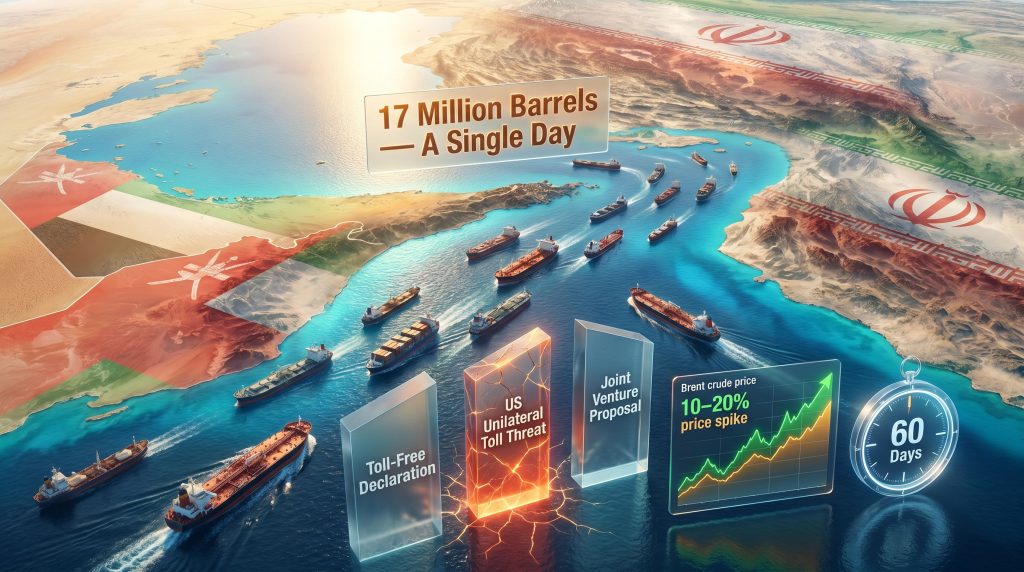
The scale of daily transit activity underscores just how dependent the global system has become on this chokepoint remaining open. Even during the period when Iranian armed forces formally announced a closure of the strait in June 2026, US Central Command reported that 55 commercial vessels carrying approximately 17 million barrels of oil transited the waterway on that same day — a striking illustration of the gap between declaratory policy and operational reality.
Historical Disruption Patterns and Price Sensitivity
The strait's price sensitivity is not theoretical. Historical episodes demonstrate that even partial disruption — not a full closure — has been sufficient to generate sharp upward moves in Brent crude benchmarks within days. Furthermore, the geopolitical oil price risks associated with Hormuz have been well-documented across multiple crises:
-
The 1980s Tanker War, when Iran and Iraq both targeted commercial shipping in the Persian Gulf, produced sustained freight insurance premium spikes and contributed to broader oil market volatility throughout the decade.
-
The 2019 Gulf of Oman incidents, in which multiple tankers were attacked near the strait's approach, triggered a single-day Brent crude price jump of more than 4 percent on initial reports — before any confirmed supply disruption had actually occurred.
-
Markets have consistently demonstrated that the threat of Hormuz disruption commands a measurable risk premium, even when physical flows remain uninterrupted.
This price architecture is what gives the Trump Hormuz tolls proposal its market significance. A toll mechanism does not need to physically stop oil flows to inflict economic consequences — the uncertainty alone reshapes shipping economics.
Decoding the Toll Proposal: Three Contradictory Positions
What makes the Trump administration's Hormuz toll stance so analytically challenging is its internal inconsistency. Across multiple statements and platforms, at least three distinct and sometimes mutually contradictory policy positions have emerged.
| Policy Position | Core Claim | Current Status |
|---|---|---|
| Toll-Free Declaration | The strait was declared permanently toll-free by the US | Effectively superseded by subsequent statements |
| Unilateral US Toll Threat | Washington may impose transit charges if no Iran deal is reached within 60 days | Active conditional threat as of June 2026 |
| Joint US-Iran Venture | A collaborative toll-charging arrangement between the two nations was floated | Exploratory, unconfirmed, legally untested |
The framing Trump applied to the potential toll was notable for its transactional language. He characterised any charges as compensation for American military operations in the region — describing the US as a protective presence for which payment in both retrospective and ongoing terms was appropriate. According to Al Jazeera, this reframes decades of US naval presence in the Gulf from a strategic public good into something resembling a billable security service.
The 60-Day MoU Window: Diplomatic Grace Period or Commercial Countdown?
The immediate trigger for the toll debate was a 14-point Memorandum of Understanding signed virtually by Trump and Iranian President Masoud Pezeshkian. The document established a 60-day ceasefire framework covering the reopening of the strait, a cessation of active hostilities, and a structure for broader nuclear negotiations.
During this window, the MoU explicitly prevents any toll imposition. However, Trump's public statements made clear that the situation changes materially if no comprehensive agreement is reached before the window closes. The 60 days therefore function simultaneously as:
-
A diplomatic negotiating runway for the Switzerland talks
-
A commercial countdown for shipping companies assessing forward route risk
-
A coercive deadline designed to accelerate Iranian concessions on the nuclear file
The toll ultimatum is best understood not as a genuine infrastructure policy but as a pressure instrument — one designed to introduce economic costs for non-compliance that extend beyond conventional sanctions into the operational mechanics of international oil trade.
International Maritime Law: Where the Toll Proposal Collides With UNCLOS
The legal foundation underlying any Hormuz toll scheme is deeply contested. The United Nations Convention on the Law of the Sea (UNCLOS) enshrines the principle of transit passage through international straits used for international navigation. This right cannot be suspended unilaterally and is broadly understood to prohibit charges levied purely for the act of passage.
Legal scholars draw a critical distinction between two categories of maritime charges that carry very different legal implications:
-
Passage tolls — fees imposed simply for transiting a strait, widely regarded as unlawful under UNCLOS transit passage provisions
-
Service fees — charges tied to demonstrably provided services such as navigational safety infrastructure, pollution control, or environmental management, which occupy a more ambiguous legal space and may be permissible under certain conditions
| Charge Category | Legal Status Under UNCLOS | Established Precedent |
|---|---|---|
| US Unilateral Passage Toll | Broadly unlawful under transit passage provisions | No precedent for strait-wide toll imposition |
| Iran Service Fee Model | Potentially permissible when tied to documented services | Environmental fees in select straits have withstood legal challenge |
| Joint US-Iran Toll Venture | Legal ambiguity — no international framework exists | No comparable precedent in maritime history |
Iran's own approach to monetising Hormuz access reveals a sophisticated understanding of this legal landscape. Rather than imposing what would be called tolls, Iranian authorities have signalled their intention to collect fees for specific services, including environmental levies. This linguistic and legal distinction is strategically significant — it positions Tehran within a grey zone of international law rather than in direct violation of UNCLOS.
A further enforcement complexity: neither the United States nor Iran exercises exclusive jurisdiction over the strait. The navigable channel passes through overlapping Omani and Iranian territorial waters, meaning any unilateral US toll mechanism would face immediate jurisdictional challenges — and near-certain legal action at the International Court of Justice from affected maritime nations.
The Switzerland Architecture: Who Is Negotiating What
The diplomatic infrastructure assembled around the 60-day window is notably complex. Talks in Switzerland involve at minimum three parallel negotiating tracks running simultaneously:
-
Ceasefire compliance verification — addressing alleged violations by both US-Israeli forces in Lebanon and Iranian-aligned proxy forces across the region
-
Strait of Hormuz access conditions — formalising the commercial and legal framework under which the waterway remains open to international shipping
-
Iran's nuclear programme — the overarching strategic objective, encompassing uranium enrichment ceilings, inspection and verification protocols, and the sequencing of sanctions relief
The principal participants include US envoys Steve Witkoff and Jared Kushner leading the American team, with Vice President JD Vance expected to participate in follow-on sessions. Iran's delegation is led by Foreign Minister Abbas Araghchi, with Parliament Speaker Mohammad Ghalibaf also expected to attend. Qatar's Prime Minister Sheikh Mohammed bin Abdulrahman Al Thani arrived in Switzerland in a mediating capacity, reflecting Doha's established role as the primary diplomatic conduit between Washington and Tehran.
Why Iran Announced a Closure That Wasn't Actually Enforced
One of the most analytically revealing episodes in this saga was the sequence surrounding Iran's formal announcement of the strait's closure. Following the MoU signing, Israeli strikes in Lebanon continued — actions Tehran characterised as ceasefire violations by the US-Israeli axis. Iran's armed forces responded by formally declaring the closure of the Strait of Hormuz. And yet, CENTCOM confirmed that commercial traffic through the strait increased on the same day.
Iran's closure announcement operated as a diplomatic signalling instrument rather than an operationally enforced blockade. By reserving and publicly asserting the right to close the strait without physically preventing transit, Tehran retained maximum negotiating leverage while avoiding a direct military confrontation with US naval forces already operating in the area.
This pattern has deep historical roots. Iran has employed asymmetric deterrence as a strategic doctrine for decades — using credible threats of disruption rather than actual disruption to extract diplomatic and economic concessions. The threat carries market weight precisely because the capability is real, even when the will to exercise it is constrained by the costs of escalation. Moreover, the broader trade war economic impact of this standoff extends far beyond energy markets alone.
Which Economies Face the Greatest Exposure
The distributional consequences of any sustained Hormuz disruption — whether through physical closure, enforced tolls, or elevated insurance premiums — fall unevenly across the global economy. In addition, the US-China trade war impacts compound the vulnerability for Asian economies already navigating complex supply chain pressures.
| Economy | Hormuz Dependency Level | Primary Vulnerability |
|---|---|---|
| Japan | Very High (~80% of oil imports) | Energy security, industrial competitiveness, power generation costs |
| South Korea | Very High (comparable to Japan) | Petrochemical sector feedstock, electricity generation |
| India | High (majority of crude imports) | Refinery economics, transport fuel inflation, current account pressure |
| China | High (largest single volume importer) | Manufacturing input costs, strategic reserve strategy, geopolitical positioning |
| Europe | Moderate (diversified supply routes) | LNG spot pricing, energy transition economics |
For India specifically, the stakes are acute. A sustained Hormuz disruption or toll imposition would flow directly into domestic petrol and diesel prices, complicate the Reserve Bank of India's inflation management, and widen the current account deficit at a time when the rupee faces external pressure. Japan and South Korea, with their near-total dependence on imported hydrocarbons, face even sharper structural vulnerability.
The next major ASX story will hit our subscribers first
Three Scenarios for the Post-60-Day World
Scenario 1: Comprehensive Deal Reached
A nuclear agreement is finalised within the ceasefire window. The Strait of Hormuz is formally declared open under a multilateral framework. Oil markets stabilise, shipping insurance premiums return to baseline, and the toll threat is permanently shelved. The diplomatic infrastructure in Switzerland suggests the architecture for this outcome exists, but significant gaps on enrichment limits and sanctions sequencing remain.
Scenario 2: No Deal, Unilateral US Tolls Activated
Washington moves to impose the toll mechanism as leverage. Major oil-importing nations — particularly China, India, Japan, and South Korea — mount immediate legal challenges at international forums. Brent crude prices spike in the range of 10 to 20 percent depending on enforcement credibility. Shipping companies face a compliance dilemma between US demands and their UNCLOS obligations under international maritime law. The resulting oil price movements could ripple through commodity markets globally.
Scenario 3: Negotiated Joint Fee Structure
A compromise is reached in which a shared fee arrangement is established under diplomatic cover, framed as service charges rather than passage tolls. This creates a legally contested but politically functional precedent. Major oil importers absorb structurally higher energy costs on an ongoing basis. Long-term impacts on LNG economics and tanker freight markets are significant and durable. As reported by The Hill, this joint venture model remains one of the more plausible compromise frameworks under active diplomatic consideration.
What the MoU Still Leaves Unresolved
The 14-point Memorandum of Understanding is a framework document, not a binding treaty. It establishes conditions for negotiation rather than resolving the underlying disputes. However, several critical elements remain entirely open:
-
The ceiling on Iranian uranium enrichment and the verification mechanism for enforcing it
-
The timeline and conditionality of sanctions relief for Iran
-
The status of Iranian proxy forces in Lebanon, Yemen, Iraq, and Syria
-
The precise legal architecture governing Hormuz transit fees, if any are ultimately agreed
-
The role of third-party guarantors in ensuring ceasefire compliance
Each of these items represents a potential breakdown point in negotiations. The history of US-Iran diplomacy since 2015 suggests that the distance between a framework agreement and a durable resolution is rarely short.
Frequently Asked Questions: Trump Hormuz Tolls Explained
What are Trump's proposed Hormuz tolls on ships?
Trump indicated that Washington could impose transit charges on vessels passing through the Strait of Hormuz if a comprehensive agreement with Iran is not finalised within a 60-day ceasefire window. The charges are framed as reimbursement for American military security operations in the region covering past, present, and future costs.
Are Hormuz passage tolls legal under international law?
Maritime legal experts broadly consider pure passage tolls on international straits unlawful under UNCLOS transit passage provisions. However, fees linked to specific, demonstrably provided services occupy a more ambiguous legal space and may survive international legal scrutiny under certain conditions.
How much oil transits the Strait of Hormuz daily?
Approximately 20 to 21 percent of the world's total petroleum liquids transit the strait annually. US Central Command reported 55 commercial vessels carrying roughly 17 million barrels transited the waterway in a single day during the period when Iran announced its closure.
What is the 60-day ceasefire period?
The 60-day window was established under a 14-point MoU signed by Trump and Iranian President Masoud Pezeshkian. During this period, no tolls will be imposed and nuclear negotiations are expected to take place in Switzerland. If no deal is reached, Trump Hormuz tolls on ships could be activated unilaterally.
Who is mediating the US-Iran talks?
Qatar is serving as the principal mediator, with its Prime Minister and Foreign Minister present in Switzerland. The US negotiating team is led by envoys Steve Witkoff and Jared Kushner, with Vice President JD Vance expected to participate in follow-on sessions. Iran's delegation is led by Foreign Minister Abbas Araghchi.
This article contains forward-looking analysis and scenario projections based on publicly available information. Geopolitical outcomes, oil price movements, and diplomatic developments are inherently uncertain and subject to rapid change. Nothing in this article constitutes financial or investment advice. Readers should conduct independent research before making any investment or commercial decisions.
Want to Stay Ahead of How Geopolitical Shocks Move Commodity Markets?
Discovery Alert's proprietary Discovery IQ model delivers real-time alerts on significant ASX mineral discoveries, cutting through complex market noise to surface actionable opportunities — even as energy crises and maritime disruptions reshape commodity economics. Explore how historic mineral discoveries have generated substantial returns on Discovery Alert's dedicated discoveries page, and begin your 14-day free trial today to position yourself ahead of the broader market.