June 21, 2026
The Hidden Cost of Import Dependency: Why India Is Rewriting Its Coal Strategy
Every year, India spends tens of billions of dollars importing commodities that could theoretically be produced at home. Urea to feed its farms. Ammonia to supply its chemical plants. LNG to power industrial processes. And yet beneath Indian soil sits one of the largest coal reserve bases on the planet, sitting largely untapped beyond its most basic application: burning it to generate electricity.
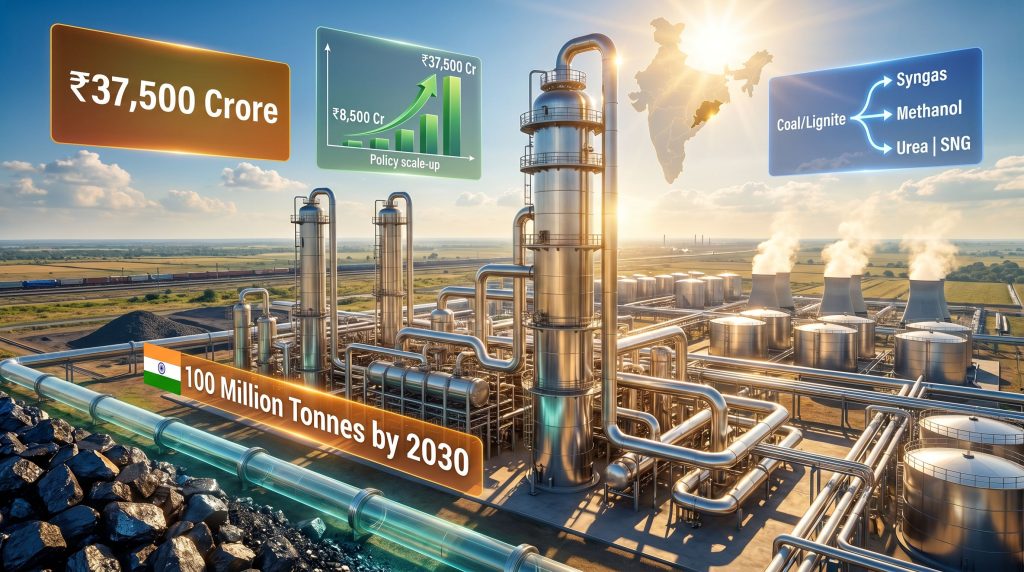
This is the structural paradox that India coal gasification incentives are designed to resolve. Rather than continuing to treat coal purely as a combustion fuel, policymakers are now repositioning it as a chemical industry feedstock, capable of producing the very commodities India currently imports at great expense. The policy shift is neither incremental nor experimental. With a total incentive pool now reaching ₹37,500 crore, India is making one of the most significant single-sector industrial commitments in its recent economic history.
When big ASX news breaks, our subscribers know first
India's Structural Vulnerability: The Import Dependency Loop
To understand why India coal gasification incentives have reached this scale, it helps to first understand the problem they are solving. India's reliance on imported LNG, urea, ammonia, and methanol creates a persistent foreign exchange drain and exposes critical supply chains to global commodity price volatility. Furthermore, the country's resource and energy exports landscape adds another layer of strategic complexity to these dependencies.
The structural irony runs deep. Approximately 73% of India's thermal power generation relies on coal, making the country one of the world's most coal-dependent economies from an electricity perspective. Yet the chemical and fertilizer sectors, which could theoretically draw on the same resource base, remain heavily tied to international markets. Coal is extracted in vast quantities but converted to higher-value products only at a fraction of its potential.
India currently ranks as one of the world's largest urea importers, a position that creates fiscal exposure every time global natural gas prices spike. Because conventional urea production relies on natural gas as a hydrogen feedstock, international LNG price movements flow directly into India's fertilizer import bill and ultimately into farm economics. Coal gasification offers an alternative hydrogen pathway, one anchored entirely in domestic resource availability.
From Combustion to Chemistry: Understanding the Gasification Value Chain
Coal gasification is not a new technology. It has been deployed commercially in China, South Africa, and parts of the United States for decades. What distinguishes India's current push is the explicit integration of gasification into a national import substitution agenda, backed by financial architecture designed to attract both large industrial conglomerates and mid-tier operators.
The fundamental chemistry involves converting coal or lignite into syngas — a mixture of carbon monoxide and hydrogen — through a high-temperature reaction with steam and a controlled oxygen supply. That syngas then becomes the input for a range of downstream industrial processes:
- Methanol (fuel and chemicals)
- Ammonia and Urea (fertilizers)
- Synthetic Natural Gas (SNG for energy use)
Each of these downstream products represents a current import category for India. Synthetic natural gas reduces LNG import volumes. Domestically produced urea displaces imported fertilizer. Methanol supports blending mandates in transport fuels. Ammonia feeds both industrial chemical supply chains and emerging clean energy applications. The value chain logic is compelling precisely because it addresses multiple import dependencies through a single upstream technology platform.
The Policy Architecture: Breaking Down the ₹37,500 Crore Scheme
India's current incentive framework is structured across several interlocking mechanisms. Understanding each component individually clarifies how the overall policy reduces investment risk and improves returns for project developers. According to the official government announcement, the scheme reflects a deliberate and well-considered escalation in ambition.
| Incentive Parameter | Details |
|---|---|
| Total Scheme Value | ₹37,500 crore |
| Financial Support Rate | Up to 20% of plant and machinery cost |
| Per-Project Cap | ₹5,000 crore |
| Per-Product Cap (excl. SNG and Urea) | ₹9,000 crore |
| Per-Entity Group Cap | ₹12,000 crore across all projects |
| Disbursement Structure | Four equal instalments tied to project milestones |
| Coal Gasification Target | ~75 million tonnes (near-term); 100 million tonnes by 2030 |
Milestone-Linked Disbursement: Reducing Fiscal Risk Without Reducing Ambition
A critical design feature of the incentive scheme is its milestone-linked disbursement structure. Capital is released across four equal tranches, each tied to verifiable project completion checkpoints. This approach prevents front-loaded fiscal exposure for the government while maintaining continuous investment momentum for developers. It also creates accountability frameworks that reduce project abandonment risk, a common failure mode in large-scale industrial subsidy programmes.
The Revenue Share Rebate Mechanism
For operators participating in commercial coal block auctions, a 50% rebate on revenue share obligations is available to those who direct a minimum of 10% of total coal production toward gasification. This mechanism is particularly significant because it lowers the effective operating cost base for integrated mining and gasification operations, improving project economics at the production rather than the capital expenditure stage.
Extended Coal Linkage Tenure: Solving the Feedstock Security Problem
One of the least-discussed but most commercially important features of the policy is the extension of coal linkage tenure to up to 30 years for syngas and gasification projects. Gasification infrastructure is capital-intensive, with payback horizons typically spanning 15 to 25 years. Without guaranteed long-term feedstock supply, lenders and equity investors face a fundamental underwriting problem. The 30-year tenure provision directly addresses this barrier, converting what was previously a deal-breaker into a manageable planning variable.
How the Current Scheme Compares to the 2024 Framework
The scale-up from the January 2024 scheme to the current framework represents a 4.4-fold expansion in total incentive value, signalling a transition from pilot-phase experimentation to full industrial deployment.
| Comparison Dimension | January 2024 Scheme | Current Scheme |
|---|---|---|
| Total Incentive Pool | ₹8,500 crore | ₹37,500 crore |
| Projects Under Implementation | 8 projects | 35+ companies entering |
| Capital Committed (flagship project) | ₹6,233 crore | ₹25,016 crore (Lakhanpur alone) |
| Policy Maturity | Pilot-phase framework | Full-scale industrial deployment |
Beyond the headline numbers, the policy design itself evolved substantially. Eligibility criteria were broadened to include mid-tier industrial players, reducing concentration of the programme among a small number of large conglomerates. Indigenous technology provisions were introduced, with the Ministry of Coal issuing RFP clarifications in 2025 covering technology sourcing rules. Product-specific caps were added to prevent any single downstream commodity from absorbing a disproportionate share of available incentives.
Notably, the government has also explicitly signalled openness to international technology providers entering India through partnership and licensing structures. This reflects an honest acknowledgement that domestic gasification engineering capability requires augmentation before the 100 million tonne production target for 2030 becomes achievable.
The Lakhanpur Project: Flagship Investment and Proof of Concept
The most visible expression of India's coal gasification ambition is the ₹25,016 crore Lakhanpur project located in Jharsuguda district, Odisha. Its scale alone makes it one of the largest single industrial investments in the coal-to-chemicals sector anywhere in Asia outside of China.
The choice of Jharsuguda is strategically deliberate. The district sits within one of India's most coal-dense corridors, providing direct feedstock proximity that reduces logistical costs and transport infrastructure requirements. Odisha's existing industrial base — encompassing power generation, rail connectivity, and water resource access — further reduces greenfield development costs compared to alternative locations.
The project's downstream output is intended to feed into urea, methanol, and synthetic natural gas production chains. Each tonne of domestically produced urea or methanol that displaces an imported equivalent reduces India's foreign exchange outflow and strengthens supply chain resilience for downstream industries.
Investment Scale Context: At a 20% capital subsidy rate on plant and machinery costs, the total implied private investment across the full ₹37,500 crore incentive scheme could exceed ₹1.5 to ₹2 lakh crore at full utilisation, representing a significant multiplier on direct government expenditure.
The next major ASX story will hit our subscribers first
Sectoral Ripple Effects: Who Wins and Who Faces Disruption
The downstream consequences of India's coal gasification push extend across multiple industries. In addition, understanding the country's global coal reserves position helps contextualise why this policy is both feasible and strategically sound. The table below maps the primary impact vectors:
| Sector | Impact Mechanism | Direction |
|---|---|---|
| Coal Mining | Demand uplift from gasification-linked offtake agreements | Positive |
| Fertilizer and Urea | Domestic feedstock security, reduced import exposure | Positive |
| LNG Imports | Substitution pressure from domestic SNG production | Negative for importers |
| Methanol | New domestic supply source and transport blending mandates | Positive |
| Industrial Chemicals | Lower ammonia input costs as domestic production scales | Positive |
For LNG traders and importers, the scale of India's domestic SNG ambitions represents a meaningful medium-term demand headwind. India has been one of the fastest-growing LNG import markets globally, and any structural reduction in that demand trajectory carries implications for long-term LNG contract negotiations and spot market pricing in the Asian basin.
Eligible Participants and Technology Transfer Provisions
The current incentive framework is designed to accommodate a broad range of participant types:
- Public sector undertakings with coal, energy, or chemical mandates
- Private industrial conglomerates with downstream fertilizer or chemical operations
- Joint ventures between international technology licensors and domestic industrial partners
- Commercial coal block auction participants who commit minimum gasification production quotas
The technology transfer dimension deserves particular attention. Gasification technology is not a commodity. Leading gasifier designs — including entrained-flow, fixed-bed, and fluidised-bed systems — each carry distinct performance characteristics in terms of coal rank tolerance, water consumption, syngas composition, and thermal efficiency. India's coal resource base includes a significant proportion of high-ash, low-calorific-value coals that are technically challenging inputs for certain gasifier configurations. The government's openness to international technology partnerships reflects awareness of this constraint.
NLC India and the Critical Mineral Convergence
One of the more strategically significant and underappreciated dimensions of India's broader coal policy is the convergence between gasification ambitions and critical minerals and energy security. Neyveli Lignite Corporation, already active in lignite gasification, has signed a Memorandum of Understanding with the Bhabha Atomic Research Centre to advance rare earth extraction capabilities from its Tamil Nadu operations.
This development signals an important conceptual shift: coal-bearing and lignite-bearing geological formations are being reconsidered as multi-resource assets rather than single-commodity extraction sites. Rare earth elements occur in association with coal deposits in specific geological settings, and the technical capability to extract them alongside or following primary energy production creates an additional value layer on top of the gasification economics.
Furthermore, India's critical minerals strategy at the national level provides the policy framework within which this convergence is being pursued, positioning India's coal and mining sector as a contributor to materials security alongside its traditional energy security role.
Aatmanirbhar Bharat and Viksit Bharat: The Strategic Framing
India's coal gasification incentive programme cannot be fully understood outside its broader political and economic framing. The Aatmanirbhar Bharat initiative, which translates broadly as self-reliant India, explicitly targets import substitution across sectors deemed strategically important. Gasification-derived chemicals represent a high-priority category within this framework because they address simultaneous vulnerabilities in energy, agriculture, and industrial supply chains.
The longer-horizon Viksit Bharat 2047 development agenda, which envisions India as a fully developed economy by the centenary of independence, requires deep domestic capability in precisely the industrial sectors that coal gasification serves: chemicals, fertilizers, synthetic fuels, and industrial gases. Framing coal not as a legacy fuel but as a domestic feedstock for 21st-century chemistry is central to making this vision achievable. India's proposed coal trading exchange proposal further reinforces this strategic repositioning of coal as a commercially managed industrial resource.
Key Takeaways for Industry Observers and Investors
The scale, design, and trajectory of India coal gasification incentives carry several important implications worth summarising:
- The ₹37,500 crore incentive pool represents a 4.4x expansion from the 2024 framework, confirming policy commitment at the highest level
- Milestone-linked disbursement across four tranches reduces fiscal risk while maintaining project momentum
- The 30-year coal linkage tenure extension is the single most important investor-facing improvement, directly addressing feedstock security risk
- Over 35 companies are preparing to commence gasification operations, suggesting private sector confidence in the policy framework is real and accelerating
- The ₹25,016 crore Lakhanpur project in Odisha serves as the anchor investment and proof-of-concept for replication across coal-bearing states
- Technology gap provisions create an entry pathway for international gasification technology providers through licensing and joint venture structures
- The NLC-BARC partnership on rare earth extraction from lignite operations points to an emerging multi-resource strategy that extends well beyond the energy transition narrative
For a deeper understanding of how the V-KALP incentive scheme underpins this policy architecture, further reading is available covering the programme's detailed eligibility and disbursement mechanics.
Disclaimer: This article is intended for informational purposes only and does not constitute financial or investment advice. Projections regarding incentive utilisation, capital mobilisation, and production targets are forward-looking and subject to policy, regulatory, and market variables. Readers should conduct independent due diligence before making any investment decisions related to sectors discussed herein.
For ongoing coverage of India's coal sector policy developments, ministerial statements, and energy transition updates, ET EnergyWorld at energy.economictimes.indiatimes.com provides continuous reporting on the regulatory and industrial landscape shaping these markets.
Want to Stay Ahead of Major Resource and Energy Discoveries Before the Broader Market?
India's coal gasification pivot underscores how quickly commodity and resource dynamics can shift, creating time-sensitive investment opportunities for those positioned early. Discovery Alert's proprietary Discovery IQ model delivers real-time alerts on significant ASX mineral discoveries — including those spanning the energy and resources sectors central to India's import substitution agenda — with historic examples of exceptional returns available on Discovery Alert's dedicated discoveries page. Begin your 14-day free trial today and ensure you're never the last to act on a major discovery.