May 21, 2026
The Invisible Greenhouse Gas Hiding in Plain Sight
When climate scientists and policymakers debate the fastest levers available for reducing near-term global warming, methane consistently ranks near the top. Unlike carbon dioxide, which lingers in the atmosphere for centuries, methane is a short-lived climate pollutant with a warming potency roughly 80 times greater than CO₂ over a 20-year timeframe. Reducing methane emissions delivers measurable climate benefits within years, not decades. Yet one of the largest and most tractable sources of anthropogenic methane, coal mine methane (CMM), remains systemically undermonitored, underreported, and underaddressed in global climate policy. The India coal mine methane data gaps story is not simply a national accounting problem. It is a window into a global measurement failure with serious consequences for climate credibility.
When big ASX news breaks, our subscribers know first
Coal's Methane Footprint: Larger Than Most Climate Frameworks Acknowledge
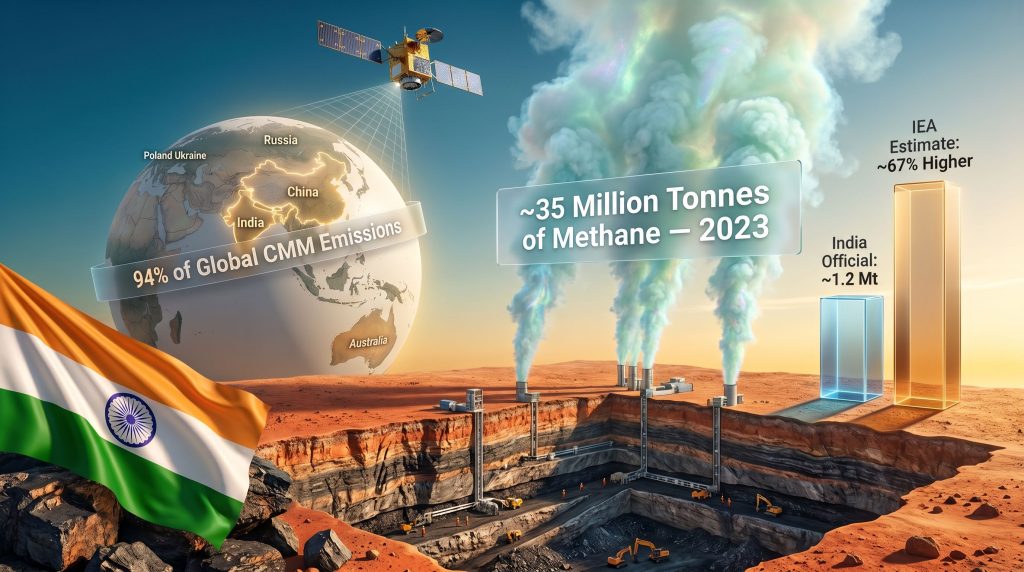
Global coal mining released approximately 35 million tonnes of methane in 2023, a volume broadly comparable to total methane output from either the oil sector or the gas sector considered individually, according to Ember's Global Coal Mine Methane Review. That equivalence is rarely communicated in mainstream climate discourse, where oil and gas methane receive the bulk of regulatory attention and investment in monitoring infrastructure.
What makes this figure particularly concerning is its trajectory. Despite rising global coal production volumes since 2021, aggregate CMM emissions have remained essentially flat across the same period. Rather than signalling genuine emissions stability, this plateau is more likely a reflection of stagnating measurement systems than actual environmental progress. When production volumes climb and reported emissions hold steady, the most plausible explanation is not successful abatement, but reporting systems that are failing to capture what is physically being released.
Furthermore, the coal supply challenges of 2025 have only added complexity to an already opaque emissions landscape, making accurate measurement even more critical for informed policy decisions.
The Seven-Country Concentration Problem
The geographic distribution of coal mine methane adds further complexity to global mitigation efforts. An estimated 94% of all CMM emissions originate from just seven nations: China, the United States, Russia, India, Australia, Poland, and Ukraine. In theory, this level of concentration should make the problem tractable. Coordinated regulatory action across a small number of jurisdictions could address the overwhelming majority of global coal mine methane at source.
In practice, however, the multilateral monitoring architecture needed to hold these seven nations accountable simply does not exist at the required level of granularity. The concentration of emissions in a handful of countries has not translated into concentrated regulatory scrutiny.
| Emitter Group | Share of Global CMM Emissions |
|---|---|
| Top 7 coal-producing nations | ~94% |
| All remaining coal-producing countries | ~6% |
A Global Reporting System That Cannot See What It Is Measuring
The structural deficiencies in CMM reporting are not peripheral. They are foundational. In 2023, only 23 of 73 coal-producing nations submitted methane emissions data to the UNFCCC, leaving approximately 31 million tonnes of methane absent from official international inventories. Ember's analysis estimates that 89% of actual global CMM emissions went uncaptured in formal national reporting during that same year.
This is not a rounding error or a marginal discrepancy. It represents a near-complete breakdown in the global emissions accounting architecture for one of the world's largest methane source categories. For context, the volume of unreported CMM alone, roughly 31 million tonnes, is comparable in scale to the total methane emissions of entire industrial sectors in many developed economies.
Why Generic Emission Factors Systematically Distort Inventory Data
The problem is compounded by the near-universal reliance on generic, standardised emission factors. Approximately 99% of reported coal production globally comes from countries that calculate CMM using default IPCC-derived values rather than direct, mine-level measurement. These generic factors are population averages, essentially proxies designed for situations where direct data collection is impractical or cost-prohibitive.
The fundamental problem with using generic factors across diverse geological and operational contexts is that they obscure the variance that matters most for policy. Methane release from coal mines is influenced by:
- Coal seam depth and geological pressure conditions
- Coal rank and inherent gas content of the seam
- Mining method, whether surface or underground extraction
- Ventilation system design and extraction efficiency
- Regional hydrogeological characteristics
Averaging across all of these dimensions produces a number that fits no individual mine particularly well. Applied at national scale, generic factors create an illusion of measurement precision while masking the actual distribution of emissions across operations.
Regulatory frameworks built on generic emission factors create a structural incentive toward underreporting, because default values are typically conservative and rarely revised upward to reflect real-world operational variability.
India's CMM Accounting: A Three-Way Discrepancy That Reveals System-Wide Failure
India serves as the most analytically revealing case study in global CMM data transparency, precisely because the discrepancies in its reported figures are so large and so well-documented. Three independent measurement frameworks produce substantially different estimates of India's coal mine methane output, and the gap between the lowest and highest figures is not a matter of decimal places.
The India coal mine methane data gaps problem is further illuminated by understanding India's coal market structural developments, which have reshaped production incentives and reporting obligations in recent years.
| Estimation Source | Approximate CMM Estimate |
|---|---|
| India's Official National Inventory | ~1.2 million tonnes (2024) |
| Global Energy Monitor (GEM) | Broadly aligned with national figures |
| International Energy Agency (IEA) | ~67% higher than officially reported |
| IEA Alternative Baseline Methodology | ~2,941 kt CH₄ |
The IEA's estimate, sitting approximately 67% above India's self-reported figure, reflects fundamental disagreements about emission factor selection, mine classification criteria, and measurement protocol. High-resolution gridded inventory approaches, by contrast, have produced estimates significantly lower than some global inventories yet broadly consistent with India's UNFCCC submissions, demonstrating how methodology choice alone can generate dramatically divergent outcomes from the same underlying physical reality.
Reporting Transitions Masquerading as Emissions Reductions
A particularly important analytical point concerns India's historical methane intensity trajectory. Reported methane intensity per tonne of coal produced fell sharply at two distinct junctures, around the year 2000 and again around 2010. These declines were not the product of verified physical abatement. They were driven by methodological transitions: shifts from IPCC default emission factors to country-specific measurement protocols and refined calculation frameworks.
Without transparent documentation of these methodological revisions, the apparent improvement in India's emission intensity metrics appears to reflect genuine environmental progress. In reality, it reflects how a nation's reported figures change when it adopts different counting rules, not because its mines are emitting less methane.
A decline in reported methane intensity is not equivalent to a decline in actual methane emissions. The distinction between genuine physical abatement and methodological revision is not always visible in national inventory data, and that invisibility is a policy risk in itself.
The Geological Reality Behind India's Relatively Low CMM Intensity
One factor that is frequently overlooked in comparative CMM analysis is the role of geology. India's underground coal seams have lower inherent gassiness compared to those in countries like Australia, where coal beds carry significantly higher gas content. This geological characteristic mechanically produces lower emission intensity metrics per tonne of coal produced, independent of any mitigation measures.
This distinction matters enormously for policy interpretation. If India's CMM intensity is treated as a benchmark of abatement performance rather than a reflection of geological endowment, it creates a misleading precedent for other coal-producing nations. Lower intensity in India is partly a geological fact, not a policy achievement. In addition, understanding metallurgical coal trends helps contextualise why different coal types carry different methane emission profiles.
What Field Measurements Reveal That Inventories Cannot Capture
The Underground Mine Sampling Crisis
India's underground coal sector encompasses approximately 338 classified underground mines. Recent field measurement campaigns have achieved coverage of only around 108 of these operations, representing a sampling rate of roughly 32%. The historical emission factor dataset underpinning national inventory calculations was derived from measurements at just 16 surface mines and 83 underground mines, a sample that has not been comprehensively updated despite significant structural changes in India's coal sector.
Indian coal mines are categorised by gassiness into Degree I, II, and III classifications. However, applying averaged emission factors across these categories introduces substantial uncertainty because geological variability within each classification band can be considerable. A Degree II mine in one region may release meaningfully different quantities of methane than a Degree II mine in another, depending on local coal rank, seam geometry, and hydrological conditions.
Production Mix Shifts: How Structure, Not Policy, Drove Apparent Intensity Reductions
Between 2010 and 2019, India's aggregate coal production grew by approximately 28%, while reported CMM emissions increased by only around 4% across the same period. This apparent decoupling looks, on the surface, like successful emissions management. The underlying driver, however, was a structural shift in mining method, not targeted abatement.
Over that decade, surface mining expanded by approximately 38% while underground production contracted by roughly 71%. Because underground mines are inherently gassier than surface operations, this compositional change automatically reduced aggregate emission intensity without any deliberate methane control measures being implemented.
Satellite Monitoring: A Verification Tool Barely Being Used
Approximately 73% of India's hard coal production occurs in geographic regions technically suited to satellite-based methane monitoring using instruments like the TROPOMI sensor. TROPOMI data has detected elevated methane concentration trends of roughly 9 to 10 parts per billion per year over Indian coal mining regions, consistent with ongoing substantial emissions from the sector.
Despite this monitoring potential, virtually no publicly accessible methane plume detection data exists for Indian coal operations. This absence of satellite-derived verification data is particularly significant given India's plans to expand both surface and underground coal output in the coming years. The gap between monitoring capability and monitoring practice represents a structural transparency deficit that limits independent scientific scrutiny and undermines the credibility of national inventory figures.
India's Abandoned Mine Methane: A Data Void Within a Data Void
Abandoned coal mines represent an especially acute monitoring challenge. Unclear ownership structures, poor historical regulatory documentation, physical inaccessibility in remote areas, and the absence of a centralised abandoned mine registry combine to create near-total data voids for this category of emissions. No active abandoned mine methane mitigation projects have been publicly reported in India, and the regulatory infrastructure needed to locate, characterise, and monitor legacy sites does not currently exist at scale.
India's primary coal-producing states, Jharkhand, Odisha, and Chhattisgarh, contain significant concentrations of legacy mining activity where abandoned mine methane release is occurring without measurement or mitigation. Consequently, mining waste management reform must be considered alongside methane monitoring improvements as part of any comprehensive regulatory overhaul.
The Abatement Opportunity: Solutions Exist, Implementation Does Not
What Capture Technology Can Realistically Deliver
The scale of the CMM mitigation opportunity is often underappreciated. Ember's analysis indicates that more than half of global coal mine methane emissions could be reduced within the current decade using technologies that are already commercially available and operationally proven. Methane captured from ventilation air systems and drainage infrastructure can be redirected for use as fuel, creating potential revenue streams that partially offset the capital expenditure required for capture infrastructure deployment.
Globally, estimated recoverable methane from coal mine capture operations could reach approximately 15 billion cubic metres (bcm) annually, a volume that represents a meaningful energy resource if systematically captured and utilised.
| Metric | Volume |
|---|---|
| Estimated globally capturable CMM | ~15 bcm/year |
| LNG transiting Strait of Hormuz (2025) | ~112 bcm |
| Global CMM emitted in 2023 | ~35 million tonnes |
The 15 bcm capture potential represents roughly 13% of the LNG volume that transited the Strait of Hormuz in 2025, a comparison that contextualises coal mine methane not merely as a climate liability but as an underutilised energy asset. The recent attention paid to Strait of Hormuz supply chain fragility has highlighted the strategic value of domestic gas resources, yet coal mine methane, which could partially substitute for imported gas in some operational contexts, remains almost entirely wasted globally.
India's Projected Emissions Trajectory Without Intervention
Under a business-as-usual production expansion scenario, India's CMM emissions could exceed 1.6 million tonnes per year by 2030. The IEA estimates a mitigation potential of approximately 35% from currently available technologies, meaning that a significant portion of this projected growth could be addressed without requiring breakthrough innovation, only deployment of existing systems.
Global methane reduction commitments, including pledges made under the Global Methane Pledge framework, are structurally unlikely to be achieved if coal mine methane continues to be excluded from rigorous monitoring and abatement requirements. The coal sector's methane contribution is comparable in magnitude to that of the oil and gas industries, yet it receives a fraction of the regulatory attention. Moreover, the demand for energy transition minerals underscores why addressing India coal mine methane data gaps is increasingly viewed as integral to any credible decarbonisation strategy.
The next major ASX story will hit our subscribers first
A Five-Step Framework for Closing India's CMM Data Gaps
Step 1: Mandate Site-Level Measurement Across All Active Mines
The transition from generic IPCC emission factors to direct, mine-level methane measurement across all operating underground mines is the foundational prerequisite for credible CMM accounting. Minimum measurement frequency and reporting standards should be aligned with IEA and UNFCCC technical guidance to ensure international comparability.
Step 2: Establish a National Abandoned Mine Methane Registry
A centralised, publicly accessible database of abandoned coal mine locations, ownership histories, and estimated emission profiles would provide the regulatory foundation for monitoring and eventually mitigating legacy emissions. Priority characterisation should focus on high-risk sites in Jharkhand, Odisha, and Chhattisgarh.
Step 3: Integrate Satellite Monitoring Into the National Verification Architecture
Formalising the use of TROPOMI and next-generation satellite instruments as independent verification tools within India's national inventory process would enable cross-checking of ground-based estimates against satellite-derived data. Publishing plume detection data on a publicly accessible platform would allow independent scientific scrutiny and support international confidence in national figures.
Step 4: Align National Reporting With IEA and GEM Methodologies
The persistent 67% discrepancy between India's national CMM figures and IEA estimates requires structured technical dialogue to identify and reconcile the specific sources of divergence. Transparent documentation of all emission factor revisions is essential to prevent methodological changes from being misread as physical abatement progress. Research published in peer-reviewed environmental science has consistently demonstrated that such divergences can only be resolved through standardised, mine-level data collection.
Step 5: Develop a CMM Capture Incentive Framework
Regulatory and fiscal mechanisms that incentivise coal operators to invest in methane drainage and ventilation capture infrastructure would accelerate deployment of existing abatement technology. Linking CMM capture credits to India's emerging carbon market architecture under the Carbon Credit Trading Scheme could provide an additional economic rationale for operators to invest in capture systems. The EPA's assessment of India's CMM market identified several such incentive pathways that remain underutilised at the policy level.
Frequently Asked Questions: India Coal Mine Methane Data Gaps
What are India's officially reported coal mine methane emissions?
India's national inventory reported approximately 1.2 million tonnes of methane from coal mining in 2024. However, the IEA estimates actual emissions may be around 67% higher than this figure, reflecting differences in methodology and emission factor selection.
Why do different organisations report such different CMM estimates for India?
The divergence stems from three primary sources: the use of generic versus mine-specific emission factors, incomplete coverage of underground and abandoned mines, and methodological transitions in national reporting that have not been consistently documented or communicated.
How much of India's coal production area can be monitored by satellite?
Approximately 73% of India's hard coal production occurs in regions technically suitable for satellite methane monitoring using instruments like TROPOMI. Despite this, publicly available plume detection data for Indian coal operations is almost entirely absent.
What is the mitigation potential for coal mine methane in India?
The IEA estimates a mitigation potential of approximately 35% using currently available technologies. Under a high-production scenario, India's CMM emissions could exceed 1.6 million tonnes per year by 2030 without targeted intervention.
How does India's CMM intensity compare to other major coal producers?
India's methane intensity per tonne of coal produced is relatively lower than countries such as Australia, primarily because Indian underground coal seams have lower inherent gassiness, a geological characteristic rather than a reflection of active abatement measures.
What is abandoned mine methane and why is it particularly difficult to monitor in India?
Abandoned mine methane refers to methane released from coal mines that are no longer in active operation. In India, monitoring these sites is complicated by unclear ownership, poor historical regulation, physical inaccessibility, and the absence of a centralised abandoned mine registry.
Measurement Reform as a Prerequisite for Climate Credibility
India's position as both a major coal producer and a signatory to international climate frameworks creates a structural tension that cannot be resolved through diplomacy alone. It requires transparent, independently verifiable emissions accounting as its foundation.
The current CMM data architecture, characterised by methodological opacity, incomplete mine coverage, absent satellite verification, and an unmonitored legacy mining estate, makes it structurally impossible to assess whether India's coal sector is genuinely reducing its climate impact or simply reporting under different assumptions. That ambiguity is not merely a technical problem. It is a credibility problem with consequences for international climate negotiations, domestic policy design, and the mobilisation of capital toward clean energy transition pathways.
The gap between India's reported coal mine methane figures and independent estimates is not primarily a story about India. It is a story about the global failure to build measurement systems capable of holding the coal sector accountable at the scale the climate challenge demands.
Closing India coal mine methane data gaps would accomplish more than improving a national inventory. It would establish a replicable model for transparent CMM accounting in a major emerging economy, demonstrate that measurement reform and production growth can coexist, and provide the evidentiary foundation needed to unlock investment in methane capture infrastructure. The technologies to address coal mine methane already exist. What is missing is the measurement infrastructure to make the problem visible, and the policy will to act on what the data reveals.
Readers seeking broader context on India's energy sector developments, including coal, renewable energy, and environmental reporting, can explore ongoing coverage at ETEnergyWorld, which tracks developments across India's energy landscape.
Disclaimer: This article draws on data from Ember's Global Coal Mine Methane Review and related analysis from the International Energy Agency and Global Energy Monitor. Projections and estimates referenced herein reflect methodological assumptions that vary across organisations. Forward-looking figures, including India's projected 2030 CMM emissions, represent scenario-based estimates under specific assumptions and should not be interpreted as definitive outcomes. Readers should consult primary sources when making policy or investment decisions.
Want To Stay Ahead Of The Next Major ASX Mineral Discovery?
Discovery Alert's proprietary Discovery IQ model delivers real-time alerts on significant ASX mineral discoveries, transforming complex geological and commodity data into actionable investment insights for both short-term traders and long-term investors. Explore how historic discoveries have generated substantial returns on Discovery Alert's dedicated discoveries page, and begin your 14-day free trial today to position yourself ahead of the broader market.