
May 14, 2026
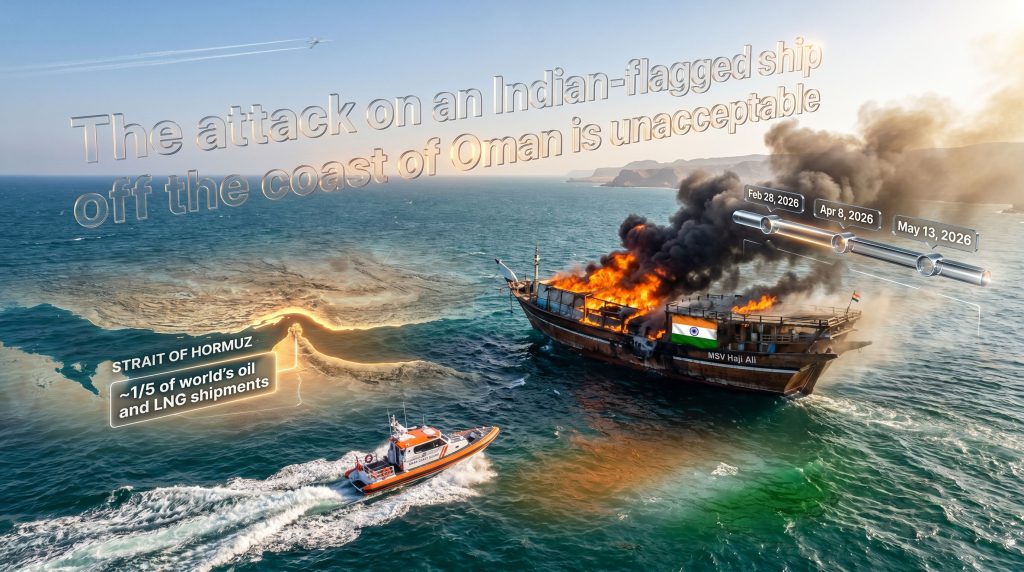
When Civilian Ships Become Collateral: The New Reality of Gulf Maritime Risk
The global shipping industry has long operated on the assumption that civilian cargo vessels, particularly small-scale regional traders, exist beneath the threshold of geopolitical conflict. Wooden dhows carrying livestock, fishing boats transporting catches between ports, and low-value cargo ships navigating well-worn trade routes were considered, by tacit international consensus, too insignificant to be worth targeting. That assumption is no longer reliable in the waters south of the Strait of Hormuz, as India condemns attack on Indian-flagged ship off Oman in a significant escalation of regional maritime tensions.
The sinking of the MSV Hajj Ali on May 13, 2026, off the coast of Limah, Oman, represents something more consequential than a single maritime incident. It signals a structural shift in the risk environment governing one of the world's most economically critical waterways, where the distinction between military and civilian targets has become dangerously blurred.
When big ASX news breaks, our subscribers know first
The Strait of Hormuz: A Chokepoint Under Sustained Pressure
Few geographic features carry as much economic weight as the Strait of Hormuz. Under normal peacetime conditions, roughly one-fifth of the world's oil and liquefied natural gas shipments transit this narrow waterway, making it the single most important maritime chokepoint for global energy security. Disruptions here do not stay local. They travel rapidly through commodity markets, insurance pricing, shipping route decisions, and ultimately consumer energy costs across Asia, Europe, and beyond.
Since the outbreak of hostilities between the United States, Israel, and Iran on February 28, 2026, the strait has operated in a fundamentally different mode. Iran largely blocked commercial shipping passage through the corridor following the conflict's start, whilst the United States simultaneously imposed a naval blockade on Iranian ports. A fragile ceasefire took effect on April 8, 2026, but maritime incidents have continued to accumulate in the weeks since, demonstrating the dangerous gap between political agreements and operational security on the water.
The economic exposure for India is particularly acute. As one of the world's largest energy-importing economies and home to a significant population of maritime workers operating across Gulf trade routes, India sits at a unique intersection of financial vulnerability and human risk whenever Gulf shipping volatility escalates. Disruptions in this corridor translate directly into oil price volatility for Indian consumers and compounding supply chain pressures for Indian industry.
The Dual Blockade Dynamic and Its Commercial Consequences
What makes the current environment structurally distinct from previous Gulf tension cycles is the simultaneous operation of two competing blockade frameworks. Iran's restriction of commercial passage through the Strait of Hormuz and the US naval blockade of Iranian ports have created a corridor where vessels face multilateral pressure from opposing directions. Commercial operators must navigate not only the physical threat of drone and missile strikes but also the legal and logistical complexity of operating between two enforced restriction zones.
This dual-pressure environment has had measurable consequences. Shipping insurance premiums for Gulf routes have spiked considerably. Vessel routing decisions increasingly favour longer, more expensive alternatives. Furthermore, the pattern of incidents in the corridor has expanded well beyond oil tankers to include smaller civilian cargo vessels that historically operated beneath the risk threshold for maritime security planning.
Inside the Attack on the MSV Hajj Ali: What the Evidence Shows
The MSV Hajj Ali was not a vessel that would typically attract strategic attention. According to maritime tracking data cited by maritime security firm Vanguard, the ship was a 54-metre (177-foot) wooden dhow, a vessel type that has served Arabian Sea trade routes for centuries. Its cargo on May 13, 2026, was livestock, transported along a routine commercial route from Berbera in Somalia's breakaway Somaliland region to Sharjah in the United Arab Emirates.
The following table summarises the verified details of the vessel and the incident:
| Detail | Confirmed Information |
|---|---|
| Vessel Name | MSV Hajj Ali |
| Vessel Type | Wooden dhow cargo vessel |
| Length | 54 metres (177 feet) |
| Crew Aboard | 14 Indian nationals |
| Flag State | India (Gujarat ownership) |
| Departure Port | Berbera, Somaliland |
| Destination Port | Sharjah, United Arab Emirates |
| Cargo | Livestock |
| Attack Date | May 13, 2026 |
| Attack Location | Off Limah, Oman, south of the Strait of Hormuz |
| Attack Method | Suspected drone or missile strike |
| Vessel Fate | Sunk |
| Crew Outcome | All 14 rescued by Oman Coast Guard |
Vanguard's reporting indicates that a suspected explosion, believed to have been caused by a drone or missile strike, ignited a fire aboard the vessel. The fire forced all 14 crew members to abandon ship before the MSV Hajj Ali went down. The Oman Coast Guard responded and rescued the entire crew without fatalities.
Why a Livestock Dhow Raises Harder Questions Than a Tanker
The nature of the targeted vessel deserves specific analytical attention. A wooden dhow carrying livestock to the UAE carries no strategic cargo, hosts no military technology, and presents no obvious intelligence value. Its Indian flag and civilian profile would, under established international maritime law, place it firmly outside any legitimate military targeting framework.
This raises three possibilities that the available evidence cannot yet resolve:
- Deliberate targeting of an Indian-linked commercial asset as a signal to New Delhi during a period of heightened regional tension
- Indiscriminate engagement of vessels operating in a designated threat corridor without verification of vessel type or flag state
- Misidentification, where the attacking party incorrectly assessed the vessel as presenting some form of strategic relevance
As of May 14, 2026, no party has officially claimed responsibility for the attack, leaving the intent question unresolved. What is clear is that the incident fits a pattern of expanding target profiles across the Gulf corridor.
India Condemns Attack on Indian-Flagged Ship Off Oman: The Official Response
India's Ministry of External Affairs issued a formal condemnation on May 14, 2026, characterising the attack as unacceptable and calling for the protection of commercial shipping and civilian mariners operating in international waters. The statement expressed gratitude to Omani authorities for their swift rescue of all 14 crew members and reiterated India's commitment to freedom of navigation as a foundational principle of international maritime order.
Critically, India's condemnation did not assign responsibility to any specific actor. New Delhi declined to name a perpetrator and did not disclose additional operational details about the vessel or the circumstances of the attack. This decision was deliberate rather than indicative of uncertainty, reflecting a carefully managed diplomatic calculation.
The BRICS Dimension: Diplomacy Under Pressure
The timing of India's response created an unusually complex diplomatic situation. On the same day that the MEA issued its condemnation, India was hosting BRICS foreign ministers in New Delhi, a gathering that included Iranian Foreign Minister Abbas Araghchi. The presence of Iran's top diplomat in New Delhi whilst an Indian vessel lay sunk off the Omani coast created an inherent tension that India's measured language was designed to navigate.
Araghchi, speaking in New Delhi, made no reference to the attack on the MSV Hajj Ali. He did, however, assert that the Strait of Hormuz remains open to commercial vessels that cooperate with Iran's naval forces. This conditional framing of access to an internationally recognised waterway represents a significant departure from the principle of universal freedom of navigation and was widely read as an implicit assertion of Iranian control over commercial passage rights.
India's decision to condemn the attack without attribution reflects a foreign policy posture that seeks to maintain functional diplomatic channels with Tehran while simultaneously registering a formal protest. It is a calibration driven by competing strategic imperatives rather than ambiguity about the facts.
India's invocation of freedom of navigation in its MEA statement was not incidental. It aligns with India's longstanding maritime doctrine and its broader strategic interest in open sea lanes across the Indo-Pacific and Gulf regions. By framing the condemnation in terms of international principles rather than bilateral grievance, New Delhi effectively addressed all parties operating in the Gulf corridor without singling out any one actor.
A Pattern Taking Shape: The Broader Maritime Security Picture
The MSV Hajj Ali incident did not occur in isolation. In the days immediately preceding the attack, a UAE-owned tanker suffered a fuel leak off Oman following an Iranian strike. Japanese-linked crude oil tankers have been monitored transiting the Strait of Hormuz under heightened security conditions. The corridor has consequently become a zone of active and ongoing maritime threat across multiple vessel categories.
The table below illustrates the expanding risk profile across vessel types in the Gulf region:
| Vessel Category | Incident (2026) | Primary Risk Factor |
|---|---|---|
| Wooden dhow cargo vessels | MSV Hajj Ali (sunk, May 13) | Suspected drone or missile strike |
| Oil/LNG tankers | UAE-owned tanker fuel leak (May 13) | Iranian strike |
| Crude oil tankers | Japan-linked tanker passage monitored (May 14) | Interdiction risk |
What this pattern demonstrates is that no vessel category operating in or near the Strait of Hormuz corridor can currently claim practical immunity from engagement. The risk environment has expanded beyond military and strategic targets to include the smallest and most commercially mundane vessels on Gulf trade routes.
Economic Reverberations for India and Asia's Energy Markets
Sustained disruption to Gulf shipping routes creates compounding economic pressures that extend well beyond the immediate incident zone. For India specifically, the consequences operate across several dimensions simultaneously:
- Energy import costs rise as route disruptions drive an oil price shock in markets already under pressure from the Strait blockade
- Shipping insurance premiums increase for any vessel operating under an Indian flag or crewed by Indian nationals in Gulf waters
- Maritime worker risk becomes a domestic political issue, as Indian seafarers represent a substantial proportion of the global seafaring workforce with significant numbers operating in Gulf trade corridors
- Supply chain reliability for Gulf-dependent sectors, including energy, petrochemicals, and consumer goods, faces structural uncertainty that is difficult to hedge
The disruption of routes that normally carry approximately one-fifth of global oil and LNG shipments has already driven measurable volatility in energy markets. Shifts in global LNG supply are adding further pressure for energy-importing economies across South and Southeast Asia, with the consequences compounding with each additional incident in the corridor.
The Geopolitical Stakes: India's Gulf Exposure in a Contested Maritime Zone
India occupies a uniquely complex position in Gulf geopolitics. It maintains substantial economic and diplomatic relationships across multiple Gulf states simultaneously, including Iran, the UAE, Oman, and Saudi Arabia. Indian-flagged vessels and Indian-crewed ships operate extensively across Gulf trade routes, creating numerous points of potential vulnerability whenever regional tensions escalate. The broader geopolitical risk landscape makes managing these exposures increasingly difficult for New Delhi.
The sinking of the MSV Hajj Ali places this complexity in sharp relief. India cannot credibly protect its commercial maritime interests in the Gulf through diplomacy alone when vessels are being struck in international waters with no formal accountability mechanism in place. Yet the same diplomatic relationships that create India's exposure also constrain the severity of its public response.
Freedom of Navigation as a Strategic Instrument
India's repeated public invocation of freedom of navigation in the context of the attack on the Indian-flagged ship off Oman serves a purpose that extends beyond the immediate incident. It is a restatement of the international norm that commercial vessels have an unconditional right to transit international waters without interference, a norm that Iran's conditional framing of Hormuz access directly challenges.
By articulating this principle publicly and at a moment when Iran's foreign minister was present in New Delhi, India sent a multilateral signal to the international community about where it stands on the fundamental architecture of maritime law. The message was directed as much to the broader international audience as to any specific bilateral interlocutor.
Oman's role in this episode also deserves recognition. The Oman Coast Guard's rapid rescue of all 14 crew members reinforces Oman's longstanding position as a neutral stabilising force in Gulf regional affairs, a posture that has served it well during periods of heightened US-Iran tension.
The next major ASX story will hit our subscribers first
Frequently Asked Questions
What vessel was attacked off Oman in May 2026?
The vessel was the MSV Hajj Ali, a 54-metre Indian-flagged wooden dhow cargo ship carrying 14 Indian crew members. It was transporting livestock from Berbera in Somaliland to Sharjah in the UAE when it was struck by a suspected drone or missile off the coast of Limah, Oman, on May 13, 2026. The vessel caught fire and subsequently sank.
Were there casualties in the MSV Hajj Ali attack?
No fatalities were reported. All 14 Indian crew members were rescued safely by the Oman Coast Guard following the attack and abandonment of the vessel.
Who was responsible for the attack?
As of May 14, 2026, no party has officially claimed responsibility for the attack. India's MEA did not attribute blame in its public statement, and the incident remains unattributed pending further investigation.
Why does the Strait of Hormuz matter so much to global trade?
The Strait of Hormuz is the world's most critical maritime chokepoint for energy transport, carrying approximately one-fifth of global oil and LNG shipments under peacetime conditions. Disruptions to this corridor affect energy prices and supply security across Asia, Europe, and beyond, with cascading effects throughout the global economy.
What is the current status of shipping through the Strait of Hormuz?
Since the outbreak of US-Israel-Iran hostilities on February 28, 2026, Iran has largely blocked commercial shipping through the strait. A ceasefire has been in place since April 8, 2026, but maritime incidents have continued. Iran's foreign minister has stated the strait remains open to commercial vessels that cooperate with its navy, a position that implies conditional rather than universal access.
How did India respond diplomatically?
India's MEA formally condemned the attack as unacceptable and called for the protection of commercial shipping and civilian mariners. India stopped short of naming a responsible party, reflecting its diplomatic engagement with multiple Gulf stakeholders, including Iran, during concurrent BRICS ministerial discussions in New Delhi.
Key Takeaways
The MSV Hajj Ali incident carries implications that extend well beyond the sinking of a single civilian cargo vessel. The key conclusions emerging from this episode include:
- The attack on a small wooden dhow carrying livestock confirms that no vessel category is currently immune from engagement in the Gulf corridor, regardless of cargo profile or commercial significance
- India's carefully calibrated condemnation demonstrates the limits of multilateral diplomacy when a nation's maritime assets are directly struck in an active conflict zone
- The convergence of a fragile ceasefire, ongoing vessel strikes across multiple categories, and Iran's conditional framing of Strait access creates a structurally volatile maritime environment with no near-term resolution pathway visible
- Oman's rapid rescue of all 14 crew members reinforces its role as a neutral stabilising actor in Gulf regional security, a function that has become increasingly valuable as the conflict environment has intensified
- India faces a growing strategic imperative to develop more robust frameworks for protecting Indian-flagged vessels and Indian mariners in high-risk Gulf corridors, a challenge that sits uncomfortably alongside its existing diplomatic relationships in the region
- The economic consequences of sustained Hormuz disruption will continue to be felt most acutely by energy-importing economies across South and Southeast Asia, with India among the most exposed to compounding pressure
This article is based on reporting current as of May 14, 2026. The situation in the Gulf corridor remains fluid and subject to rapid change. Readers seeking real-time updates are advised to consult official maritime security advisories and reputable news sources for the latest developments.
Want to Stay Ahead of the Market Shifts Driving Resource and Energy Volatility?
Sustained disruption to the Strait of Hormuz corridor is already sending shockwaves through global energy markets, creating significant volatility in the commodities that underpin ASX-listed mining and exploration stocks — and Discovery Alert's proprietary Discovery IQ model delivers real-time alerts the moment significant ASX mineral discoveries are announced, ensuring subscribers can act on emerging opportunities before the broader market catches on. Explore historic discoveries and their exceptional returns or start your 14-day free trial today to position yourself ahead of the next major market move.