June 24, 2026
The Hidden Fragility at the Heart of Asia's Largest Emerging Economy
Most conversations about energy transition focus on technology costs, carbon targets, and climate commitments. Far less attention goes to what may be the more urgent question: what happens to a rapidly growing economy when the arteries supplying its primary energy inputs are physically severed? For India, that question moved from theoretical to operational in early 2026, when conflict in West Asia exposed just how deeply the world's third-largest energy consumer remains tethered to a single, vulnerable supply corridor.
Understanding India energy diversification requires stepping beyond policy announcements and examining the structural architecture of the country's energy system, the geopolitical forces reshaping it, and the extraordinary complexity of executing multiple simultaneous transitions at scale.
When big ASX news breaks, our subscribers know first
Why India's Energy Import Exposure Is a Macro-Level Risk
India's energy balance sheet carries a level of concentration risk that would alarm any portfolio manager. The country imports more than 85% of its crude oil requirements and over 50% of its natural gas demand, while fossil fuels still account for approximately 78% of electricity generation despite years of renewable expansion. Taken together, imported energy sources represent close to 40% of total national energy demand, creating a direct transmission channel between global geopolitical instability and domestic economic performance.
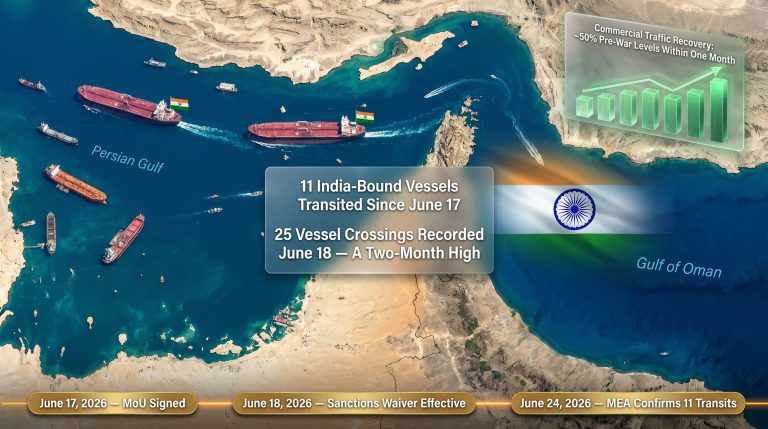
This is not a new vulnerability, but the 2026 West Asia conflict brought it into sharp relief. When the United States and Israel launched military action against Iran on February 28, 2026, and Iran responded by effectively blockading the Strait of Hormuz, India found itself acutely exposed. The Strait is the world's most consequential oil chokepoint, handling nearly one-fifth of global oil and LNG supplies. For a nation sourcing the majority of its crude from the Gulf region, the disruption was immediate and material.
NITI Aayog Vice Chairman Ashok Kumar Lahiri characterised the episode as a manageable disruption rather than a systemic crisis, drawing a distinction between a temporary supply shock and a structural collapse of the kind that would trigger far deeper economic damage. His framing, however, carried an implicit warning: the lesson was not that India survived the crisis comfortably, but that the concentration of import dependency in a single geographic corridor cannot be allowed to persist.
The geopolitical situation evolved rapidly. On June 18, 2026, US President Donald Trump signed an agreement with Iran that required Tehran to dilute its stockpile of highly enriched uranium, while simultaneously waiving US-backed sanctions and allowing Iran to resume selling oil freely on international markets. The speed of that reversal, from blockade to free passage within months, illustrates precisely why structural diversification cannot rely on diplomatic resolution as a backstop. The global LNG supply outlook further underscores how quickly these dynamics can shift.
The key risk insight here is that geopolitical agreements are reversible. Physical infrastructure, diversified supply contracts, and domestic production capacity are not. India's planning frameworks must be built around the latter, not the former.
The Five-Pillar Architecture of India's Diversification Strategy
India's response to structural energy vulnerability is organised around five interconnected transformation pillars, each targeting a different dimension of the dependency problem:
-
Coal gasification converts domestic coal reserves into synthetic gas, reducing the need for imported natural gas while leveraging existing resource endowments.
-
Biofuels and compressed bio-gas (CBG) deploy India's vast agricultural biomass base to substitute petroleum in transport and distributed energy applications.
-
Nuclear energy expansion targets a doubling of existing capacity, providing reliable low-carbon baseload power that complements intermittent renewables.
-
Green hydrogen development is designed to build a full domestic value chain, from electrolysis through to export-capable infrastructure, positioning India as a clean fuel producer rather than solely a consumer.
-
Pumped hydro storage enables the grid to absorb and dispatch large volumes of intermittent renewable power, solving the storage bottleneck that currently limits renewable penetration.
Each pillar addresses a distinct failure mode in the current system, and critically, each requires a different combination of capital, technology, regulation, and timelines to execute.
Renewable Energy: Progress That Reframes the Debate
The fastest-moving component of India's diversification agenda is renewable energy deployment, and the numbers are beginning to reshape how analysts think about the country's energy trajectory.
| Renewable Source | Installed Capacity Target (2030) | Status |
|---|---|---|
| Solar | 280 GW | Significant capacity commissioned |
| Wind | 140 GW | Onshore and offshore pipeline expanding |
| Biomass / Biogas | 11.35 GW | Operational and diversifying portfolio |
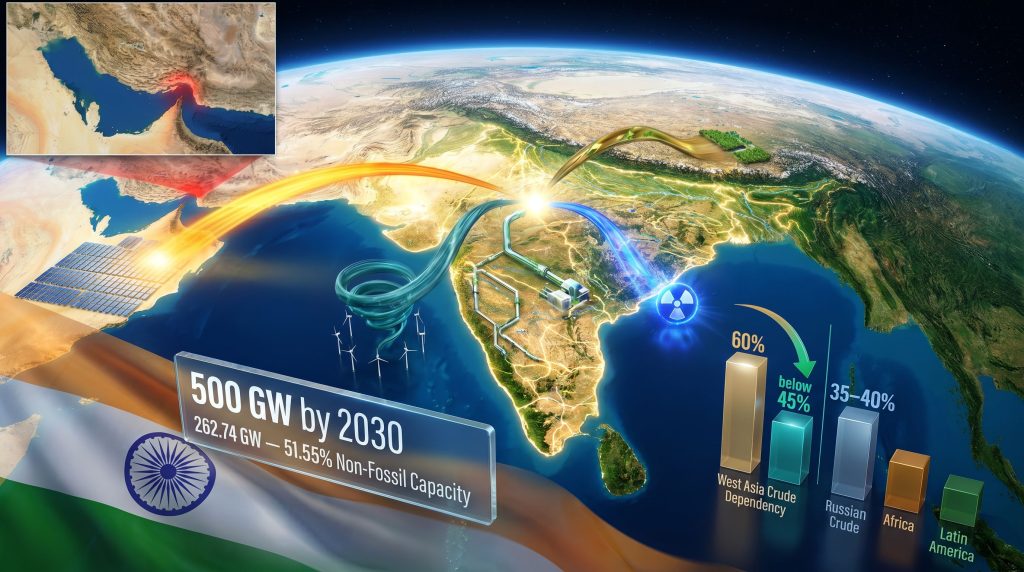
| Total Non-Fossil | 500 GW | 262.74 GW reached by November 2025 |
Non-fossil energy sources now represent 51.55% of total installed generation capacity in India, a milestone that would have seemed implausible a decade ago. More meaningfully, renewables met 51.5% of daily electricity demand in July 2025, demonstrating that installed capacity is being actively utilised rather than sitting as paper infrastructure.
Total national generation capacity stands at approximately 462 GW, with renewables accounting for roughly 45% of that figure. The directional shift is clear: coal's share of meeting new electricity demand dropped from 91% in 2023 to 64% in 2024, a structural inflection point that signals the beginning of a genuine transition rather than incremental adjustment. According to Ember's India energy tracker, this momentum is expected to accelerate as policy incentives and falling technology costs converge.
Restructuring Crude Oil Supply: The Geography of Diversification
Beyond renewables, India has been quietly but deliberately restructuring the geographic composition of its crude oil imports. West Asian crude's share of India's import basket declined from approximately 60% to below 45% between 2024 and 2025, a substantial rebalancing achieved through pragmatic supplier diversification.
Russian crude now constitutes 35 to 40% of India's total crude oil imports, reflecting a commercially rational decision to access discounted supply following Western sanctions on Russian energy exports after 2022. Africa, particularly Nigeria and Angola, and Latin America, particularly Brazil, are being developed as supplementary supply corridors, providing geographic spread that reduces single-region dependency.
On the gas side, India maintains 5.3 million metric tonnes (MMT) of Strategic Petroleum Reserves as a short-term buffer against acute supply disruptions. Long-term LNG supply contracts with Qatar, Russia, and Mozambique are anchoring gas security beyond spot market exposure, reducing the price volatility risk that accompanies reliance on short-duration purchasing.
A critical but underappreciated dynamic: Russia's growing share of India's crude supply creates a different form of concentration risk, substituting geopolitical exposure in the Middle East for geopolitical exposure linked to the Russia-Ukraine conflict and ongoing Western sanctions frameworks. True diversification requires managing both geographic and political dimensions simultaneously.
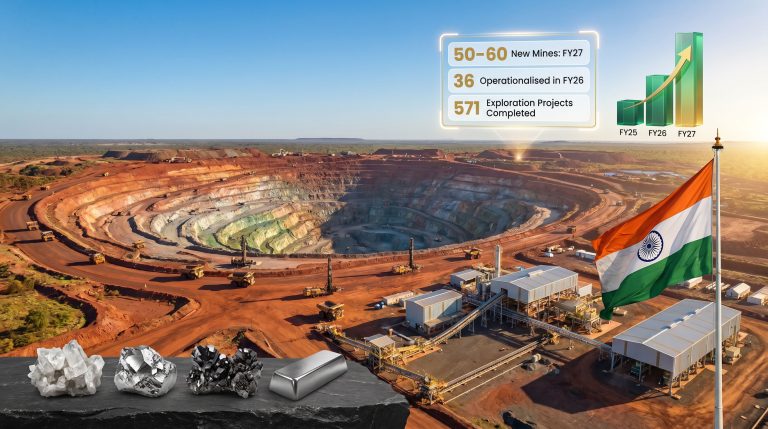
Furthermore, the critical minerals demand surge associated with India's transition to clean energy is adding another layer of import dependency that policymakers must address in parallel.
Green Hydrogen, Biofuels, and the Alternative Fuel Ecosystem
The National Green Hydrogen Mission
India's green hydrogen ambitions extend beyond domestic energy substitution. The National Green Hydrogen Mission is designed to develop a complete value chain, from large-scale electrolysis capacity through to export infrastructure, positioning India as a potential supplier to energy-importing nations across Asia and Europe. This dual role, as both consumer and exporter, could fundamentally alter India's position in global clean energy trade flows over the coming decade.
Biofuels and Agricultural Energy Integration
The Ethanol Blending Program (EBP) is progressively substituting petroleum-based transport fuels with domestically produced ethanol, reducing both import volumes and foreign exchange expenditure. The PM-KUSUM scheme deploys solar energy in agricultural applications, directly displacing diesel consumption in rural areas and targeting one of the most diffuse but significant sources of fossil fuel dependency in the Indian economy.
Production Linked Incentive (PLI) schemes for battery manufacturing are simultaneously accelerating domestic battery production capacity, which underpins both electric vehicle adoption and grid-scale storage deployment.
Nuclear Energy's Strategic Role
Nuclear power occupies a quietly critical position in India's diversification architecture. Doubling nuclear capacity would provide large volumes of dispatchable, low-carbon baseload power that neither solar nor wind can consistently deliver. This matters specifically because it reduces the coal-to-gas transition burden: without sufficient baseload alternatives, any rapid reduction in coal generation creates reliability gaps that gas must fill, re-creating import dependency in a different fuel form.
The next major ASX story will hit our subscribers first
Trade Policy as an Energy Security Instrument
One of the less widely recognised dimensions of India's diversification strategy is the deliberate integration of energy provisions into trade policy architecture. NITI Aayog has recommended that future Free Trade Agreements include dedicated energy chapters alongside pharmaceutical chapters, reflecting a strategic understanding that trade frameworks can lock in supply relationships in ways that transcend short-term geopolitical volatility.
A bilateral India-US trade agreement, currently in advanced negotiation stages, could unlock preferential access to US LNG exports. This would provide India with a politically stable, geographically diversified gas supply source, reducing dependence on Middle Eastern and Russian gas simultaneously. Embedding energy commitments within legally binding trade frameworks creates supply security that diplomatic goodwill alone cannot replicate.
In addition, India's lithium supply strategy demonstrates how this trade-integrated approach is already being applied to secure the critical mineral inputs that underpin battery and clean energy manufacturing ambitions. The broader context of critical minerals and energy security makes clear that this is fast becoming as consequential as oil and gas supply management.
Structural Challenges That Cannot Be Overlooked
India energy diversification confronts several structural constraints that policy ambition alone cannot dissolve:
-
Demand growth outpaces transition speed. India is projected to account for one-third of global energy demand growth through to 2050, placing enormous pressure on the pace at which diversification must proceed. Every year of delayed structural change increases the volume of imports required to bridge the gap.
-
Grid integration bottlenecks. Scaling intermittent renewable energy to 500 GW by 2030 requires parallel investment in grid modernisation and storage infrastructure. Without it, installed renewable capacity cannot be reliably dispatched, forcing continued coal dependence for system stability.
-
The National Gas Grid target of 33,500 km by 2030 is critical to enabling gas as a legitimate transition fuel between coal and fully renewable generation. Current progress toward this target will determine whether gas can play a meaningful bridging role or remains geographically constrained.
-
Capital intensity of parallel transitions. India is simultaneously managing coal phase-down, renewable scale-up, green hydrogen development, and nuclear expansion. Each requires distinct capital structures, regulatory frameworks, and technology partnerships, creating coordination complexity that centrally planned economies can manage through mandate but market-based systems must navigate through incentive design.
India's Energy Diversification Scorecard
| Strategic Dimension | Current Position | 2030 Target | Risk Level |
|---|---|---|---|
| Non-fossil installed capacity | 262.74 GW (51.55% of total) | 500 GW | Medium |
| West Asia crude dependency | Below 45% of imports | Below 30% (estimated) | High |
| Russian crude reliance | 35-40% of imports | Balanced multi-source | Medium-High |
| Green hydrogen value chain | Early-stage development | Export-capable infrastructure | High |
| Strategic Petroleum Reserves | 5.3 MMT | Expansion planned | Medium |
| National Gas Grid | Partial completion | 33,500 km by 2030 | Medium |
| Nuclear capacity | Current baseline | Doubled capacity | Low-Medium |
From Reactive Management to Structural Sovereignty
The deepest strategic insight emerging from India's 2026 supply disruption experience is that India energy diversification cannot be maintained through tactical responses to individual crises. Strategic Petroleum Reserves, emergency supplier negotiations, and diplomatic interventions are necessary tools, but they address symptoms rather than causes.
The principle that Lahiri articulated, that no economy should concentrate its import and export dependencies in a single basket, is not a new insight. What is new is the institutional seriousness with which India is now embedding that principle into planning frameworks, infrastructure investment cycles, trade negotiations, and technology procurement decisions.
India's position in the global energy transition is uniquely consequential. As the world's third-largest energy consumer and the nation projected to drive approximately one-third of global energy demand growth to 2050, the choices India makes about its energy architecture will shape commodity markets, clean technology supply chains, and geopolitical energy alliances for decades. The IEA's World Energy Investment 2025 report on India highlights just how central India's decisions will be to global clean energy outcomes. The transition from energy vulnerability to energy sovereignty is not simply a national policy objective; it is a variable with global implications.
Disclaimer: This article contains forward-looking statements, projections, and scenario analyses drawn from publicly available data and policy frameworks. Readers should note that energy transition timelines, capacity targets, and geopolitical scenarios involve inherent uncertainty and are subject to change. This content does not constitute financial or investment advice. For further reading on India's energy policy landscape, ET EnergyWorld provides ongoing coverage at energy.economictimes.indiatimes.com.
Want to Identify ASX Opportunities Linked to India's Critical Minerals and Energy Transition Boom?
Discovery Alert's proprietary Discovery IQ model delivers real-time alerts on significant ASX mineral discoveries — including the critical minerals central to India's accelerating energy diversification strategy — instantly empowering subscribers to identify actionable opportunities ahead of the broader market. Explore historic discoveries and their exceptional returns on Discovery Alert's dedicated discoveries page, and begin your 14-day free trial today to position yourself ahead of the market.