June 24, 2026
The Quiet Race to Build Sovereign Resource Capacity
Across the global economy, a structural shift is reshaping how nations think about raw material security. The energy transition has made critical minerals demand the new oil, and countries that once treated mining policy as an afterthought are now recasting it as a matter of national economic survival. The speed at which a country can move from geological discovery to operational mine output has become a defining competitive variable in the 21st century resource race.
India's trajectory within this context is particularly instructive. For decades, the country relied heavily on imports to satisfy industrial demand for lithium, nickel, cobalt, and rare earth elements. That dependence created structural vulnerability across sectors ranging from electric vehicle manufacturing to defence electronics. The question was never whether India needed to build domestic supply capacity, but rather how quickly its policy architecture could translate ambition into extraction.
When big ASX news breaks, our subscribers know first
India Plans to Operationalise Up to 60 Mines in FY27: The Numbers Behind the Target
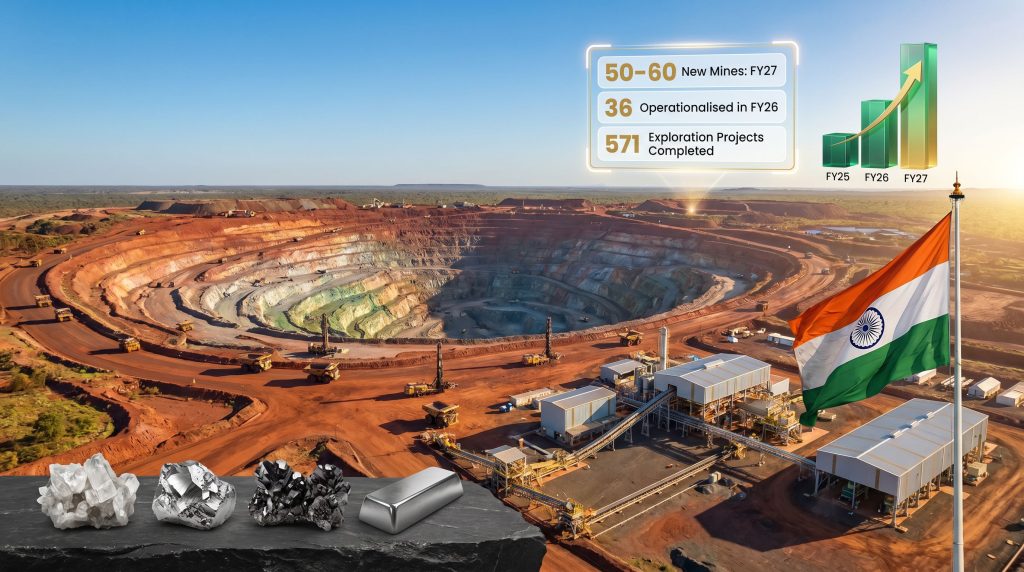
The scale of what India is attempting in the 2026-27 fiscal year deserves careful unpacking. India plans to operationalise up to 60 mines in FY27, and the government's target to operationalise between 50 and 60 new mines is not a modest incremental step. In FY26, 36 mines were operationalised, including 28 greenfield projects, which was itself a significant acceleration. Achieving 50 to 60 in a single fiscal year would represent a 39 to 67% increase in annual mine delivery, compressing what would normally be a multi-year pipeline into twelve months.
Since the current auction regime was introduced in 2015, 58 greenfield mines have been operationalised in total. If FY27 targets are met, India could effectively double its entire post-2015 greenfield output in a single year. That is an extraordinary rate of acceleration, and it signals genuine institutional momentum rather than aspirational target-setting.
India's mine operationalisation ambition in FY27 is not simply a policy announcement. It reflects an auction pipeline that has matured to the point where greenfield projects are moving from bid award to operational status at a pace that was not considered achievable five years ago.
What Greenfield Development Actually Involves
Understanding the Complexity Behind Each New Mine
A common misconception in public discourse is that a mine announcement is equivalent to a mine opening. In practice, greenfield development — which involves constructing an entirely new extraction operation on a previously undeveloped site — requires navigating environmental impact assessments, securing water and land access rights, building access roads and power connections, and commissioning processing infrastructure.
The fact that India is now tracking greenfield operationalisation as its primary delivery metric, rather than simply counting auctions or exploration completions, reflects a meaningful maturation in how the government measures progress. An operationalised mine produces ore. An auctioned block is a legal right. The distance between the two is where most resource development programmes historically stall.
The Minerals Driving FY27 Prioritisation
| Mineral | Primary Application | India's Strategic Priority |
|---|---|---|
| Lithium | EV batteries, grid-scale storage | Processing unit bids within three months |
| Nickel | Battery anodes, stainless steel | Processing tender fast-tracked alongside lithium |
| Rare Earth Elements | Wind turbines, defence electronics, EVs | Self-sufficiency target by 2031 |
| Zirconium | Nuclear reactors, aerospace ceramics | Domestic sufficiency goal by 2031 |
| Titanium | Aerospace structures, advanced manufacturing | Strategic self-sufficiency targeted |
| Cadmium | Industrial recycling and battery applications | Recovery and recycling now operational domestically |
Cadmium's inclusion on this list is worth highlighting. Unlike lithium or nickel, cadmium is rarely discussed in mainstream critical minerals coverage. Yet cadmium recovery from zinc smelting residues and battery recycling represents a commercially viable near-term output stream. The fact that significant cadmium quantities are now being domestically recovered signals that India's circular economy framework for critical minerals is already generating measurable results, not just theoretical future capacity.
The Exploration Pipeline: India's Long-Game Advantage
GSI Progress and the Upward Revision of 2031 Targets
Most resource strategies fail not at the mine development stage but at the geological discovery stage. A country cannot auction what it has not yet identified. This is where India's Geological Survey of India (GSI) programme becomes strategically decisive. Furthermore, according to the Ministry of Mines, GSI has been directed to take up 300 critical mineral projects specifically in FY27.
The GSI has now completed 571 exploration projects, and a further 300 are scheduled for completion in FY27 alone. What makes this figure particularly significant is the context around the original planning benchmark. The initial 2031 target was 1,200 exploration projects. India is now projecting it will complete more than 2,000 projects by 2031, a revision of over 65% above the original goal.
When a government revises its exploration targets upward by more than 65% not because of political optimism but because the existing programme is outperforming its original assumptions, it signals institutional delivery credibility of a kind that is rare in large-scale resource development programmes.
Private Sector Participation: Exceeding Original Benchmarks
The performance of private-sector exploration blocks adds another dimension to this story. The original target was to auction 100 private exploration blocks by 2031. As of mid-2026, 56 blocks have already been auctioned, and the government now projects the final total will exceed 200, more than double the initial ambition.
| Programme | Original 2031 Target | Current Status | Revised Projection |
|---|---|---|---|
| GSI Exploration Projects | 1,200 | 571 completed | 2,000+ by 2031 |
| Private Exploration Blocks | 100 | 56 auctioned | 200+ by 2031 |
| Greenfield Mine Operationalisations | Incremental | 58 since 2015 | 50-60 in FY27 alone |
This pattern of consistent target outperformance is analytically important. It suggests the exploration-to-production conversion pipeline is not just growing in volume but accelerating in velocity, which has positive implications for sustained mine operationalisation beyond FY27.
Processing Infrastructure: The Critical Link That Mine Numbers Alone Cannot Solve
Why Ore Without Refining Capacity Is a Partial Solution
One of the least appreciated constraints in critical mineral development is the gap between extracting ore and producing a commercially usable material. A lithium mine that ships raw spodumene concentrate to a foreign processor does not deliver supply chain sovereignty. It delivers raw material export with value capture occurring elsewhere.
India's recognition of this distinction is reflected in the decision to fast-track bids for lithium and nickel processing units, with tender invitations expected within three months of the FY27 mine operationalisation announcement. This is a deliberate value-chain integration strategy that parallels approaches adopted by Australia, which has similarly pushed to develop domestic hydroxide and sulphate processing capacity rather than exporting raw concentrate indefinitely. In this context, technologies such as direct lithium extraction are increasingly relevant to achieving faster, more efficient processing outcomes.
The lithium processing segment is technically demanding. Converting spodumene or brine lithium into battery-grade lithium hydroxide or lithium carbonate requires acid roasting, leaching, purification, and crystallisation stages. Each step requires specialised chemical engineering infrastructure and strict quality controls to meet battery manufacturer specifications. India's decision to begin the tendering process now, in parallel with mine development, reflects an understanding that processing capacity has a longer lead time than mine construction.
Fiscal Architecture Supporting the Scale-Up
The Financial Instruments Behind India's Mining Ambition
Operational delivery at the scale India is targeting requires more than regulatory frameworks. It requires capital mobilisation. Several fiscal instruments are actively supporting the FY27 push:
- A ₹5,000 crore incentive scheme under the SASCI (State Assistance for Sustainable Critical minerals Infrastructure) framework targeting mining reforms, block auctions, and state-level operationalisation
- Customs duty exemptions on capital goods used in critical mineral processing, reducing the investment cost threshold for downstream refining facilities
- Dedicated mineral corridors under development across Odisha, Tamil Nadu, Kerala, and Andhra Pradesh, creating logistics and infrastructure networks aligned with the country's most resource-rich geographies
| State | Corridor Focus | Key Minerals |
|---|---|---|
| Odisha | Base metals and critical minerals | Nickel, chromite, manganese, iron ore |
| Tamil Nadu | High-tech material supply | Rare earths, titanium, zirconium |
| Kerala | Specialised industrial inputs | Rare earth minerals, silica |
| Andhra Pradesh | Diversified resource base | Bauxite, limestone, critical minerals |
The corridor strategy is significant because it addresses a constraint that mine targets alone cannot solve: the physical infrastructure required to move ore from remote extraction sites to processing facilities and eventually to industrial consumers.
The next major ASX story will hit our subscribers first
India's Position in the Global Critical Mineral Competition
How India Compares to Competing Resource Economies
The geopolitical context around India's FY27 push is worth examining carefully. China currently controls approximately 85% of global rare earth processing capacity, a dominance built over three decades of deliberate industrial policy. India's stated goal of self-sufficiency in rare earth elements, zirconium, and titanium by 2031 is an explicit strategic counter to this concentration risk. However, it is important to note that displacing entrenched processing ecosystems takes longer than building extraction capacity. Consequently, the broader implications of China's rare earth export restrictions have only reinforced India's urgency to accelerate domestic development.
The United States, through the Inflation Reduction Act, and the European Union, through the Critical Raw Materials Act, are both constructing domestic supply chain frameworks with urgency. India is entering this competitive environment with structural advantages that are often underestimated:
- Large, significantly underexplored geological formations across the Deccan Plateau, peninsular India, and the Himalayan belt
- A mature institutional capacity in the GSI that has been systematically upgraded over the past decade
- A functional private sector auction regime that has demonstrated it can outperform original targets
- A growing domestic EV and clean energy manufacturing base that creates natural demand pull for processed minerals
In addition, the green transition materials imperative is driving many of these nations to compete intensively for the same finite resource base, making India's domestic supply acceleration all the more strategically significant.
Execution Risks: Where the 60-Mine Target Could Face Headwinds
Structural Bottlenecks That Cannot Be Ignored
The operational optimism embedded in the FY27 target needs to be balanced against realistic execution constraints:
- Environmental clearance timelines remain one of the most persistent bottlenecks in Indian mining development. Greenfield projects in ecologically sensitive zones can face multi-year delays regardless of auction completion
- Workforce capability gaps in specialised mining engineering and mineral processing roles represent a medium-term constraint that infrastructure investment alone cannot resolve
- Processing unit readiness lag is perhaps the most significant near-term risk. If lithium and nickel processing facilities remain in the tender stage while mine output comes online, raw ore may need to be exported for processing, undermining the value-chain integration objective
- Remote site connectivity in mineral-rich but infrastructure-poor regions of Odisha, Rajasthan, and Chhattisgarh requires parallel investment in roads, power, and water
Scenario Modelling: Outcomes Across Different Delivery Rates
| Scenario | Mines Operationalised | Downstream Implications |
|---|---|---|
| Full delivery (target met) | 50-60 new mines | Processing bids awarded; 300 GSI projects completed; private block auctions accelerate |
| Moderate shortfall | 35-45 new mines | Processing timeline slips 6-12 months; exploration revision pace moderates |
| Upside case | 60+ mines | 2031 exploration target exceeds 2,000; India begins refined mineral exports in select categories |
The Recycling Dimension: Building a Circular Critical Minerals Economy
Why Secondary Recovery Matters as Much as Primary Extraction
One aspect of India's critical mineral strategy that receives insufficient attention is the parallel development of a domestic recycling and secondary recovery ecosystem. The Materials Recycling Association of India (MRAI) is an active stakeholder in this process, and the cadmium recovery programme that is now delivering measurable results is the first operational proof point of a broader circular economy ambition.
The strategic logic is compelling. Over a long enough time horizon, recycled critical minerals from spent batteries, electronics, and industrial equipment can reduce the volume of primary mining required to satisfy industrial demand. The battery recycling process, in particular, has the potential to supply a meaningful percentage of lithium and nickel demand once the first generation of EV batteries reaches end-of-life at scale, which global analysts broadly expect to occur in the late 2020s and through the 2030s.
India's simultaneous development of primary extraction, downstream processing, and secondary recovery infrastructure represents a more complete supply chain strategy than simply counting mine operationalisations. It is the integration of these three layers that will ultimately determine whether the 2031 self-sufficiency targets are achievable.
Frequently Asked Questions: India's FY27 Mine Operationalisation Plan
How Many Mines Is India Planning to Open in FY27?
India plans to operationalise up to 60 mines in FY27, predominantly greenfield projects, building on 36 mines opened in FY26. The total greenfield count since the 2015 auction regime stands at 58.
What Critical Minerals Are the Priority for India's FY27 Mining Expansion?
Lithium and nickel are the headline processing priorities, alongside rare earth elements, zirconium, titanium, and cadmium, all of which are essential for clean energy, electric vehicles, and advanced defence manufacturing.
What Is India's Revised Exploration Project Target for 2031?
The original target of 1,200 GSI exploration projects by 2031 has been revised upward to more than 2,000. With 571 already completed and 300 more scheduled for FY27, India is on track to substantially exceed its original benchmark.
What Financial Incentives Support India's Mining Expansion in FY27?
A ₹5,000 crore incentive scheme under the SASCI framework has been launched alongside customs duty exemptions on capital goods used in critical mineral processing facilities and investment in dedicated state-level mineral corridors.
When Will Bids for Lithium and Nickel Processing Units Be Invited?
Tender invitations for lithium and nickel processing units are expected within three months of the FY27 mine operationalisation announcement, reflecting the government's priority to build downstream refining capacity in parallel with primary extraction. Official government press releases confirm the broader policy framework underpinning these commitments.
Key Takeaways: India's Critical Mineral Mining Trajectory
- FY27 target: 50-60 new mine operationalisations, versus 36 in FY26, representing a potential 39-67% year-on-year increase
- Total greenfield mines since 2015: 58 completed; FY27 target could effectively double this figure in a single year
- Exploration revision: 2031 GSI target upgraded from 1,200 to 2,000+ projects with 571 already completed
- Private sector blocks: 56 of an original 100-block target already auctioned; revised projection now exceeds 200
- Processing infrastructure: Lithium and nickel facility bids to be invited within three months, with customs duty exemptions reducing investment barriers
- Fiscal support: ₹5,000 crore SASCI scheme combined with state mineral corridor development across four key states
- 2031 ambition: Full self-sufficiency in rare earth elements, zirconium, and titanium, supported by a parallel circular economy recycling programme
- Cadmium recovery: Already operational domestically, providing the first validated proof point for India's integrated critical mineral strategy
Disclaimer: This article contains forward-looking statements, projections, and scenario analysis based on publicly available information. Readers should conduct their own research before making any investment or policy-related decisions. Target timelines and output figures are subject to change based on regulatory, environmental, and operational developments.
Want To Be First When the Next Major Mineral Discovery Hits the ASX?
Discovery Alert's proprietary Discovery IQ model scans ASX announcements in real time, instantly converting complex mineral data across more than 30 commodities into clear, actionable insights — so investors can act before the broader market catches on. Explore historic examples of major mineral discoveries and their returns, then start your 14-day free trial at Discovery Alert to position yourself at the forefront of the next significant find.