August 20, 2026
Understanding India's Energy Import Dependency Crisis
India's position as the world's third-largest oil importer creates structural exposure to global supply shocks that reverberates through every sector of its economy. The India oil import bill surge has become a critical economic challenge as the nation consumes 4.3 million barrels of crude oil daily, translating to an annual import expenditure of approximately $180 billion under normal market conditions. This massive energy requirement reflects India's industrial growth trajectory and expanding transportation infrastructure, making energy security a cornerstone of economic stability.
The evolution of India's oil dependency relative to GDP reveals both progress and persistent vulnerability. Historical data shows that oil and gas imports represented 6.8-7.3% of GDP during the period 10-15 years ago, compared to the current level of 3.8% of GDP. This improvement indicates enhanced energy efficiency across industrial processes, a structural shift toward service-sector-led economic growth, and increased renewable energy integration reducing overall fossil fuel intensity.
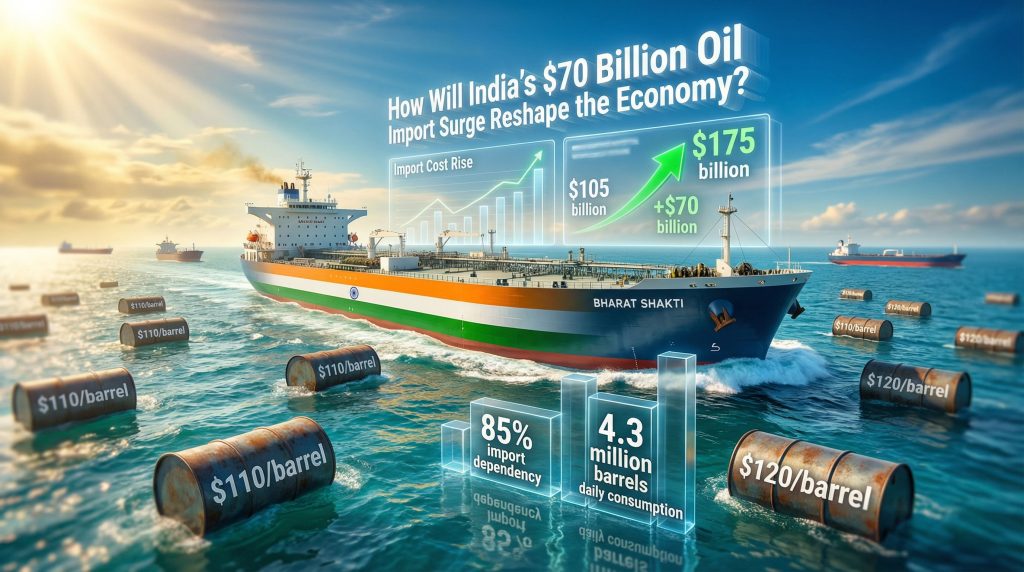
However, this reduced dependency ratio faces severe testing during supply disruptions. Current geopolitical tensions have elevated crude prices from pre-conflict levels of $65 per barrel to the $110-120 range, creating potential additional annual costs exceeding $70 billion. Furthermore, the scale of this impact demonstrates how quickly improved energy efficiency gains can be overwhelmed by external supply shocks.
Key factors contributing to India's import vulnerability include:
• Geographic concentration of traditional supply sources in politically unstable regions
• Limited domestic production covering only 15% of total consumption requirements
• Refinery infrastructure designed primarily for imported crude processing rather than domestic alternatives
• Storage capacity constraints limiting strategic reserve utilisation for price smoothing
The transformation from 6.8% to 3.8% GDP dependency represents significant structural improvement, yet the absolute scale of 4.3 million barrels daily consumption ensures that price volatility continues generating substantial macroeconomic consequences. In addition, this dependency structure requires continuous strategic adaptation as global energy markets evolve.
When big ASX news breaks, our subscribers know first
What Economic Forces Drive India's Import Bill Escalation?
Current crude price dynamics reflect multiple compounding factors beyond traditional supply-demand fundamentals. The West Asia conflict has created persistent upward pressure on global oil prices, with market analysis indicating limited probability of near-term reversion to pre-conflict levels. This price elevation operates through direct commodity cost increases and secondary effects including currency depreciation and logistics cost inflation.
Price Impact Analysis:
| Price Scenario | Annual Import Cost | Additional Burden vs. Baseline |
|---|---|---|
| $65/barrel (pre-conflict) | $105 billion | Baseline |
| $110/barrel (current range) | $175 billion | +$70 billion |
| $120/barrel (escalation case) | $190 billion | +$85 billion |
The rupee's depreciation of approximately 4% to the 95 USD/INR range compounds these challenges through a multiplier effect. Dollar-denominated crude purchases become more expensive in rupee terms, while simultaneously, the absolute dollar price of crude has increased substantially. This dual impact creates monthly foreign exchange outflows $7-8 billion higher than historical baselines, straining India's current account balance.
Structural factors supporting elevated price levels include:
• Refinery capacity destruction requiring extended reconstruction periods
• Supply chain disruption affecting multiple production and distribution nodes
• Insurance premium escalation for energy infrastructure and transportation
• Freight cost increases due to route diversification and risk premiums
Market analysis suggests these cost elevations exhibit persistence rather than temporary spikes. Unlike previous oil shocks driven primarily by production capacity constraints, current disruptions involve physical infrastructure damage requiring months or years for complete restoration. Additionally, shipping and logistics costs have structurally increased due to enhanced security requirements and alternative routing necessities.
The elasticity of India's import costs to crude price changes demonstrates significant leverage: each $10 per barrel increase translates to approximately $14-16 billion additional annual expenditure. However, this relationship accounts for daily consumption of 4.3 million barrels across 365 days, creating immediate fiscal impact without adjustment lags.
Currency pass-through mechanisms amplify these effects. The 4% rupee depreciation increases effective crude costs by additional percentage points when combined with higher absolute prices, creating compound purchasing power erosion that affects not only energy imports but broader commodity trade relationships.
Which Supply Chain Vulnerabilities Threaten India's Energy Security?
Maritime chokepoints represent the most critical vulnerability in India's energy supply architecture. The Strait of Hormuz handles 20% of global crude oil transit, creating single-point-of-failure risk for energy supplies serving multiple continents. Current geopolitical tensions surrounding this corridor have elevated risk premiums and forced consideration of alternative routing options with substantially different cost structures.
Regional escalation poses additional threats through the Bab Al-Mandeb corridor, another crucial maritime passage for Middle Eastern crude shipments. Combined disruption of both chokepoints could force energy shipments around the Cape of Good Hope, adding weeks to voyage time and increasing transportation costs by estimated $20-30 billion annually for India's total import requirements.
Physical infrastructure damage extends beyond transportation routes to production and refining capacity. Multiple global natural gas and oil refineries have sustained significant damage requiring comprehensive reconstruction efforts. Unlike temporary production shutdowns, damaged refinery infrastructure necessitates complete facility assessment, equipment replacement, and operational restart procedures spanning months or years.
Critical Infrastructure Assessment:
• Refinery reconstruction timelines: Typically 12-36 months depending on damage severity
• Alternative route costs: Cape of Good Hope routing adds 15-20 days voyage time
• Insurance premium increases: Risk coverage costs elevated 200-400% in affected regions
• Tanker availability constraints: Limited vessel capacity for alternative routing requirements
Shipping cost escalation operates through multiple channels beyond basic freight charges. Insurance costs for energy transportation have increased dramatically due to expanded risk zones and potential conflict exposure. Tanker availability faces constraints as vessels require longer voyage times for alternative routing, reducing overall fleet efficiency and driving charter rate increases.
The persistence of these logistics cost increases represents a structural shift rather than temporary adjustment. Even with eventual conflict resolution, enhanced security protocols, insurance requirements, and infrastructure replacement needs will maintain elevated baseline costs for energy transportation and processing.
"Supply chain resilience now requires redundant routing options and diversified supplier relationships, fundamentally altering the cost structure of energy imports for major consuming nations."
Emergency response capabilities depend heavily on strategic petroleum reserve utilisation and alternative supplier activation. India's current storage capacity provides limited buffering against extended supply disruptions, necessitating rapid diversification implementation during crisis periods rather than gradual transition planning.
How Does India's Import Diversification Strategy Address Cost Pressures?
India's strategic pivot toward geographic diversification represents a fundamental shift from cost optimisation toward supply security prioritisation. Current initiatives demonstrate 225% year-over-year growth in US crude imports, reaching $4.5 billion in value, while simultaneously expanding relationships with Russia, Norway, and Australia across both crude oil and liquefied natural gas markets.
This diversification strategy involves deliberate trade-offs between cost efficiency and supply reliability. US shale crude typically commands premium pricing due to transportation distances and different crude characteristics requiring refinery adaptation. Similarly, Norwegian and Australian energy exports involve higher logistics costs but provide geographically separated supply sources reducing concentration risk.
Diversification Target Analysis:
• United States: 24% growth trajectory targeting $22.7 billion annual imports
• Russia: Enhanced energy relationship despite sanctions complexity
• Norway: LNG partnership development for natural gas requirements
• Australia: Long-term contract negotiations for diversified energy supplies
Russian energy relationships present unique complexity due to international sanctions frameworks requiring alternative payment mechanisms and specialised contract structures. For instance, geographic proximity and existing pipeline infrastructure offer potential cost advantages offsetting political risk considerations. India's Russian oil imports have demonstrated the practical benefits of this diversification, with import volumes reaching significant levels despite global sanctions.
Technical compatibility represents another critical factor in diversification success. Different crude oil grades possess varying sulfur content, density characteristics, and refining requirements. India's refinery infrastructure, originally designed for Middle Eastern crude processing, requires operational adjustments to efficiently handle light sweet crude from US sources or heavy crude from alternative suppliers.
Port infrastructure capacity constrains the pace of diversification implementation. Increased import volumes from geographically dispersed sources require expanded receiving, storage, and distribution capabilities. Current port utilisation rates and planned capacity expansions determine realistic timelines for meaningful supply source rebalancing.
Long-term Contracting Strategies
Long-term contracting strategies balance price predictability against supply flexibility. Traditional Middle Eastern suppliers often provide favourable pricing through long-term agreements, while spot market purchases from diversified sources offer supply security at premium costs. Consequently, India's strategy involves optimising this portfolio approach to minimise both cost and supply risk exposures.
The success of diversification efforts depends critically on infrastructure development timelines and technical adaptation requirements. Enhanced port capacity, refinery modifications, and logistics network expansion require substantial capital investment and multi-year implementation periods before achieving material impact on supply security metrics.
What Macroeconomic Consequences Will Higher Import Costs Trigger?
Oil price increases transmit through India's economy via multiple interconnected channels, creating cascading effects across manufacturing, transportation, and consumer price indices. Economic analysis demonstrates that each $10 per barrel crude price increase generates approximately $14-16 billion in additional import costs, while simultaneously triggering 0.4% GDP increase in current account deficit. This represents the second instance where the India oil import bill surge creates significant economic pressure across multiple sectors.
Inflation Transmission Analysis:
| $10/barrel Price Increase | Economic Impact |
|---|---|
| Net Import Cost | +$14-16 billion |
| Current Account Deficit | +0.4% of GDP |
| WPI Inflation | +80-100 basis points |
| CPI Inflation | +40-60 basis points |
Wholesale Price Index (WPI) inflation demonstrates greater sensitivity to crude price changes than Consumer Price Index (CPI) inflation, reflecting direct input cost impacts on industrial and manufacturing processes. The 80-100 basis point WPI increase translates to 40-60 basis point CPI impact with typical 2-3 month transmission lags as wholesale cost increases flow through supply chains to consumer pricing.
Sectoral impact distribution varies significantly across economic segments:
• Transportation and Logistics: Immediate diesel cost increases affecting freight charges across all goods movement
• Manufacturing: Energy input cost escalation impacting production economics, particularly in energy-intensive industries
• Agriculture: Fertiliser and irrigation cost increases flowing through food supply chains with 1-2 quarter lag effects
• Aviation: Direct jet fuel cost increases already implemented through multiple price adjustments
Second-order effects include manufacturing competitiveness erosion as higher energy costs increase production expenses without corresponding productivity improvements. Export competitiveness suffers when domestic cost structures rise faster than international competitor costs, potentially affecting trade balance beyond direct import cost increases.
Policy Response Mechanisms
Policy response mechanisms include targeted excise duty reductions, exemplified by the Rs 10 per liter cut implemented during previous price spikes. However, sustained crude price elevation limits the effectiveness of temporary fiscal measures, particularly during state election periods when political considerations influence fuel pricing decisions.
Monetary policy implications emerge through imported inflation pressures requiring Reserve Bank of India assessment of appropriate interest rate responses. Higher crude costs create inflationary pressure conflicting with growth support objectives, potentially constraining monetary policy flexibility during economic expansion phases.
Currency depreciation amplifies these inflationary pressures through additional cost increases for all dollar-denominated imports beyond crude oil. The 4% rupee decline to approximately 95 USD/INR creates broader import cost inflation affecting consumer goods, industrial inputs, and capital equipment purchases.
Can India's Economy Absorb This Energy Cost Shock?
India's enhanced resilience compared to historical oil shocks reflects structural economic evolution over the past decade. The reduction in oil import dependency from 6.8-7.3% to 3.8% of GDP demonstrates improved energy efficiency, economic diversification, and reduced vulnerability to commodity price volatility. This improvement provides meaningful buffer capacity against current cost escalations, yet the India oil import bill surge continues to pose significant challenges.
Several factors contribute to enhanced shock absorption capability:
• Renewable energy expansion reducing overall fossil fuel dependency growth rates
• Energy efficiency improvements across industrial and transportation sectors
• Economic structure shift toward less energy-intensive service sector growth
• Strategic petroleum reserves providing temporary price smoothing during supply disruptions
However, absolute consumption levels of 4.3 million barrels daily ensure that significant price increases continue generating substantial fiscal and economic impacts. The current $70 billion potential annual increase represents meaningful pressure on current account balances, inflation metrics, and government fiscal planning assumptions.
Policy response capacity includes established mechanisms for managing energy cost shocks. Previous excise duty reductions demonstrate government ability to provide temporary consumer protection through fiscal measures. Nevertheless, sustained high prices limit the duration and effectiveness of such interventions, particularly given revenue implications for government budgets.
Foreign exchange management capabilities have improved through enhanced reserves and current account management strategies. India's foreign exchange reserves provide buffering capacity against increased import costs, while export promotion initiatives can partially offset trade balance deterioration from higher energy import expenses.
Historical Comparison Analysis
Comparative analysis with historical oil shocks reveals both improved resilience and persistent vulnerabilities:
• 1970s oil shocks: 6-7% GDP impact with limited policy response mechanisms
• 2008 financial crisis period: 4-5% GDP impact with enhanced monetary policy tools
• Current scenario: Estimated 3.8% GDP exposure with diversified response strategies
Private sector adaptation mechanisms include accelerated efficiency improvements, alternative fuel adoption, and supply chain optimisation reducing energy intensity per unit of output. Manufacturing sectors particularly demonstrate enhanced adaptability through technology upgrades and process improvements reducing crude oil derivative consumption.
Long-term absorption capacity depends critically on energy transition challenges and domestic energy production enhancement. Current renewable capacity expansion programmes provide foundation for reduced import dependency, while enhanced domestic exploration and production initiatives offer potential supply augmentation over multi-year horizons.
The next major ASX story will hit our subscribers first
What Long-term Structural Changes Will Emerge?
Extended energy cost elevation will accelerate India's transition toward alternative energy sources and enhanced domestic production capacity. Current policy frameworks supporting renewable energy expansion gain increased economic justification as fossil fuel import costs maintain elevated levels, improving the relative competitiveness of solar, wind, and alternative fuel technologies.
Strategic energy security architecture requires fundamental reconstruction incorporating lessons from current supply disruptions. Enhanced strategic petroleum reserve capacity becomes critical infrastructure investment, while diversified supplier relationships reduce concentration risk from any single geographic region or political relationship. This transformation reflects how the India oil import bill surge necessitates comprehensive policy recalibration.
Hypothetical Long-term Scenario Analysis:
If crude oil prices average $115 per barrel through FY27, India's trade deficit could exceed 3% of GDP, necessitating structural economic adjustments including:
• Consumption pattern modifications reducing energy-intensive activities and imports
• Export promotion intensification to offset increased import costs through enhanced foreign exchange earnings
• Manufacturing productivity improvements to maintain competitiveness despite higher energy input costs
• Service sector emphasis leveraging India's comparative advantages in less energy-dependent economic activities
Energy security infrastructure development will emphasise redundancy and resilience over pure cost optimisation. Alternative transportation routes, enhanced storage capacity, and domestic production augmentation become strategic priorities warranting substantial public and private investment despite potentially higher unit costs.
Technological Innovation Acceleration
Technological innovation acceleration emerges as critical adaptation mechanism. Enhanced energy efficiency technologies, alternative fuel development, and industrial process optimisation gain increased investment priority as energy cost structures shift fundamentally higher than historical baselines.
Regional energy partnership frameworks will evolve to provide collective bargaining power and supply security assurance. Initiatives through BRICS, Shanghai Cooperation Organisation, and bilateral relationships with major energy producers become increasingly important for long-term supply contract negotiation and infrastructure development coordination.
Financial market development supporting energy transition includes expanded hedging instruments, risk management tools, and investment mechanisms for renewable energy and energy efficiency projects. Enhanced capital markets capability becomes essential for financing large-scale energy security dynamics transformation requirements.
How Will Global Energy Markets Respond to India's Demand Patterns?
India's position as a major energy consumer provides substantial market influence in supplier relationship negotiations and long-term contract development. The 4.3 million barrels daily consumption represents significant demand volume that energy-producing nations prioritise for market access and revenue stability, creating negotiating leverage for favourable contract terms.
Global supply chain reconfiguration responds to major consumers' diversification strategies by developing enhanced production and transportation infrastructure. US shale producers, Norwegian LNG facilities, and Australian energy exporters expand capacity specifically targeting Asian market growth, including India's increased demand from diversified sources.
Long-term contracting dynamics shift from primarily Middle Eastern concentration toward geographically distributed supply portfolios. This transformation affects global energy pricing mechanisms, transportation infrastructure development, and political relationships between energy-producing and consuming nations. Furthermore, these changes reflect broader oil price trade war effects that influence international energy markets.
Market power evolution reflects India's strategic importance as both major consumer and growing economic force. Energy producers increasingly compete for Indian market access through competitive pricing, infrastructure investment, and technological partnership development, providing India enhanced bargaining position in bilateral negotiations.
Strategic Partnership Development:
• Technology transfer agreements for refining capacity enhancement and efficiency improvements
• Infrastructure financing partnerships for port, pipeline, and storage capacity expansion
• Joint venture development in renewable energy and alternative fuel technologies
• Financial hedging cooperation for price risk management and supply cost predictability
Regional energy cooperation frameworks evolve to accommodate India's enhanced role as major consumer and potential energy hub for South Asian distribution. Infrastructure development connecting multiple supply sources through Indian territory creates additional strategic value and negotiating capability with neighbouring nations.
Innovation in Transportation and Logistics
Innovation in transportation and logistics emerges from necessity to serve diversified supply relationships cost-effectively. Alternative shipping routes, enhanced pipeline connectivity, and specialised storage facilities develop to support India's energy security objectives while maintaining economic efficiency.
The global energy market structure adapts to accommodate major consumers' security-focused strategies rather than purely cost-optimisation approaches. This evolution affects long-term investment patterns, infrastructure development priorities, and international energy partnership frameworks across multiple continents and political systems. Additionally, these developments integrate with broader oil price rally insights that shape strategic planning assumptions.
Consequently, India's approach to managing energy import costs must balance immediate economic pressures with long-term strategic objectives. The comprehensive macroeconomic impacts analysis demonstrates how energy security decisions influence broader economic stability across multiple sectors and policy domains.
Further exploration of India's evolving energy import dynamics requires monitoring of ongoing policy developments, infrastructure projects, and international partnership negotiations that continuously reshape the strategic landscape for energy security and economic resilience.
Want to Stay Ahead of Global Energy Market Shifts?
Stay informed about critical energy market developments that impact global investment opportunities through Discovery Alert's proprietary Discovery IQ model, which delivers real-time insights on mineral discoveries across energy transition commodities. Navigate volatile energy markets and commodity price movements by exploring Discovery Alert's dedicated discoveries page to understand how major mineral finds create substantial market returns, then begin your 14-day free trial to position yourself ahead of emerging market opportunities.