August 10, 2026
Understanding Asia's Most Critical Energy Security Challenge
Global energy markets face unprecedented volatility as supply chain vulnerabilities expose the fragility of modern economies dependent on fossil fuel imports. For major consuming nations, the intersection of geopolitical instability and concentrated supply routes creates scenarios requiring sophisticated risk management frameworks that extend far beyond traditional market mechanisms. Furthermore, the India oil contingency plan represents one of the most comprehensive approaches to energy security in the region.
The complexity of these challenges becomes particularly acute when examining how large importing economies manage supply disruption scenarios. Strategic planning must account for multiple variables: reserve depletion rates, alternative sourcing capabilities, domestic production flexibility, and demand management protocols that can be implemented without causing economic collapse.
Strategic Reserve Architecture and Crisis Response Timing
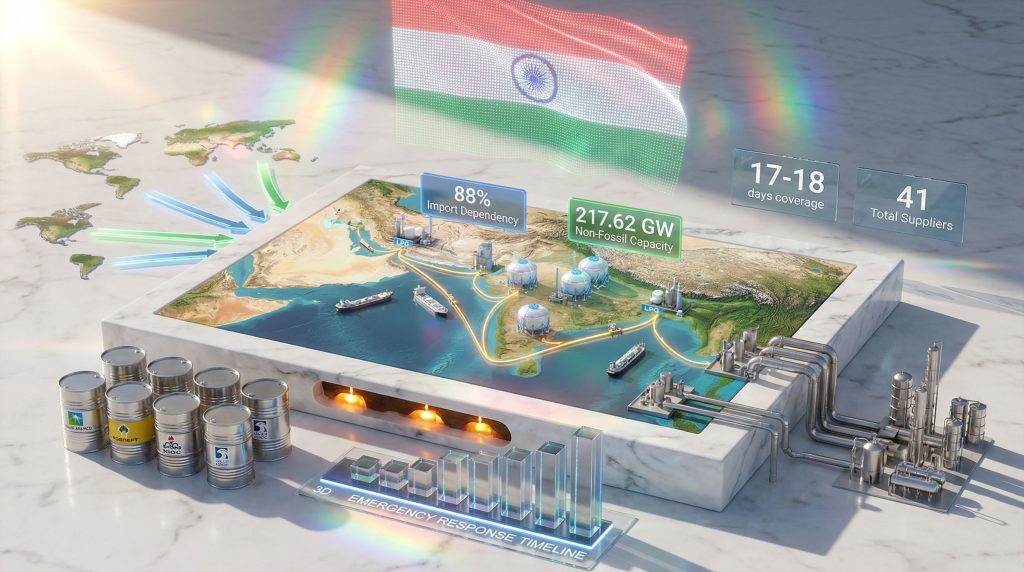
India's energy security infrastructure operates through a sophisticated hierarchy of reserve systems designed to provide graduated response capabilities based on disruption severity and duration. The strategic petroleum reserve system provides 17-18 days of crude oil coverage, while refined fuel inventories extend protection to 20-21 days for petrol and diesel products.
This multi-tiered approach recognizes that different disruption scenarios require different response strategies. Short-term supply interruptions can be managed through immediate reserve deployment, while extended disruptions necessitate more complex interventions involving export restrictions, alternative sourcing arrangements, and demand management protocols. Moreover, the renewable energy transition continues to reshape long-term security planning.
Critical Reserve Capacity Analysis:
| Energy Product | Strategic Coverage | Risk Classification | Response Timeline |
|---|---|---|---|
| Crude Oil | 17-18 days | High | 24-48 hours |
| Refined Fuels | 20-21 days | Medium | 2-7 days |
| LNG | 10-12 days | Critical | Immediate |
| LPG | <14 days | Severe | Real-time |
The vulnerability hierarchy reveals that liquefied natural gas and LPG represent the most acute risks, with coverage periods significantly shorter than crude oil and refined products. This disparity requires specialized contingency planning for gas-based energy systems that cannot rely on the same buffer periods available for liquid petroleum products.
Geographic Concentration and Alternative Route Development
The Strait of Hormuz remains a critical chokepoint for Asian energy security, handling approximately 50% of India's crude oil and LNG imports in recent periods. This geographic concentration creates systemic vulnerability that traditional diversification strategies struggle to address completely. Additionally, India's energy contingency plan addresses these geographic risks through diversified sourcing strategies.
However, alternative pipeline infrastructure provides some redundancy. The UAE's Habshan-Fujairah Pipeline offers 1.5 million barrels per day capacity, while Saudi Arabia's East-West Pipeline system can handle 5 million barrels daily. These alternative routes bypass the Hormuz chokepoint entirely, providing critical backup capacity during transit disruptions.
The development of non-Hormuz supply routes represents a long-term strategic investment in energy security infrastructure. Direct Red Sea shipping routes, while operationally more complex, eliminate dependence on Gulf chokepoints and create genuine supply chain redundancy.
Alternative Sourcing Mechanisms:
- Russian Federation: Floating storage capabilities for rapid deployment
- United States: Shale production flexibility responding to price signals
- West African Suppliers: Nigeria and Angola providing Atlantic Basin alternatives
- Latin American Sources: Brazilian and Venezuelan backup supply potential
Export Restriction as Emergency Supply Management
India's refining sector produces substantial export volumes that can be redirected domestically during supply emergencies. Current export patterns include approximately one-third of petrol production, one-quarter of diesel output, and half of aviation fuel production. Furthermore, the oil price rally influences these export decisions significantly.
This export capacity provides immediate domestic supply augmentation without requiring new international procurement. The redirection mechanism operates through government coordination with state-owned refiners and potentially through taxation or licensing adjustments affecting private sector participants.
Cross-product flexibility adds another dimension to emergency response capabilities. Aviation turbine fuel can be processed into alternative product streams through refinery operations, though this requires specific technical capabilities and involves processing efficiency losses that reduce the absolute volume of additional supply created.
State-run refiners including Indian Oil Corporation, Hindustan Petroleum, and Bharat Petroleum have demonstrated proactive capability by increasing LPG output at select petrochemical-integrated refineries even before formal policy mandates. This indicates industry awareness and preparedness for potential supply disruption scenarios.
Liquefied Petroleum Gas Vulnerability Assessment
LPG represents India's most critical energy security vulnerability due to 67% import dependency and extremely limited strategic reserves. Approximately 85-90% of LPG imports originate from Gulf region sources, creating concentrated geographic risk that compounds import dependency. Consequently, the India oil contingency plan prioritises LPG supply security through multiple mitigation strategies.
Industry estimates suggest that combined stocks including onshore inventories and cargoes already in transit may provide less than two weeks of coverage if Gulf supplies face sustained interruption. This timeline is significantly shorter than crude oil or refined fuel buffers, requiring specialized emergency protocols.
LPG Risk Management Framework:
| Risk Element | Current Status | Mitigation Approach |
|---|---|---|
| Import Dependency | 67% of consumption | Domestic production increases |
| Source Concentration | 85-90% from Gulf | Geographic diversification |
| Reserve Duration | <14 days coverage | Strategic inventory expansion |
| Rural Distribution | High dependency | Alternative fuel promotion |
Targeted demand management represents the primary short-term response mechanism for LPG shortages. Rural areas with access to alternative cooking fuels including biomass and electricity become priority targets for consumption reduction, preserving LPG availability for urban consumers without viable alternatives.
Price Volatility and Market Response Mechanisms
Energy supply disruptions create immediate price signals that affect both government policy responses and private sector behavior. During recent disruption scenarios, Brent crude futures increased nearly 10% to $80 per barrel while European gas prices jumped over 40% within single trading sessions. In addition, US natural gas forecasts suggest continued volatility across energy markets.
These price movements demonstrate that financial markets immediately incorporate supply disruption risk, creating inflationary pressure that compounds physical shortage impacts. The currency implications are equally significant, as increased dollar demand for emergency energy procurement can pressure domestic currency values.
Economic impact modeling suggests that each $10 per barrel oil price increase creates approximately $13-14 billion in additional import costs for major consuming economies. These fiscal burdens may require government intervention through subsidies or other price stabilization mechanisms that create secondary macroeconomic consequences.
Demand Management Through Targeted Rationing
Emergency demand management operates through differentiated approaches recognizing that consumer categories vary significantly in their ability to reduce consumption or switch to alternative fuels. Industrial users typically possess fuel-switching capabilities during price spikes, while residential consumers may lack alternatives.
The transportation sector demonstrates price-responsive behavior through route optimization and modal shifts toward more efficient options. Power generation facilities can deploy alternative fuels including coal and renewable sources, though this requires sufficient backup generation capacity. However, the US oil production decline creates additional supply pressures globally.
Consumption Reduction Hierarchy:
- Industrial Applications: Fuel switching to alternatives
- Transportation: Route optimization and efficiency improvements
- Power Generation: Coal and renewable backup deployment
- Residential Use: Conservation behaviors and alternative cooking fuels
International Coordination and Diplomatic Flexibility
Supply chain disruption responses require careful coordination with international trading partners and supplier nations. Export restrictions may conflict with existing contractual obligations, creating potential legal liability or trade retaliation risks that must be managed alongside energy security objectives. Additionally, the OPEC production review affects global supply dynamics significantly.
Floating storage strategies represent an innovative approach to supply chain risk management. Significant quantities of crude oil remain in maritime storage that can be redirected relatively quickly toward consuming markets during emergency scenarios. This provides flexibility without requiring permanent infrastructure investments.
The relationship with alternative suppliers becomes particularly critical during extended disruption scenarios. If traditional Gulf suppliers face sustained production or transit difficulties, consuming nations must rapidly activate relationships with non-traditional sources while navigating any sanctions regimes or trade restrictions that may complicate procurement. "India must prepare for volatile energy markets by diversifying supply sources," according to recent energy security analyses.
Long-Term Structural Transformation Strategies
Beyond immediate crisis management, energy security requires fundamental shifts toward reduced import dependency and diversified energy systems. India's renewable energy capacity has reached 217.62 GW as of January 2025, representing substantial progress toward reduced fossil fuel reliance.
The government's ₹20,000 crore budget allocation for Carbon Capture, Utilization, and Storage (CCUS) technology demonstrates commitment to long-term energy transition while maintaining industrial capabilities during the transition period. Furthermore, the India oil contingency plan incorporates these transitional elements into comprehensive security planning.
Nuclear power expansion provides baseload generation capacity without fossil fuel imports, though development timelines extend beyond immediate emergency planning horizons. Biofuel development offers domestic alternative fuel production that reduces petroleum product import requirements over time.
Structural Security Enhancements:
- Grid Modernization: Battery storage and smart grid infrastructure
- Industrial Electrification: Reduced petroleum product demand patterns
- Alternative Transportation: Electric vehicle adoption reducing oil consumption
- Energy Efficiency: Conservation reducing absolute import requirements
Risk Assessment and Scenario Planning Methodologies
Effective contingency planning requires continuous assessment of disruption probability and potential duration. Recent conflict scenarios have generated estimates ranging from rapid normalization within days to extended disruptions lasting up to four weeks. Consequently, robust scenario planning becomes essential for effective emergency response.
This uncertainty requires flexible planning frameworks that can adapt response mechanisms based on evolving situation assessments rather than predetermined trigger points. Real-time monitoring systems track supply chain indicators including tanker movements, production facility status, and alternative route utilization rates.
The coordination between government agencies, state-owned enterprises, and private sector participants enables rapid implementation of emergency measures. However, the effectiveness of these coordination mechanisms depends on clear communication protocols and pre-established decision-making authorities.
Financial Impact and Fiscal Sustainability Considerations
Emergency response measures create substantial fiscal implications that extend beyond immediate procurement costs. Forgoing export revenues reduces foreign exchange earnings while emergency imports at premium prices increase dollar demand and currency pressure.
The opportunity cost of strategic reserve utilization must be balanced against alternative response mechanisms. Depleting reserves provides immediate supply but reduces future emergency capabilities, requiring careful calculation of optimal utilization rates based on disruption duration projections.
Subsidy requirements during sustained price increases can create unsustainable fiscal burdens if disruptions extend beyond planned buffer periods. This creates pressure for demand management measures that may impose economic costs through reduced consumption or alternative fuel deployment. Moreover, effective implementation of the India oil contingency plan requires balancing immediate costs against long-term energy security benefits.
Disclaimer: This analysis is based on publicly available information and industry assessments as of the publication date. Energy security scenarios involve complex geopolitical and market variables that can change rapidly. Readers should consult current government announcements and official sources for the most recent policy developments. Investment decisions should not be based solely on emergency planning assessments, as energy market conditions remain subject to multiple risk factors beyond supply chain disruption scenarios.
Looking to Position Yourself in Energy Security Investments?
Discovery Alert provides instant notifications on significant ASX mineral discoveries across critical energy commodities, powered by its proprietary Discovery IQ model. Subscribers receive rapid insights into actionable trading and investment opportunities in the energy transition sector, ensuring quick and informed decisions ahead of broader market movements. Begin your 14-day free trial today to gain a market-leading edge in energy security investments.