June 17, 2026
Understanding India's Energy Security Through Strategic Reserve Infrastructure
Strategic petroleum reserves represent one of the most critical components of national energy security infrastructure, particularly for countries heavily dependent on energy imports. For major energy consumers operating in volatile geopolitical environments, these underground storage facilities serve as essential buffers against supply chain disruptions, price volatility, and market instability. The effectiveness of such systems depends not only on storage capacity but also on geographic distribution, technological sophistication, and integration with broader energy diversification strategies.
India's approach to building India strategic petroleum reserve capacity reflects the complex challenges facing emerging economies seeking energy independence while managing fiscal constraints and geopolitical risks. The nation's current strategic reserve infrastructure encompasses multiple storage technologies, from advanced salt cavern systems to underground rock formations, distributed across coastal locations to optimise supply chain flexibility.
When big ASX news breaks, our subscribers know first
Current Strategic Reserve Infrastructure and Operational Capacity
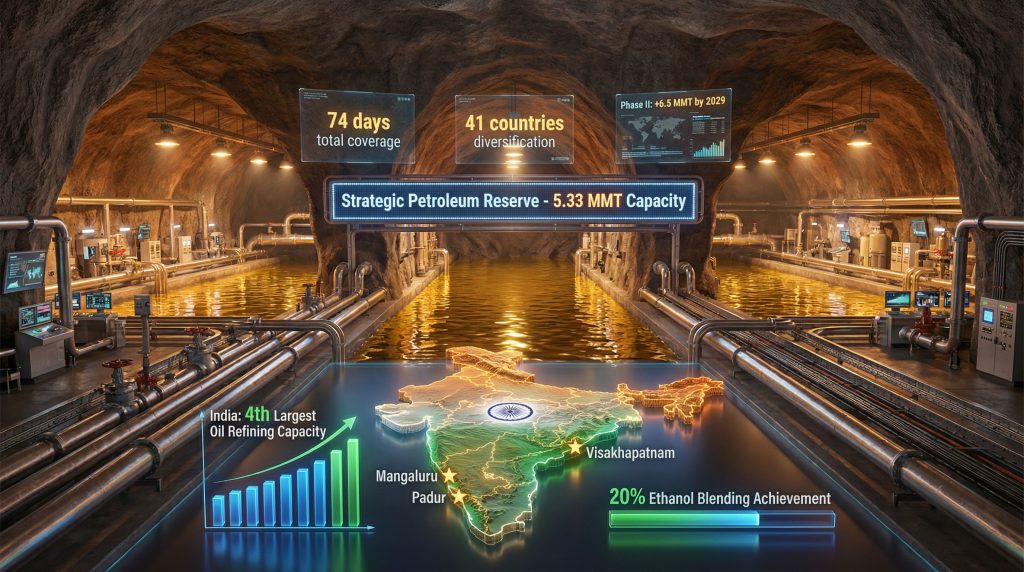
India's strategic petroleum reserve system currently maintains operational capacity across three major coastal facilities, each employing different storage technologies optimised for local geological conditions. The total strategic reserve capacity of 53 lakh tonnes (approximately 39 million barrels) represents a significant achievement in infrastructure development, though it falls short of international benchmarks for import-dependent economies.
Strategic Reserve Facility Analysis:
| Facility Location | Capacity (Lakh Tonnes) | Storage Technology | Geographic Coverage |
|---|---|---|---|
| Visakhapatnam | 13.3 | Underground rock caverns | Eastern seaboard |
| Mangaluru | 15.0 | Underground storage | Western coast |
| Padur | 25.0 | Salt cavern technology | Southern access |
The Padur facility represents the largest single strategic storage installation, utilising advanced salt cavern technology that offers superior storage efficiency and operational flexibility compared to conventional underground storage methods. Salt cavern storage provides enhanced security against contamination while enabling faster injection and withdrawal rates during emergency scenarios.
Geographic Distribution Strategy
The coastal positioning of strategic reserve facilities reflects careful consideration of India's import infrastructure and refining capacity distribution. Eastern and western coast coverage ensures strategic reserves can support multiple supply chains simultaneously, reducing vulnerability to single-point failures in port infrastructure or transportation networks.
Furthermore, Visakhapatnam's position on the eastern seaboard provides strategic coverage for refineries in eastern and northeastern India. Meanwhile, the Mangaluru and Padur facilities on the western coast serve the significant refining capacity concentrated in Gujarat, Maharashtra, and Karnataka states.
Strategic Reserve Coverage Analysis and International Comparisons
India's current India strategic petroleum reserve coverage provides approximately 9 to 13 days of consumption based purely on strategic reserves. This extends to 74 days when combined with commercial petroleum stocks held by oil marketing companies and refiners. This combined coverage approaches but remains below the International Energy Agency's recommended minimum of 90 days for member countries.
Reserve Adequacy Framework
The 16-day gap between current combined reserves and IEA recommendations represents approximately 12-15 million barrels of additional storage requirement, equivalent to roughly 16-20 lakh tonnes of strategic reserve capacity.
Comparative Reserve Coverage (Days of Import Coverage):
- United States: 90+ days (714 million barrels strategic reserves)
- Japan: 200+ days (government plus private reserves)
- China: 90+ days (estimated combined reserves)
- India: 74 days (strategic plus commercial reserves)
The coverage gap becomes particularly significant during geopolitical crises affecting major supply routes. Consequently, India's substantial dependence on Middle Eastern crude oil, transported through the Strait of Hormuz chokepoint, amplifies the importance of strategic reserve adequacy during regional conflicts or infrastructure disruptions.
Energy Import Diversification and Supply Chain Resilience
India has systematically expanded its energy import diversification over the past decade, increasing source countries from 27 to 41 nations. This geographic diversification strategy reduces concentration risk while providing greater flexibility in procurement during market volatility or political instability affecting specific regions.
Supply Chain Monitoring Infrastructure
The government maintains continuous oversight of energy import operations through an inter-ministerial coordination group that conducts daily assessments of import-export chain functionality. This real-time monitoring system enables rapid identification of potential disruptions and activation of contingency protocols.
Risk Mitigation Mechanisms:
- Daily monitoring protocols for import infrastructure
- Alternative route identification for supply chain redundancy
- Emergency procurement procedures for crisis scenarios
- Strategic reserve deployment protocols for supply disruptions
In addition, the coordination framework integrates multiple government agencies including the Ministry of Petroleum and Natural Gas, Ministry of External Affairs, and security agencies. This ensures comprehensive situational awareness and rapid response capabilities.
Strategic Reserve Expansion Plans and Infrastructure Development
India's Phase II strategic reserve expansion represents a 65 lakh tonnes capacity addition through new facility construction and existing facility expansion. This development program will increase total strategic reserve capacity to approximately 118 lakh tonnes by 2029, significantly enhancing the nation's energy security posture.
Phase II Development Timeline
Chandikhol Facility Development:
- Location: Odisha (eastern coast)
- Capacity: 40 lakh tonnes
- Technology: Advanced underground storage
- Strategic importance: Enhanced eastern seaboard coverage
Padur Expansion Project:
- Additional capacity: 25 lakh tonnes
- Construction status: Contract awarded October 2025
- Completion target: 2028-2029
- Technology upgrade: Enhanced salt cavern systems
However, the Chandikhol facility location provides strategic advantages for serving refineries in eastern India while offering alternative supply routes during western coast disruptions. The facility's substantial capacity will significantly enhance strategic reserve flexibility and emergency response capabilities.
Investment and Financing Structure
Phase II development requires estimated investment of ₹8,000-10,000 crore funded through government budgetary allocation. This investment level reflects the strategic priority placed on energy security infrastructure while demonstrating commitment to achieving international reserve standards.
Furthermore, the financing approach utilises direct government funding rather than public-private partnerships. This ensures complete strategic control over reserve management and deployment decisions during crisis scenarios.
Refining Capacity Integration and Energy Processing Strategy
India has achieved fourth position globally in oil refining capacity through substantial expansion over the past decade. This enhanced refining capability provides strategic advantages by reducing dependence on refined product imports while enabling domestic processing of strategically stored crude oil.
Refining Capacity Strategic Benefits
Operational Advantages:
- Reduced import vulnerability for refined products
- Strategic crude oil processing capability during emergencies
- Export potential for surplus refined products
- Enhanced supply chain integration between reserves and processing
The combination of strategic crude oil reserves with expanded refining capacity creates a more resilient energy supply chain. During supply disruptions, India can process strategically stored crude oil domestically, reducing reliance on both crude oil and refined product imports simultaneously.
Enhanced refining capacity allows optimal utilisation of strategic petroleum reserves by enabling domestic processing during supply chain disruptions, effectively extending the functional duration of strategic buffer stocks.
The next major ASX story will hit our subscribers first
Alternative Energy Integration and Demand Management
The India strategic petroleum reserve system operates within a broader energy security framework that includes significant alternative energy initiatives. These initiatives are designed to reduce petroleum demand pressure and extend strategic reserve effectiveness.
Ethanol Blending Program Impact
The achievement of 20% ethanol blending in petrol represents substantial petroleum displacement, equivalent to approximately 44 million barrels annually in reduced import requirements. This demand reduction extends the effective duration of strategic reserves during supply disruptions.
Demand Reduction Achievements:
- Railway electrification: Nearly 100% completion reduces diesel demand
- Metro rail expansion: Significant urban transport fuel displacement
- Ethanol blending: 20% petrol displacement through domestic production
- Industrial efficiency: Reduced petroleum consumption per unit GDP
For instance, these demand management initiatives provide strategic benefits beyond immediate petroleum savings. During crisis scenarios, reduced baseline consumption extends strategic reserve duration while alternative energy infrastructure provides continued economic functionality.
Geopolitical Risk Assessment and Regional Security Implications
The Strait of Hormuz represents a critical chokepoint for global energy security, with 21% of global petroleum liquids transiting this narrow waterway. India's substantial Middle Eastern crude oil imports create significant exposure to disruptions affecting this strategic passage.
Regional Conflict Impact Analysis
Recent developments in West Asia, including conflicts affecting regional stability and shipping infrastructure, demonstrate the practical importance of strategic petroleum reserves. The government's daily monitoring of regional developments through inter-ministerial coordination reflects the dynamic nature of geopolitical risks affecting energy security.
Risk Factors Assessment:
- Strait of Hormuz vulnerability to military or terrorist action
- Regional conflict escalation affecting multiple supply sources
- Infrastructure targeting of oil production or transport facilities
- Insurance and shipping costs increasing during crisis periods
Consequently, India's strategic response combines diplomatic engagement with producing nations, diversified sourcing strategies, and enhanced strategic reserve capacity to mitigate these multifaceted risks. These challenges are further compounded by oil price movements that affect global market stability.
Economic Benefits and Market Stabilisation Functions
Strategic petroleum reserves provide economic benefits extending beyond energy security through market stabilisation mechanisms, investment attraction, and crisis management capabilities. The economic insurance value of strategic reserves often exceeds their infrastructure costs when evaluated against potential disruption impacts.
Market Confidence and Investment Climate
Economic Impact Factors:
- Price volatility buffering through strategic release capability
- Market confidence enhancement supporting investment decisions
- Industrial continuity during supply chain disruptions
- Foreign exchange protection against oil price spike impacts
The presence of adequate strategic reserves provides psychological market benefits by demonstrating government capacity to manage supply crises effectively. This confidence factor supports industrial investment and economic planning by reducing energy security uncertainty.
Strategic petroleum reserves function as economic insurance policies where the cost of storage infrastructure represents a fraction of potential economic losses from sustained supply disruptions affecting industrial operations, transportation systems, and broader economic activity.
International Best Practices and Technology Integration
India's strategic reserve development incorporates international best practices while adapting to local geological conditions and operational requirements. Technology transfer from established reserve systems provides operational efficiency improvements and cost optimisation opportunities.
Commercial Integration Models
The ADNOC partnership at Mangaluru demonstrates innovative commercial utilisation of strategic reserve infrastructure. This leasing arrangement provides revenue generation while maintaining strategic control, creating a sustainable financing model for reserve operations.
Partnership Benefits:
- Revenue generation from commercial storage leasing
- Operational cost sharing with commercial partners
- Technology transfer from international partners
- Strategic flexibility through partnership agreements
In addition, commercial partnerships enable more efficient utilisation of strategic reserve infrastructure while maintaining government control over emergency deployment capabilities. These partnerships must navigate challenges similar to those faced by nations dealing with declining US oil production and OPEC's global influence on market dynamics.
Future Challenges and Strategic Opportunities
India's strategic petroleum reserve system must navigate evolving challenges including climate transition policies, technological disruption from electric vehicle adoption, and shifting geopolitical dynamics affecting global energy markets.
Climate Transition Considerations
Balancing Factors:
- Long-term petroleum demand trends under climate policies
- Strategic reserve optimisation for changing consumption patterns
- Infrastructure repurposing potential for alternative energy storage
- Investment prioritisation between fossil fuel and renewable infrastructure
The strategic reserve system requires adaptation to accommodate India's climate commitments while maintaining energy security during the transition period. This balance involves optimising reserve capacity for evolving demand patterns while preserving crisis response capabilities.
Regional Leadership Opportunities
India's strategic reserve expertise positions the nation to serve as a regional energy security anchor for South Asian neighbours. Potential cooperation frameworks could include shared reserve access, technical expertise sharing, and coordinated crisis response mechanisms.
Regional Integration Potential:
- SAARC energy security cooperation frameworks
- Technology sharing with neighbouring countries
- Emergency sharing agreements during regional crises
- Commercial storage services for regional partners
However, Australia faces similar energy exports challenges, while Canada grapples with energy transition challenges that provide valuable lessons for regional cooperation frameworks.
Strategic Reserve System Optimisation and Future Outlook
India's strategic petroleum reserve infrastructure represents a critical foundation for energy security that continues evolving to meet changing geopolitical and economic challenges. The current 53 lakh tonnes capacity, combined with ongoing 65 lakh tonnes expansion, positions India for enhanced resilience against supply disruptions.
The integration of strategic reserves with expanded refining capacity, alternative energy initiatives, and diplomatic diversification creates a comprehensive energy security framework extending beyond simple storage solutions. As Phase II development progresses and operational optimisation continues, the India strategic petroleum reserve system will remain central to maintaining economic stability and energy independence.
For instance, the success of India's approach demonstrates how emerging economies can develop effective strategic reserve systems through careful planning, international cooperation, and integration with broader energy policy frameworks. Future optimisation will require continuous adaptation to evolving geopolitical risks, technological changes, and economic priorities while maintaining the fundamental objective of energy supply security for sustained economic development.
Furthermore, India's strategic petroleum reserve infrastructure continues to enhance its strategic petroleum reserves capacity through technological innovation and international partnerships. This comprehensive approach ensures long-term energy security while adapting to changing global energy dynamics and climate transition requirements.
Looking to Invest in Energy Infrastructure Companies?
Discovery Alert's proprietary Discovery IQ model delivers real-time alerts on significant ASX mineral discoveries, including critical energy transition metals and infrastructure opportunities. Explore how major mineral discoveries have historically generated substantial returns by visiting Discovery Alert's discoveries page, then begin your 14-day free trial to position yourself ahead of the market.