June 21, 2026
When Energy Security Becomes the Central Economic Variable
Across the history of modern economic development, few forces have proven as capable of disrupting growth trajectories as sudden, concentrated disruptions to energy supply. For import-dependent emerging economies, the arithmetic is unforgiving: energy underpins transport, manufacturing, agriculture, and household consumption simultaneously. When that supply is threatened from a single geographic concentration, the entire macroeconomic architecture feels the strain at once.
This is the precise situation India now navigates. The ongoing West Asia conflict has triggered what a joint report by S&P Global and Crisil, titled India Forward, describes as the largest energy shock on record, one that is testing India's economic resilience across multiple dimensions at the same time. Understanding the full scope of that challenge requires examining not just headline GDP figures, but the structural channels through which this India energy shock and GDP growth slowdown is propagating across supply chains, fiscal accounts, and agricultural systems.
When big ASX news breaks, our subscribers know first
How Severe Is India's Energy Vulnerability? Understanding the Structural Exposure
India's Crude Oil Import Dependency: A Quantitative Baseline
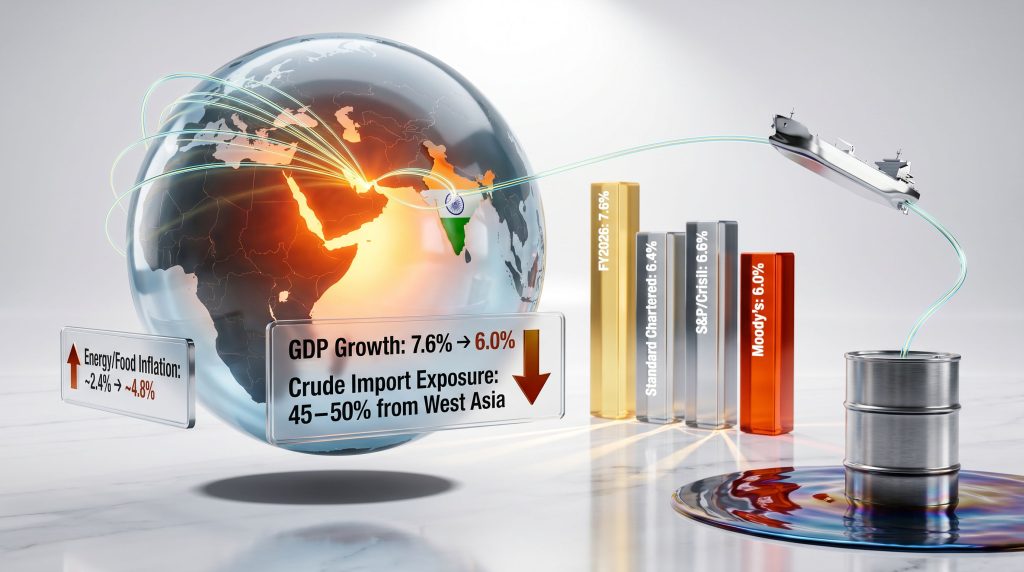
India occupies a structurally exposed position in global energy markets. As the world's third-largest crude oil importer, it sources between 45% and 50% of its crude oil supply from West Asia, according to S&P Global and Crisil's India Forward report. That concentration is not merely a commercial arrangement; it is a systemic vulnerability that amplifies any geopolitical disruption originating from the region.
The exposure extends well beyond crude oil. Approximately 90% of India's LPG imports transit through the Strait of Hormuz, a narrow waterway whose restriction creates cascading shortages across household energy access and agricultural input costs. Furthermore, the India LNG import structure reveals that India also imports roughly 35% of its total energy requirements from external sources, meaning supply shocks transmit with limited buffering capacity across fuel, manufacturing, and food production sectors simultaneously.
Consider the compound nature of this exposure:
- Crude oil price inflation compresses manufacturing margins and broadens the current account deficit
- LPG supply constraints reduce household cooking fuel access and raise rural energy costs
- Petrochemical feedstock disruptions affect downstream industrial production across plastics, textiles, and chemicals
- Fertiliser precursor shortages threaten agricultural yields during critical crop cycles
The Strait of Hormuz as a Systemic Risk Multiplier
The de facto restriction of the Strait of Hormuz does not affect crude oil in isolation. It simultaneously disrupts LNG, LPG, and petrochemical feedstocks, creating a multi-vector energy shock that compounds across supply chains rather than resolving at any single point.
The disruption's early signatures are already visible in trade data. Crude inflows from Iraq, Saudi Arabia, and the UAE declined sharply in March 2026 relative to February levels. While tripled deliveries from Angola partially compensated, Angola's overall share of India's import basket remains comparatively small, making the substitution effect limited in absolute volume terms.
India has activated parallel mitigation strategies, including selective procurement arrangements and expanded Russian crude imports enabled by regulatory waivers. However, structural supply gaps remain, and the adequacy of these diversification measures depends heavily on how long the conflict persists and whether Hormuz transit conditions deteriorate further.
What Is the West Asia Conflict's Macroeconomic Transmission Mechanism Into India?
From Energy Prices to Broader Economic Stress: The Cascade Model
The conflict's economic transmission into India does not operate through a single channel. Instead, it functions through five interconnected pressure points that reinforce each other as the disruption extends over time:
- Crude Oil Price Inflation – Sustained elevated prices compress corporate margins, raise transport costs, and widen the current account deficit
- Freight and Insurance Cost Escalation – Maritime risk premiums in conflict-adjacent shipping lanes increase the landed cost of all seaborne imports, not just energy
- Fertiliser Supply Disruption – Agricultural dependence on imported fertiliser precursors creates direct yield risk for winter and summer crop cycles
- Rupee Depreciation Pressure – A widening trade deficit and elevated global uncertainty weaken the rupee, amplifying the domestic cost of all foreign-denominated inputs
- Bond Yield Elevation – Rising inflation expectations push borrowing costs higher, constraining both government fiscal space and private investment appetite
The oil price volatility seen throughout this period has been a key amplifier. DK Joshi, Chief Economist at Crisil, has noted that as the conflict extended beyond two months, rising bond yields, higher inflation, and a weakening rupee all began weighing on growth simultaneously. This convergence of pressures is what distinguishes the current situation from simpler oil price cycles: the shock is transmitting through financial markets, currency dynamics, and real supply chains concurrently rather than sequentially.
Sectoral Ripple Effects: Industry, Agriculture, and Households
| Impact Channel | Affected Sector | Nature of Disruption |
|---|---|---|
| Crude price surge | Transport, manufacturing | Input cost inflation, margin compression |
| LPG supply constraints | Households, agriculture | Cooking fuel scarcity, rural energy access risk |
| Fertiliser shortages | Agriculture (winter crops) | Yield risk for rabi season; summer crops relatively insulated |
| Freight cost increases | Import-dependent industries | Elevated landed costs across goods categories |
| Currency depreciation | All import-reliant sectors | Amplified cost of all foreign-denominated inputs |
On the agricultural dimension specifically, Joshi has indicated that the rabi (winter) crop cycle faces fertiliser shortage risk if the conflict continues, while the kharif (summer) crop is in a comparatively better position due to earlier procurement cycles that were completed before peak conflict escalation. This seasonal asymmetry matters for food security planning and for the inflation trajectory of agricultural commodities in the second half of FY2027.
How Much Has India's GDP Growth Forecast Been Revised Downward?
Comparative Forecast Revisions Across Major Analytical Institutions
The scale of downward revisions signals a broad analytical consensus that the India energy shock and GDP growth slowdown represents a material and sustained drag on India's near-term growth trajectory.
| Institution | Pre-Shock FY2027 Forecast | Revised FY2027 Forecast | Primary Drivers Cited |
|---|---|---|---|
| S&P Global / Crisil | 7.1% | 6.6% | West Asia conflict spillovers, freight, fertiliser, fiscal pressure |
| Moody's Ratings | 6.8% | 6.0% | Iran conflict escalation, energy and food inflation doubling |
| Standard Chartered | 7.0% | 6.4% | High oil prices, supply disruption, inflation, fiscal strain |
| Indian Government (Jan 2026) | 6.8-7.2% | Not yet revised | Pre-shock baseline |
| SBI Research | N/A | 6.5-6.8% | Domestic demand resilience, policy buffers |
*India's GDP growth for FY2026 was estimated at 7.6%. The projected moderation to as low as 6.0% under the most bearish scenario represents a potential reduction of up to 1.6 percentage points within a single fiscal year, driven almost entirely by an externally originating energy supply shock rather than any domestic policy failure.*
According to the India Forward report, Crisil's revised figure of 6.6% for FY2027 reflects a 50 basis point downgrade from its prior estimate of 7.1%. This is a significant adjustment, but it still represents a relatively resilient outcome compared to Moody's more bearish projection of 6.0%, which assumes a more severe and prolonged conflict scenario. For broader context, according to Asian News Network, India is nonetheless projected to lead regional growth at 6.4% under UN ESCAP assessments, underscoring the relative strength of its macroeconomic foundations.
What Is Driving the Divergence Between Bearish and Resilience-Based Forecasts?
Bearish case drivers (Standard Chartered, Moody's):
- Energy and food inflation projected to roughly double from approximately 2.4% in FY2026 to around 4.8% in FY2027
- Sustained high crude prices with no near-term resolution pathway in sight
- Fiscal space constraints limiting the government's capacity to absorb energy subsidy costs
- A potential stagnationary dynamic combining rising prices with decelerating output growth
Resilience-case drivers (SBI Research):
- Strong domestic consumption base providing a durable growth floor
- Robust banking sector fundamentals reducing financial contagion risk
- Policy experience drawn from the Russia-Ukraine oil shock period offering a tested playbook for supply diversification
- Ongoing renewable energy expansion providing a partial structural buffer against fossil fuel price volatility
The truth likely lies somewhere between these analytical poles. India's diversification capacity is real but bounded. The domestic consumption base is large, but it is not immune to inflation erosion or employment market softening.
Is India's Fiscal Consolidation Trajectory at Risk?
The Fiscal Deficit Reversal Threat
India's post-pandemic fiscal consolidation stands as one of the most significant macroeconomic achievements of the past five years. The fiscal deficit was brought down from 9.2% of GDP in FY2021 to 4.4% of GDP in FY2026, representing a disciplined, multi-year reduction achieved despite global inflationary pressures and geopolitical volatility. That achievement now faces its most serious stress test since the pandemic.
The India Forward report identifies a dual fiscal pressure dynamic operating simultaneously:
- Rising subsidy obligations as the government faces pressure to shield households and industry from energy price pass-through
- Weakening revenue growth as the GDP slowdown reduces tax collection momentum across both direct and indirect tax streams
India's debt-to-GDP ratio is projected to rise from 56.1% in FY2026 to 57.5%, reversing the downward trajectory that fiscal consolidation had established. While this 140 basis point deterioration is not catastrophic in isolation, it signals a potential inflection point in India's medium-term debt trajectory.
Policy Tension: The government faces a structural dilemma with no clean resolution. Absorbing energy price increases through subsidies protects households and suppresses headline inflation but widens the fiscal deficit. Passing costs through to consumers controls the deficit but accelerates consumer price inflation and suppresses private consumption growth. Neither option is painless.
Three Policy Priorities Emerging From the Crisis
According to analysis from Crisil's chief economist, three domains require immediate and sustained strategic attention:
- Energy Security – Accelerating supply diversification away from West Asia dependency through alternative supplier relationships, domestic production expansion, and faster renewables deployment
- Food Security – Protecting agricultural output from fertiliser supply disruptions, with particular urgency for winter crop cycles where procurement lead times are shorter
- Economic Reforms – Advancing deregulatory and structural reforms to improve the investment climate, reduce bureaucratic friction, and sustain long-term competitiveness against other emerging market destinations
Joshi has specifically emphasised that deregulatory measures and structural improvements to the business environment will be pivotal in maintaining India's appeal as a global investment destination during and after the shock period. This framing is strategically important: it positions the crisis as a moment for institutional improvement rather than purely defensive management.
Could the Energy Shock Paradoxically Accelerate India's Structural Transformation?
The Crisis-as-Catalyst Hypothesis
Historical precedent across emerging markets consistently demonstrates that acute external shocks, while damaging in the near term, can catalyse structural reforms that would otherwise face sustained political resistance during periods of stable, comfortable growth.
The India Forward report by S&P Global and Crisil explicitly frames the current shock as a potential catalyst for addressing near-term bottlenecks, with positive implications for long-term growth architecture. This is not naive optimism; it is grounded in the empirical observation that urgency concentrates political will in ways that peacetime reform agendas rarely achieve.
Several structural dynamics support this hypothesis:
- The Russia-Ukraine conflict period demonstrated India's capacity to rapidly diversify crude sourcing, establishing alternative supplier relationships with Russia, the United States, and African producers that now serve as the activation framework for the current response
- India's domestic refining infrastructure provides flexibility to process a wider range of crude grades when preferred West Asian suppliers are disrupted, reducing substitution costs
- Inefficient state electricity distribution companies (discoms) have historically slowed the pace at which renewable capacity converts into reduced import dependency; crisis pressure may accelerate discom reform timelines that have been politically stalled
The broader energy security transition trajectory is particularly important in this context. A structurally lower fossil fuel import dependency is the only durable solution to India's vulnerability. The shock may sharpen the urgency of that transition in ways that are visible in capital allocation decisions over the next 12 to 24 months.
The next major ASX story will hit our subscribers first
How Does This Shock Compare to Historical Oil Price Crises?
Contextualising the 2026 West Asia Shock Within Global Energy History
The India Forward report characterises the current disruption as the largest energy shock on record, a designation that places its supply disruption magnitude above the 1973 OPEC embargo and the 1979 Iranian Revolution. This is a striking claim that warrants contextual analysis. Indeed, the geopolitical oil price pressures witnessed in earlier cycles provide a useful benchmark for understanding the severity of what India now confronts.
India's exposure in the 2026 shock differs from earlier historical episodes in several important structural respects:
- Greater renewable energy capacity now provides a partial buffer that simply did not exist during the 1970s oil crises
- More sophisticated financial markets and currency management tools give the Reserve Bank of India greater capacity to manage external shocks compared to earlier decades
- Established alternative supplier relationships developed during the 2022 post-Russia invasion period (Russia, Angola, United States) provide diversification options that were structurally absent in earlier episodes
Scenario Modelling: Three Possible Trajectories for India
| Scenario | Conflict Duration | Crude Price Assumption | FY2027 GDP Range | Fiscal Deficit Outcome |
|---|---|---|---|---|
| Base Case | 6-12 months | Elevated but stabilising | 6.4-6.6% | Deficit widens modestly |
| Prolonged Shock | 12-24 months | Sustained high | 6.0-6.2% | Significant fiscal deterioration |
| Rapid Resolution | Under 6 months | Quick normalisation | 6.8-7.0% | Consolidation trajectory preserved |
In addition, the trade war oil impacts from earlier global trade disputes have demonstrated how compounding external pressures can narrow India's policy manoeuvring room precisely when flexibility is most needed. India's resilience framework, as described by the Economic Times, underscores that the country remains resilient, if not shock-free, as it charts a path through these concurrent pressures.
Disclaimer: These scenarios are illustrative projections based on publicly available forecast data from S&P Global, Crisil, Moody's, and SBI Research as of May 2026. They do not constitute investment advice. Actual outcomes will depend on geopolitical developments, commodity market dynamics, and policy responses that remain uncertain.
Key Takeaways: India's Energy Shock Risk Dashboard
| Metric | FY2026 (Baseline) | FY2027 (Projected) | Change |
|---|---|---|---|
| GDP Growth | 7.6% | 6.0-6.6% (range) | Down up to 1.6 percentage points |
| Energy/Food Inflation | ~2.4% | ~4.8% (Moody's estimate) | Approximately doubled |
| Debt-to-GDP Ratio | 56.1% | 57.5% | Up 1.4 percentage points |
| Fiscal Deficit | 4.4% of GDP | Widening | Deteriorating |
| Crude Import Exposure | 45-50% from West Asia | Diversifying | Partial mitigation underway |
Frequently Asked Questions: India Energy Shock and GDP Growth Slowdown
Why is India particularly vulnerable to the West Asia energy crisis?
India's vulnerability stems from concentrated import dependency, sourcing between 45% and 50% of crude oil and approximately 90% of LPG from the West Asia region. Unlike energy-self-sufficient economies, India cannot rapidly substitute these volumes domestically. External supply disruptions therefore transmit directly into industrial output, household energy access, and agricultural productivity with limited buffering capacity.
What is the current GDP growth forecast for India in FY2027?
According to the India Forward report by S&P Global and Crisil, GDP growth is projected at 6.6% for FY2027, down from a prior estimate of 7.1% and an FY2026 estimated outcome of 7.6%. Moody's projects a more bearish 6.0%, while SBI Research's domestic resilience-focused analysis suggests a range of 6.5-6.8%.
How does the energy shock affect Indian agriculture?
The primary agricultural transmission channel is fertiliser supply disruption. India relies on imported fertiliser precursors that move through West Asia shipping routes. Prolonged conflict creates shortage risk for winter (rabi) crop cycles, while summer (kharif) crops are considered comparatively better insulated due to earlier procurement completion before peak conflict intensity.
Is India's fiscal deficit at risk of widening significantly?
Yes. India's debt-to-GDP ratio is projected to rise from 56.1% to 57.5%, and the fiscal deficit, reduced from 9.2% of GDP in FY2021 to 4.4% in FY2026, faces renewed expansion pressure from rising energy subsidy obligations and slowing revenue growth associated with the GDP deceleration.
What policy responses is India pursuing?
Key policy responses centre on energy supply diversification through expanded alternative supplier engagement, agricultural protection measures to safeguard fertiliser access and crop yields, and structural economic reforms designed to improve the investment climate and reduce long-term import dependency through accelerated domestic energy production and renewables buildout. Consequently, the India energy shock and GDP growth slowdown may, in the longer term, serve as a catalyst for the very structural transformation that positions India more durably against future external shocks.
This article incorporates analysis and data drawn from the S&P Global and Crisil joint report India Forward (May 2026) as reported by ET EnergyWorld. Forecast figures sourced from Moody's, Standard Chartered, and SBI Research are as published prior to May 2026. All forward-looking projections are subject to material uncertainty and should not be construed as investment advice.
Want to Stay Ahead of the Commodity and Resource Discoveries Driving the Next Investment Cycle?
Discovery Alert's proprietary Discovery IQ model delivers real-time alerts on significant ASX mineral discoveries — cutting through complex data to surface actionable opportunities across energy-linked commodities and critical resources the moment they are announced. Explore how historic mineral discoveries have generated substantial market returns and begin your 14-day free trial today to position yourself ahead of the broader market.