
August 22, 2026
Understanding India's Energy Storage Revolution Through 2030
India energy storage demand 2030 represents a critical transformation as renewable penetration reaches unprecedented levels requiring sophisticated grid balancing mechanisms. Traditional power systems designed around predictable fossil fuel generation patterns encounter fundamental operational challenges when integrating variable renewable sources at scale. Storage technologies emerge as the bridge between intermittent clean energy generation and consistent electricity demand, creating new infrastructure requirements that reshape entire power sector investment strategies.
The mathematical relationship between renewable capacity and storage requirements follows exponential rather than linear progression curves. As grid operators navigate these transitions, emerging markets like India present unique case studies where rapid renewable deployment coincides with growing electricity demand, creating compelling scenarios for large-scale storage deployment.
When big ASX news breaks, our subscribers know first
Peak Demand Trajectories and Grid Stability Requirements
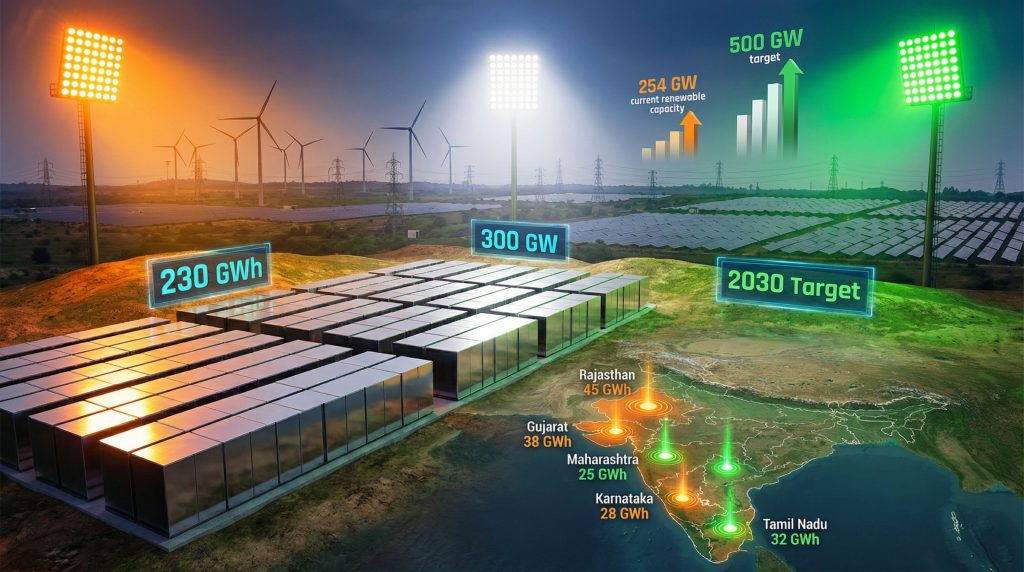
India's electricity consumption patterns reveal critical infrastructure challenges approaching by decade's end. According to statements from former Ministry of New & Renewable Energy Secretary Bhupinder Singh Bhalla at the Indian Power & Energy Storage Conference 2025, peak power demand trajectory points toward 300 GW capacity requirements while electricity demand grows at 6-7% annually.
Table: India's Power Demand Growth Framework
| Metric | Current Status | 2030 Projection | Growth Pattern |
|---|---|---|---|
| Peak Demand | ~250 GW | ~300 GW | 6-7% annually |
| Renewable Capacity | 254 GW | 500 GW (target) | Variable acceleration |
| Storage Requirement | <10 GWh | 230 GWh | Exponential scaling |
Renewable Integration Mathematics
The relationship between renewable penetration and storage requirements demonstrates non-linear characteristics as India approaches its 500 GW non-fossil fuel capacity target. Current renewable capacity stands at 254 GW, representing over 50% non-fossil share in overall installed power capacity, with renewables accounting for 26% of total electricity generation.
Key Integration Challenges:
• Variable renewable output requiring 4-6 hour storage duration
• Grid frequency regulation during high renewable penetration periods
• Seasonal demand variations across India's diverse climate zones
• Industrial load balancing during renewable generation intermittency
Grid operators encounter the "duck curve" phenomenon where solar generation peaks during midday while demand surges during evening hours. This timing mismatch intensifies as solar capacity expands, requiring storage systems capable of shifting energy delivery across multiple-hour periods while maintaining grid frequency within operational parameters.
Technology Evolution and Market Dynamics
India's storage technology roadmap emphasises lithium-ion dominance through 2030, with emerging technologies gaining market share for specific applications requiring longer duration storage. Furthermore, according to industry analysis presented at the conference, over 212 GWh of storage capacity has been tendered within five to six years, demonstrating market transformation from conceptual planning to execution phases.
Technology Deployment Timeline:
• 2025-2027: Lithium-ion market dominance (90% of deployments)
• 2027-2029: Technology diversification (sodium-ion, flow batteries)
• 2029-2030: Long-duration storage integration (8+ hour systems)
Manufacturing and Supply Chain Considerations
Domestic manufacturing capabilities significantly influence technology selection, with government policies favouring locally-produced storage systems through production-linked incentives. In addition, the development of a battery-grade lithium refinery becomes crucial for supporting domestic production capabilities. R. P. V. Prasad of Envision Energy India emphasised that India reaches a tipping point where falling battery prices, fast-charging ecosystems, and strong policy support enable storage to evolve from a balancing tool to a core grid resource delivering resilience and flexibility at scale.
Supply Chain Development Priorities:
• Cell manufacturing: 150 GWh annual production capacity target
• System integration: Domestic assembly and testing capabilities
• Raw materials: Lithium processing and battery recycling breakthrough infrastructure
• Quality standards: International safety and performance certifications
However, industry experts caution against ultra-low bidding and weak technical standards, emphasising the need for robust safety frameworks and global best practices to ensure sustainable market development.
Economic Drivers and Investment Requirements
Energy storage economics in India reflect unique market conditions where battery costs have experienced significant declines in recent auction processes, making storage increasingly competitive against conventional grid infrastructure investments. For instance, the economic justification extends beyond simple energy arbitrage to encompass multiple value streams.
Economic Justification Framework:
• Avoided peaker plant investments: Reducing thermal capacity requirements
• Grid stability cost savings: Frequency regulation and voltage support
• Renewable energy curtailment reduction: Improving renewable utilisation rates
• Transmission infrastructure deferral: Postponing grid expansion investments
Revenue Stacking Opportunities
Multiple revenue streams enable storage projects to achieve financial viability through diversified income sources rather than single-purpose grid applications. Furthermore, critical minerals for energy transition play a vital role in supporting this economic framework. Industry experts note that storage systems must be allowed to stack revenues across grid services, demand response, and ancillary markets while longer-duration solutions evolve to deliver baseload-like reliability.
Primary Revenue Sources:
-
Capacity markets: Grid reliability payments
-
Ancillary services: Frequency regulation, voltage support
-
Energy arbitrage: Peak/off-peak price differentials
-
Renewable firming: Guaranteed power delivery contracts
Total capital requirements for India energy storage demand 2030 represent substantial investment commitments requiring innovative financing structures beyond traditional project finance approaches. State Bank of India's Deputy Managing Director Ashok Sharma noted that storage projects demand fundamental shifts in risk assessment and capital deployment approaches, given that batteries form the majority of project costs.
Regional Deployment Patterns and Strategic Placement
Regional analysis reveals significant variation in storage requirements based on renewable energy penetration, industrial demand patterns, and grid infrastructure maturity. Consequently, interstate transmission constraints create localised storage requirements where regional renewable generation exceeds transmission capacity to demand centres.
High-Priority Storage Regions:
• Rajasthan: Solar-heavy generation profile requiring substantial storage
• Gujarat: Industrial demand balancing and grid stability
• Tamil Nadu: Wind energy integration and grid management
• Karnataka: Mixed renewable portfolio optimisation
• Maharashtra: Commercial and industrial load centre support
Grid Interconnection Strategy
Strategic storage placement requires consideration of renewable energy generation hubs with limited transmission, major industrial load centres requiring power quality, grid stability nodes managing interstate power flows, and urban areas with high commercial/residential demand density.
The geographic distribution of storage deployment reflects India's diverse renewable resource availability and load concentration patterns, necessitating customised approaches for different regions and applications.
Policy Framework and Market Design Evolution
India's regulatory environment has evolved to support storage deployment through Energy Storage Obligations mandating progressive increases from initial percentages to more substantial requirements by 2029-30. These obligations create guaranteed demand for storage capacity while requiring renewable energy sourcing for charging operations.
Policy Implementation Timeline:
• 2025: State-level storage procurement mechanisms
• 2026: Interstate storage trading frameworks
• 2027: Long-duration storage incentive programs
• 2028: Grid code updates for high storage penetration
• 2029: Performance standards for storage system integration
Market Participation Opportunities
Electricity market reforms enable storage systems to participate across multiple market segments, optimising revenue potential through sophisticated bidding strategies. Market design evolution includes day-ahead energy markets for price arbitrage and renewable firming, real-time balancing markets for grid stability and frequency regulation, capacity markets for long-term reliability commitments, and ancillary services markets for voltage support and black-start capability.
Industry experts emphasise that achieving India's 500 GW non-fossil target requires cohesive national and state-level regulatory frameworks providing investors with long-term confidence. However, innovative funding mechanisms including cap-and-floor mechanisms, viability gap funding, and storage-as-a-service models become critical for de-risking investments and unlocking private capital at required scales. Investors seeking comprehensive guidance can refer to our investment strategies guide for detailed market analysis.
The next major ASX story will hit our subscribers first
Implementation Timeline and Success Factors
Storage deployment follows exponential growth patterns with significant acceleration expected during 2027-2029 as manufacturing capacity, financing mechanisms, and regulatory frameworks mature simultaneously. The trajectory toward 230 GWh operational capacity requires coordinated action across government, industry, and financial sectors.
Deployment Milestones:
• 2025: 25 GWh operational (tender execution phase)
• 2026: 60 GWh operational (manufacturing scale-up)
• 2027: 110 GWh operational (policy implementation)
• 2028: 170 GWh operational (market maturation)
• 2029: 230 GWh operational (target achievement)
Critical Success Dependencies
Multiple interdependent factors must align to achieve 230 GWh deployment targets. Manufacturing capacity must meet 70% of domestic demand through local production capabilities. Grid infrastructure requires transmission and distribution upgrades supporting high storage penetration. Skilled workforce development becomes essential for installation and maintenance operations.
Success Requirements:
-
Manufacturing capacity: Domestic production meeting demand requirements
-
Grid infrastructure: Transmission and distribution system upgrades
-
Skilled workforce: Technical expertise for deployment and operations
-
Quality assurance: Testing and certification infrastructure development
-
Recycling systems: End-of-life battery management capabilities
Moreover, innovative technologies such as direct lithium extraction process developments will support the supply chain requirements for achieving these ambitious targets.
Industry stakeholders emphasise the importance of technology diversity, pursuing storage manufacturing with urgency while remaining technology-agnostic and leveraging batteries, pumped storage, and emerging solutions to build long-term, resilient infrastructure supporting India's clean energy transition objectives.
The convergence of falling technology costs, supportive policy frameworks, and growing grid integration requirements positions India energy storage demand 2030 for unprecedented expansion, representing a critical component of the nation's broader renewable energy transformation strategy.
Ready to Capitalise on India's Energy Storage Revolution?
Discovery Alert's proprietary Discovery IQ model delivers real-time alerts on significant lithium, battery technology, and critical minerals discoveries, instantly empowering subscribers to identify actionable opportunities ahead of the broader market in this rapidly expanding sector. Begin your 30-day free trial today and secure your market-leading advantage as India's energy storage demand creates unprecedented investment opportunities.