
May 21, 2026
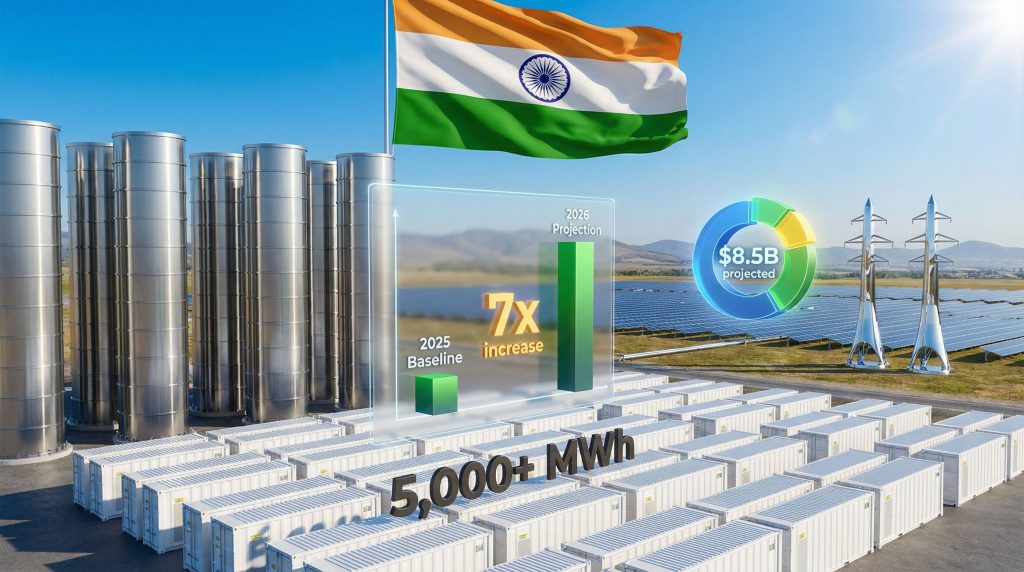
India's energy storage market in 2026 represents a critical inflection point where years of policy development, project tendering, and infrastructure planning converge into operational reality. The economic forces reshaping power systems worldwide have created unique conditions in India, where renewable energy expansion, industrial competitiveness pressures, and grid stability requirements are driving storage adoption at an accelerated pace.
Economic Transition from Procurement to Deployment
The transformation of India's energy storage market in 2026 reflects a fundamental economic shift from speculative procurement to operational deployment. Projects awarded during the intensive tendering period of 2023-2025 are entering their commissioning phase, following standard development cycles of 18-24 months. This timeline encompasses critical phases including initial financing arrangements, equipment procurement and manufacturing, civil works and installation, and comprehensive commissioning testing.
The operational validation phase represents more than technical achievement. It establishes India as a credible execution market for international investors and technology suppliers who have watched the aggressive tariff compression with cautious optimism. The India Energy Storage Alliance has identified 95 GWh of capacity currently in various execution stages, representing the largest coordinated storage deployment program in South Asia.
Infrastructure maturation extends beyond individual projects to encompass grid integration capabilities, regulatory frameworks, and supply chain optimisation. State electricity regulatory commissions have updated grid codes to accommodate storage participation in frequency regulation and ancillary services markets, creating revenue diversification opportunities that improve project economics beyond simple energy arbitrage.
Furthermore, India's lithium strategy has influenced capital allocation shifts from speculative bidding to execution financing, attracting institutional investors who previously remained cautious about India's storage market. International development finance institutions are structuring long-term credit facilities specifically for energy storage projects, recognising the strategic importance of grid stabilisation infrastructure in emerging markets.
When big ASX news breaks, our subscribers know first
Market Scale and Growth Dynamics Analysis
India's energy storage market expansion in 2026 reflects unprecedented coordination between policy implementation and private sector execution. The total tendered capacity of 224 GWh as of December 31, 2025, represents a dramatic acceleration from historical levels, with 69 tenders totalling 102 GWh issued in 2025 alone. This volume nearly equals the combined total of tenders issued between 2018-2024, demonstrating the exponential growth trajectory.
The technology composition reveals strategic diversification across battery energy storage systems (92 GWh) and pumped hydro storage (132 GWh). This 41% BESS to 59% hydro distribution indicates India's approach to balancing short-duration grid services with long-duration energy shifting capabilities. Battery systems excel in providing rapid frequency response and peak shaving services, while pumped hydro offers multi-hour seasonal storage capacity.
Current Market Status Breakdown:
| Category | Capacity (GWh) | Percentage | Primary Applications |
|---|---|---|---|
| In Execution | 95 | 42% | Utility-scale, C&I |
| Under Tender | 80 | 36% | Grid services, hybrid |
| Cancelled | 47 | 21% | Various (financing issues) |
| Operational (2025) | 0.7 | <1% | Pilot projects |
The operational capacity baseline of 0.7 GWh in 2025 provides context for the magnitude of planned expansion. With an additional 2.0 GWh expected by December 2026, the market is transitioning from pilot-scale demonstrations to commercial-scale validation. The Adani Gujarat project, scheduled for March 2026 commissioning with 1,126 MW capacity and 3,530 MWh storage, represents the first multi-GWh operational validation case in India.
Regional deployment patterns reflect state-level renewable energy mandates and grid stability requirements. Gujarat's pharmaceutical and petrochemical industrial clusters create substantial C&I demand, while Rajasthan's solar resource abundance drives utility-scale solar-plus-storage integration. Tamil Nadu's high solar penetration (9+ GW installed) creates frequent generation-demand mismatches requiring storage smoothing services.
Economic Drivers Accelerating Storage Adoption
The convergence of multiple economic factors is creating sustained demand for energy storage across utility, commercial, and industrial market segments. Renewable energy integration costs have reached levels where storage provides cost-effective solutions for grid operators managing variable generation resources. The technical challenge of integrating 25-30% solar penetration in leading states like Gujarat and Rajasthan creates 2-3 hour "duck curve" ramp requirements that battery energy storage systems can address more economically than traditional peaking generation.
Industrial power cost optimisation through peak shaving represents a rapidly expanding market opportunity. Commercial and industrial customers face peak-hour tariffs at ₹10-15/kWh versus off-peak rates of ₹4-6/kWh, creating arbitrage opportunities worth ₹20,000-30,000/MW/day for 4-hour battery systems. Juniper Green Energy's commissioning of a 60 MWh merchant battery project in December 2025 demonstrates the commercial viability of this business model.
Key Economic Performance Indicators:
• Grid Stability Value: 5-7% reserve margin requirements reduced by 2-3% through storage deployment
• Industrial Cost Savings: ₹4-6/kWh peak-shaving arbitrage potential
• Renewable Integration: 90%+ capacity utilisation during peak demand periods
• Frequency Services: Sub-second response capability replacing spinning reserve requirements
Export manufacturing competitiveness considerations are increasingly driving industrial storage adoption. Industries such as textiles, pharmaceuticals, and electronics manufacturing require reliable power supply to maintain quality standards and delivery schedules for international markets. Power supply disruptions can result in production losses worth 10-20 times the cost of backup power, making storage economically attractive even at current investment levels.
Grid modernisation requirements represent a structural demand driver that will persist beyond 2026. India's power system is transitioning from coal-based dispatchable generation to renewable-dominated supply, requiring increased flexibility resources. Storage provides multiple grid services simultaneously, including frequency regulation, voltage support, and congestion management, creating value streams that improve project economics beyond energy arbitrage.
How Is Tariff Compression Reshaping Market Dynamics?
The aggressive tariff compression witnessed in 2025 reflects the intersection of declining battery costs and intense market competition. Standalone battery energy storage system tariffs have reached ₹1.48 lakh/MW/month, while solar-plus-4-hour battery combinations are being awarded at ₹2.70-2.76/unit. These levels represent 60-65% discounts compared to traditional peaking generation costs of ₹4-5/kWh, fundamentally altering the economics of grid operations.
Battery cost deflation has been the primary enabler of this pricing compression. Stationary storage pack costs fell to $70/kWh in 2025, representing a 45% decrease from 2024 levels according to Bloomberg NEF analysis. This cost reduction, combined with the entry of 50+ new market participants, has created competitive intensity that extends beyond technology cost improvements alone. Moreover, battery recycling breakthrough innovations are helping to further reduce long-term costs.
The tariff structure components reveal the economic pressures facing project developers. Capital cost recovery represents 70-75% of total project costs, with operations and maintenance accounting for 10-15%, grid charges and transmission costs 5-10%, and debt service 5-10%. The extension of Interstate Transmission System charge waivers through 2028 has reduced the transmission cost component for qualifying projects.
Competitive Pricing Evolution:
• 2023-2024 Tariffs: ₹3.50-4.00/unit for solar-plus-storage
• 2025 Achievement: ₹2.70-2.76/unit representing 30%+ compression
• Technology Cost Impact: $70/kWh battery costs enabling sub-₹3/unit economics
• Market Entry: 50+ new participants driving bid intensity
However, industry experts caution that aggressive pricing has raised concerns about project viability. The India Energy Storage Alliance notes that tightening trade policies and export restrictions on battery materials could undermine the assumptions underpinning ultra-low tariffs awarded in recent tenders. The 18-24 month delay between award and operations creates significant financing risk for developers who must secure project funding against uncertain future battery costs.
Consequently, the financing challenge is particularly acute for projects awarded at ultra-competitive tariffs. Institutional lenders are requiring additional due diligence and risk assessment for projects with tariffs below ₹3.00/unit, as these levels leave limited margin for cost overruns or schedule delays. The second tranche of viability gap funding worth INR 5,400 crore supporting 30 GWh of standalone battery projects partially addresses this constraint by providing government backing for marginal projects.
Investment and Capital Requirements
The scale of capital requirements for India's 2026 storage pipeline reflects the sector's transition from pilot projects to utility-scale deployment. The 95 GWh execution pipeline requires estimated investments of $15-20 billion across utility-scale battery systems, commercial and industrial storage, grid services applications, and pumped hydro development. This investment level positions India among the top three global energy storage markets by annual deployment value.
Segmented Investment Analysis:
| Market Segment | Capacity (GWh) | Investment (USD Billion) | Key Characteristics |
|---|---|---|---|
| Utility-Scale BESS | 60 | 12-15 | Grid integration, renewable pairing |
| C&I Storage | 5-8 | 1-2 | Behind-meter, peak shaving |
| Grid Services | 15-20 | 3-4 | Ancillary services, frequency regulation |
| Pumped Hydro | 25-30 | 8-10 | Long-duration, seasonal storage |
The financing landscape has evolved significantly with the emergence of specialised energy storage financing products. International development finance institutions are structuring long-term credit facilities that recognise the strategic importance of grid stabilisation infrastructure. Domestic financial institutions are developing expertise in storage project risk assessment, moving beyond traditional power project evaluation methodologies.
Risk assessment evolution reflects the growing operational track record of energy storage technologies under Indian operating conditions. Early projects provide performance data that enables more accurate financial modelling and risk pricing. However, tariffs' impact on investments means that the concentration of project commissioning in 2026 requires financing decisions with limited local operational precedent, particularly for multi-GWh utility-scale installations.
Government support mechanisms play a crucial role in addressing financing gaps for marginal projects. The viability gap funding mechanism provides up to 30% of project costs for qualifying storage projects, reducing developer equity requirements and improving debt service coverage ratios. The 20% domestic value addition requirement creates additional complexity but also supports local manufacturing development.
Supply Chain and Manufacturing Economics
The supply chain dynamics defining 2026 performance reflect India's strategic approach to reducing import dependency while maintaining cost competitiveness. Chinese battery cost volatility affects project economics directly, as most large-scale projects rely on imported lithium-ion cells for near-term deployment. However, the 20% domestic value addition requirement is reshaping procurement strategies toward local assembly and component manufacturing.
Trade policy uncertainties create additional complexity for project developers managing multi-year development timelines. Import duties on battery cells and components can vary based on trade agreements and strategic policy decisions, requiring developers to structure procurement contracts with appropriate risk allocation. Some developers are establishing inventory buffers to reduce exposure to short-term price volatility, though this approach increases working capital requirements.
Furthermore, direct lithium extraction technologies are being explored to reduce supply chain dependencies, while local manufacturing capacity building represents a long-term strategic priority that extends beyond immediate project needs. Several large Indian conglomerates are establishing battery cell manufacturing capabilities with capacity targets of 10-20 GWh annually by 2028-2030. This domestic capacity will reduce supply chain risks and potentially improve cost competitiveness through reduced logistics and inventory costs.
Technology Cost Evolution Factors:
• Battery Cells: $70/kWh (2025 baseline) with projected 15-20% further reduction
• System Integration: Declining costs through standardisation and volume economies
• Alternative Chemistry: Sodium-ion and LFP gaining acceptance for duration applications
• Standardisation Benefits: Reduced engineering costs through repeat designs
System integration costs are declining through standardisation of designs and installation processes. Leading system integrators are developing standardised container-based solutions that reduce site-specific engineering requirements and installation timelines. This standardisation also improves operational reliability by enabling common maintenance procedures and spare parts inventory.
The emergence of alternative battery chemistries offers potential cost and supply chain diversification benefits. Sodium-ion batteries are gaining attention for longer-duration applications where energy density is less critical than cost per kWh. Lithium iron phosphate (LFP) chemistry provides improved safety characteristics and longer cycle life compared to higher-energy-density nickel-based chemistries, making it attractive for utility-scale applications with 20-year operational requirements.
The next major ASX story will hit our subscribers first
Regional Market Development Patterns
State-level deployment patterns reflect the interaction of renewable energy resources, industrial demand, and policy frameworks across India's diverse regional markets. Gujarat leads utility-scale development with the Adani 3.53 GWh project anchoring the western corridor, while its pharmaceutical and petrochemical industrial clusters create substantial commercial and industrial storage demand. The state's proactive renewable energy policies and grid infrastructure investments have established it as the primary hub for large-scale storage deployment.
Rajasthan's solar resource abundance drives solar-plus-storage adoption, with the Pugal Solar Park integration project expected to tender in January 2026 demonstrating utility-scale renewable integration models. The state's mandate requiring renewable projects above 5 MW to include energy storage creates sustained demand that extends beyond current tendering cycles. This policy framework provides developers with long-term market visibility that supports investment planning and supply chain development.
State-Level Development Characteristics:
• Gujarat: Industrial demand anchoring + utility-scale validation projects
• Rajasthan: Solar abundance + storage mandates driving hybrid development
• Tamil Nadu: High renewable penetration creating grid stability requirements
• Maharashtra: Industrial power cost optimisation + grid modernisation needs
Tamil Nadu's high solar penetration of 9+ GW installed capacity creates frequent generation-demand mismatches that require storage smoothing services. In addition, the state's industrial base in textiles, automotive, and information technology provides substantial commercial customer demand for reliable power supply. The development of a battery-grade lithium refinery in the region would further strengthen this industrial ecosystem.
Maharashtra's position as India's industrial and financial centre creates unique market dynamics where grid stability requirements intersect with commercial customer demand for cost optimisation. The state's electricity regulatory commission has been progressive in developing frameworks for storage participation in ancillary services markets, creating revenue diversification opportunities that improve project economics.
State policy evolution demonstrates the iterative nature of regulatory framework development. Early-adopter states like Gujarat and Rajasthan are providing operational experience that informs policy development in other regions. This learning process is accelerating regulatory adaptation and reducing implementation risks for developers entering new state markets.
Risk Assessment and Market Challenges
The concentration of project commissioning in 2026 creates execution risks that could significantly impact delivery targets and market confidence. Project financing gaps represent the most immediate constraint, particularly for projects awarded at ultra-competitive tariffs below ₹3.00/unit. Institutional lenders require additional due diligence and risk assessment for these projects, as minimal margins leave limited flexibility for cost overruns or schedule delays.
Supply chain disruptions from geopolitical tensions pose systemic risks to the 95 GWh execution pipeline. Most large-scale projects rely on imported battery cells, inverters, and specialised components that could face trade restrictions or logistics delays. The concentration of global battery manufacturing in China creates particular vulnerability to trade policy changes or supply allocation decisions by major manufacturers.
Critical Risk Categories:
• Financing Access: Ultra-low tariff projects struggling to secure debt financing
• Supply Chain: Import dependency creating delivery and cost risks
• Grid Integration: Complex technical requirements for multi-GWh projects
• Technology Validation: Limited operational track record under Indian conditions
Grid integration complexities for large-scale deployment require sophisticated technical solutions and regulatory coordination. Multi-GWh battery systems can significantly impact local grid stability if not properly integrated with existing infrastructure. Utilities must upgrade protection systems, communication networks, and operational procedures to accommodate storage resources, creating potential bottlenecks in project commissioning.
Technology performance validation under Indian operating conditions represents a long-term market development challenge. While battery technologies are well-established globally, the specific combination of high temperatures, humidity variations, and grid conditions in India may affect system performance and lifetime. The operational experience gained from 2026 commissioning will provide critical data for future project development and financing decisions.
Battery cost volatility affects project economics throughout the development cycle, as 18-24 month timelines between award and operations expose developers to significant price movements. Raw material costs for lithium, nickel, and cobalt can fluctuate based on supply-demand dynamics and geopolitical factors affecting major producing regions. Currency exchange risks add additional complexity for projects with significant import components.
What Business Models Are Emerging in India's Storage Market?
The maturation of India's energy storage market in 2026 is catalysing the emergence of sophisticated business models that extend beyond traditional utility ownership and operation. Merchant storage operations are gaining traction as developers recognise opportunities to capture price arbitrage between off-peak and peak electricity markets. This model requires sophisticated market forecasting and risk management capabilities, as revenue depends on accurately predicting price spreads and grid conditions.
Ancillary services markets represent significant revenue diversification opportunities for storage operators. Modern battery systems can provide multiple grid services simultaneously, including frequency regulation, voltage support, and spinning reserve services. Regulatory frameworks are evolving to enable storage participation in these markets, with compensation mechanisms that recognise the unique capabilities of battery systems to provide rapid, precise response to grid signals.
Emerging Business Model Categories:
• Merchant Operations: Price arbitrage and market participation strategies
• Ancillary Services: Grid support services with regulatory compensation
• Behind-the-Meter: C&I customer cost optimisation solutions
• Energy-as-a-Service: Third-party ownership with performance guarantees
Behind-the-meter applications are expanding rapidly in industrial segments where customers face significant peak demand charges and power quality concerns. Energy-as-a-Service models allow customers to access storage benefits without capital investment, with third-party providers assuming technology and performance risks. These arrangements require sophisticated contracts that allocate operational risks and define performance standards over 15-20 year terms.
The evolution toward integrated renewable-storage portfolios reflects the technical and economic advantages of co-locating generation and storage resources. Solar-plus-storage projects can provide firm capacity that competes directly with conventional power plants, while capturing higher value through improved grid services capability. This integration requires advanced control systems that optimise energy flow based on real-time grid conditions and market prices.
Market consolidation dynamics are beginning to emerge as large conglomerates build integrated clean energy portfolios that include generation, storage, and transmission assets. This vertical integration enables optimised asset operation and risk management across the value chain. International technology providers are establishing local partnerships to access market opportunities while navigating regulatory requirements and cultural considerations.
Macroeconomic Impact and Strategic Implications
India's energy storage market expansion in 2026 generates substantial macroeconomic benefits that extend beyond direct investment and employment creation. The development of a robust storage sector enhances energy security by reducing dependence on imported fossil fuels and providing grid stability services that enable higher renewable energy penetration. According to the Indian Energy Storage Alliance, this transition supports India's climate commitments while improving industrial competitiveness through more reliable and cost-effective power supply.
Job creation across the energy storage value chain encompasses manufacturing, installation, operations, and supporting services. The India Energy Storage Alliance estimates that the 95 GWh execution pipeline will create approximately 50,000-75,000 direct and indirect employment opportunities across skill levels from manufacturing technicians to system integration engineers. This employment impact is particularly significant in industrial regions where traditional manufacturing sectors are experiencing transition pressures.
Strategic Economic Benefits:
• Energy Security: Reduced fossil fuel import dependency through grid flexibility
• Industrial Competitiveness: Reliable power enabling export manufacturing growth
• Technology Innovation: R&D ecosystem development around storage applications
• Regional Supply Hub: Manufacturing capacity serving South Asian markets
The enhancement of industrial competitiveness through reliable power supply supports India's broader manufacturing and export objectives. Power supply interruptions can cost industrial facilities 10-20 times the expense of backup power systems, making storage attractive even at current investment levels. Industries such as pharmaceuticals, electronics, and textiles require consistent power quality to maintain international certification standards and delivery commitments.
Technology innovation potential emerges as domestic R&D capabilities develop around storage applications, grid integration, and advanced control systems. Indian institutes of technology and private sector research facilities are developing expertise in battery management systems, grid integration software, and application-specific storage solutions. This innovation ecosystem positions India to capture higher-value segments of the global storage market.
Furthermore, the positioning of India as a regional manufacturing hub for energy storage components supports broader industrial policy objectives. The 20% domestic value addition requirement is encouraging international technology providers to establish local production capabilities, creating technology transfer opportunities and export potential for regional markets. Industry reports suggest that India's energy storage market could surge dramatically, positioning India as a cost-competitive supplier for Southeast Asian and African markets experiencing similar energy transition requirements.
India's energy storage market in 2026 represents more than a sectoral transition; it embodies the convergence of technological advancement, policy innovation, and market forces that position the country as a global leader in clean energy infrastructure. The successful execution of the 95 GWh pipeline will validate India's capability to deliver complex energy projects at scale, establishing credibility that supports future investment attraction and technology development. This market development creates a foundation for sustained growth that extends well beyond 2026, positioning India's energy storage sector for continued expansion as grid modernisation requirements and renewable energy penetration accelerate globally.
Disclaimer: This analysis includes projections and market assessments that involve inherent uncertainties. Energy storage market development depends on multiple factors including technology costs, regulatory policies, financing availability, and supply chain dynamics that may change significantly. Investment decisions should be based on comprehensive due diligence and professional financial advice.
Looking to Capitalise on India's Energy Storage Boom?
Discovery Alert's proprietary Discovery IQ model delivers instant notifications on significant ASX mineral discoveries, including critical battery materials like lithium and rare earth elements fuelling India's energy transition. With the country's storage market set to surge from just 0.7 GWh to over 95 GWh in execution, now is the time to position yourself ahead of the market with Discovery Alert's comprehensive discovery insights.